


Now officially in the Kraken general manager’s chair, Jason Botterill has spent the first half of the non-playing months tinkering with Seattle’s roster—but not overhauling it completely. He acquired forwards Mason Marchment and Freddy Gaudreau, worked some cap voodoo to get Andre Burakovsky’s $27.5 million off the books for only the cost of buying out Joe Veleno at a $796K bargain, and signed veteran defensive defenseman Ryan Lindgren to a four-year, $18 million contract at the opening of free agency.
One thing we heard at Botterill’s “introductory” press conference back in May (I say “introductory” in quotes because Botterill has been with the team since its inaugural season and because that presser doubled as the annual end-of-season “what went wrong?” panel) was that team co-owner and co-chair Samantha Holloway said the organization wants to quickly evolve into a “perennial” playoff contender.
“Everyone at this table is committed to winning,” Holloway said. “Our hockey folks and our staff have worked hard and deserve winning. Our partners and our fans who support us every night deserve winning.”
How does that timeline look? Do the Kraken realistically expect to be back in the postseason in 2025-26? Or are we looking at two or three years down the line?
I also asked Botterill, when we interviewed him for the Sound Of Hockey Podcast, what his goals are for next season.
“To me, it’s just building a culture,” Botterill said. “It’s building a team that our fans know every day what’s going to happen from the production and just the style of play. I think we’re in an industry that focuses on end results. Right now, where we’re at, we can’t focus on end results. [New head coach Lane Lambert has] talked about getting better every day, and that’s what we have to do. I think we have a team right now that’s ready to compete for a playoff spot at the end of the year, but we have some steps that we certainly have to take.”
When I asked former GM Ron Francis that same question at the end-of-year presser following the team’s second season—when the Kraken came up a game short of the Western Conference Final—he was more specific and stated that he wanted the team to make the playoffs again in 2023-24. But the Kraken came up well short of that goal, and now—two head coaches and a front-office shuffle later—the franchise is still trying to recapture the lightning it bottled during the 2022-23 season.
So have the Kraken done enough this offseason to get back into the playoffs? I’m considering that question thanks to some data pulled by John Barr (who will also chime in on this article; we’ll make it clear when it’s him talking and not me).
The changes so far
Darren: On the whole, I like the moves Botterill has made to this point. I do believe improved structure under Lambert will be a better fit than the free-wheeling approach of Dan Bylsma, which calls for more star power than the Kraken had last season.
I also think the three acquired players all bring elements that will make the team better in the specific areas the front office wants to improve—being generally harder to play against—and in varying ways, they fit the mold of players who can help Seattle both get to the slot area in the offensive zone and protect the slot in the defensive zone. Those are good things.
Marchment and Gaudreau also bring some scoring ability, with Marchment notching 22 goals and 25 assists in an injury-shortened 2024-25 season (62 games), while Gaudreau had 18 goals and 19 assists playing up and down the lineup in Minnesota.
Are those adds, plus the shutdown talents of Lindgren, enough to get Seattle back in playoff contention? My gut says no.
John: I’ve shared some analysis before that suggests teams should aim for a positive goal differential if they want a solid shot at making the playoffs. I use a metric I call adjusted goal differential, which I define as: goals for minus empty-net goals for minus goals against minus empty-net goals against. More simply, it’s goal differential but without empty-netters.

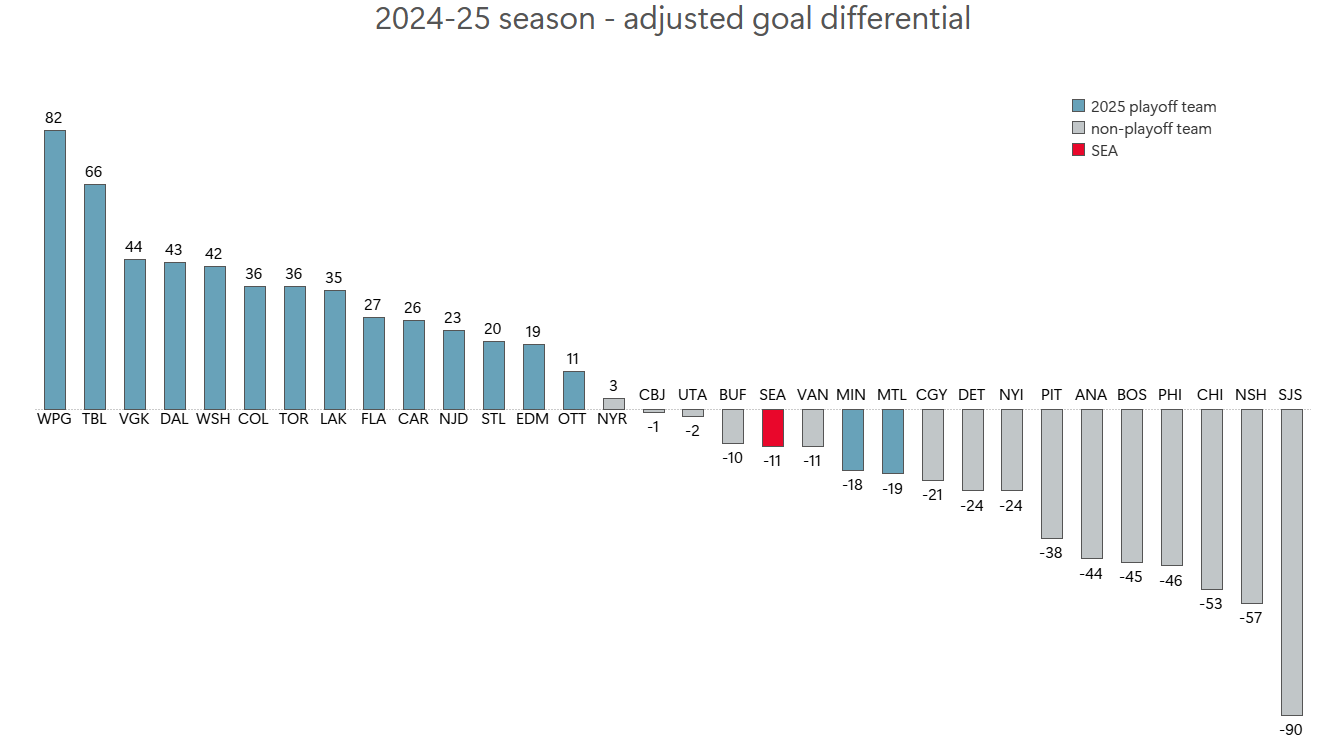
Historically, teams that finish a season with an adjusted goal differential between plus-one and plus-five make the playoffs about 50 percent of the time. Not surprisingly, the odds improve as that number gets higher. For example, teams with an adjusted goal differential between plus-11 and plus-20 make the playoffs roughly 94 percent of the time.
Last season, the Kraken finished with a minus-11 adjusted goal differential, which historically gives a team just about a 10 percent chance of making the playoffs. To even be in the conversation for a playoff spot, they’ll need to find a way to improve that differential by around 12 goals.
Forecasting goals against is tricky, so for the sake of this exercise, we’re going to focus on the “goals for” side of the equation and assume the defense performs similarly to last season (I know, there is hope the team will improve in its own end next season). Let’s take a look at how this offseason’s roster changes might help close that gap.

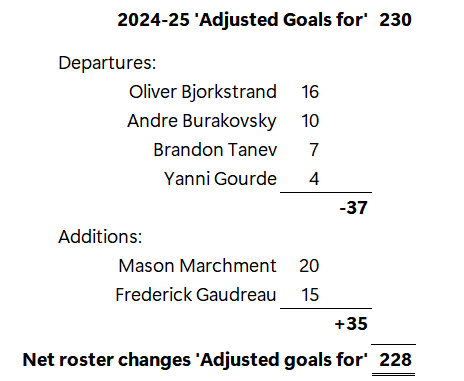
This is obviously a simplified look at how the major roster changes could impact goal scoring, but on paper, the team has lost two goals from last season. We could also factor in the potential boost from a full season of Kaapo Kakko or the possibility of Jani Nyman and Berkly Catton cracking the lineup this fall. But to keep things conservative, let’s assume the offseason moves didn’t significantly move the needle on goal production.
Darren: That doesn’t look all that encouraging. I do think Shane Wright could be a big producer this season, and Matty Beniers was better in the second half with Kakko on his wing, so there’s a chance the team gets an uptick in scoring from those two as well. But I agree—no offseason acquisition has pushed the team over the hump of playoff contention.
Can the Kraken still improve this offseason?
Darren: At this stage, I’m still wondering if the Kraken are done for the offseason. My heart says they’re not done, and I’m still holding out hope they’ll swing a big move before training camp, but my brain says they’re going to get into the season and see what they have. I hate what my brain is telling me on that front, because after seeing John’s breakdown above, I remain convinced they need a top-tier scoring winger to give themselves a sniff of the postseason.
There have been rumors that players like Jordan Kyrou and Jason Robertson could be had (although the Kyrou conversations have likely fizzled now that Kyrou’s full no-movement clause has kicked in), and either of those guys could bring enough improvement to the top six to make the Kraken competitive.
John: As much as I’d love for the Kraken to add a 30-plus goal scorer, just about every team in the league would jump at the chance to get a guy like Kyrou or Robertson. So, in my opinion, it’s not realistic to expect a move like that, simply because there would be a ton of competition to land one of those players. Plus, bringing in someone at that level would likely cost you one of your better NHL players, so the net impact might not be as big as it seems. I think it’s much more likely the team adds a depth winger as insurance in case Jani Nyman or Berkly Catton aren’t quite ready to make the jump.
Darren: Yeah, this is back to the heart-versus-brain argument. Again, my heart tells me they should do something like that, but my brain knows better.
What say you, folks? Are they done and willing to (likely) miss the playoffs again—perhaps to give themselves a chance to win the draft lottery and generational talent Gavin McKenna? Or is there a big swing on the horizon?