After a brief hiatus, Sound Of Hockey is back with a fantastic interview with a fantastic guest, Kraken Director of Player Development, Jeff Tambellini. With Jeff, you’ll get some memories of his playing journey, including the famed “Nashville Backcheck,” as well as his experiences playing with Yanni Gourde and his thoughts on some rising Kraken prospects.
Also in this episode, John and Darren welcome Curtis back into the studio, who gives his two cents on the Vince Dunn contract and waxes poetic about Patrice Bergeron.
After the interview with Tambellini, the guys move to segments, which this week feature:
We hear a lot about it, but when is the “competitive window” open for the Seattle Kraken? It’s a question John Barr and Darren Brown received in the most recent Sound Of Hockey Podcast mailbag episode, and one I’ve been thinking about.
Asked about the expected timeframe for a typical Kraken draft pick to debut in the NHL, general manager Ron Francis said on July 1, “It’s probably a three-to-four-year timeline.” Francis might as well have been describing the shelf life of the current iteration of the Seattle Kraken team, though.
Digging into the data, the Kraken have one of the oldest rosters in the NHL and have relied heavily on those older players to produce. But unlike some teams, the Kraken are not locked into their current roster long term. Many contracts phase out over the next couple years, and Seattle has no contracts at all with more than four years of term remaining. This puts them in rare company. The Kraken are one of only two NHL teams with zero dollars in cap commitments after the 2026-27 season.
All of this points to significant roster turnover in the coming years. It also gets us back to that question Francis received—about the timeline for Seattle’s prospects. With any luck, several of a trove of high draft picks from Seattle’s first three drafts will start pushing for NHL roles between the 2024-25 season (the fourth season after Seattle’s first draft) and the 2026-27 season (the fourth season after the team’s third and most recent draft).
It’s easy to see the fit with the timing of the team’s NHL deals. If things go according to plan, in three-to-four years, Kraken homegrown talent will be contributing on cheaper contracts, and the team will have relatively clean books to supplement that talent via free agency. If the draft picks do not work out, the team will still be in position to reset, unhampered by long contracts for declining players. Seattle would be able to trade its last big NHL contracts, restock its draft picks, and try again.
There is a lot of work ahead for the Kraken front office, but they’ve put the team in an enviable position. On the one hand, the Kraken are contending for the playoffs with their current roster. On the other hand, they have the resources—both in terms of prospects and future cap space—to take a further step forward in three-to-four years. The status of the Kraken roster suggests this may be the true “competitive window” the team is targeting.
Kraken prospects are finally starting to knock at the door
Tye Kartye advances the puck (Photo/Brian Liesse)
As Francis noted, it takes time for drafted prospects to start to arrive at the NHL level. “Ideally it’s two more years, if they’re in juniors, and then they start coming up the American [Hockey] League,” Francis explained.
Seattle is just now two full seasons removed from its inaugural draft. Right on Francis’s schedule, the Coachella Valley Firebirds will see their first significant influx of young talent this season, with drafted prospects Jacob Melanson, Ryan Winterton, Tucker Robertson, and Ville Ottavainen, and undrafted free agent Logan Morrison, all projected to join the team.
That group is only the beginning. Across three drafts, the Seattle Kraken have used 17 top-100 draft picks. That total is third most in the league behind only the Chicago Blackhawks (19) and the Arizona Coyotes (18). This is significant. Consider that six teams—the Boston Bruins, Edmonton Oilers, Florida Panthers, Pittsburgh Penguins, Tampa Bay Lightning, and Toronto Maple Leafs—have made just four top-100 picks in the same span.
While the first of Seattle’s draft picks, Matty Beniers, has already emerged as a legitimate NHL player, the rest are still developing. It is still too soon to know what they will be, but there are reasons to be optimistic about the group of players Seattle has coming.
Most notably, the team has secured a stable of high-scoring forwards from the junior hockey ranks. According to data tracked by Pick224, among those playing at least 20 CHL games last season, the Seattle Kraken had five of the top 25 in primary points per game—Melanson, Morrison, Shane Wright, David Goyette, and Jagger Firkus.
This group is supported by a diverse cupboard of skaters bringing physicality and scoring (Tye Kartye and Jani Nyman) or defensive profiles (Oscar Fisker Mølgaard and Zeb Forsfjall) to high-level professional leagues at a young age.
On the blue line, Ryker Evans was an AHL All-Star in his rookie professional season. And, in the CHL, Lukas Dragicevic and Ty Nelson both ranked within the top 20 defensemen in even-strength primary points per game, while also showing the ability to play key power-play minutes.
Wright is likely to contribute this year or next. Francis has spoken highly of Evans and Kartye too, and it seems probable both will get an opportunity for a full-time role with the Kraken by the 2024-25 season at the latest. Players like Melanson, Nelson, Ottavainen, or Winterton could push for NHL time after that.
Seattle’s NHL roster is aging
At the NHL level, the Kraken have a veteran-heavy lineup. This is not surprising, of course. Since draft picks take time to develop, Seattle was constrained to build its initial teams by two main methods. First, the Kraken had the Expansion Draft, a process that exempted most young players. Second, Seattle had unrestricted free agency, where most players are only eligible for UFA status after they are 27 years old.
Fast forward two years and the Kraken roster is one of the oldest in the league. I calculated the average age of projected 2023-24 NHL rosters using the starters projected in depth chart tool on CapFriendly. The average age of the projected Kraken lineup is 28.30, which is tied with the New York Islanders and Minnesota Wild for the sixth-oldest lineup in the league.
Paired with what we know about how NHL players’ skills decline over time, the age of Seattle’s roster weighs heavily on my mind when considering whether a 2023-24 Kraken team that returns mostly the same lineup can improve from last year’s performance.
Individual players can skew averages, though, so I also looked at how many 30+-year-old players each team projected to carry on their 2023-24 rosters. All studiesseem to agree that players peak in their 20’s. So age 30+ players—as a group, on average—can be expected to decline. (Beyond that, there is no magic to this cutoff I used beyond its roundness. Could the cutoff have been 29 or 31? Yes.)
By this measure, too, Seattle has an old roster. The Kraken are projected to carry 11 players at least 30 years of age, which is tied for second most in the league with the New York Rangers and Washington Capitals, and behind only the Pittsburgh Penguins.
As an aside, the Penguins stand out as an extreme outlier, with, by far, the oldest roster in the NHL. In fact, the difference in average age between the Penguins (30.91) and the second-oldest team, the Washington Capitals (29.00), is bigger than the difference between the Capitals and the 22nd-oldest team, the Winnipeg Jets (27.17). Pittsburgh also projects to carry four more age 30+ players than any other team.
Since no two players on a roster are equally valuable or relied upon, I also looked at (1) how many games those 30+-year-old players played in the 2022-23 season, (2) their average time on ice, and (3) how many goals they scored. If a team’s over-30 players are fourth-line forwards, backup goaltenders, or healthy scratches, there is less of a concern about age-related regression.
This analysis showed that the Kraken are heavily reliant on their older players. Seattle’s age 30+ players: (1) played 794 games in the 2022-23 season, second most in the league; (2) averaged 17:41 of ice time per game, tenth most in the league, and (3) scored 101 goals, eighth most in the league.
All of this suggests that the arc of the current NHL roster is likely to decline without changes to address age-related regression.
Seattle’s minimal contract commitments give the team flexibility
The Kraken have constructed their roster carefully, however, and find themselves in relatively strong position to solve for any age-related issues. Absent any other transactions this offseason, the Kraken will enter the season with more than $2 million in cap space—ample room to make any in-season moves.
Looking forward, Seattle’s veteran contracts all cycle out over the next four years. Setting aside entry-level contracts, the Kraken have fifteen NHL contracts covering the 2024-25 season, but that number drops down to seven in 2025-26, four in 2026-27, and none in 2027-28 and beyond.
Of course, it is desirable to lock in young talent on long-term deals, like New Jersey has done, for example. But Seattle has not yet had those options with early-prime players. (Beniers is the first player worthy of such a contract, and I expect Seattle to pursue it.)
Instead, Seattle has exercised admirable restraint in resisting maximum-term deals for older potential free agent targets (like Gabriel Landeskog at the Expansion Draft) or high uncertainty internal options (Vince Dunn).
Seattle’s future flexibility is even more pronounced when looking at the salary cap charges of the future contract years on the books.
This information on future contracts and cap charges was drawn from the active player database at CapFriendly.
Changes are on the horizon
I infer from the information above that the Kraken may be targeting a timeframe three-to-four years out—when the team is cycling in a large wave of young talent to replace the current veteran core—as an ideal window to take the “next step.” The Kraken’s veteran contracts will be off the books, and the team should have as much or more cap space than any competitor to target free agents to supplement a cheaper group of prime-aged players.
In the meantime, Seattle has a veteran-driven lineup that has proven capable of making the playoffs and making noise when it gets there. This is quite the trick.
Curtis Isacke
Curtis is a Sound Of Hockey contributor and member of the Kraken press corps. Curtis is an attorney by day, and he has read the NHL collective bargaining agreement and bylaws so you don’t have to. He can be found analyzing the Kraken, NHL Draft, and other hockey topics on Twitter and Bluesky @deepseahockey.
The deal means the team and player avoid a contentious arbitration hearing, which had been scheduled for July 24. With the contract signed, Dunn now becomes the highest-paid player on the Kraken.
Dunn, selected from the St. Louis Blues in Seattle’s Expansion Draft, blossomed into a top defenseman last season. The puck mover played on the top pair with Adam Larsson throughout the year and quarterbacked Seattle’s power play.
Coming off a two-year deal that paid him $4 million per season, Dunn was the last remaining restricted free agent for the Kraken to sign this offseason. The contract eats up most of Seattle’s remaining cap space, which CapFriendly now projects to be just $934,424.
The Kraken will surely create extra breathing room by placing either Chris Driedger or Joey Daccord on waivers after training camp, but still, if nothing changes between now and then, Seattle will be within spitting distance of the cap. So, this could mean the Kraken front office is close to finished with its offseason tinkering. At this point, any significant upgrades would likely have to come via player-for-player trade, as a futures-for-player trade wouldn’t fit.
A deal months in the making
It is no surprise to see this deal get done. From the day Seattle’s season ended, Francis and Dunn both expressed a desire to get a long-term deal consummated. Dunn told media on locker cleanout day that he was “all in” on the Kraken organization and had every intention of staying in Seattle for the foreseeable future. It was always his expectation that he would be here beyond the upcoming season.
While this contract took longer to get done than the smaller, less complicated ones signed by RFA’s Kole Lind, Will Borgen, and Cale Fleury earlier this summer, it was always going to happen. Kraken fans can breathe a sigh of relief, though, as the looming arbitration hearing would have resulted in a one-year deal being awarded.
What the Kraken have in Vince Dunn
Dunn, 26, had a nice breakout for Seattle last season, and at one point was hearing his name mentioned in Norris Trophy conversations. After his first five seasons in the NHL, he had never scored more than 35 points, but in 2022-23, he erupted for 64 points (14—50=64).
The career season was surely helped by his veteran, stay-at-home defense partner, Larsson, who allowed Dunn to roam more freely and make riskier stretch passes to send teammates on odd-man rushes. Larsson is under contract for two more seasons, so the top pair will likely remain intact at least through 2024-25. This new deal also means Dunn will remain in Seattle throughout the prime of his career, as he will be under contract with the Kraken until he turns 30 years old.
Darren Brown
Darren Brown is the Chief Content Officer at soundofhockey.com and the host of the Sound Of Hockey Podcast. He is a member of the PHWA and is also usually SOH’s Twitter intern (but please pretend you don’t know that). Follow him @DarrenFunBrown and @sound_hockey or email darren@soundofhockey.com.
The Seattle Kraken announced Wednesday they had given coach Dave Hakstol a two-year contract extension that will last through the 2025-26 season. The new deal is a vote of confidence from general manager Ron Francis—also contractually extended earlier this offseason—and Kraken ownership, who watched Hakstol lead a dramatic turnaround for the franchise from its first season to its second.
“It’s the next step for us,” Hakstol said. “Obviously, we’re going to try to work to build the foundation, and we did that a little bit year one and made progress in year two. So for myself and for our staff, we take pride in the opportunity to continue working towards continuing in the right direction. For that, I’m really grateful for that opportunity.”
The Kraken finished their inaugural season in last place in the Pacific Division with a measly 60 points in the standings. Yet, the team never quit on Hakstol during that campaign, even after the NHL Trade Deadline when several veteran players had been jettisoned for draft picks.
Seattle kept that never-say-die attitude in its second season, and the result was a shocking 40-point improvement, a playoff series win over the defending champion Colorado Avalanche, and a seven-game series loss to the Dallas Stars in the second round of the Stanley Cup Playoffs. In the end, the Kraken came up just one goal short of the Western Conference Finals.
“We believe we are heading in the right direction with Dave as our head coach and it was important to show that confidence with this contract extension,” Francis said via a press release Thursday. “Dave and his staff have done a great job of creating a close-knit, team-first mindset in our locker room and their work ethic helps set the tone for our team.”
For his efforts behind the bench, Hakstol was a finalist for the Jack Adams Award but finished third behind Boston’s Jim Montgomery and New Jersey’s Lindy Ruff. The contract extension is a nice consolation prize, though, and a deserved one at that, as Hakstol proved this season that the Kraken got it right by hiring him as their first head coach.
Quieting the naysayers
The naysayers were plentiful as the Kraken sunk to the bottom of the standings in 2021-22, and those same social media pundits calling for Hakstol’s job were again very vocal when Seattle didn’t get out to the hottest start to 2022-23.
Kraken Twitter got downright painful at times early in the team’s second season, when seemingly every Sound Of Hockey tweet after a loss was met with some varietal of “Fire Hakstol.”
But the players persevered under Hakstol, showed they had fully bought into his systems and philosophy, and eventually got onto a couple massive hot streaks that propelled them into the postseason.
What struck us as most impressive about the job Hakstol did last season was the way the Kraken addressed problems on the fly. A great example was the penalty kill, which struggled mightily in the early going, then changed tactics and personnel and became one of the more consistent PK’s in the league for the second half of the season. We detailed those in-season changes here.
As improvements were made, little by little, and as the team started to solidify its position in the playoffs, Hakstol’s naysayers gradually went quiet.
A steady style and comfortability with the players
Whether he heard the critics or not, Hakstol never let it show, even in the worst moments of the inaugural season, when the coach himself had to be wondering about his job security. He took responsibility for losses when he could, rarely called out individual players directly, and was sure to give credit to everyone but himself if the team won.
That’s the thing with Hakstol, though; at least publicly, you almost always know exactly what you’re going to get. There’s no change in his demeanor from one game to the next, even after the biggest wins and the worst losses, and the team is much bigger than its coach.
Meanwhile, behind closed doors, Hakstol and his staff have fostered an environment of open and honest communication and formed close bonds with the players, something Hakstol said “didn’t happen overnight.”
“If you look at the members of our staff, we’ve got great communicators, you’ve got different personalities, different backgrounds,” Hakstol said. “And my true belief is inside of our coaches room, we care about our players and how we can connect with them.”
In true unselfish Hakstol fashion, he also made sure to directly credit associate coach Dave Lowry, assistant coaches Jay Leach and Paul McFarland, and goalie coach Steve Briere for their efforts.
Coming back with a clean slate
Whether the organization can replicate what it did in 2022-23 or even improve upon it remains to be seen. Either way, Hakstol will be the man at the helm of the Kraken ship for the foreseeable future.
In communicating with his returning players this summer, Hakstol says he likes what he’s hearing.
“I really want our guys to have a sense of pride in what they were able to accomplish last year and what we were able to build,” Hakstol said. “And I sense that. I feel that in the conversations with our players. But the other piece that I feel, the part that is really important is our guys are very disappointed in losing game seven in round two.”
Hakstol said he hopes the taste of success and the disappointment that followed will bring the players into training camp with extra motivation to reach the next level in 2023-24. Now, with his two-year extension, the coach can rest assured that Seattle’s ownership and front office believe in him as the right man to guide them there.
Darren Brown
Darren Brown is the Chief Content Officer at soundofhockey.com and the host of the Sound Of Hockey Podcast. He is a member of the PHWA and is also usually SOH’s Twitter intern (but please pretend you don’t know that). Follow him @DarrenFunBrown and @sound_hockey or email darren@soundofhockey.com.
The Seattle Kraken AHL affiliate, the Coachella Valley Firebirds, won the Western Conference and made it within one game of winning the Calder Cup in their inaugural season.
“We probably don’t talk enough about the American Hockey League team,” Seattle Kraken CEO Tod Leiweke told the assembled media during the May 31, 2023, press conference announcing the team’s agreement to extend the contract of general manager Ron Francis. Leiweke was not boasting, though. To the contrary, he mentioned the Firebirds in order to credit Francis for building a contender in the desert. “Others certainly helped [build the Firebirds], but Ron had the vision,” Leiweke remarked.
No doubt the Kraken front office deserves credit, but Leiweke and his co-owners are among the “others” that should be mentioned. The Kraken ownership group—which also owns and operates the Coachella Valley Firebirds—has invested significant resources in assembling a deep and talented group at the AHL level. Looking at the available contract data for the 2023-24 season, few teams project to spend more on their AHL players.
The Kraken aren’t spending this money for appearances; they don’t talk about it, and nobody is covering it. Instead, it seems Seattle has quietly spent more than most of their competitors for one reason only—to win.
To be certain, a competitive AHL roster is crucial to developing the fanbase in Coachella Valley. But the team has shown a willingness to spend beyond what is necessary just to compete and get fans in the door. The commitment to building a contender in Seattle and Palm Desert runs deep.
There are few limits on roster spending at the AHL level
AHL teams are made up of players on NHL contracts (paid by the NHL team) and AHL contracts (paid by the AHL team)—though, in the case of the Firebirds, the money is coming from the same place. Players signing NHL contracts are entitled to a minimum salary in the NHL based on their draft year, ranging from $62,500 if drafted in 2005 to $82,500 if drafted in 2023. Terms of AHL contracts are not made publicly available, but there is a flat minimum salary of $52,725 for the 2023-24 season.
Beyond that, there is no salary cap applicable to the AHL level, and there are no maximum salaries limiting AHL contracts (or the NHL contracts assigned there). There are not even roster size limits on AHL rosters until the playoffs. In fact, the only real AHL roster construction limitation is the so-called “veteran rule,” which requires that each AHL team dress a minimum of 12 players with fewer than 260 games of NHL experience.
NHL-level teams are limited by an upper restriction on the total number of active player contracts they can maintain at any given time (50) and an upper limit on spending ($83.5 million in 2023-24). NHL contracts can be either (a) “one-way” contracts, meaning the contract provides for a fixed, guaranteed salary regardless of whether the player is in the NHL or AHL, or (b) “two-way” contracts, meaning the contract has one salary for time spent at the NHL level and another salary for time spent at the AHL level.
Players assigned to the AHL do not count against the limit unless the contracts call for an AHL salary above a specified threshold ($1,150,000 in 2023-24). This is what it means to “bury” an NHL contract in the minor leagues. (For more on “buried” contracts, check out CapFriendly‘s explainer here.)
Taking these rules together, there is very little in the AHL or NHL collective bargaining agreements limiting teams from acquiring as much talent as they can afford—particularly when those contracts carry AHL salaries below the threshold to be “buried” in the AHL without consequence on the NHL salary cap.
The Kraken have built NHL depth through the AHL roster
When it comes to investing in the roster, few teams outpace the Seattle Kraken. In the inaugural season, Seattle’s ownership group declared its willingness to spend to the cap on the NHL team. In year two, Seattle’s owners spent every dime of the $82.5 million NHL roster upper limit. In fact, the Kraken effectively spent beyond the cap and will carry a bonus overage on Matty Beniers’s contract onto their 2023-24 books.
But nowhere is Seattle’s commitment to spending more evident than in its efforts to build depth at the AHL level. In the short term, while the team is still building its pipeline of drafted prospects, the Kraken have invested heavily in veteran AHL talent with the ability to play top-of-the-lineup roles. This has been critical to Coachella Valley’s on-ice success and developing the fanbase there. Even more importantly, it is smart insurance for the NHL team.
For example, defenseman Gustav Olofsson not only played top-four minutes for the Firebirds last season, he was first in line for a call up on the left side of the NHL blue line, until his injury prompted Seattle to trade for Jaycob Megna. Even with Megna on board, and prospect Ryker Evans developing, Seattle valued Olofsson’s role in the organization enough to re-sign him to a two-year, two-way contract this offseason that guarantees him at least $800,000 over those two years, even if he spends all of that time in Palm Desert. That is a hefty commitment to protect the NHL team. It’s not the type of move every team would make.
Gustav Oloffsson looks to pass the puck. (Photo/Brian Liesse)
The Joey Daccord signing is perhaps the clearest example of Seattle’s willingness to spend money on depth. With Philipp Grubauer ensconced as the starter in net, either Daccord, and his $1.2 million average annual value (AAV) contract, or Chris Driedger, and his $3.5 million AAV contract, project to be blocking AHL pucks this season. But that extra goaltender is just one injury away from being a critical piece for the NHL club.
The Kraken are near the top of the league in spending on projected AHL players
Quantifying where Seattle ranks among its NHL competitors in AHL spending for the 2023-24 season is complicated by the fact that AHL contract terms are not disclosed. It’s also difficult to project exact payrolls because AHL free agency—and, to a lesser extent, NHL free agency—remains ongoing. The Firebirds announced their first AHL contract signing for the 2023-24 season just yesterday.
To get a decent picture of where Seattle stacks up, I started by projecting NHL contracts likely to be assigned to the AHL level. I compiled all active NHL contracts in CapFriendly’s contract database and then backed out the contracts of all players contained in that site’s projected NHL depth charts. I then made minor adjustments to these depth charts to reflect likely roster composition (i.e, one or two “extra” forwards, one “extra” defenseman, and only two total goalies). I moved Daccord to the AHL level for the Kraken because CapFriendly had three goalies listed at the NHL level, which is highly unlikely assuming all three are healthy, and replaced him with Kole Lind.
This procedure left a list of players on NHL contracts projected to play outside the NHL. I used this list to look at which team had the most contracts with above-minimum salary guarantees for players playing the AHL. This includes players on “one-way” contracts—on which players earn at least the NHL minimum salary even if they are in the AHL—and those on “two-way” contracts whose contracts call for an AHL salary above the applicable minimum.
As anticipated, Seattle ranks highly. The Kraken are one of only eight NHL clubs with 10 or more players projected to play in the AHL on NHL contracts calling for greater than minimum AHL salaries. For Seattle, this includes three players on “one-way” contracts—Daccord, Cale Fleury, and Andrew Poturalski. The Pittsburgh Penguins lead the way with 13 players projected to play in the AHL on NHL contracts calling for salaries above the AHL minimum salary, including a staggering six one-way contracts for players currently projected to be in the AHL.
Digging a bit deeper, I then built an approximated AHL payroll associated with each NHL team. Of course, many players on NHL entry-level contracts will be loaned back to CHL clubs or clubs in other professional leagues. But those entry-level contracts carry minimum minor-league salaries, and if those players are not in the AHL, they will likely be replaced on the AHL team with roughly comparable minimum-NHL-contract or AHL-contract salaries.
To the extent the team did not have enough associated contracts to fill an AHL roster of approximately 23 players, I used a standard contract value ($80,000) between the minimum salary on AHL contracts ($52,725) and the minimum salary of the most recent draftees on NHL deals ($82,500) as “stand-in” values for the estimated cost of further additions. To the extent the team had more than 23 non-NHL contracts, I subtracted out the value of the most recent entry-level contracts associated with the team, projecting that those players would end up back in the CHL or elsewhere.
Acknowledging that this procedure yields nothing better than a rough estimate, this projection puts Seattle’s overall AHL payroll as the third-highest in the league. Individual players can skew these results. If, for example, Chris Driedger were sent through waivers instead of Joey Daccord in the upcoming season, the Firebirds’ total roster cost would be higher. On the other hand, if Daccord or Driedger were claimed off waivers, the roster cost would be lower. There is a lot of uncertainty in projecting an AHL payroll in July.
One thing is certain, though; Seattle has committed to spending on talent that will play mostly in Coachella Valley. The Seattle front office deserves credit for identifying a group of players that can compete with the very best in the AHL. But ownership deserves credit, too, for spending beyond what many other teams are willing to do. We probably don’t talk about that enough.
Curtis Isacke
Curtis is a Sound Of Hockey contributor and member of the Kraken press corps. Curtis is an attorney by day, and he has read the NHL collective bargaining agreement and bylaws so you don’t have to. He can be found analyzing the Kraken, NHL Draft, and other hockey topics on Twitter and Bluesky @deepseahockey.
With the offseason lull seemingly in full swing, we thought it would be a good time to break down the 2023-24 Seattle Kraken schedule to get a flavor for what lies ahead. Here we will dig into travel, back-to-back games, and give some interesting factoids to understand what is on the docket for the Kraken this coming season.
Travel distance
One bit of housekeeping before we get into the breakdown. For simplicity, I did not incorporate the travel involved for the NHL Global Series for teams traveling to Sweden in mid-November. This means that Detroit, Minnesota, Ottawa, and Toronto will have understated miles on any charts and references to their travel distance.
Based on the location of Seattle in North America, the Kraken will always have one of the heavier travel schedules across the league. This year is no different in that regard.
The Kraken have the ninth-most travel miles over the regular season with 45,434 miles expected. That is up 600 miles from last season. As you might be able to tell by looking at the teams in the top 10, the Pacific Division teams generally have more travel than other NHL teams.
Here is how it breaks down by division:
The Pacific Division teams are clustered with similar amounts of travel, and Seattle falls just below the average for its divisional rivals.
Number of road trips
One side benefit of the increased travel is that the Kraken have fewer road trips than most other teams. This is because when they hit the road, they tend to also visit more cities and games on a single trip to limit the number of longer-haul flights. Seattle is tied for the fewest road trips in the league.
Here is a look at how homestands and road trips break down by month for this coming season:
November looks a bit crazy, but there are two one-game road trips in there to Edmonton and Vancouver, so that skews things a bit.
Back-to-back games
Statistically speaking, teams playing the second game of a back-to-back scenario have a disadvantage, winning just 181 out of 410 games in 2022-23. The good news for the Kraken is they have the fewest back-to-backs in the league in 2023-24 with just seven of these occasions on their schedule.
The bad news is that the Kraken were 5-3-0 in the second game of back-to-back scenarios last season, so maybe they would have liked to play more of them? ¯\_(ツ)_/¯
I am declaring Nov. 13-20 as hockey week in the Puget Sound. There are three Kraken home games and two home games each for the Silvertips and Thunderbirds, including a home-and-home against each other. That’s seven games across those eight days. How many games can you (and we) attend?
If a full week of hockey is just too many days for you, there is also a packed hockey weekend in December. There are five games from Dec. 8-10 across the Kraken and local junior teams. If you wanted to, you could see the Tri-City Americans versus the Seattle Thunderbirds Friday night, the Tampa Bay Lightning against the Kraken on Saturday night, and the Portland Winterhawks against the Everett Silvertips on Sunday. That sounds like a heck of a weekend.
There are also seven days where the Everett Silvertips, Seattle Thunderbirds, and Seattle Kraken all play on the same day.
If you are looking to catch glimpses of any Seattle Kraken prospects as they roll through town, you should get ample opportunity to see Lukas Dragicevic (TC), Caden Price (KEL), and Kaden Hammell (EVT), but the two games I am circling on my calendar are when Jagger Firkus and the Moose Jaw Warriors come to town. The Firkus Circus visits the Silvertips on March 1 and the Thunderbirds on March 2.
Epic Seattle Kraken hockey fan road trip
When I saw the Kraken schedule get released, I already blocked off my calendar for March 21 and 22 to see the Kraken take on Vegas and Arizona respectively on the road. But then the AHL schedule came out…
I do not know if I will make all four games of that sequence, but I know I have to get down to Coachella Valley this season for a Firebirds game. That atmosphere looked awesome all year, and it looked extra rowdy in the playoffs.
If you have any questions or games that you are looking forward to, let us know in the comments below. Only 85 days until opening night.
Just when the Sound Of Hockey guys thought they were low on content, the listeners came through with plenty of questions for a robust Mailbag on this week’s episode.
This one gets a little off the rails, as John and Darren get a little silly in the Mailbag segment, but it’s fun stuff, so give it a listen.
Also on this episode, the guys discuss several Kraken signings made in the past week, then move on to segments.
Over the weekend, the Seattle Kraken announced deals with two of the team’s restricted free agents. First, on Saturday, Forward Kole Lind signed a one-year, two-way deal, worth $775,000 at the NHL level. Then, on Sunday, defenseman Cale Fleury signed a two-year, one-way deal worth $800,000 annually with the Kraken. Following a deal with defenseman Will Borgen on Friday, only one Kraken restricted free agent remains unsigned – Vince Dunn.
The Kraken sign Kole Lind to a one-year deal
Lind, 24, spent the entire 2022-23 season with the Coachella Valley Firebirds, appearing in all 72 games and 26 postseason games. He had a terrific scoring season in the AHL, recording 30 goals and 32 assists in the regular season. His 62 points were second on the team and tied for 16th in the entire AHL. Lind elevated his already lofty play in the postseason, leading all AHL skaters in points (31) and assists (22), and trailing only teammate Max McCormick in goals (9).
The 6-foot-1 right-handed winger has two goals and six assists in 30 career NHL games, most coming during the 2021-22 season with the Kraken.
Lind’s deal for the 2023-24 season is a two-way contract, meaning that while he is set to earn $775,000 at the NHL level, he will earn a lower minimum guaranteed salary of $345,000 if he returns to the AHL again this season.
An NHL role for Kole?
Lind has proven that he can be an elite playmaker and finisher at the AHL level. Since he pairs those skills with a willingness to play a physical game and serve as an agitator, there is plenty to like about Lind’s projection to the NHL level. In my mind, the questions with Lind are, first, whether he can keep pace at the NHL level, particularly defensively, given his below-average skating speed, and, second, whether he can keep the penalties under control.
I believe Lind should be a strong consideration for the fourth-line right wing or extra forward role in Seattle this coming season. I think Kailer Yamamoto likely has the edge over Lind for regular playing time to start, but Lind will have training camp to make his case. In the event of an injury to a winger, he and Tye Kartye are at the front of the line to fill in.
Kole Lind (Photo/Brian Liesse)
A mutually advantageous deal?
Seattle extended a qualifying offer to Lind for a one-year, two-way contract worth $892,500 at the NHL level. Even so, Lind negotiated and agreed to a deal with lower monetary upside in the NHL. Why? I can speculate at two potential explanations.
First, Lind may have agreed to a lower NHL salary in return for an increased AHL salary above the minimum that would have come with the qualifying offer. His minimum guaranteed salary last season was $175,000. That sum has almost doubled this year to $345,000. This is significant for a player whose estimated earnings to date are just over $1 million.
Second, Lind’s camp may have reached the conclusion that he had a greater chance to actually earn the higher NHL salary if he agreed to take a bit less. How so? With other potential end-of-the-roster players like John Hayden and Pierre-Édouard Bellemare carrying $775,000 cap numbers, taking a higher NHL number may have worked against Lind’s chances of staying on the NHL roster with the Kraken. With Seattle spending to the cap, every dollar matters and can be significant in weighing marginal pieces. Of course, this is true of other teams around the NHL too. Lind could be slightly more interesting on waivers at $775,000 than he would have been at $892,500 (or more).
This latter consideration may have also contributed to his decision to forego his right to request salary arbitration. Even if he was “successful” at arbitration, the contract would have been a two-way deal and a high NHL salary may have helped push him back to the AHL level for another season. Certainly, Lind would have preferred a one-way deal at or around the value of the qualifying offer, but Seattle wasn’t willing to offer it.
An unrestricted free agent at 25 years old next offseason?
As I have written about, a player who would otherwise be a restricted free agent qualifies as a “Group 6” unrestricted free agent if the player’s contract ends and he is (a) over 25 years old, (b) has played three or more professional seasons, and (c) has played in fewer than 80 NHL games.
Unless Lind appears in 50 regular-season or postseason NHL games this season, or is re-signed in the interim, Lind will meet each of these criteria next offseason. At 25 years old and boasting a prolific AHL scoring resume, he will likely have leverage and suitors on the open market. All of this makes it an important year for Lind and his future with the Kraken organization.
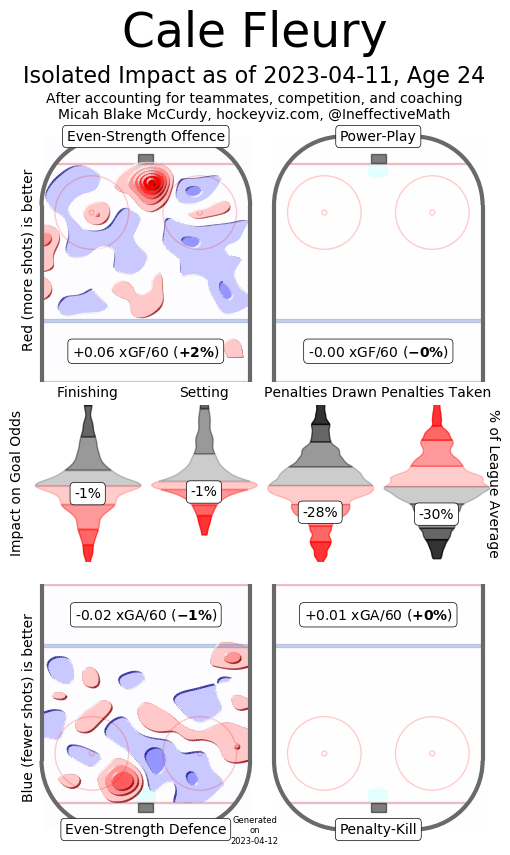
Fleury, 24, spent the 2022-23 season with the Kraken, but he rarely saw the ice as an extra defenseman on a relatively healthy blue line. He appeared in 12 games, totaled just under 160 minutes on the ice and recorded no goals and one assist. Overall, Fleury has appeared in 68 NHL games, with two points (one goal and last year’s assist).
In the press release announcing the signing to a two-year deal, the Kraken noted that Fleury’s 10.51 hits per sixty minutes led the 2022-23 Kraken, and his 4.88 blocked shots per sixty minutes ranked second among all skaters who played in more than 10 games.
Since his sample size is small, we can’t take too much from his on-ice shot analytics, but the information we do have doesn’t stand out positively or negatively. In my mind’s eye, Fleury was a capable sixth or seventh defender who swung back and forth between impressive and frustrating plays and reads on the defensive side and was fairly quiet offensively.
Was a two-year term the key to a compromise?
Similar to the offer extended to Lind, Seattle’s qualifying offer to Cale Fleury was a one-year, two-way deal worth $787,500 at the NHL level and less at the AHL level. Unlike Lind, though, Fleury has a longer NHL track record, more leverage, and requested arbitration to set his salary, absent a negotiated agreement. Seattle, recognizing that leverage, agreed to a one-way deal structure over two years to get the deal done.
On Fleury’s side, the two-year deal guarantees him $1.6 million no matter where he plays. On Seattle’s side, the term is also significant. Like Lind, Fleury had the chance to be a Group 6 unrestricted free agent after this upcoming season. With 62 NHL games under his belt, if the team had sent him through waivers to the AHL or he sat another year behind three healthy right-shot defensemen, he may not have gotten into 18 additional games.
The two-year deal avoids the potential Group 6 conundrum this coming offseason and locks Fleury in for the 2024-25 season as well. Assuming Fleury stays with Seattle for the full two years and gets in 18 games over those two seasons, he would again be a restricted free agent in the 2025 offseason.
Cale Fleury (Photo/Brian Liesse)
Could we see a Fleury in the desert?
The Kraken have eight defensemen on one-way contracts for this coming season: Dunn (when it gets finished, it will be a one-way deal), Adam Larsson, Jamie Oleksiak, Will Borgen, Brian Dumoulin, Justin Schultz, Jaycob Megna, and Fleury. Theoretically, the team could keep all eight in Seattle. The Kraken carried eight defenders for much of their inaugural season. Seven defenders is more typical, however.
Seattle didn’t send Fleury through waivers last year (a) because he was the best bet on the roster for the seventh defender role, and (b) they didn’t have the AHL depth on the right side to withstand losing him to a waiver claim. The dynamic is different this year. Megna can capably fill the seventh defender role, and Seattle has righty defender Connor Carrick, a veteran of 242 NHL games, signed to a one-year deal and bound for Coachella Valley.
If Carrick clears waivers earlier in camp, which he likely will, the Kraken might feel confident enough to test waivers on Fleury. Fleury is still a young player who needs ice time to develop. 160 minutes of ice time in an entire season is not doing him or Seattle any favors. If given the option, I think the team would rather see Fleury get a full slate of games in the AHL while the older Megna serves as the occasionally used NHL healthy scratch.
The two-year, one-way deal structure might also cause a team to hesitate claiming Fleury on waivers. This too could help him get through waivers and to Coachella Valley this year.
Performance and injuries, if any, in camp will be a significant factor. But, as it stands in early July, I could see Fleury with the Firebirds this coming season. In the desert he could start building chemistry with future Kraken teammate Ryker Evans.
A 2024-25 NHL role in mind?
Looking forward, Seattle has only two other right-side defensemen, Larsson and Borgen, signed for the 2024-25 season. This contract places Fleury squarely in the mix to compete for a full-time role then. If I am correct that Seattle may prefer to get Fleury reps in the AHL this season, could Evans and Fleury both join the NHL team next year, perhaps even as an occasional bottom-line pairing? I could see it.
Beyond Fleury, the team doesn’t have much in the way of NHL-caliber depth at right-handed defense coming up through the system just yet. Ville Ottavainen, Seattle’s fourth-round pick in the 2021 draft, is scheduled to play in North America for the first time this season with the Coachella Valley Firebirds. If he has an impressive season, he could be in the mix. But, typically, even successful prospects on his trajectory take two or more seasons in the minors before breaking through.
Where do the Kraken go from here?
All eyes turn to negotiations with the team’s last restricted free agent, Dunn. He now has an arbitration hearing date set for July 24, so Seattle will be looking to get an extension in place before that date. Aside from that, I suspect Seattle will keep working the phones to monitor opportunities for upgrades via trade.
The Seattle Kraken made two moves on Friday afternoon. First, the team announced it was signing veteran, unrestricted free agent forward Pierre-Édouard Bellemare to a one-year, league minimum $775,000 contract. About an hour later, Elliotte Friedman reported that the team had re-signed restricted free agent defenseman Will Borgen to a two-year, $2.7 million contract. (The Kraken confirmed the signing shortly thereafter.)
The Kraken sign Pierre-Édouard Bellemare to a one-year deal
Bellemare is a 38-year-old, defense-first forward, coming off a down season statistically and analytically. A native of Blanc-Mesnil, France, Bellemare spent much of his twenties playing in Europe in the SHL. He arrived in the NHL in the 2014-2015 season, when he signed a contract with the Philadelphia Flyers. Since then he has logged 660 games played, totaling 60 goals and 71 assists, for Philadelphia, Las Vegas, Colorado, and, most recently, Tampa Bay. He has helped his team deep into the playoffs, making the Stanley Cup Finals twice, once with Las Vegas in 2017-18 and once with Tampa Bay in 2021-22.
In a press release issued with the signing, Kraken GM Ron Francis credited Bellemare as a “hard-working, defensive-minded forward.” Bellemare fits a team need on the depth chart for a bottom line player capable of winning face-offs (51.4% win percentage for his career) and taking penalty kill minutes. “He is effective in the faceoff dot and brings valuable veteran experience,” Francis said.
Bellemare’s effectiveness defensively, including in shorthanded situations, waned last season, and his offensive production fell off drastically. That said, the risk here is minimal. If nothing else, he is a good insurance policy for the team if another stronger option does not present itself before the end of camp. Moreover, his experience and perspective – in the face-off circle, for example – could be a valuable add to the team for however long his tenure may be.
If Bellemare does not make the team, his minimum salary would not have any impact on Seattle’s cap.
The Kraken re-sign Will Borgen to a two-year deal
Borgen, 26, was one of the Seattle Kraken’s original expansion draft picks. He spent much of his first season with the team buried on the depth chart and scratched from the lineup. After the 2022 trade deadline, he assumed a more regular role, and carried over that momentum into the 2022-23 season when he played all 82 regular season and 14 postseason games for Seattle. He has totaled 28 points in 132 career regular season games.
Borgen started this past season on the third defensive pair with Carson Soucy but eventually earned a promotion to the second unit along side Jamie Oleksiak. He was up to the new challenge, for the most part, in 2022-23, but the most intriguing part about Borgen is that there could more upside in his game still. He has played less than 150 total NHL games – a number he may more than double during the term of this new two-year deal. Additional experience could unlock yet more production from Borgen, who is an impressive size and speed athlete with solid puck skills.
Already a stalwart on the Kraken penalty kill, Borgen’s retention feels like a critical piece of business for Seattle, particularly amid rumors that Borgen’s name had come up on the trade market. The average annual value of the deal is much higher than I had predicted based on market comparable research, but it is not difficult to find the argument that he could be worth it, for the reasons I laid out above. And Borgen had leverage. Earlier this week he had exercised his right to have his salary set by arbitration failing an agreement.
For the Kraken, this deal gets them an important piece back, in his prime, and buys out one UFA year at a price that does not break the bank. For Borgen, he gets the security for which he has worked very hard. He’ll make almost as much this year alone as he has made in his career to date. And he’ll get the chance to be unrestricted at age 28 upon this deal’s expiration. If his upward trend continues, he’ll be looking at an even bigger deal then. All things considered, Borgen did very well here.
Where do the Kraken go from here?
Seattle’s focus now turns to reaching deals with their remaining restricted free agents, Vince Dunn, Cale Fleury, and Kole Lind. Dunn is the big one as he is looking for a massive payday. How does that play out? Dunn requested salary arbitration too, as did Fleury. Beyond that, the team has filled all of its obvious “needs.” I anticipate that, following the RFA deals, the Kraken will still have a bit of cap space in reserve for opportunities to upgrade the roster that may present themselves.
A day after adding Brain Dumoulin to the blue line, the Seattle Kraken made another NHL level move, signing Spokane, Wash., native Kailer Yamamoto to bolster the team’s forward group.
When asked about Yamamoto after development camp that afternoon, head coach Dave Hakstol described the diminutive winger as “tenacious.” With that single word, Hakstol surely intended to compliment Yamamoto’s quick, grinding, and pesty game.
But the Kraken bench boss may as well have been contrasting the Kraken’s newest bottom-six right-handed winger with a player that filled that role last season, Daniel Sprong. Economics played a role in the swap—Yamamoto signed for less than Sprong received in Detroit. But Sprong was always a bit of a square peg in a round hole at the bottom of Seattle’s lineup. He cheated for offense and was routinely “hidden” against weaker competition to protect his defensive game.
Now, Yamamoto may not “look” like the round peg Seattle needs toward the bottom of their forward group either. He’s 5-foot-8 and maybe 160 pounds soaking wet. He also doesn’t have any real track record playing down lineup. He was always an offensive standout in junior and minor-league hockey, and he rarely fell out of a top-six role with Edmonton.
But, as I watched his shifts from the end of last season in Edmonton, I started to see a player I could envision producing down lineup—using his speed, forecheck, and net-front mentality to score, while also playing responsible hockey in his own end. Add to that his versatility to play higher in the lineup, as he showed in Edmonton, and the pieces started to fit together for me.
A bit undersized and underestimated, he is, as Hakstol succinctly stated, tenacious. Paired with a team full of like-minded skaters, he can wear out an opponent. This may make him a perfect Kraken.
What is the deal?
One week ago Kailer Yamamoto was an Edmonton Oiler entering the last year of a $3.1 million AAV contract. On June 29, Edmonton traded Yamamoto to Detroit, along with forward Klim Kostin, in a cap clearing move.
Detroit “strongly considered” keeping Yamamoto after the trade but reportedly “couldn’t make moves to make it work.” So the Red Wings bought out the winger’s contract on June 30; Detroit took some dead money on its cap, and Yamamoto became a free agent on July 1. (For an explainer on buy outs, look here.)
24 hours later Yamamoto was a Kraken, signing a one-year, one-way, $1.5 million contract with Seattle. The winger will play the entire 2023-24 season at 25 years old and will be a restricted free agent with arbitration rights at the end of the season. This means that, if the fit works, the Kraken are in position to retain Yamamoto going forward. On the other hand, if team and player don’t see eye to eye on value, the Kraken will face a similar conundrum to what it faced with Sprong and Morgan Geekie this offseason: Do you risk arbitration with a down-lineup forward?
Kailer Yamamoto player profile
Age: 24 Born: September 29, 1998 Birthplace: Spokane, Washington, United States Height: 5’8″ Weight: 153 lbs Shot: Right
Check out all of Yamamoto’s shifts from the Edmonton Oilers’ April 11, 2023, game against the Colorado Avalanche here: first period and second and third periods.
My two cents: The first thing that stands out about Yamamoto is his (lack of) size. Only one player in Capfriendly’s database of active players played even a single NHL game last season at less than Yamamoto’s listed weight of 153 pounds. That player is Matthew Phillips of the New York Islanders, and he played only two games. Only three players played a game last season while measuring in shorter than Yamamoto: Phillips, Blake Lizzotte, and Cole Caufield.
Lizzotte is a wrecking ball forechecker, weighing in at 175 pounds, and Caufield is an offensive sniper. Yamamoto doesn’t have a carrying trait like those players. He is quick on his feet and has above-average speed, but he is not a blazer. He has very good but not elite hands. His shot isn’t particularly hard. He’s willing to throw a check, but his hits are more disruptive than punishing.
Yamamoto’s physical and skill profile are quite literally without comparison in the NHL right now. How has he made it work? It’s with hockey sense and attention to detail.
Yamamoto is active in the defensive zone shadowing his check and pressuring the opponent at critical moments. His defensive stick is effective. While takeaways is an imperfect, subjective statistic, Scott Malone of ROOT Sportsnoted that Yamamoto was 14th in the NHL with 2.81 takeaways per sixty minutes of ice time, tied with Yanni Gourde.
Once he successfully tracks down a puck on defense he is highly efficient at getting the puck out of the defensive zone. As noted below, his defensive zone analytics have been consistently above average. Per HockeyViz, he suppressed opponent shots at a rate 4 percent better than average at even strength. These skills also serve him well on the penalty kill, where he has been an above-average second unit contributor for the Oilers.
In the offensive zone, his NHL role has been two-fold. First, he hunts pucks on the forecheck following uncontrolled entries. Second, after his team gets control, he uses his quickness and savvy to get to the net front for tips and re-directions while Edmonton’s stable of skilled shooters swarmed around the perimeter. His shot chart (see to the right) is essentially just a pile of dots in the slot. For a team like Seattle that generated more shots from the outside rather than in close, Yamamoto’s skill set fits. He’s not a traditional hulking presence at the net, but his ability there fills a Seattle need for an interior scorer.
In the below clip, he pressures the puck below the goal line, forces a turnover, drops the puck for Connor McDavid, and moves immediately to the net front to create chaos and look for a rebound.
In this clip, Yamamoto again pressures the puck carrier down low and contributes to an Edmonton takeaway. He then moves into the high slot and tips in a point shot.
This final clip from a game against Seattle is fairly typical of his offensive-zone positioning. He gets net-front position by his quickness and anticipation, rather than brute force. Then, when a lane opens, he is strong and skilled with his stick to redirect the puck into the back of the net.
Combine Yamamoto’s size with his fearless net drives and forechecking, and it is reasonable to be concerned whether he can hold up long term. Last season Yamamoto spent 41 days on injured reserve and missed 24 games. On the other hand, he was relatively healthy the previous two seasons, missing only five games total across those two years. Will he hold up moving forward? It’s a risk, but one that a team like Seattle, with its depth of forwards, can afford to take on.
Is there untapped potential in Yamamoto?
Since Yamamoto has been well-known in Washington State for a longtime, it is easy to forget he is not yet even 25 years old. In fact, he is two months younger than the recently departed Morgan Geekie. For those opining patience on Geekie’s skill game due to his age, the same argument can be made with respect to Yamamoto. And Yamamoto comes with a much stronger amateur pedigree than Geekie: Both drafted in 2017, Yamamoto went 22nd overall whereas Geekie went 67th.
Beyond that, I am intrigued by Yamamoto because his usage in Edmonton may have hidden some underlying skills that he should get a chance to display in Seattle. New responsibilities could be for the better or the worse, of course, but I see reasons for optimism that a new role will help him elevate his game.
1. Transition skill
In Edmonton, the Oilers transition game plan was clear: get the puck to elite puck possession forwards in Leon Draisaitl and Connor McDavid.
An example comes at 3:24 in the video above. Yamamoto has the puck along the boards breaking out of the defensive zone with Draisaitl to his left. With just a single defender ahead, Yamamoto could have advanced the puck, skating wide while the German center drove the net. Instead, Yamamoto immediately deferred to Draisaitl to allow the superstar the opportunity to dictate the play in transition.
To be clear, this was probably the “correct” hockey play because Draisaitl can navigate zone entries like few in the NHL. Corey Sznajder’s AllThreeZones data tracking put Draistail in the 94th percentile in the NHL in total zone entries. (McDavid ranks even higher, in the 98th percentile.) But Edmonton’s approach forced Yamamoto into a very deferential and passive role through the middle of the ice. Sznajder had Yamamoto in just the 15th percentile among NHL forwards in total zone entries.
In Seattle, Yamamoto will get opportunities on the puck in the transition game. He won’t be paired with any transition game “monster” because Seattle doesn’t have one. This will require him—but also empower him—to seize control of plays more often and press an advantage when he sees it. I saw some evidence he has the skill to possess the puck under duress, press his advantage with speed, and dictate the play.
More opportunities like this should get him involved in transition scoring opportunities. In Edmonton, the large majority of his chances came off the forecheck or on net-front tips, which is a valuable role, but a very difficult way to generate volume offense.
2. Offensive-zone playmaker
I also see some untapped potential in Yamamoto as an offensive-zone distributor and shooter. This last year with Edmonton, he was most frequently paired with Draisaitl and one of Ryan Nugent-Hopkins or Evander Kane. All of those players are clear top-six caliber, skilled, puck-dominant players in the offensive zone. This left Yamamoto to assume a different role.
As mentioned above, he was the lead forechecker and drove to the front of the net when the team was established in the offensive zone. Except on cycles, he rarely possessed the puck in the offensive zone. If the puck hit his stick, it was most commonly followed by an immediate shot, tip, or pass.
Seattle’s forwards have various strengths, but the lines aren’t constructed quite so asymmetrically. I expect Yamamoto will have the opportunity to possess the puck a bit more offensively. When he does, he shows creativity and even flashes the ability to handle the puck and finish.
As a facilitator, the talent is there with increased opportunities. Even in his off-puck role, he was above average in a metric tracked by Corey Sznajder called “chance assists,” which are passes that lead to a scoring look. In this clip, Yamamoto has the skill and sense to find Kane with an accurate cross-slot pass for a tap-in goal. There is more in the tank for Yamamoto on plays like this.
3. Power-play scorer
Yamamoto was heralded during his time in juniors and the AHL for his power play skill. In Edmonton, he couldn’t break through and establish a role on the best unit in the NHL. Seattle is far from the best, and down a key right-handed cog after the loss of Daniel Sprong. Yamamoto won’t take Sprong’s role as a one-timer threat, but there could be opportunity as a bumper (if Oliver Bjorkstrand shifts out, for example) or net-front presence. In either position, his hand-eye coordination and hockey sense could be helpful attributes.
I am less confident in Yamamoto’s likelihood of breaking through on the man advantage, but the same passing and puck-handling skills mentioned above should play in this role. At least he’ll get a look on the power play in Seattle. He didn’t really have a chance in Edmonton.
What do the analytics say?
Yamamoto’s impacts on shot outcomes match the “eye test,” showing slightly above-average work on the defensive side, and approximately neutral impacts offensively. His contributions are average on the power play in limited playing time—though Seattle should welcome an “average” power play unit—and again slightly better than average on the penalty kill. This isn’t the profile of a “needle-mover,” but I doubt Seattle is looking to him to be a top-of-the-lineup player in any particular game situation. As a complimentary piece and a bet on untapped potential, he is a good addition.
Where does he project with the Kraken?
As we stand in early July, I think Yamamoto has an inside track to a roster spot and a role. Again, I should be clear again that Yamamoto is not, and doesn’t project as, an above-average top-six producer. I wouldn’t necessarily expect him to play to the level of recent under-appreciated additions Eeli Tolvanenen or Oliver Bjorkstrand either. He is more of a calculated gamble on mid-range upside.
Yamamoto has played mostly on the right wing. This past season, the Kraken deployed righty Jordan Eberle, lefty Andre Burakovsky, righty Bjorkstrand, and righty Sprong on the right side for the most part. With Sprong out the door, there is a vacancy at the bottom of the depth chart. Clearly, Yamamoto is a contender. But there are others.
Kole Lind, coming off a strong AHL regular season and an outstanding playoff run, is a right wing and in the conversation for the role. He doesn’t bring the same speed or possession skill Yamamoto does, but he is bigger, more physical, and has a a heavy, accurate shot.
Alternatively, lefty Tye Kartye could earn a role following his impressive playoff stint with the Kraken, which would mean he or (more likely) Brandon Tanev would slide over to the right side on the fourth line, playing the off wing.
As of July 6, this looks like a three-way competition for one wing role, with the runner up taking the thirteenth forward position and the other player likely destined for Coachella Valley (or another team on waivers). While Kartye projects best long term, I’d rate Yamamoto as the best bet to hold the winger role on opening day. Seeing value in keeping all three players, I’d also tentatively project Lind as the thirteenth forward with the waivers-exempt Kartye in Coachella Valley to start.
Where do the Kraken go from here?
The Kraken have filled out their NHL depth chart at wing and on the blue line. Any further additions in those areas are likely to be opportunistic rather than necessary. I do think the Kraken will strive for one more move if a top-tier talent becomes available, but it is by no means a sure thing. In the relatively unlikely event the team moves on from defensemen Vince Dunn or Will Borgen due to a contract impasse, a countermove would likely be necessary to fill the vacated blue line spot.
Beyond that, I think the Kraken have one more hole in the depth chart—fourth-line center. If Shane Wright is ready to seize a role, there is no issue. And John Hayden could play there if a better alternative is not forthcoming on the market. But I suspect the Kraken will look to add to their center depth. Pius Suter is the best center remaining on the market. Free agent Tomas Nosek might fit the team need best as a faceoff specialist and penalty killer.
More reading on Yamamoto
Daniel Nugent-Bowman of The Athletic analyzed Yamamoto’s tenure with Edmonton after his trade to Detroit and explained why Yamamoto was a prime candidate to move out given Edmonton’s cap crunch.