


On Tuesday, the Seattle Kraken announced the trade of defenseman Brian Dumoulin to the Anaheim Ducks in exchange for Anaheim’s 2026 fourth-round draft pick. Dumoulin, who signed a two-year contract with the Kraken on July 1, 2023, with an annual cap hit of $3.15 million, played 80 games during the 2023-24 season, scoring six goals and adding 10 assists.
Why did Seattle trade Dumoulin? How do we evaluate the move, and what does it mean for Seattle’s offseason plans? Let’s dive in.
Dumoulin played a valuable role for the Kraken

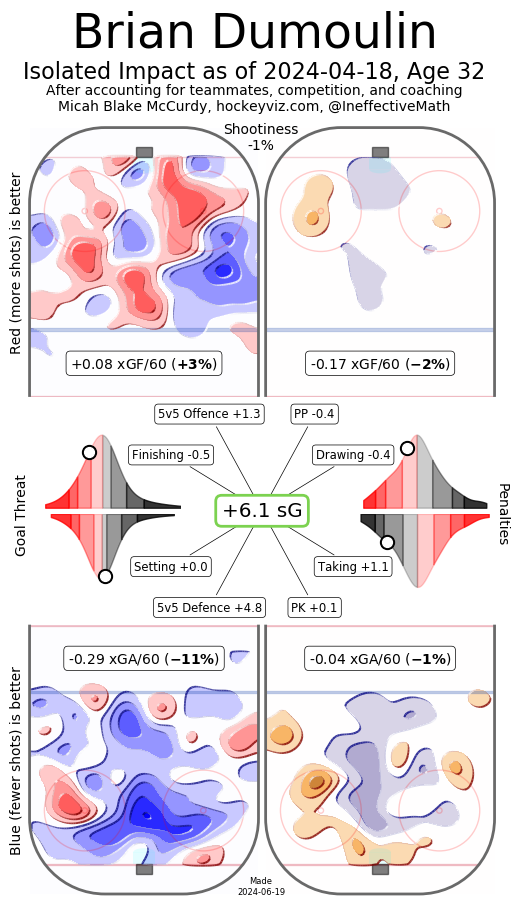
Before discussing team dynamics, it’s important to note Dumoulin’s solid performance for a Kraken team that fell short of expectations last season. Although he faced initial challenges upon joining the Kraken, Dumoulin quickly established himself as a valuable asset.
Just how valuable was he? While Dumoulin achieved a career high in goals (six), his true impact lies beyond the score sheet. As a defensive defenseman, his effectiveness is measured by how well he suppresses opponent opportunities and shifts momentum in Seattle’s favor.
He excelled in this role last year. According to HockeyViz, with Dumoulin on the ice, the Kraken suppressed opponent shot quality by 11 percent above average. Additionally, the team generated 54.5 percent of the overall shot quality during 5-on-5 play with Dumoulin on the ice, per Natural Stat Trick. Among regular lineup players, none achieved a higher expected goals-for percentage. These on-ice results translated into success; Dumoulin ranked third on the team in on-ice plus-minus at +3, while the team as a whole was at -19.
Although primarily deployed as a third-pair defenseman, Dumoulin earned trust from the coaching staff and often stepped up when injuries required it.
Kraken free agent additions dictate a roster move
Why, then, did Seattle trade Dumoulin if he played such a crucial defensive role? The team’s recent signings in free agency necessitated a move to manage its salary cap.
Shortly after free agency opened on July 1, 2024, the Kraken announced a seven-year contract with defenseman Brandon Montour, averaging $7.14 million annually. This brought the number of established NHL defensemen on the roster to seven: Montour, Dumoulin, Vince Dunn, Adam Larsson, Jamie Oleksiak, Will Borgen, and Ryker Evans.
Within hours, center Chandler Stephenson was also signed to a seven-year deal with an average annual value of $6.25 million. These contracts marked the largest total-value signings in Seattle’s or any Ron Francis-managed team’s history.
Assuming Shane Wright and Evans make the team, these signings left the Kraken with approximately $8.25 million in cap space, with 10 forwards and seven defensemen already signed. Qualified restricted free agents Eeli Tolvanen and Matty Beniers, who are yet to sign, will bring the total number of forwards to 12 once their contracts are finalized.
Here are some possible contracts for Tolvanen and Beniers from two prominent contract projections:


Considering Beniers’ decreased point production in the 2023-24 season, most analysts predict a shorter, so-called “bridge” deal. Using the data points above, a reasonable estimate for a bridge deal might be a three-year, $4.6 million AAV contract.
As for Tolvanen, the prevailing wisdom favors a multi-year deal with an expected cap hit in the $3 million to $4 million range. Let’s use a three-year, $4 million AAV contract as a placeholder for Tolvanen.
If Beniers and Tolvanen were added to Seattle’s salary cap table after their spending spree in free agency, the team would already exceed the cap, even without a 13th (or 14th) forward on the roster.


Even a shorter-term deal for Tolvanen, such as a one-year contract at $3.2 million, would leave insufficient room to add a full-time 13th forward. Something had to give.
The team’s decision to trade Dumoulin
Kraken general manager Ron Francis met with the media after the Montour and Stephenson signings on Monday, July 1. When he was asked if the signings would necessitate further moves, Francis said: “[N]ot at this point,” before noting that “[i]t will depend on… talks … with Matty [Beniers] and [Eeli] Tolvanen.” Any subsequent moves will “depend on where those [contracts] come in… But we have looked at a lot of different scenarios and we feel comfortable we will be under the cap and ready to go when the season starts.”
When Sound Of Hockey’s Darren Brown asked Francis what he thought of a crowded seven-player blue line, Francis answered “that’s what training camp is for.” Francis continued: “We carry seven normally all season long. So, we felt comfortable with our six before today, and now we feel really good about our seven.”
We were cautious taking these comments at face value, suspecting that disclosing a tight financial position during negotiations could weaken the team’s bargaining stance.
Lo and behold, less than 24 hours later, Seattle announced Dumoulin’s trade to Anaheim, effectively clearing their defensive logjam and fixing their cap situation. With Dumoulin’s $3.15 million cap hit off the books, the team now had $11.4 million in cap space to accommodate Beniers, Tolvanen, and potentially add a 13th forward and seventh defenseman.
Other potential trade candidates, such as Will Borgen ($2.7 million AAV) or Adam Larsson ($4 million AAV), were less straightforward solutions for Seattle’s roster needs. The team likely values them higher and prefers to either retain or trade them under more favorable circumstances. Alternatively, trading a forward like Brandon Tanev ($3.5 million AAV) without a ready replacement could have simply traded one problem for another by creating a new roster vacancy.
Completing the Kraken roster
The cap picture is much clearer following the Dumoulin trade. Allocating $8.6 million total to Beniers and Tolvanen based on our calculations above, the team could then easily add one depth forward and one depth defenseman on minimum contracts and remain under the cap. Consider the following scenario where John Hayden and Cale Fleury assume those roles:


Alternatively, on July 1, the Kraken signed 25-year-old forward Ben Meyers to a one-year contract at a $775,000 cap hit. Bringing six goals in 67 games of NHL experience, Meyers should compete with Hayden to stick with the team as a 13th forward.
On the blue line, the Kraken signed 26-year-old, left-shot defenseman Josh Mahura to an identical one-year, $775,000 minimum contract on July 3. Mahura has 191 games of NHL experience. He was a full-time, third-pair defender for the Florida Panthers in 2022-23, and continued in that role to begin 2023-24 before a lower-body injury knocked him out of the lineup, and he shifted down the depth chart in favor of other options. Mahura should compete with Fleury for the depth defenseman role.
Evaluating the Dumoulin trade
Given Dumoulin’s strong performance in Seattle and reasonable contract term, some might question why the Kraken didn’t secure a better return in the trade. Recent trade trends indicate that deals around this time of year often prioritize cap management over maximizing player value. The Kraken took advantage of that dynamic when it came to acquiring Oliver Brjorkstrand, but were on the other side of it this time.
Here are the completed player-for-pick trades just before or during the first 10 days of free agency over the last three years:
- July 2, 2024: Seattle trades LD Brian Dumoulin to Anaheim for a 2026 fourth-round pick.
- July 1, 2024: Pittsburgh trades F Reilly Smith (plus salary retention) to New York Rangers for 2025 fifth-round pick and 2027 second-round pick.
- June 30, 2024: Montreal trades RD Johnathan Kovacevic to New Jersey for a 2026 fourth-round pick.
- July 2, 2023: Tampa Bay trades F Patrick Maroon (plus 20 percent salary retention) to Minnesota for a 2026 seventh-round pick.
- July 1, 2023: Dallas trades LD Colin Miller to New Jersey for a 2025 fifth-round pick.
- July 1, 2023: Montreal trades Joel Edmundson (plus 50 percent salary retention) to Washington for 2024 third- and seventh-round picks.
- July 22, 2022: Columbus trades F Oliver Bjorkstrand to Seattle for 2023 third- and fourth-round picks.
- July 13, 2022: Ottawa trades F Connor Brown to Washington for a 2024 second-round pick.
Kovacevic is the most recent comparable for the Dumoulin deal. Kovacevic is a 26-year-old, 6-foot-5, right-shot defenseman who played 62 NHL games in 2022-23 in a third-pair role, tallying 13 points. He is also cheaper than Dumoulin, with just a $766,667 cap hit for one year. Dumoulin is a better player, no doubt, but it is easy to see how the other factors could even out the value based on the acquiring team’s need. Add in that San Jose’s 2026 fourth-round pick is likely to be a better pick than the one secured for Kovacevic return, and the deals look roughly similar.
The 2023 Joel Edmunson trade may be the closest fit in terms of player profile traded in our sample. The return was slightly better in that case, but I attribute that to Montreal’s $1,750,000 salary retention. Edmunson cost Washington approximately half what Dumoulin will cost against the cap.
The 2023 Colin Miller trade is another comparable deal. Again, Dumoulin is the better player, but Miller was cheaper ($1.85 million AAV for one-year), and he brought a lesser return.
All told, it appears Seattle took a trade in line with what might be expected on the market.
Importantly, Seattle avoided a scenario where they would need to sweeten the deal with prospects or draft picks to move Dumoulin’s contract, similar to Detroit’s experience with Jake Walman, who had two years at $3.4 million average annual value remaining on his deal. Detroit sent a second-round pick to San Jose to facilitate Walman’s trade due to cap constraints.
Revisiting Soucy vs. Dumoulin a year later
All of this made me recall the decision faced by Seattle last offseason whether to re-sign Carson Soucy or sign Brian Dumoulin. Opting for the latter, the team underscored that the shorter term accepted by Dumoulin was important to avoid blocking Ryker Evans. Leap to today, and Evans is ready for the NHL, has a clear path to a role, and the Kraken have a minor draft asset for their troubles.
If the team had instead signed Soucy to the same contract he took in Vancouver, the Kraken would have a player with two years remaining at a $3.25 million annual cap hit. If Soucy had experienced a similarly injury-plagued season in Seattle as he did in Vancouver, moving him may have incurred costs akin to Detroit’s situation with Walman.
Final takeaways
The Dumoulin trade was a necessary step to navigate Seattle’s cap situation while finalizing contracts with restricted free agents Beniers and Tolvanen. Given their current cap space, the deal does not portend additional acquisitions, beyond depth signings, unless the Kraken move out additional existing player contracts in the interim.
Could Seattle have secured a better return for Dumoulin if it had more cap flexibility to hold onto him? Perhaps, but the team prioritized securing targeted players in free agency, placing them in a weaker bargaining position during trade negotiations amidst a depressed summer trade market. In this context, the trade appears fair and aligned with market norms.
* * *
What do you think about the Dumoulin trade and the rest of Seattle’s offseason moves? Do you think the Kraken are done? Do you have anything else you’d like to see the team do? Are the Kraken a better team heading into the 2024-25 season? Let us know in the comments below or X, formerly known as Twitter, @sound_hockey and @deepseahockey.


Curtis Isacke
Curtis is a Sound Of Hockey contributor and member of the Kraken press corps. Curtis is an attorney by day, and he has read the NHL collective bargaining agreement and bylaws so you don’t have to. He can be found analyzing the Kraken, NHL Draft, and other hockey topics on Twitter and Bluesky @deepseahockey.