


It’s become an annual tradition at the Sound Of Hockey to dive into the latest USA Hockey registration numbers, and the 2024-25 season brings plenty to talk about. We like using this data as a proxy for the popularity and growth of the sport as a whole. Here’s what we learned about membership trends over the last year.
Year-over-year growth
USA Hockey hit an all-time high in player memberships during the 2024-25 season, adding 13,396 new players compared to last year. That’s a stronger jump than the 8,282 gained in 2023-24, and it marks three straight years of steady growth. The sport is clearly bouncing back from the pandemic lull. For context, the previous record was 567,908 members back in 2018-19, the last full season before COVID disruptions, and we’ve now officially surpassed that milestone.

Youth numbers keep climbing
Youth hockey is setting records for the third year in a row. USA Hockey added 6,705 new youth members, bringing the 2024-25 total to 396,525—a new all-time high. In an era when youth sports overall are facing participation challenges, it’s exciting to see hockey bucking that trend.

Female participation keeps rising
Female participation continues to be one of the brightest growth areas for USA Hockey. The 2024-25 season saw 4,784 more girls and women register, a 5.1 percent increase year-over-year. That’s the largest non-pandemic bounce the female category has seen since USA Hockey began breaking out female-specific data. With sustained momentum like this, the pipeline for women’s hockey at all levels is getting stronger each year. You have to imagine that female participation will continue to increase as the rise and growth of the Professional Women’s Hockey League (PWHL) continues.

State-by-state highlights
Looking at where the growth is happening, two states really stood out this season. Florida led the country with an 8.4 percent increase in memberships, fueled by the Florida Panthers’ Stanley Cup win. Meanwhile, Utah posted the second-highest percentage growth, boosted by the buzz of the NHL’s arrival in Salt Lake City. It’s early, but the impact is already visible. With Utah Mammoth owner Ryan Smith publicly committing to growing the game at the grassroots level, Utah could be hockey’s next big expansion story.

Washington State
Washington added 711 new player memberships in 2024-25, a 5.8 percent increase over last season. That’s a healthy jump, and most of the growth came from youth hockey—467 of those new members were under 18. That said, the state continues to run up against a familiar roadblock: ice time. Since the Kraken opened Kraken Community Iceplex with three ice sheets back in 2021-22, no new rinks have been built, and most facilities are operating at or near capacity.

The Kirkland Kraken facility still appears to be moving forward, but with no shovel in the ground yet, it’s hard to imagine it opening before the 2027-28 season. Until then, Washington’s growth will likely be capped more by rink availability than by interest.
Explore the numbers yourself
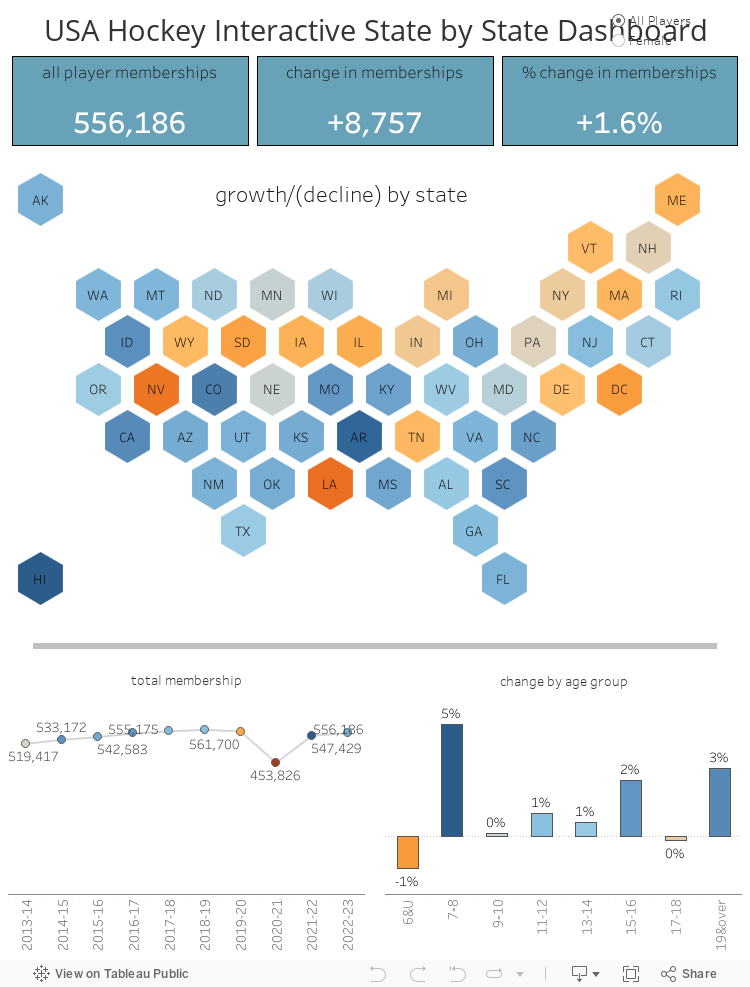
As always, I’ve put together an interactive dashboard where you can explore USA Hockey membership by state, age group, or gender.
If you have questions, feel free to reach out—I love digging into the details.


When I was in B.C Canada, there was an increase in arena being built year after year, That was because propert was still priced low. Unfortunately, Seattle has out priced its self for new rinks. There are ways around this, but it takes creative thinking and creative financing to do it as well. Greed blocks creatiivity, until profits can combine with youth hockey to improve this. You do not even see roller rinks anymore and parially, because of this, kids have no where to go to have fun and release that pent up energy. Leaving politics out of this, this is a culture issue that will only grow because greed and investment must go hand in hand and kids do not inspire investment.
Lack of ice availability is really going to hinder growth in the greater Seattle area. The Jr Kraken filled up teams instantly for next year. So kids who want to play but weren’t in the program at 6 or 7 are waitlisted with no chance of playing. It seems like they could easily have several more coed 10u teams. It’s also going to get worse because there are a 8-12u kids playing now than 5 years ago when KCI didn’t exist. So the constraint will snowball with more 14/16/18u demand as they age.
There is easily enough demand for a several more sheets in Seattle. I would love to see rinks in Interbay and SODO to spread out availability to more Seattle neighborhoods. But I don’t know how the economics would work with little demand 8-4 Mon-Fri though. Especially since we don’t have the benefit of municipal rinks or ODRs.
The lack of ice definitely kept me from playing when I was old enough to go to the juniors. I fell in love with the game when I was a teenager, but where is a poor kid in nineties Pierce County going to play? The best I could do was to get a pair of roller blades, a beat-up old wooden stick, and an orange ball.
A lack of ice has always been the biggest limiting factor in hockey’s growth as far as I can tell. The game is fun. It is probably the most explosive and exciting game out there. The problem with it is that you need a lot more than a ball and a yard to play with friends, and I don’t think that is something that the NHL alone can help with. We need investors who can see the profit potential in more suburban rinks, because I think there is enough demand to support them.
I concur with many of the above the comments. When I was a kid (growing up on QA Hill) the only (close by) options for skating were Highland Ice Arena, Mercer Arena, and a converted warehouse in Ballard where I skated (near Salmon Bay). Just focusing on west side of Lake Washington, currently closest rink south of the Kraken complex is literally the Kent Valley Ice Center (where I now skate) – a gap of over 25 miles between rinks.
All the existing rinks in the Puget Sound area (including the eastside) provide only 15 or so sheets of ice available for all skating-related activities, which is clearly not enough to grow hockey at the grass roots level. I believe the NHL is serious about its outreach to underserved communities, so I think the way to increase capacity would some kind of public/private partnership that would build rinks in areas like the Central District and White Center. It’s hard to see City of Seattle have the financial resources to lead the way on this, but perhaps some kind of public/private partnership could make this work.
All major professional sports in North America had modest beginnings. Baseball started in sandlots; it’s now our national pastime. In the 40’s and 50’s professional basketball players worked jobs in the offseason to make ends meet; now the NBA has created cultural icons known simply as Lebron, Steph, Shaq (and of course Kobe). Professional football started (literally) with players in leather helmets and games played in cities like Akron, Canton, and Muncie. Now the NFL literally owns a day of the week.
Given the current growth in TV revenue, now is the time for the NHL and its’ teams to invest in the next generation of life-long fans and thus secure hockey its future in a competitive sports landscape. It has to start at the grass-roots level, and much of that burden will fall on teams. Figure out a way to build rinks (the public/private partnership model?) and provide equipment for beginners from lower income families. Convert excess asphalt into roller rinks. Organize and sponsor street hockey tournaments in neighborhoods throughout the city. Kids will FALL IN LOVE with hockey (whatever version they play); their gratitude for the opportunity to play as a youngster will translate into a generation of loyal fans who will then teach their kids the game.
But it all starts with the teams. It will take long-term financial commitments to bear fruit. But hey – hockey’s the greatest sport ever invented, and everyone needs to know what the sport is all about.
There is a really interesting document related to the potential ice rink over in Kirkland (link below) – one of the things they highlight is the ice sheets per population (pg 15). On a surface level it looks like Seattle is comparable to other “non-traditional hockey markets” (1 per 277k people), but that ignores the popularity of hockey here vs those locations and the capacity constraints. Just look at the number of registered players in Georgia (2.6k) or Nevada (5.3k) vs Washington (13k). Seattle is a city of transplants – so you have a ton of people from the Northeast and Mid-West, where there are 10x more rinks per person than here. With most rinks being privately run we also run into the cost hurdle – Massachusetts has 42 rinks operated by the state alone. It would be great if Seattle parks even built a few roller / street hockey rinks around that don’t require the same facilities.
https://www.kirklandwa.gov/files/sharedassets/public/v/1/city-managers-office/pdfs/kraken-facility-caaicon-report-august-2024.pdf
Smitty – thanks for this. I had the link to the article about the Kirkland rinks, but didn’t look at the attached documents – thanks for highlighting the information above. Agree with your idea that Seattle Parks Dept could at least provide help by building street hockey rinks – which just require asphalt and should be too expensive.
It’s understandable that the Puget Sound area has far fewer rinks per capita than places like Massachusetts. Just for fun, I checked the Greater Chicago Metropolitan area and counted 67 indoor rinks, and 5-10 outdoor rinks. A few (but not many) of the indoor rinks would have two sheets, so for the sake of argument let’s say the Chicago area has approximately 90 sheets of ice available during wintertime. The Greater Chicago Metropolitan area’s population is ~ 9.4mm residents. By comparison, the Puget Sound Metropolitan Region has just over 4 million residents. So, the Chicago Metro area has ~ 2.35x the population relative to PSMR, but 6x the number of rinks. Maybe a better comparison for Puget Sound would be the Bay Area. The greater Bay area (San Francisco-San Jose-East Bay) has a population of approximately 9.2mm, but only about 10 indoor hockey facilities (and 13-15 sheets of ice). So as bad as the shortage of rinks is in the Puget Sound area, just be lucky you’re not trying to play hockey in Northern California I used to drive 40 miles on Sunday from Concord to Vacaville (near Sacramento) just to play my games.
The problem (as mentioned by others above) is that during the past three decades real estate has become grotesquely expensive. So, building additional indoor rinks is going to be difficult. But the real overriding (and nagging) question to all to all this is the following:
Is Seattle REALLY a hockey town?
How much appetite exists to genuinely grow the sport in Seattle (and the greater Puget Sound Region). I wouldn’t be surprised if Puget Sound area’s “hockey rink profile” looks like Los Angeles and teams the NHL added as part of its “Sunbelt Strategy.” If we’re honest, the REAL reason the Seattle City Council engaged in rebuilding CPA was NOT to attract an NHL team, but to pave the way for the Sonics to return. We who comment on SOH are obviously fans, but HOW MANY of the 17,109 that attend Kraken games are GENUINE hockey fans? How many will abandon the team when the NBA (which I couldn’t personally give a shit about) returns. If this area truly supports hockey the current shortage of hockey rinks in Puget Sound will take care of itself (in the long term). If not, interest at the grass roots level will wane, and the Kraken will suffer.
Interesting article as well as the current status on rinks in the area. My understanding is that there is some concerns about the rinks in Lynnwood because the land is valuable for redevelopment. Would love to see some more growth on the north end. We have two sheets in Everett but could use some more.
That the status of the Lynnwood rink is uncertain is telling. I suggested some kind of public/private partnership to build rinks, , I would guess that an ice rink is the least attractive investment from an economic standpoint and hard to see how private investors would want to do that. Much more attractive to build a generic office park with high density housing. Oh well.