As a hockey fan tracks the puck ricocheting around the ice between whistles, one might reasonably conclude that the sport is nothing more than improvised chaos (with sword shoes!). If you cast a broader gaze, though, the coordination of a ballet and the tactics of a chess match are revealed. Each foray is met with a coordinated response that is both instinctual and strategic.
Today, we’ll look at the defensive schemes new Seattle Kraken head coach Lane Lambert and his staff may deploy to meet opposing attacks, and how these may differ (or not) from what we’ve seen from the Kraken in the past. We’ll do that by examining the approaches Lambert utilized last season while helming the defense as the Associate Coach of the Toronto Maple Leafs.
We focused on Lambert’s time in Toronto and not his other coaching stops for two reasons. First, as Lambert told Sound Of Hockey, his strategies have evolved as he has seen changes in the game. Tactics he may have deployed in earlier coaching stops may be outdated given the way the game is now played.
Second, and more practically, there is still video available for review from last season (until ESPN+ purges its 2024-25 archive in August, at least). To that end, if you’d rather learn by watching Lambert’s defenses, we’re here for you: You can check Toronto’s defensive work from Apr. 15, 2025, vs. Buffalo, Mar. 19, 2025, vs. Colorado (part one and part two), and Feb. 6, 2025 vs. Seattle.
Decisions about Seattle’s defensive approach and strategies have likely already happened. “You make those decisions [about schemes] before you get to training camp,” Lambert told Sound Of Hockey in a June 12 interview. “Through the summer here, that’s where the work comes in, and you get prepared for training camp. It’s a little bit personnel-based, for sure, but you also [set schemes] conducive to the style of play you want.” So, there is no better time to dive in.
Let’s make this about the Leafs for a moment
Before looking at how Lambert’s Toronto defenses played, let’s briefly look at the quality of Leafs’ defensive work last season. The Maple Leafs were eighth in goals against overall—third in goals against at 5-on-5, and 24th on the penalty kill. According to Evolving Hockey, Toronto was about average (17th overall) in total shot quality against per 60 minutes at 5-on-5, and in the bottom third of of the league (24th overall) in expected goals against on the penalty kill. Evolving Hockey suggests that Toronto received strong goaltending behind Lambert’s defenses, with Leafs goalies saving approximately 42 goals above expected last season.
Looking to shot maps produced by HockeyViz, generally speaking, we see that Toronto opponents tended to shoot more than league average from the outside (shown in red in the 5-on-5 chart and yellow/brown in the penalty kill chart) and created fewer shots than average closer to the goal (shown in blue and purple, respectively, in the charts).
Charts from HockeyViz
Without further ado, let’s start with the neutral-zone forecheck, then turn to coverage in the defensive zone, and strategies in shorthanded situations.
The neutral zone: 1-2-2 forecheck
Whenever you raise the topic of defense with hockey coaches, they’ll tell you that it begins in the offensive zone. Lambert is no exception. “[Defense] starts in the offensive zone, and it starts with your gaps and your back pressure and taking away time and space,” Lambert told Sound Of Hockey.
Defensive play starts with a key read in the offensive zone: Pressure the puck deep in the offensive zone or assume a neutral-zone defense structure to disrupt a rush and, ideally, force a turnover farther up ice. “[T]he worst thing a defenseman can do is on the offensive blue line when the other team gets the puck, they start to back up,” Lambert explained.
The judgment call is “about spacing, it’s about gaps,” Lambert continued. “If the [opposing] defensemen are going back [to retrieve or control the puck] and you can see numbers on [their back], you can go with two [forechecking forwards], you can pressure them. And then the third [forward] will, you know, read off of that. [I]t’s all about playing on your toes and putting pressure and being aggressive.”
On the other hand, if the opponent is “what we say, ‘eyes up’ and they’re looking at you and they’ve got complete control of the puck, then you’re more into your [neutral-zone forecheck] structure,” Lambert said.
In the neutral-zone forecheck “you’ve got gap control, you’ve got space control, and eventually, the idea is to force something before or very near the red line,” Lambert said. “[I]f you do force that and turn the puck over, then. . . [y]ou can turn it into a half-ice game and just transition right back onto offense. And you don’t have to come 200 feet, you only have to come 100 feet.”
Lambert’s neutral-zone forecheck is a 1-2-2 system. This is similar to what the Kraken ran under both Dave Hakstol and Dan Bylsma and the most common neutral-zone system utilized in the NHL.
Toronto defenders (in blue) defend the neutral zone in a 1-2-2 formation
The forward farthest up ice and closest to the puck (F1) assumes a position at the top of the formation and presses the opponent to commit to an attack or allow his teammates to change. F1 will also look for turnovers opportunistically. The next level (F2 and F3) looks to deny the red line, which would cause the opponent to ice the puck if they simply fire it into the offensive zone. Secondarily, this layer is looking to either funnel the attacker into a small area that the defensemen can then rotate over and cut off or force a lengthy dump-in from just across the red line.
Neutral zone 1-2-2
The last layer (D1 and D2) looks to deny controlled entries into the zone (meaning zone entries where the opposition can carry the puck over the blue line, rather than dumping it). But the defensemen are reading the play in front of them and will retreat toward their defensive-zone positioning if the opponent rush has broken down Seattle’s structure.
As mentioned by Lambert, the third forward’s read is often important, particularly if two forechecking forwards are caught up ice and are racing back to catch the play. The F3 may attempt to funnel the play to the side on his own or retreat further, conceding the neutral zone, in an effort to disrupt a controlled offensive-zone entry.
Example of neutral-zone defense with forecheckers caught deep
According to manually tracked data from All Three Zones, Toronto’s neutral-zone forecheck conceded a near-league-average number of controlled offensive-zone entries, but ranked sixth in the league at suppressing opponent controlled entries leading directly to a scoring chance. This is one area that distinguished Toronto from Seattle defensively last season.
Chart from All Three Zones
The defensive zone: zone coverage (2-3 coverage)
Once the opponent gets the puck into the offensive zone, the coverage evolves into a different zone structure.
Defensive-zone coverage
If the opponent has possession high in the zone, two high forwards (typically the wingers) each patrol the halves of the ice above the dots, keeping position between themselves and the potential shooters. The high forwards (W1 and W2 in the image below) can interchange and carry an opponent who is skating the puck side-to-side high in the zone. The defensemen (D1 and D2) patrol halves of the ice from the dots down, working to keep themselves between the post and offensive players in their zone. Finally, the third forward (typically the center) defends the slot and carries attacking forwards through that area and lower.
Defensive zone: high possession coverage
If the puck moves below the dots along the half wall or into the corner, the coverage shifts. The defenseman to that side of the ice typically moves to contain and pressure the puck carrier. The center follows in to provide support in the corner and join in a puck battle if necessary. The remaining defenseman moves to cover the net front.
Defensive zone: low/corner coverage
The strong-side high forward, typically a winger (W1 in the image above) moves in support toward the half wall to limit the low-to-high passing lanes while the weak-side high forward, typically the other winger (W2), moves down to the slot area. His role is to monitor for a defenseman crashing down for a shot and any players who could sneak toward the net for a “backdoor” play.
Defensive zone: low/corner coverage (one second later)
Similar rules apply if the puck moves up the wall closer to the dots, though in those scenarios, the strong-side winger may activate to create pressure while the center provides support coverage low.
Defensive zone: half wall coverage
All of these principles are similar to the strategies Dan Bylsma’s staff deployed, but the difference is in the finer coaching details. Toronto displayed better connectivity and discipline working inside-out. Last year we often saw Kraken players attempting to create turnovers in the corner or at the half wall through individual effort, but this often pulled the team’s structure out of sync, creating gaps. Lambert’s approach creates strong-side pressure with its structure, subtly shifting all players a little more toward the strong side to take away space and passing lanes, while protecting the middle over all else.
Defensive zone: coordinated strong-side coverage
The result was Lambert’s Leafs had fewer defensive breakdowns and conceded fewer high-danger slot chances, at least in the games I viewed. If Seattle’s in-zone defense improves in 2025-26 it is likely because this inside-out, connected approach takes hold, particularly with defenders like Jamie Oleksiak, Adam Larsson, and Ryan Lindgren.
The penalty kill: triangle and one
One area where Lambert’s approach has evolved over the years is on the penalty kill. “You’re always adjusting. [I]n New York, we were a little bit more of a diamond [formation penalty kill],” Lambert told Sound Of Hockey. The “diamond” formation is the system Seattle has utilized in recent years. Lambert moved away from that in Toronto, utilizing a “triangle and one” (or “wedge and one”) PK.
“There’s a lot of thought and detail that has to go into the penalty kill. And it is based a little bit on personnel and personnel who we have and what the plan is in terms of who’s killing penalties.”
That said, “when I came into the league 14 years ago, and I ran the penalty kill in Nashville… it used to be 19 or 20 percent [conversion rate] was a really good power play. And now 20 percent is the standard,” Lambert explained. “[T]he players are getting more skilled.” So, “last year with Toronto, we needed to have some pressure.” This led Lambert to adopt the triangle and one.
Shorthanded: triangle and one
The two defensemen default to positions just above the outer edges of the crease (forming the base of the triangle), and a forward is positioned in the mid-to-high slot (completing the triangle). These defenders form the core of the defense and will look to thwart cross-seam passes and scoring opportunities with active stick checks.
Shorthanded: triangle-and-one setup
The second forward (the “one” penalty killer) activates in a straight line from the goal toward the opposing player in possession of the puck. The player’s goal is to be in a position to block a shot and then either force the opposing player to concede possession or angle him to a lower-danger portion of the ice.
Shorthanded: top forward pressures puck carrier to give up the puck
Since the offense can move the puck via pass more quickly than the “one” skater can reposition to renew his pressure, the forwards are taught to interchange, with the forward at the top of the triangle activating to become the “one” defender if he is closer to the puck while the previous “one” defender backfills the vacated point of the triangle.
Shorthanded: forwards exchange the pressure role
Will Lambert utilize the triangle and one in Seattle? It’s an issue to watch when training camp arrives. As Lambert mentioned, penalty kill schemes are selected with an eye toward roster ability. In Toronto, he believed he had forwards better suited to be aggressive at the top of the triangle and one. In Seattle we know that Dave Hakstol’s staff made the opposite decision to move away from the triangle and one scheme in favor of the diamond scheme during the 2022-23 season. Matty Beniers’ defensive skill could be a reason to favor the relatively active triangle and one, but we’ll have wait and see where Lambert’s staff comes down.
Coaching hockey is equal parts art and science
Fans may discount it when a coach talks postgame about “toughness,” “discipline,” or “buy-in” as contributing factors to a loss. One might reasonably suspect that there are deeper reasons for a defeat—owing to scheme breakdowns or personnel disadvantages—that are left unsaid. This may be true, in part, but every coach goes into a game with confidence that success will follow the proper implementation of an attack plan. Failure is not always a question of the “science” of gameplay; the “art” matters too.
Today, we discussed some “science”—the defensive schemes Lambert and his staff may deploy. It must be underscored, though, that the “art” of coaching matters with equal measure. The job of the coach is not only to impart fundamentals and scheme, he must mold off-ice approach and on-ice temperament. The best coaches balance these crafts in a volatile alchemy that elevates individual players as a cohesive whole.
Though there were positives, with hindsight we know the 2024-25 Seattle Kraken did not achieve at a level greater than the sum of its parts. To the contrary, despite adding multiple high-priced free agents and enjoying progress from multiple young core pieces, the team remained mired in mediocrity. The vision of the team was never realized.
If Lambert and his staff are going to re-write the story this season, it will be as much about mentality and character as it is about gap control in the neutral-zone forecheck. The schemes discussed in this piece are all widely utilized in the NHL. None will surprise opponents or win games on their own. Success will hinge on how players work within the schemes.
“You set a standard and you don’t deflect from that standard, you don’t deviate from that standard,” Lambert said at his introductory press conference. “It’s an everyday thing. You do the same things every day, repetition, and if something isn’t right, you take care of it. You have to nip it. That is the key to the accountability. You can’t turn a blind eye and let something slide.”
The Kraken are betting structure and accountability will elevate the team this season.
Curtis Isacke
Curtis is a Sound Of Hockey contributor and member of the Kraken press corps. Curtis is an attorney by day, and he has read the NHL collective bargaining agreement and bylaws so you don’t have to. He can be found analyzing the Kraken, NHL Draft, and other hockey topics on Twitter and Bluesky @deepseahockey.
The Seattle Kraken have signed restricted free agent Kaapo Kakko to a three-year, $13.575 million contract, avoiding arbitration just days before his scheduled July 25 hearing. The $4.525 million average annual value will carry Kakko into his prime, setting him up to hit the open market at age 27.
The signing comes as a relief for fans who were growing antsy about the arbitration process, which I previously discussed in a Sound Of Hockeyarticle on July 9.
Kakko contributions
Kakko was acquired from the New York Rangers during the 2024-25 season after falling out of favor in their top-six forward group. Drafted second overall in 2019, the Finnish winger arrived in Seattle seeking a fresh start and more ice time. He found flashes of both. While his production wasn’t eye-popping, signs of renewed confidence emerged.
Since joining the Kraken, Kakko’s numbers have climbed with the increased opportunity he received. He boosted his full-season scoring pace from 38 points with New York to 50 points in Seattle and tripled his power-play production.
Just as encouraging was his impact on linemates. Consistently skating with Matty Beniers and Jaden Schwartz, Kakko helped drive up both players’ offensive production.
Beniers’ even-strength goals per game jumped from 0.121 to 0.224 after Kakko’s arrival. He also found new life on the power play, scoring five goals in the final 49 games after netting none in the first 33. While Beniers and Kakko typically skated on separate power-play units, the increased confidence appeared to ripple across situations.
Schwartz saw a similar bump, improving his even-strength goals per game from 0.181 to 0.285 goals per game. Of Kakko’s 20 assists, 14 came on goals by Schwartz (nine goals) or Beniers (five).
This deal signals the Kraken’s belief in Kakko’s continued growth and value as a top-six contributor. He logged heavy minutes after joining the team and appears poised for continued progresssion. The Schwartz–Beniers–Kakko line was the team’s most consistent foward line, logging 459 minutes together—more than double any other forward combination, per moneypuck.com. That’s especially impressive considering Kakko played just 49 games with the Kraken. The Oliver Bjorkstrand–Shane Wright–Eeli Tolvanen trio was next at 189.9 minutes.
Still, player development isn’t always a straight line. At just 24, Kakko still carries untapped upside. His improved numbers—and the boost he gave teammates—suggest Seattle might have landed a player on the rise.
The $4.525 million cap hit represents 4.74 percent of this season’s cap. But with the ceiling projected to rise to $113.5 million by 2027–28, that figure drops to 4.0 percent. In other words, this deal seems like a bargain.
The Kraken are banking on Kakko to continue thriving as a top-six forward, especially after his step forward last season in both production and play-driving. This signing reflects Seattle’s commitment to building around youth and structure.
How does Kakko’s contract compare
For comparison, here’s what similar restricted free agents (RFAs) with 45–55 points signed for on contracts beginning in the 2025–26 season:
Juraj Slafkovský – Eight years at $7.6 million
Alexis Lafrenière – Seven years at $7.45 million
Matt Coronato – Seven years at $6.5 million
Simon Holmstrom – Two years at $3.625 million
Locking in Kakko at $4.525 million looks like a discount relative to Slafkovský, Lafrenière, and Coronato. Holmstrom’s deal came in lower but covers fewer years and will expire with RFA status. Kakko is nestled between Coronato and Holmstrom, and it is good to have him under contract for three years.
With Kakko under contract, general manager Jason Botterill can now focus on re-signing defenseman RFA Ryker Evans and exploring trade options to potentially add offense. The Kraken have roughly $7 million in cap space, offering room for additional moves before training camp.
Comment below with your thoughts on the signing and what you think the Kraken’s next move should be.
Blaiz Grubic
Blaiz Grubic is a contributor at Sound Of Hockey. A passionate hockey fan and player for over 30 years, Blaiz grew up in the Pacific Northwest and is an alumni of Washington State University (Go Cougs!). When he’s not playing, watching, or writing about hockey, he enjoys quality time with his wife and daughter or getting out on a golf course for a quick round. Follow @blaizg on BlueSky or X.
Now officially in the Kraken general manager’s chair, Jason Botterill has spent the first half of the non-playing months tinkering with Seattle’s roster—but not overhauling it completely. He acquired forwards Mason Marchment and Freddy Gaudreau, worked some cap voodoo to get Andre Burakovsky’s $27.5 million off the books for only the cost of buying out Joe Veleno at a $796K bargain, and signed veteran defensive defenseman Ryan Lindgren to a four-year, $18 million contract at the opening of free agency.
One thing we heard at Botterill’s “introductory” press conference back in May (I say “introductory” in quotes because Botterill has been with the team since its inaugural season and because that presser doubled as the annual end-of-season “what went wrong?” panel) was that team co-owner and co-chair Samantha Holloway said the organization wants to quickly evolve into a “perennial” playoff contender.
“Everyone at this table is committed to winning,” Holloway said. “Our hockey folks and our staff have worked hard and deserve winning. Our partners and our fans who support us every night deserve winning.”
How does that timeline look? Do the Kraken realistically expect to be back in the postseason in 2025-26? Or are we looking at two or three years down the line?
“To me, it’s just building a culture,” Botterill said. “It’s building a team that our fans know every day what’s going to happen from the production and just the style of play. I think we’re in an industry that focuses on end results. Right now, where we’re at, we can’t focus on end results. [New head coach Lane Lambert has] talked about getting better every day, and that’s what we have to do. I think we have a team right now that’s ready to compete for a playoff spot at the end of the year, but we have some steps that we certainly have to take.”
When I asked former GM Ron Francis that same question at the end-of-year presser following the team’s second season—when the Kraken came up a game short of the Western Conference Final—he was more specific and stated that he wanted the team to make the playoffs again in 2023-24. But the Kraken came up well short of that goal, and now—two head coaches and a front-office shuffle later—the franchise is still trying to recapture the lightning it bottled during the 2022-23 season.
So have the Kraken done enough this offseason to get back into the playoffs? I’m considering that question thanks to some data pulled by John Barr (who will also chime in on this article; we’ll make it clear when it’s him talking and not me).
The changes so far
Darren: On the whole, I like the moves Botterill has made to this point. I do believe improved structure under Lambert will be a better fit than the free-wheeling approach of Dan Bylsma, which calls for more star power than the Kraken had last season.
I also think the three acquired players all bring elements that will make the team better in the specific areas the front office wants to improve—being generally harder to play against—and in varying ways, they fit the mold of players who can help Seattle both get to the slot area in the offensive zone and protect the slot in the defensive zone. Those are good things.
Marchment and Gaudreau also bring some scoring ability, with Marchment notching 22 goals and 25 assists in an injury-shortened 2024-25 season (62 games), while Gaudreau had 18 goals and 19 assists playing up and down the lineup in Minnesota.
Are those adds, plus the shutdown talents of Lindgren, enough to get Seattle back in playoff contention? My gut says no.
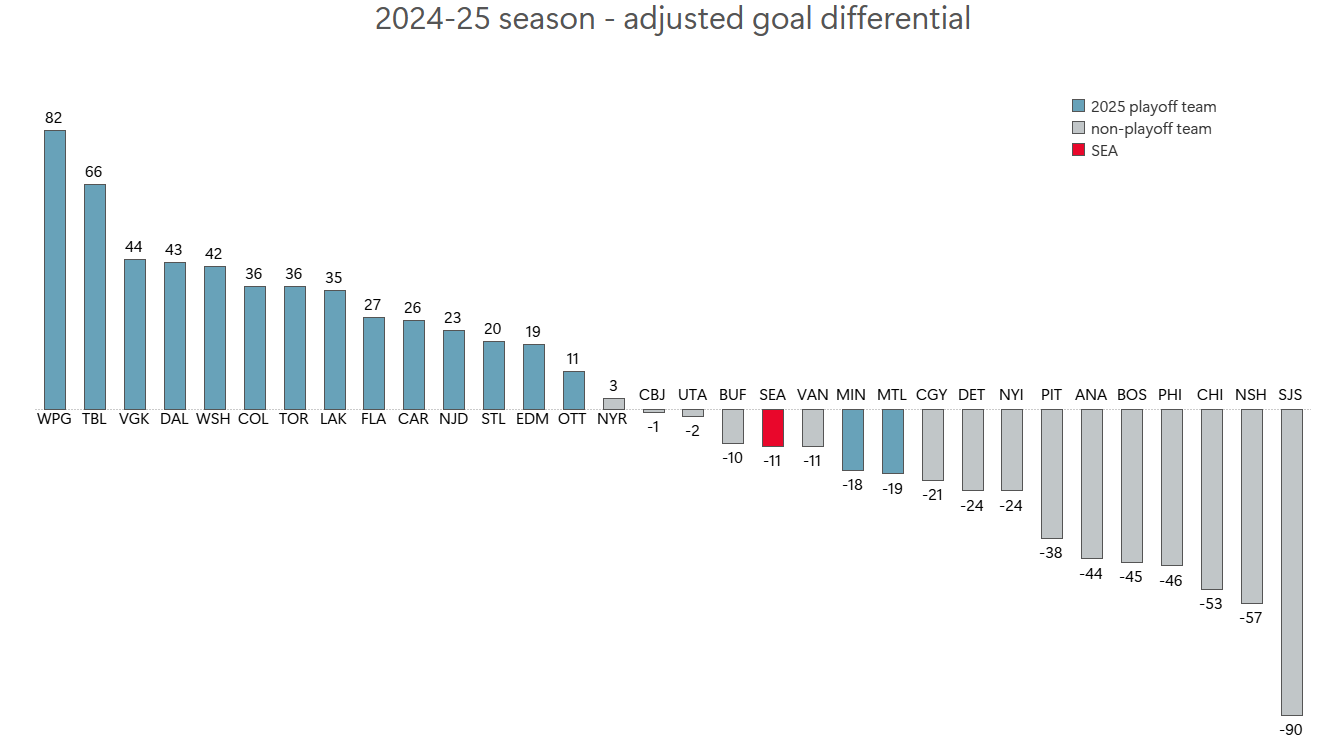
John: I’ve shared some analysis before that suggests teams should aim for a positive goal differential if they want a solid shot at making the playoffs. I use a metric I call adjusted goal differential, which I define as: goals for minus empty-net goals for minus goals against minus empty-net goals against. More simply, it’s goal differential but without empty-netters.
Historically, teams that finish a season with an adjusted goal differential between plus-one and plus-five make the playoffs about 50 percent of the time. Not surprisingly, the odds improve as that number gets higher. For example, teams with an adjusted goal differential between plus-11 and plus-20 make the playoffs roughly 94 percent of the time.
Last season, the Kraken finished with a minus-11 adjusted goal differential, which historically gives a team just about a 10 percent chance of making the playoffs. To even be in the conversation for a playoff spot, they’ll need to find a way to improve that differential by around 12 goals.
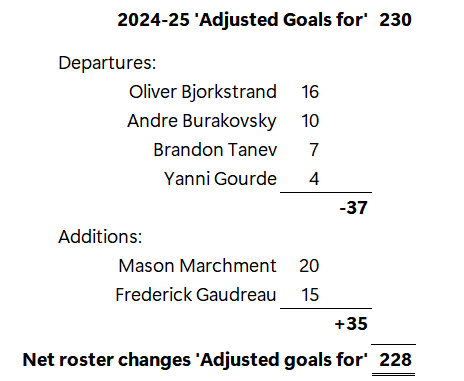
Forecasting goals against is tricky, so for the sake of this exercise, we’re going to focus on the “goals for” side of the equation and assume the defense performs similarly to last season (I know, there is hope the team will improve in its own end next season). Let’s take a look at how this offseason’s roster changes might help close that gap.
This is obviously a simplified look at how the major roster changes could impact goal scoring, but on paper, the team has lost two goals from last season. We could also factor in the potential boost from a full season of Kaapo Kakko or the possibility of Jani Nyman and Berkly Catton cracking the lineup this fall. But to keep things conservative, let’s assume the offseason moves didn’t significantly move the needle on goal production.
Darren: That doesn’t look all that encouraging. I do think Shane Wright could be a big producer this season, and Matty Beniers was better in the second half with Kakko on his wing, so there’s a chance the team gets an uptick in scoring from those two as well. But I agree—no offseason acquisition has pushed the team over the hump of playoff contention.
Can the Kraken still improve this offseason?
Darren: At this stage, I’m still wondering if the Kraken are done for the offseason. My heart says they’re not done, and I’m still holding out hope they’ll swing a big move before training camp, but my brain says they’re going to get into the season and see what they have. I hate what my brain is telling me on that front, because after seeing John’s breakdown above, I remain convinced they need a top-tier scoring winger to give themselves a sniff of the postseason.
There have been rumors that players like Jordan Kyrou and Jason Robertson could be had (although the Kyrou conversations have likely fizzled now that Kyrou’s full no-movement clause has kicked in), and either of those guys could bring enough improvement to the top six to make the Kraken competitive.
John: As much as I’d love for the Kraken to add a 30-plus goal scorer, just about every team in the league would jump at the chance to get a guy like Kyrou or Robertson. So, in my opinion, it’s not realistic to expect a move like that, simply because there would be a ton of competition to land one of those players. Plus, bringing in someone at that level would likely cost you one of your better NHL players, so the net impact might not be as big as it seems. I think it’s much more likely the team adds a depth winger as insurance in case Jani Nyman or Berkly Catton aren’t quite ready to make the jump.
Darren: Yeah, this is back to the heart-versus-brain argument. Again, my heart tells me they should do something like that, but my brain knows better.
What say you, folks? Are they done and willing to (likely) miss the playoffs again—perhaps to give themselves a chance to win the draft lottery and generational talent Gavin McKenna? Or is there a big swing on the horizon?
The Seattle Kraken’s offseason is in full swing, and while attention has (rightfully) been on the draft, trades, and free agency, I always look forward to the release of the NHL regular-season schedule. And as I do every year, I also like to dig into the numbers behind the calendar to see how the Kraken’s path through the season stacks up against the rest of the league.
Let’s dive into a few key metrics.
Travel distance by NHL team
As expected, teams based out west tend to rack up more airline miles over the course of the season. The Kraken have consistently been among the top 10 teams in this category, and the 2025-26 season is no exception.
In total, the Kraken will travel 43,361 miles this season—that’s down just over 5,000 miles from last year. That’s still a hefty chunk of sky time, but it’s hardly unexpected.
Here’s a breakdown by division:
As usual, the Pacific Division continues to dominate the “Most Frequent Flyer Miles” standings.
Number of road trips
One benefit of being geographically isolated from the eastern clusters: fewer, but longer, road trips. The Kraken are set to take just 14 road trips this season, one more than last year.
Longer trips usually mean tougher stretches, but fewer turnarounds and less overall bouncing around. It’s a tradeoff, but one the Kraken are used to navigating by now.
The Olympic break effect
This year’s schedule has a unique wrinkle, a February break for the Winter Olympics, with no NHL games from Feb. 6 to Feb. 24. That gap creates a compressed schedule, especially in January.
The Kraken will play 17 games in January, which will be the most the team has ever played in a single month.
Excluding February, here is the average days between games by month for all teams.
Back-to-back games
Seattle will play 13 back-to-backs this season, up one from last year and right around the league average of 13.4.
I hate to bring it up, but the Kraken were 0-12-0 on the second night of back-to-backs last season. Just when I thought it couldn’t get any worse… mathematically, it actually could. They were the only team in the league to fail to earn even a single standings point in those games. Let’s hope that improves dramatically this year.
Odds and ends of the 2025-26 Kraken schedule
For only the second time in franchise history, the Kraken will open the season at home—against the Anaheim Ducks on Thursday, Oct. 9.
The opening stretch is going to be tough. After just three games, the team heads out on a six-game road trip. Eight of Seattle’s first 10 games are against playoff teams from last season. Oof.
Thankfully, November looks a bit softer, with two games each against the rebuilding Blackhawks and Sharks. But let’s not forget what happened last season…
The Kraken have 10 Saturday home games this year, the most common day of the week for home games. Thursdays are next. They have just one Friday night home game, Jan. 23 vs. Anaheim.
Mark your calendars: Oliver Bjorkstrand and Yanni Gourde return to Climate Pledge Arena with the Tampa Bay Lightning on March 17. It will be their first game back since they were moved at the NHL Trade Deadline this past season.
Looking for a road trip? That Montreal–Ottawa–Toronto swing in the second week of the season could be a great one: three arenas, and weather shouldn’t be an issue yet.
You could also knock off both Southern California teams with two separate back-to-back sets in December and February—Anaheim and L.A. in one go.
And if you’re staying local for Thanksgiving, you’re in luck; Seattle will host the Stars the night before Turkey Day and then face the Oilers in a Saturday matinee.
Bonus scheduling fun: There appears to be just one Sunday when both the Seahawks and Kraken are at home. On Dec. 14, the Seahawks host the Colts at 1:25 p.m., and the Kraken drop the puck against the Sabres at 5 p.m. Three of Seattle’s four Sunday home games will be 5 p.m. starts.
Along with the Kraken, Thunderbirds, and Silvertips, the Pacific Northwest hockey calendar will be even more packed this season with the arrival of PWHL Seattle. If the PWHL follows a similar cadence as past years, their regular season will start in late November and run through early May—plus, they’ll have the Olympic break to navigate, too.
Final thoughts
The Kraken schedule always comes with its share of challenges, and 2025-26 is no exception. With Olympic-induced calendar compression and those ever-brutal long-haul trips, the team will need to manage its energy and depth carefully throughout the season and somehow get up for those second games of a back-to-back.
As always, I’d love to hear from you. Are there any home games you’re already targeting? Have your eye on a specific road trip? Let me know in the comments.
On July 6, the NHL and NHLPA announced they had agreed to a new four-year deal extending their labor agreement through the 2029-30 season. The new agreement contains a number of league-wide changes scheduled to take effect in the 2026-27 season. For example, NHL teams will play 84 regular-season games, instead of 82, and will be subject to a salary cap in the playoffs.
Digging a bit deeper, the Seattle Kraken will reckon with many subtler impacts. For example, 2025 first-round pick Jake O’Brien will likely get a development opportunity his elder teammate Berkly Catton did not. John Hayden’s contract will look a bit different 14 months from now. And there will be an important new deadline in contract extension negotiations with Shane Wright next summer.
Let’s get into all of it, starting with the basics. What is the Collective Bargaining Agreement (CBA) and what does it do? Then we’ll get into the sides’ recent agreement, what’s in it, and some big picture thoughts on what it means for the Kraken and the league moving forward.
The CBA explained
The CBA is a contract between the NHL and the NHL Players’ Association containing requirements, limitations, and other terms on NHL teams’ employment of NHL players.
The CBA reaches into many business and strategic aspects of the game. For example, it covers scheduling and work limitations (number of games, training camp length, etc.), player compensation (revenue split, the salary cap, length and minimum/maximum requirements of player contracts, etc.), and player rights (the draft, entry-level contracts, free agency rules, assignments to other leagues, etc.).
On the other hand, with some limited exceptions, the CBA typically does not reach on-ice matters or gameplay. Those matters are covered by separate agreements, including an official NHL Rulebook issued annually.
The current CBA became effective as of Feb. 15, 2013. Originally it was due to expire on Sept. 15, 2022. The NHL and NHLPA extended the CBA by four years under a 2020 Memorandum of Understanding (“2020 MOU”). As modified by the 2020 MOU, the CBA was then due to expire on Sept. 15, 2026.
The recent July 6 announcement concerned the NHL and NHLPA’s approval of a second Memorandum of Understanding, dated June 27, 2025 (“2025 MOU”). This agreement extends the existing agreements through Sept. 15, 2030.
First and foremost, this assures five more seasons without a bargaining-related play disruption—whether a strike or lockout. This is a win for the fans. What else is in the 2025 MOU? Let’s look into that now.
Regular season and preseason schedule adjustments
Beginning with the 2026-27 season, NHL teams will play 84 games, up from the 82-game schedule of recent years. The change will allow for “balanced” scheduling, with each of the 32 teams playing non-conference teams twice (home and away), in-conference, non-division teams three times, and in-division teams four times (two home and two away). For the owners, this balance is likely an incidental benefit to a revenue-focused change.
To partially mitigate the added burden, new restrictions on the preseason and training camp will arrive simultaneously. At least two preseason games will be eliminated from the schedule, with each team allowed to play a maximum of four preseason games total. Players with 100 or more NHL games played will be limited to two preseason games.
Players who played in at least 50 NHL games the preceding regular season will be required to participate in no more 13 training camp practice days. Training camp is limited to 18 days for all other players.
Kraken takeaways:Adding two games to ensure a balanced in-division schedule is good in one way: The Kraken should be playing Vancouver twice at home and twice on the road each season.
Otherwise, I have reservations about making a training camp schedule that already feels quite brief even shorter. This will be felt most acutely by teams with new coaching staffs. On the other hand, I don’t mind dispatching with a couple preseason games—particularly in conjunction with rules that limit veteran participation and guarantee there will still be opportunities for prospects to play on the big stage.
More matchups with Tyler Myers and the Vancouver Canucks are on tap. (Photo/Brian Liesse)
Long-term injury cap relief changes in the regular season
Under the existing rules, if a team’s player is expected to miss at least 10 games and 24 calendar days due to injury or illness, the team is afforded the option of “long-term” injury cap relief, allowing the team to add player salary and bonuses to the roster up to the amount of the injured and unavailable player. This allows teams to exceed the salary cap that would otherwise apply while the player is out.
Example No. 1: Heading into the 2025-26 season, the Edmonton Oilers have $93,187,500 in annualized cap commitments and $2,312,500 in annualized cap space under the $95.5 million salary cap with 12 forwards, seven defensemen, and two goalies on the roster. Assume Zach Hyman qualified with a long-term injury on Day 1 of the season.
Scenario A: If the team made no other moves beforehand, it would be able to replace Hyman’s $5.5 million salary as follows: $2,312,500 of any replacement player(s) would go into the available cap space and the team would be able to exceed the cap by $3,187,500.
Scenario B: If the team added a $2 million forward to the roster before putting Hyman on long-term injury, reducing the team’s available cap space to $312,500, it would enter the season with even more potential total cap relief: only $312,500 of any replacement players would go into the team’s available cap space, and the team could exceed the cap by $5,187,500 moving forward.
When combined with the absence of a salary cap in the playoffs, this rule created an unintended—and much-discussed—incentive for teams to sit out players who might be healthy enough to return earlier during the regular season until the playoffs while taking advantage of the cap relief to add another player. This would give the team the benefit of being able to play both players in the cap-free playoff environment.
The new agreement closes that loophole in two ways beginning with the 2026-27 season. The first adjustment comes during the regular season. In the event of a long-term injury, the team will get relief equal to the lower of (1) the player’s cap hit or (2) the average annualized salary of an NHL player from the prior year.
Example No. 2: Going into the 2026-2027 season, a player with a $5.5 million cap hit qualifies for long-term injury on a team that has $103 million in cap commitments and $1 million in cap space below the projected $104 million cap. Assuming the average salary from the 2024-25 season was $3.25 million, the team would get $3.25 million for player replacements while the injured player is unavailable. In this example $1 million would go into the team’s available cap space, and the team could exceed the cap by $2.25 million.
Example No. 3: Same setup as example No. 2, except the injured player’s contract has a $1.5 million cap hit. In this scenario, the new agreement does not change the calculation method at all because the player’s cap hit is lower than the prior season’s average player contract. If the team utilized long-term injury, $1 million in replacement player salary would go into the team’s existing cap and the team could exceed the cap by $500,000 of annualized cap hit.
There is one exception to this rule: If the NHL and NHLPA agree the severity of a player’s injury or illness justifies it, they may allow a team relief equal to the player’s full cap hit. If a team is afforded such relief, the injured player is deemed ineligible to play that season, whether in the regular season or the playoffs.
Salary cap coming to the NHL Playoffs
The second change geared toward closing the LTIR loophole is to impose a salary cap during the playoffs beginning with the 2026-27 season.
How does this work? On the day a team is to play its first NHL playoff game—by 3:00 pm local time or five hours before puck drop, whichever is earlier—the team must submit a “playing roster” of 18 skaters and two goalies to the NHL Central Registry. The annualized cap hits of those on the “playing roster” must be at or below the league salary cap—as adjusted for the specific team due to bonus overages, buyouts, or trade retentions applicable to that season. The team can then make adjustments to its “playing roster,” if it wants to do so, within the same timeframe before any ensuing playoff game. (If a player becomes unavailable to play after a “playing roster” is due but before gametime, the team can replace that player provided it notifies the NHL Central Registry as soon as possible.)
In theory, a team can maintain a full playoff roster that is over the cap, provided the 20-player “playing roster” is cap compliant. On the one hand, this new procedure prevents a team from circumventing the cap during the season with long-term injury shenanigans only to load up its lineup during the playoffs (i.e., Mark Stone or Nikita Kucherov magically being ready to play on the first day of the postseason). On the other hand, it may prevent teams from engaging in the more standard (and accepted) practice of accruing cap space early in the season to acquire additional salary at the trade deadline for a run into the playoffs.
Accordingly, the 2025 MOU requires the parties to “meet and confer” after the 2026-27 season playoffs to determine if adjustments to this playoff cap rule are necessary to avoid unintended consequences.
NHL player contract changes
The new agreement also provides for a number of NHL player contract-related changes. Under the current rules, a player can sign an extension with his own team for a maximum term of eight years or sign with any team during free agency for a maximum term of seven years. Under the new agreement, going into effect on Sept. 16, 2026, players will be limited to seven-year terms on extensions and six-year terms in free agency.
Additionally, the minimum NHL salaries will increase each season from the current level of $775,000:
2026-27: $850,000
2027-28: $900,000
2028-29: $950,000
2029-30: $1 million
A player on an NHL contract cannot receive a salary less than the minimum for the relevant league year, even if he signed a multi-year contract previously that provided for a lower salary. Accordingly, some low-salary contracts will be revised upward beginning with the 2026-27 season.
The minimum salary increases will also result in corresponding increases to the sums that can be removed from the NHL cap sheet by assigning a player contract to the AHL:
2026-27: $1,225,000
2027-28: $1,275,000
2028-29: $1,325,000
2029-30: $1,375,000
Example: If the Seattle Kraken were to assign Tye Kartye and his $1.25 million average annual value contract to the AHL on opening day in the 2026-27 season, $1.225 million of that amount would come off of Seattle’s cap hit, with only a $25,000 annualized cap charge remaining.
The new agreement also restricts teams from certain unique payment structures. “Deferred” compensation arrangements—where players receive a portion of their pay after the fact—will be prohibited. Likewise, new rules limiting the front-loading of contracts and shifting too much contract value into signing bonuses will also go into effect before the 2026-27 season.
Finally, teams will not be allowed to reduce their salary cap obligations on a player contract by moving players off the NHL roster to the minor leagues without any intent that the player actually report to the AHL team and play a game. This practice—called a “paper transaction”—will be forbidden beginning with the 2026-27 season. If a player is reassigned such that the player misses a day of NHL time, the player must actually report to the minor league team and a play a game before being recalled. (This will not affect players sent down and recalled on trade deadline day with the intent of making those players eligible for the AHL playoffs.)
Kraken takeaways: The Seattle Kraken will have at least one notable young player eligible for a contract extension next offseason: Shane Wright. Until Sept. 15, 2026, the team will be able to sign Wright to an eight-year extension. Any extension signed after that date would be capped at seven years. Might this give the team and player added incentive and a new deadline to strike a long-term arrangement?
The rising NHL salary minimums will also result in John Hayden’s 2026-2027 salary being revised upward from $775,000 to $850,000. His cap hit will rise correspondingly. Even so, the new sum could still be buried in the AHL without cap consequence.
John Hayden is due a salary bump. (Photo/Brian Liesse)
NHL Draft and player development changes
As it stands currently, an NHL team holds exclusive negotiating rights to a drafted player for differing periods of time based on the league from which the player is being drafted. Under the new agreement, the right-retention regime will be simplified and (mostly) harmonized.
Beginning with the 2027 draft, NHL teams will hold exclusive rights to players drafted in their age 18 year (i.e. first-time draft eligible players) for four years. NHL teams will hold exclusive negotiating rights for players drafted in their age 19 year or later (i.e., re-entry players) for three years. The exception for college students will continue, however, with NHL teams holding exclusive rights beyond the time period that would ordinarily apply until 30 days after the drafted player is finished with his college hockey career.
Separately, the new agreement will likely change a key player development rule. Under existing agreements, NHL teams could not assign players drafted out of the CHL directly to the AHL without first offering them back to their CHL teams until the player’s age 20 season. This left NHL teams with a juniors-or-NHL choice for many 19-year-old players who would have likely benefited from an intermediate step.
Under the new agreement, the NHL and NHLPA agreed that beginning in the 2026-27 season, one 19-year-old player per NHL team drafted out of the CHL can be assigned directly to the AHL. Importantly, this rule change will require agreement from the CHL in the form of an amendment to the CHL Transfer Agreement. Scott Wheeler of The Athletic has recently reported that these conversations have happened, and the CHL has been receptive to the change this time around.
Kraken takeaways: After drafting advanced, skilled CHL forwards at the top of the 2022 and 2024 NHL Drafts, the Kraken have been frustrated by the rule preventing CHL players younger than 20 years old from playing in the AHL for a few years now. As a 19-year-old, Berkly Catton will face an NHL-or-juniors inflection point this fall, as Wright did previously.
In contrast, the 18-year-old Jake O’Brien may be the first Kraken prospect to receive the benefit of this rule next summer—assuming his development goes as hoped in the interim. O’Brien already signed his NHL entry-level contract, which rules out the NCAA ranks as a development option for him. Before this rule change, he would have been in the same position Catton is in now. Instead, the path to the AHL is open for him.
Is Jake O’Brien headed to Coachella Valley in 2026? (Photo/Brian Liesse)
Concluding thoughts
There are more pragmatic changes and fixes in the new agreement too—from full-time, club-employed emergency backup goalies to mandatory neck protection, off-season on-ice work with skills coaches (if player initiated), new streamlined procedures for submitting no-trade lists, and one additional post-trade-deadline player recall. With the salary cap rising again and enough wealth to share between the owners and the players, the focus in the 2025 MOU seemed to be on addressing problem areas.
One change—mandating that 75 calendar days elapse between two clubs retaining salary on the same player contract in consecutive trades—is a bit of a head scratcher. Setting that one aside, though, the new agreement contains a number of sensible, incremental improvements that will be significant for the Kraken and teams across the league soon.
* * *
Which CBA changes stand out to you? Do you have any other CBA or contract-related questions? Reach out to us in the comments below or on X or BlueSky @deepseahockey or @sound_hockey.
Curtis Isacke
Curtis is a Sound Of Hockey contributor and member of the Kraken press corps. Curtis is an attorney by day, and he has read the NHL collective bargaining agreement and bylaws so you don’t have to. He can be found analyzing the Kraken, NHL Draft, and other hockey topics on Twitter and Bluesky @deepseahockey.
It happens every offseason—restricted free agents file for arbitration, and fanbases panic. In the case of the Seattle Kraken, forward Kaapo Kakko has filed for arbitration, becoming the fifth player in franchise history to do so. However, no Kraken player has ever made it to an actual arbitration hearing. Each has instead found common ground and signed a contract beforehand.
So, what does the arbitration process entail, and what does this mean for Kakko and the Kraken?
Requirements for arbitration
Arbitration is a mechanism that allows a neutral third party to determine a fair contract when the team and player can’t agree. Each side presents their case—each limited to 90 minutes—and within 48 hours, the arbitrator issues a binding ruling on the player’s salary.
The result is a one- or two-year deal at a salary determined by the arbitrator. The team, if it did not file, gets to choose the term. The exception is if the player is one year away from unrestricted free agency; in that case, only a one-year deal can be awarded. Kakko is one year away from being a UFA, so if his negotiation gets all the way to a hearing, the arbitrator will award a one-year deal.
The ruling is final, unless the award exceeds $4.85 million for the 2025 season. If it does, the team can walk away, making the player an unrestricted free agent. This threshold adjusts annually.
Who is eligible?
A player’s eligibility for arbitration depends on his age upon signing his entry-level deal and how many professional seasons he has accrued. For players who signed at age 18 or 19, a professional season is counted if he plays 10 or more NHL games. At age 20 and older, it’s 10 or more games in any pro league (NHL, AHL, ECHL, or top overseas leagues).
Here’s the breakdown:
Age 18-20 signed contract
4 professional years
Age 21 signed contract
3 professional years
Age 22-23 signed contract
2 professional years
Age 24+ signed contract
1 professional year
Who can file and when?
Both players and teams can file for arbitration, though it’s far more common for players to do so. Players must file by July 5 at 5 p.m. ET.
Teams have two windows to file:
June 15 through 48 hours after the Stanley Cup Final.
July 5 at 5 p.m. through July 6 at 5 p.m., if the player did not file.
For a team to file, the player’s previous base salary (not average annual value) must exceed $2.43 million (per PuckPedia, as of 2025). Teams may use this route if they wish to avoid issuing a qualifying offer at the player’s prior salary. Through arbitration, a salary reduction is possible, with the maximum decrease capped at 15 percent. It also blocks the player from signing an offer sheet. The Buffalo Sabres just used this strategy with Bowen Byram.
Once a filing is made, a hearing date is scheduled between July 20 and August 4. Contract negotiations can continue right up to the hearing, but once it begins, both sides must abide by the arbitrator’s ruling.
Most never reach a hearing
Despite the headlines, arbitration hearings are rare. Since Seattle entered the league in 2021-22, 60 players have filed for arbitration:
2022: 23 filed, 1 hearing
2023: 23 filed, 3 hearings
2024: 14 filed, 1 hearing
That’s just five hearings out of 60 filings. The rest were resolved with signed contracts ahead of time. This season, 11 players have filed for arbitration.
Kaapo Kakko celebrates a goal with his Kraken teammates. (Photo/Brian Liesse)
Kakko’s unique situation
Kaapo Kakko’s case is more complex than past Kraken arbitration filings. His negotiation comes at a unique intersection of three key factors:
NHL salary cap jump
The cap is set to rise from $88 million to $95.5 million next season, then to $104 million in 2026-27, and again to $113.5 million in 2027. This makes short-term deals more appealing to players who want to cash in later. But there’s risk—contracts are guaranteed, but a major injury on a one-year deal can derail a payday.
Production and potential
Kakko tallied 30 points (10 goals, 20 assists) in 49 games with Seattle after his midseason acquisition from the New York Rangers and has shown good chemistry with Matty Beniers. That projects to a 50-point season over a full schedule. At age 24, Kakko may prefer to bet on himself, aiming to boost his value heading into his prime years. Seattle, meanwhile, is likely to make an offer aligned with his current production rather than anticipated growth.
UFA status
If Kakko signs a one-year deal, he keeps his path open to unrestricted free agency. That doesn’t necessarily mean he wants to leave Seattle, but it gives him flexibility and leverage.
In March, I previewed RFA expectations for the Kraken. Kakko’s case stood out then—and even with his arbitration filing, my expectations and predictions remain unchanged.
Potential outcomes
Here are three realistic outcomes for Kakko’s contract:
Longer-term deal – Five years at $6 million AAV
Short bridge deal – One or two years at $5 million AAV
Arbitration hearing – One-year deal awarded in the $4 million to $4.5 million range
Technically, Seattle could sign Kakko for up to eight years, but that would take him through age 32. A five-year deal would expire when he’s 29, allowing him to cash in once more when he’s still in his prime and likely able to land another significant contract.
Final thoughts
Arbitration filings sound dramatic, but they’re often just a step in the negotiation dance. Most cases settle before a hearing, and both sides move on.
Still, the process can be awkward. During hearings, teams must point out a player’s flaws to justify their stance—comments that can linger long after the deal is done.
For fans, it’s easy to worry, but there’s no need to panic. This is just part of doing business in the NHL offseason. Negotiations take time—and patience is key.
Blaiz Grubic
Blaiz Grubic is a contributor at Sound Of Hockey. A passionate hockey fan and player for over 30 years, Blaiz grew up in the Pacific Northwest and is an alumni of Washington State University (Go Cougs!). When he’s not playing, watching, or writing about hockey, he enjoys quality time with his wife and daughter or getting out on a golf course for a quick round. Follow @blaizg on BlueSky or X.