With Game 6 of the Stanley Cup Final set for Tuesday, the Florida Panthers are on the verge of winning their second straight championship. The Edmonton Oilers are once again facing elimination and must win to force a Game 7—just like last year. This article isn’t about the teams currently battling for the Cup, though. It’s about Seattle’s unique ties to the most iconic trophy in sports, both through its early hockey history and the Cup’s visits to the city.
The magic of the Stanley Cup
Every year, when there’s a chance the Stanley Cup might be awarded, excitement takes hold. The on-ice celebration, the tradition, the prestige—it all feels magical. I don’t have a strong rooting interest between Florida or Edmonton, but I’ll be watching. If Edmonton wins tonight and we get another Game 7? Even better.
A quick Stanley Cup primer
The current version of the Stanley Cup was redesigned in 1948 and features five bands, each engraved with past champions. Up to 52 names—players and staff—can be engraved with each winning team. The Cup has only gone unawarded twice: in 2005 due to the NHL lockout, and in 1919 due to the Spanish flu.
Every 13 years, the top band is removed and retired to the Hockey Hall of Fame (HHOF) in Toronto, and a new one is added to the bottom. Three bands have been retired so far, covering the years 1927 to 1964.
There are actually three Stanley Cups:
The original bowl, donated in 1892 by Lord Stanley, began being phased out in 1963 and was fully retired in 1970.
The presentation cup was created in 1963 and awarded to champions each year.
The permanent cup is a replica that remains on display at the HHOF when the presentation cup is on the road.
Seattle and the Stanley Cup
Most Kraken fans know the Seattle Metropolitans were the first U.S.-based team to win the Stanley Cup, beating the Montreal Canadiens 3-1 in a best-of-five series in 1917. Seattle reached the Cup Final three times (1917, 1919, and 1920).
Back then, the championship was played between the winners of the Pacific Coast Hockey Association (PCHA) and the National Hockey League (NHL). Each league had different rules, most notably: the PCHA allowed seven players on the ice (six skaters and a goalie), while the NHL allowed only six. The home team’s rules were used for Game 1, and the leagues alternated rules for each game after that.
Seattle went 4-2 under PCHA rules and 3-4-1 under NHL rules in its 14 Stanley Cup Final games.
1917
The Canadiens didn’t even bring the Cup with them on the five-day train ride to Seattle, assuming they’d win. After losing Game 1, the Metropolitans rolled off three straight wins and took the championship. Montreal’s goalie? George Vezina—yes, that Vezina. Seattle scored 23 goals on him in four games.
Engraving is worn, but reads “Seattle / World’s Champions / Defeated Canadians / 1917”
1919
Seattle and Montreal met again. Seattle led the series 2-1 before Game 4 ended in a thrilling 0-0 double-overtime tie. With players fatigued and the Spanish flu outbreak worsening, the game was declared a draw. Montreal then won Game 5 in overtime, coming back from a 3-0 deficit. Because Game 4 ended in a tie and did not produce a winner, Game 5 was played under NHL rules. A Game 6 was planned to decide the series under PCHA rules, but it was never played due to the outbreak.
The Spanish flu ravaged Montreal’s roster, and the teams agreed to cancel Game 6. Canadiens defenseman Joe Hall died in Seattle days later.
Seattle also played the series without its top scorer, Bernie Morris, a Canadian citizen who had been arrested for draft evasion. While the legal battle played out, Morris remained incarcerated and missed the entire series. Maybe, just maybe, Seattle could have had a second Stanley Cup championship if Morris had been allowed to play.
1920
Seattle traveled to Ottawa for a best-of-five series. Warm weather produced poor ice conditions, and after the first three games in Ottawa, the final two were moved to Toronto. The Metropolitans pushed the series to a deciding Game 5 and even led 1-0 before surrendering six straight goals to the Senators. Despite Ottawa winning the Cup, Ottawa chose not to engrave its name on the trophy. The Senators were retroactively added to the Cup’s collar in the 1948 redesign.
The Stanley Cup in Seattle
The Stanley Cup has visited Seattle multiple times in the modern era:
2004: Tampa Bay Lightning amateur scout Glen Zacharias, a former Seattle Thunderbirds scout, brought the Cup to a Thunderbirds game at KeyArena. I’ve played hockey recreationally for more than 30 years, so when I got a chance to touch the Cup, I absolutely did. Some NHL players hold a superstition that they will not touch the Stanley Cup unless they win it, so if Seattle never wins it, you can blame me. This means, though, that the Stanley Cup has been under the roof of Climate Pledge Arena.
2017: On the 100th anniversary of Seattle’s 1917 championship, the Cup returned to the city. It toured multiple locations, including the original site of the Seattle Ice Arena at 5th and University.
2024 Winter Classic: During the Kraken’s 3-0 shutout win over Vegas, the NHL fan village hosted the Cup. The longest line in the village? A photo opportunity with Lord Stanley’s Cup.
I’ve seen the Cup three times: once at the HHOF in Toronto, once after the Anaheim Ducks won in 2007, and once at a Thunderbirds game. Every time, it takes my breath away.
Blaiz touching the Stanley Cup at Key Arena in 2004
Anaheim Ducks hoisting the Stanley Cup in 2007
If you plan to watch the Cup presentation this year, a tip for Xfinity users: Canadian channel CBUT usually carries extended coverage of the presentation.
Wrap-up trivia
Here are a few trivia questions on the Stanley Cup. Comment below with your answers:
How many times is Seattle engraved on the Stanley Cup?
What U.S. city was the first to be engraved on the Stanley Cup?
What was the nickname for the cup design used from 1932-1947, before the current version created in 1948?
Now that the Seattle Kraken exist, seeing them lift the Stanley Cup live is officially a bucket list goal.
Comment below with your stories and memories of the Stanley Cup.
Blaiz Grubic
Blaiz Grubic is a contributor at Sound Of Hockey. A passionate hockey fan and player for over 30 years, Blaiz grew up in the Pacific Northwest and is an alumni of Washington State University (Go Cougs!). When he’s not playing, watching, or writing about hockey, he enjoys quality time with his wife and daughter or getting out on a golf course for a quick round. Follow @blaizg on BlueSky or X.
It’s become an annual tradition at the Sound Of Hockey to dive into the latest USA Hockey registration numbers, and the 2024-25 season brings plenty to talk about. We like using this data as a proxy for the popularity and growth of the sport as a whole. Here’s what we learned about membership trends over the last year.
Year-over-year growth
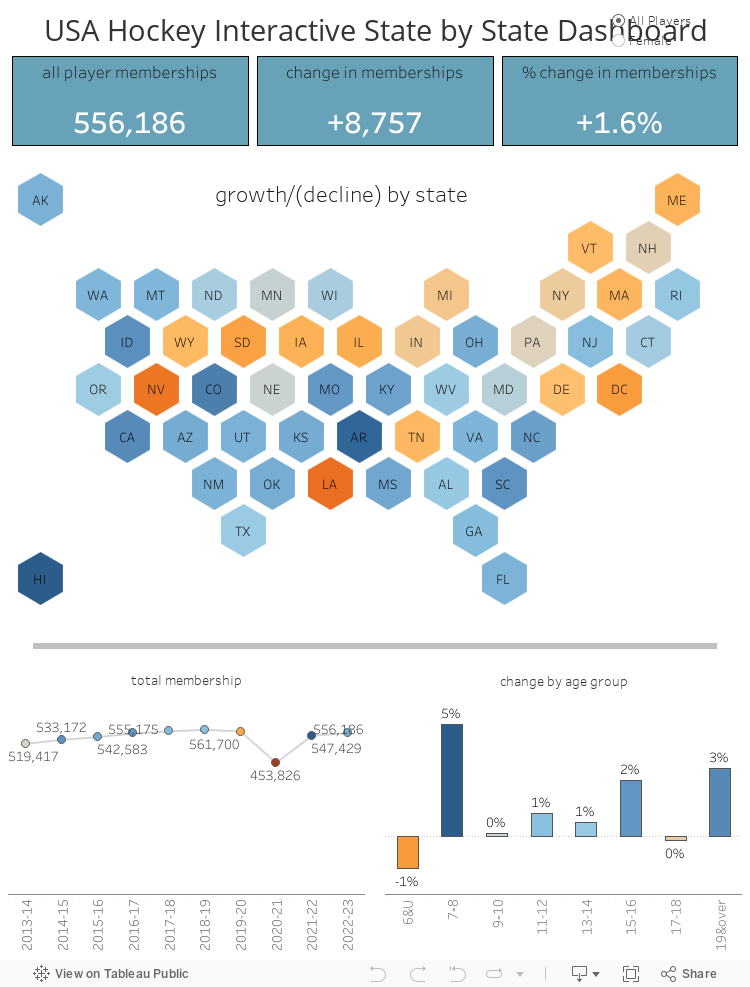
USA Hockey hit an all-time high in player memberships during the 2024-25 season, adding 13,396 new players compared to last year. That’s a stronger jump than the 8,282 gained in 2023-24, and it marks three straight years of steady growth. The sport is clearly bouncing back from the pandemic lull. For context, the previous record was 567,908 members back in 2018-19, the last full season before COVID disruptions, and we’ve now officially surpassed that milestone.
Youth numbers keep climbing
Youth hockey is setting records for the third year in a row. USA Hockey added 6,705 new youth members, bringing the 2024-25 total to 396,525—a new all-time high. In an era when youth sports overall are facing participation challenges, it’s exciting to see hockey bucking that trend.
Female participation keeps rising
Female participation continues to be one of the brightest growth areas for USA Hockey. The 2024-25 season saw 4,784 more girls and women register, a 5.1 percent increase year-over-year. That’s the largest non-pandemic bounce the female category has seen since USA Hockey began breaking out female-specific data. With sustained momentum like this, the pipeline for women’s hockey at all levels is getting stronger each year. You have to imagine that female participation will continue to increase as the rise and growth of the Professional Women’s Hockey League (PWHL) continues.
State-by-state highlights
Looking at where the growth is happening, two states really stood out this season. Florida led the country with an 8.4 percent increase in memberships, fueled by the Florida Panthers’ Stanley Cup win. Meanwhile, Utah posted the second-highest percentage growth, boosted by the buzz of the NHL’s arrival in Salt Lake City. It’s early, but the impact is already visible. With Utah Mammoth owner Ryan Smith publicly committing to growing the game at the grassroots level, Utah could be hockey’s next big expansion story.
Washington State
Washington added 711 new player memberships in 2024-25, a 5.8 percent increase over last season. That’s a healthy jump, and most of the growth came from youth hockey—467 of those new members were under 18. That said, the state continues to run up against a familiar roadblock: ice time. Since the Kraken opened Kraken Community Iceplex with three ice sheets back in 2021-22, no new rinks have been built, and most facilities are operating at or near capacity.
The Kirkland Kraken facility still appears to be moving forward, but with no shovel in the ground yet, it’s hard to imagine it opening before the 2027-28 season. Until then, Washington’s growth will likely be capped more by rink availability than by interest.
Explore the numbers yourself
As always, I’ve put together an interactive dashboard where you can explore USA Hockey membership by state, age group, or gender.
If you have questions, feel free to reach out—I love digging into the details.
The Seattle Kraken officially introduced Lane Lambert as the third head coach in franchise history with a press conference at Kraken Community Iceplex on Monday. Sitting side by side with new general manager Jason Botterill, Lambert said he was “ecstatic” about the opportunity and spoke at length about his plans for getting the Kraken back into contention next season.
“Being a coach in the National Hockey League is a privilege at any level, and being a head coach in the National Hockey League is an honor,” Lambert said. “It’s one of 32 positions, and I’m greatly honored to take this position. So thank you very much.”
Lambert, 60, is set to embark on his second stint as a head coach in the NHL after spending a season and a half as the bench boss of the New York Islanders from 2022-23 until being let go on Jan. 20, 2024. At the time of his firing, the Islanders were outside of the playoff picture but had a “winning” record at 19-15-11 (I say “winning” in quotes because they had lost a lot more than they had won but kept losing in overtime) after returning the Isles to the playoffs the season prior, following a miss in 2021-22. He then returned to an associate head coach role with the Toronto Maple Leafs last season, running the defense for head coach Craig Berube.
With the presser, Lambert has officially begun his time as the Kraken coach and got right to work Monday on sharing his vision for the group and his approach. Here are some themes from Lambert’s introduction to Seattle.
Structure and details
Playing a structured style and paying close attention to detail were recurring themes of the presser on Monday. Lambert’s commentary echoed what Botterill has said several times this summer about taking care of the important areas of the ice.
“We’ll be strong structurally, but we will also create offense, and we’ll play fast, we’ll be aggressive, we’ll be at the net in the offensive zone, we’ll shoot pucks,” Lambert said. “These are things that— if you look at the balance and you look at stressing offense or stressing defense, there’s both in there.”
Even in the midst of Seattle’s unsuccessful 35-41-6 season under Dan Bylsma in 2024-25, we could already sense that former GM and now president of hockey ops Ron Francis didn’t like the way the team was playing. Bylsma spoke on several occasions about giving players the freedom to play and make mistakes, a stark departure from how the group went about its business under previous head coach Dave Hakstol. It is now obvious that a coach’s ability to clearly articulate to Francis and Botterill how he would re-tighten the screws—particularly in Seattle’s end of the ice—was paramount in choosing a new coach.
With that in mind, and hearing Lambert and Botterill speak Monday, I understand why Lambert’s approach resonated with Seattle’s front office. His style is more similar to that of Hakstol—a coach who valued structure and detail—than that of Bylsma, who was willing to sacrifice some of that structure to attempt to create offense (though the Kraken really didn’t have the horses to outscore teams).
“Lane’s track record as a really good defensive coach, PK coach, is certainly there,” Botterill said. “And when we started getting into the details of it, we certainly saw that.”
Lambert also spoke about players having accountability and eliminating bad habits before they start.
“You set a standard and you don’t deflect from that standard, you don’t deviate from that standard. It’s an everyday thing. You do the same things every day, repetition, and if something isn’t right, you take care of it. You have to nip it. That is the key to the accountability. You can’t turn a blind eye and let something slide.”
Lambert has a reputation as a strong defensive-minded coach, so I do believe him when he says the Kraken will have better structure, which will theoretically make them a harder team to beat in 2025-26. Is that enough to get them back into the playoff picture, though? I still think that depends heavily on what kinds of personnel upgrades Botterill is able to make this summer, but Lambert fits the mold of what the front office was seeking.
Helping the young guns along
Another common theme Monday was that the Kraken see a need for a coach who will help their young players—and players coming up in the system—continue to progress once they reach the NHL level.
“It became very evident that Lane presented the attributes that we’re looking for,” Botterill said. “The combination of having a presence and knowledge to work with our veteran players, yet also be dedicated to interact with our young players for our organization to take the next step.”
Botterill clarified that he was specifically speaking about young players who are truly ready for NHL hockey and reminded us that developing junior players and prospects rising through the minor leagues is not Lambert’s job.
“We have young players in the National Hockey League that are clearly National Hockey League players in Matty Beniers, Shane Wright, and Ryker Evans. They’ve proven that they certainly can be here. It’s our job—our staff in Coachella Valley, led by Derek Laxdal, and our player development staff, led by Jeff Tambellini—to now prepare these players to be ready for National Hockey League games so that they’re ready to be inserted into the lineup.”
Still, the goal of this team has always been to build through drafting and developing. With the expectation of adding more young talent this offseason—both from outside the organization and within—this was clearly a focus in the hiring process as well. Potential arrivals of Berkly Catton, Jani Nyman, and others reinforce that direction.
Can players like Beniers and Wright become key contributors to a playoff-caliber team next season? Botterill and Francis clearly liked what they heard enough to hand Lambert those reins, though he will still have the support of Jessica Campbell, who Lambert reaffirmed will be back next season and will continue working with the young players.
Will the Kraken win in 2025-26 under Lambert?
It is true that Lambert has consistently been around winning teams, whether that’s as an assistant or associate head coach, and his time on Long Island was cut shorter than he perhaps deserved. And since he was let go, the Islanders haven’t exactly dominated; they ended up making the playoffs after Lambert was fired in 2023-24 but lost 4-1 in the opening round to the Carolina Hurricanes. They then missed the playoffs and finished sixth in the Metropolitan Division this past season, leading to Lou Lamoriello’s ouster.
I did ask Lambert what he learned from his previous head coaching gig and what he would do similarly or differently with Seattle.
“That’s a great question,” Lambert said (I couldn’t agree more… GREAT question). “You go through an experience like that, and you get let go, and you have a lot of time to reflect. And if you don’t have an ego, you can certainly say, ‘Gee, I’d do this a little bit differently, or I’d do that a little bit differently, or I’d do this about the same.’ I mean, from my standpoint, our defensive structure, the identity that we that had, the identity that we played with, I’m proud of that. There’s certain little things that I will look at and look into changing, but at the end of the day, I’m proud of what happened in New York.”
Looking back at how things have played out the last four Kraken seasons, Hakstol built a foundation of a team that played tight, structured hockey that could be competitive even without elite talent. Bylsma took a different approach, one that requires high-end offensive players (that he didn’t have) to be successful, and that didn’t jive with the mindset of the front office. So, now they will get back to having a tighter style of play, one that values defense first and looks to create opportunistic offensive chances.
History has shown (once) that the Kraken can win playing that way, and Lambert has proven he knows how to get players to go along with that strategy. Here’s hoping Botterill can bring in some skaters who will capitalize on the opportunities created by stouter defensive structure.
—
One last thought that has been rattling around in my brain over the last week. It’s impossible not to wonder if the Kraken were kicking themselves when news broke that Pete DeBoer had been fired by the Dallas Stars on Friday, one day after they announced Lambert as their hire.
But even if that news had broken a couple of days earlier, I’m not convinced DeBoer would have considered Seattle as his next landing spot, when he will surely have opportunities with teams on the precipice of winning in the near future. And who knows? Maybe the Stars were intentionally waiting to fire DeBoer until every vacancy had been filled (Pittsburgh was the other remaining open job, which had also just been filled by Dan Muse). Why they would do that, I’m not exactly sure, but the timing of DeBoer’s firing is interesting.
Regardless, that ship has sailed, and the Kraken will march ahead with Lambert. If we remove DeBoer from the conversation completely (since he really wasn’t expected to ever be a part of it), I think it is safe to say Lambert fits perfectly into the vision that Francis and Botterill have for the organization.
Will that vision finally start working in 2025-26?
Darren Brown
Darren Brown is the Chief Content Officer at soundofhockey.com and the host of the Sound Of Hockey Podcast. He is a member of the PHWA and is also usually SOH’s Twitter intern (but please pretend you don’t know that). Follow him @DarrenFunBrown and @sound_hockey or email darren@soundofhockey.com.
It’s no secret the Seattle Kraken’s future hinges on the growth of two young centers: Matty Beniers and Shane Wright. Both were high draft picks expected to become cornerstone players, and while their development paths have looked very different so far, each offers plenty of intrigue for fans playing the long game. Beniers jumped straight into a top-six role, won the Calder Trophy, and then, like many young NHLers, hit a bit of turbulence in his second season. Wright, meanwhile, has taken the scenic route, with some starts and stops in the AHL, World Juniors, and limited NHL time, leaving some fans wondering where exactly he stacks up against his peers.
So where are these two trending? And how do they compare to players drafted in similar spots? Let’s take a look at some early production metrics, with the full understanding that player development is anything but a straight line.
Data and methodology
Before we dive in, a quick note on how we’re measuring things. For this piece, we’re sticking to some good ol’ hockey basics: goals scored, points per game (PPG), and average time on ice (TOI). These are straightforward, digestible stats that give us a snapshot of how Matty Beniers and Shane Wright are progressing so far in their young NHL careers.
Now, we fully acknowledge there are far more advanced ways to evaluate player performance, things like expected goals, possession metrics, other impact models, and more. And those tools absolutely have value. But for this early career comparison, we’re keeping it simple. Why? Because sometimes it’s helpful to start with the surface-level numbers before diving into the more technical aspects of evaluation. These are the stats fans know, broadcasters talk about, and young players often get judged by (fair or not).
To create a relevant group of comparable players, I looked only at centers who made their NHL debut since the 2010–11 season and played 50 or more games before turning 21 years old. Breaking it down: 578 centers have debuted since 2010–11, but just 80 have hit that 50-game mark before their 21st birthday. With a few exceptions, this filter effectively narrows the list to the NHL’s best young centers over the past decade-plus, so even being average in this group is still very good.
It’s also worth noting that I’m not factoring in draft position for this analysis. While expectations are obviously higher for top picks, the goal here is to understand the kind of trajectory Beniers and Wright are on, regardless of the expectations attached to where they were drafted.
This isn’t a perfect science, of course. Player development is messy, and everyone’s timeline is a little different. Some guys get top-line minutes from day one; others marinate in the AHL or get eased in more slowly. But hopefully, this gives us a rough idea of where things stand today—and maybe where they’re headed next.
The analysis
Beniers has played 249 career regular-season games, and Wright has played 95. To look at different stages of development, I’ve broken the analysis into 50-game segments and used rate stats (like per-game production) where appropriate. This avoids nitpicking things like the one game Matty is short of a full 250, or Shane being five games shy of a full 100. The idea is to look at trends, not obsess over perfect math.
Points per game
The first metric we’ll look at is points per game. The visual I’m using is a box plot that shows the distribution among the 80 centers who met the criteria. The box plot breaks the data into quartiles, which helps us get a sense of where players fall relative to their peers.
As you might expect, Matty came out flying, his points-per-game metric in his first 50 NHL games was outstanding, with only a handful of centers posting better production. In games 51–100, though, his output dipped closer to the median of the peer group. That decline continued in the 101–150 segment, landing Matty in the second quartile. It’s worth pointing out that now that he’s in the 201-250 range, he’s still one of the younger players in that dataset.
To add context, I pulled the names of the five centers directly above and below Matty’s points per game in the 201–250 segment to see the types of players he’s grouped with.
Based on that group, you could argue there’s some reason to doubt if Matty will become the bona fide No. 1 center we all envisioned after his rookie season. But there are a few top-line guys in that range, so it’s certainly still in play.
Conversely, Shane’s points-per-game numbers in his first 50 games sit just above the average for this peer group. Then, in the next 45 games (remember, he’s only played 95 total), his production climbs close to the top quartile. It’s too early to throw a parade, but the trajectory is encouraging, especially when you see names like Sebastian Aho, Sam Reinhart, Robert Thomas, and Leon Draisaitl showing up around him.
Goals per game
Next up: goals per game, using the same box plot format.
Matty’s trend here mirrors what we saw with points per game. There’s a noticeable dip after his first 50 games, but an encouraging uptick in the 201–250 segment, where he jumps to the top of the third quartile. This recent bump in goal scoring also aligns with the arrival of Kaapo Kakko, giving him more offensive support.
Shane’s goals-per-game trend is similarly encouraging. He tracks a little higher than Matty in both of his segments, which is another good sign that he’s making the most of his limited minutes so far.
Time on ice per game
Out of curiosity, I also looked at average time on ice per game. This isn’t a perfect stat, since it doesn’t account for quality of minutes, special teams usage, or game situations, but it can be a loose indicator of how much trust a player has earned from the coaching staff.
What jumps out immediately is how low Shane’s ice time has been compared to Matty’s. We know Beniers has solid defensive metrics, which naturally makes him a candidate for more ice time in high-leverage situations—like when the Kraken are trying to protect a lead.
Under head coach Dan Bylsma, we saw late-game center deployments lean heavily on Chandler Stephenson, Yanni Gourde, and Beniers. That kind of trust doesn’t come overnight, and it shows where Matty stands in the pecking order.
Some key observations
Matty Beniers’ early career arc is actually pretty typical for young NHL centers. He burst onto the scene with a great first 50 games, but his production dipped in the 101–200 range—something we’ve seen from a lot of young players adjusting to more responsibilities. The recent jump in goal scoring in games 201–250 is a good sign that he might be finding his groove again, especially with more consistent linemates and offensive-zone usage.
Shane Wright’s trajectory is subtle but encouraging. While his overall NHL experience is limited, his per-game production puts him in strong company. The fact that he’s already tracking above average in points and goals in this peer group suggests there’s real upside here.
Usage really matters. Wright’s low ice time is the biggest contextual flag in this entire analysis. Less time means fewer opportunities to score, but it also reflects how the team is bringing him along—deliberately and patiently. Meanwhile, Beniers has been leaned on in all situations from the start.
Limitations of the analysis
Let’s be real for a second; no single stat (or even a bundle of them) can tell the whole story of a young player’s development. Ice time quality, linemates, team systems, special teams roles, none of that is captured in simple rate stats. Some guys get sheltered early, others get thrown into the deep end, some stick right away, and others bounce around before finding their footing.
And of course, development is not linear. A dip in production doesn’t necessarily mean regression; it might mean a new role, a rough patch, or just the natural learning curve of playing in the best league in the world.
The point of this analysis isn’t to define a player’s ceiling, it’s to offer a snapshot of how things are trending.
Wright and Beniers continuing on different paths
For a team still building its identity and core, having two young centers like Matty Beniers and Shane Wright developing side by side is a pretty good place to be.
The numbers tell us their paths are different; Matty got the fast start and is working through a midstream recalibration, while Shane had the slower start but is showing a clear upward trend. Both are holding their own among the NHL’s best young centers at this stage of their respective careers.
Whether either of them becomes a true first-line center is still an open question. But the foundation is there, and there’s every reason to believe that both players can be big parts of the Kraken’s long-term success.
Last week, we made the case that the Seattle Kraken have seven offseason priorities on the player personnel side that the team will look to address in free agency or through trades (or perhaps offer sheets?). In the days since that post, the Kraken stayed active, filling one of those needs by re-signing defenseman Josh Mahura to a two-year, $907,500 average annual value contract. The team also bolstered its depth by inking restricted free agent forward Ben Meyers to a one-year, $775,000 minimum contract.
What other opportunities in free agency and on the trade market will Seattle be considering? In today’s second part of our offseason feature, we’ll look at some candidates using Evolving Hockey‘s contract prediction model as a stand-in for market value.
Priority No. 1: The splash move
Seattle Kraken general manager Jason Botterill has noted that there is not much depth at the top of the 2025 unrestricted free agent market and implied that the Kraken would be hard at work on the trade front. That said, he conceded it is hard to know early in the offseason what trade conversations will actually materialize. Of course, it’s even more difficult for us to predict on the outside of those front-office conversations. Even so, here’s a list of unrestricted free agents, restricted free agents, and potential trade targets—deduced by logic or reports, usually both—that intrigue us.
We divided the list into four parts: “stars,” “first liners,” “rising young players,” and “veteran producers.”
Darren Brown shared in-depth thoughts on Mitch Marner last week. In short, while he’s not overly physical and more of a playmaker than a scorer, he is an elite talent, the likes of which rarely get to the open market. Seattle should be willing to go to an uncomfortable place contractually to acquire him. Unfortunately, I suspect Seattle may not be appealing to the player. (I devoted more of my thinking to the ways in which Seattle might be able to take advantage of Marner landing elsewhere.) The Jason Robertson case deserves separate treatment, and I’ll return to it at the end of this article.
There have been some rumors circulating that Martin Necas may prefer to land on a new team. I’m not sure I buy it. The system fits for Necas in Colorado, he has a good chance to win, and Colorado has incentive to pay him to “salvage” the Mikko Rantanen deal. That said, Wednesday’s Brock Nelson re-signing arched my eyebrow a bit. Necas is a talented offensive play driver with ties to members of the Seattle front office from mutual time in Carolina.
I went back and forth on including unrestricted free agent Nikolaj Ehlers as a target. I’m a believer in the talent, but he will command a seven-year deal, which means a team will be paying for an age 36 season—and on a price tag that could easily clear $10 million AAV given the scarcity of other top-end options. I’d be wary, but I can’t completely rule it out if his market comes in a bit lower than that. Similar to Marner, he doesn’t solve Seattle’s “issues,” but he carries enough talent to look past that.
The tier of players just below Ehlers, including players like Brock Boeser, John Tavares, or Sam Bennett, is the real danger zone in this market where the cost could get too high to offset the question marks. (Brock Nelson is in this tier and recently signed for $7.5 million AAV.) Absent an unexpected value, I’d steer clear of this area of free agency. Boeser, in particular, feels like a potential “fit,” but one I have real concerns about. Could it work out in the end if Seattle went that direction? Absolutely. But it’s not on my preferred list of options.
Marco Rossi is rumored to be on the market, as he and Minnesota are not seeing eye to eye on his next contract. Supposedly, Rossi wants a contract in the neighborhood of seven years, $7 million annually—which will be a middle-six deal in short order—but Minnesota isn’t convinced he has earned that yet. Rossi is a small-but-sturdy playmaker from the center position, unafraid to go to the middle of the ice, and with good play-driving impacts. I’ve considered if he could be a good line pairing with Chandler Stephenson—each compensating for the other in some ways.
For his part, J.J. Peterka is rumored to be unhappy in Buffalo (along with much of the remainder of the Sabres roster). He brings more of a dynamic speed, playmaking, and finishing package, with some shortcomings physically and on defense. There’s talk he could be an offer sheet target if the Sabres don’t work out a deal soon. His probable contract on an offer sheet sets the framework for the requested compensation parameters in a trade (first- and third-round picks). Even if the price is bid up slightly from there, Seattle has the assets to close that deal and should be involved.
One might have included Gabe Vilardi or Matthew Knies as targets in this category as well, but I didn’t consider them realistically attainable for the purposes of this exercise.
These moves may not qualify as a “splash,” though any of them could be considered a top-line player in Seattle. In particular, I like the idea of prying away Alex Tuch—another reportedly unhappy Sabre. He drives play with his physicality and his ability to get to the middle of the ice. He fits the mold of what Botterill says he is seeking. The downside is Tuch is signed for only one more season before unrestricted free agency, and the team would be looking at an extension starting in the player’s age 30 year.
If Vegas makes a splash in free agency (say, Marner?), it will likely need to subtract a useful piece or two. William Karlsson would be a good player for Seattle to catch on the cheap in that scenario, even though he is entering his post-prime years. Jonathan Marchessault is also a consideration on favorable terms only given his contract and age.
Priority No. 2: Restricted free agents
As we discussed in Part 1, these contracts are in the right neighborhood for Seattle to sign today, though we’d be open to a longer deal for Kakko. The Kraken started in on this to-do list item by signing Meyers earlier this week.
Kaapo Kakko (Photo/Brian Liesse)
Priority No. 3: Backup goalie
Assuming the team separates from Philipp Grubauer this offseason, one way or another, the team needs to add a capable NHL veteran who can pick up approximately 20 to 30 starts. Nikke Kokko had a good season in the AHL, but I don’t like the idea of rushing him into any NHL role at his age and experience level. One more season (or more) in Coachella Valley makes sense.
The best options in Seattle’s projected price range are Jake Allen, 34, and Alex Lyon, 32, and both are predicted to land multi-year deals according to Evolving Hockey. Both check in with approximately .900 save percentages over the last three seasons, though above-average numbers for goals saved above expected. Allen’s predicted two-year term is preferable. David Rittich, 32, is a top option predicted to land a one-year contract.
Priority No. 4: Top-nine winger
Trent Frederic rose on my free agent targets list the more Seattle spoke about prioritizing net-front play. He is the rare winger whose two-way playdriving value mostly comes from his willingness to work inside. Anthony Mantha is a big-framed winger with great playdriving analytics, but he is coming off surgery to repair a torn ACL in November, 2024, and it is unclear if he will be healthy to begin the season. There’s risk there but also the potential for huge value at Evolving Hockey‘s projection.
Andrew Mangiapane is smaller, but works well to the inside and gets many of his shots there. If his market is a bit weaker than anticipated, he could be a good pickup. (Fans may not like the option, though, given his history with the Kraken.) Victor Olofsson doesn’t bring the physical element but could be a value add, depending on Seattle’s other moves, for an underrated potential 20-goal scorer.
Priority No. 5: Third-pair defenseman
After our first post was published, the team addressed this need by signing our top target Josh Mahura. Mahura sat first on our board because his fit in Seattle and with the other players in the dressing room was established this past season. The deal represents strong value for the two-year term, with Evolving Hockey projecting $1.3 million AAV for a deal of that length. That said, even if the team also retains restricted free agent Cale Fleury, there could be room to add yet another depth defenseman with NHL experience.
The blue line in Coachella Valley lacks a veteran presence at the moment, with both Gustav Olofsson and Maxim Lajoie heading toward unrestricted free agency. Without another experienced player at the top of the depth chart, the group skews very young:
Even with Fleury, Coachella Valley projects to have only four of a possible six “veteran” status players. A No. 1 AHL defenseman who provides NHL depth would be a good add. Caleb Jones, a 27-year-old, left-shot blueliner with 248 games of NHL experience, could be an ideal fit on a one-year deal at or just above the league minimum.
Priority No. 6: Fourth-line center
This is the point in the list where needs downshift, and the team can be more patient and prioritize value. John Hayden, Ben Meyers, and Mitchell Stephens represent enviable center depth. In an ideal world, though, the team has a more established fourth-line center. Czech-born Radek Faksa has strong defensive impacts and is elite on the face-off dot. Nico Sturm’s profile skews a bit more toward offense, but he is also good on the dot. The goal is a one-year contract.
Priority No.7: Fourth-line winger
I’d be in favor of retaining Mikey Eyssimont, but this is a position where there is (understandably) significant depth in the free agent class. Seattle is best served waiting out the market and avoiding a bidding war. Ideally, this would be another one-year contract, near league minimum.
Bonus: An opportunistic move?
If the team wanted to layer in a defenseman above Josh Mahura who still has upside, right-shot Nick Perbix is a good target. He has size (6-foot-4), is a younger free agent (27 years old), and is a solid-average skater per NHL Edge. Perbix has learned in a good organization in Tampa Bay, and, most importantly, his on-ice impacts (in an admittedly sheltered role) are quite strong, per HockeyViz and Evolving Hockey. Jalen Chatfield was my preferred “defenseman nobody is talking about” heading into free agency last year, but he ended up re-upping with a smart organization in Carolina before he made it to free agency. I wouldn’t be surprised if the same thing happens with Perbix. If he gets to free agency and other moves don’t work out, he’s a name I have circled as an “opportunistic” add at Evolving Hockey‘s projected price tag.
Isaac Howard is another interesting player currently associated with the Tampa Bay Lightning. The unsigned former first-round pick excelled as a goal scorer at Michigan State last season but seems unlikely to sign with the Lightning after some burned bridges there. Ideally, he may not be ready to step into a full-time NHL role right away, but there’s a strong chance he’s a middle-six scorer within a year. I’m unsure there’s a fit in Seattle, though, because he’d likely want a guaranteed NHL role before signing, if a trade from Tampa Bay materializes.
Similarly, Nicholas Robertson is a player we’ve discussed on Sound Of Hockey before as a player with some talent who might be able to do more with a bigger role outside of Toronto. Again, I’m not sure of the fit with the Kraken unless the acquisition is in conjunction with other moves.
I was a big advocate for signing center Pius Suter two years ago as a hedge against losing Yanni Gourde and/or Alex Wennberg. He ended up sitting on the market for a long time before Vancouver picked him up on a bargain-basement two-year, $1.6 million AAV deal. We know how the center position has worked out for Seattle since then. For his part, Suter is entering free agency again, and, according to reports out of Vancouver, is looking for a deal north of $4 million AAV. This doesn’t make sense for Seattle unless they move one of their top three on the depth chart, but he’s still a good player at that price if other dominoes fall.
Speaking of Chandler Stephenson—who says no if Seattle and Vancouver discussed a one-for-one swap of Stephenson (and his six years, $6.25 million AAV) for Elias Pettersson (7 years, $11.6 million AAV)? I suspect both teams say no, but I admit I’ve thought about it more than once. Pettersson could be the cheapest “star” on the trade market if he regains his form, but his last year on and off the ice, along with Vancouver’s willingness to consider parting with him, are red flags that are tough to shake, particularly given his contract.
The Jason Robertson scenario
Finally, a word on Jason Robertson. His name entered the rumor mill on Monday with Jeff Marek speculating about his availability. Dallas is tight against the 2025-26 salary cap with only eight forwards signed, so it is not beyond belief that the team would consider moving one of its bigger pricetag players like Robertson, as even local coverage has speculated. (Marek has also suggested Dallas would like to sign free-agent, right-shot defenseman Aaron Ekblad, who will come with a significant salary.) On the other hand, 25-year-old point-per-game players rarely shake free, which makes this one a longshot.
Jason Robertson (Photo/Brian Liesse)
That said, if Dallas answers the phone on Robertson, this is the type of conversation Seattle should be prioritizing above any other.
Of course, a trade for Robertson would mean Seattle won a bidding war. The winger has only one year remaining at $7.75 million AAV, but he would still be a restricted free agent after that. Robertson is a regular-season star by any metric you could pick. He has, at times, drawn criticism for underwhelming in the playoffs, but his playoff scoring numbers are actually fine. Robertson is worthy of an uncomfortable “overpay,” and any player or asset should be on the table. (Shane Wright is the only close call on whether or not I would include him in a trade.)
Dallas could use some combination of (1) multiple entry-level-contract forwards with realistic near-term, top-nine potential, (2) a young, right-shot defenseman, and (3) high-end draft capital, since the team has only one first-round pick in the next four drafts. Dallas could also use the cap space that would be afforded by moving out an underperforming blueliner, like Matt Dumba or Ilya Lyubushkin.
Seattle has the draft capital to offer Dallas, with six first-rounders in the the next four drafts. It also has the cap space to absorb an additional bad contract.
On the other hand, the Kraken may not have the defenseman to offer unless a third team were involved (what would it take to get the Devils to part with Simon Nemec?). Ryker Evans, a left-shot, could work as a key piece, though he may be relatively more valuable to Seattle’s depth chart than he would be in Dallas.
In terms of forwards on ELC’s who are ready to contribute, Jani Nyman fits the bill. Parting with Nyman would be painful but may be necessary in a deal like this, particularly if Evans is not in it. Wright fits the description too, of course, but the package gets too costly, in my opinion, if Seattle is including him with other significant pieces. (Could Seattle get Isaac Howard out of his contract dispute in Tampa Bay for Seattle’s 2025 second-round pick and flip him to Dallas as part of a deal?) Eeli Tolvanen could be an additional piece of interest to Dallas, given his value contract for a 20-goal scorer.
* * *
If you’re the Kraken, do you bite the bullet and do a deal that sends one or more first-round draft picks and either Evans and a cheap top-nine forward or multiple cheap top-nine forwards for Jason Robertson? Or do you prefer a measured move for a top-six forward like the options set forth above? If not Robertson or the others, who would you like to the Kraken to go after?
Curtis Isacke
Curtis is a Sound Of Hockey contributor and member of the Kraken press corps. Curtis is an attorney by day, and he has read the NHL collective bargaining agreement and bylaws so you don’t have to. He can be found analyzing the Kraken, NHL Draft, and other hockey topics on Twitter and Bluesky @deepseahockey.
General manager of the PWHL Seattle franchise, Meghan Turner, faces probably the most critical stretch of her professional sports career as she shapes the foundation of her new team’s inaugural roster in the PWHL Expansion Draft. With a mix of high-stakes deadlines and strategic decisions looming, Turner and her Vancouver counterpart, Cara Gardner Morey, are officially on the clock as the Professional Women’s Hockey League enters expansion mode.
PWHL Expansion Draft timeline and rules
The path to building Seattle’s first-ever professional women’s hockey team begins with a three-phase process that will unfold over the span of just one week:
Tuesday, June 3: Protected player lists due
By 9 a.m. Pacific time on Tuesday, the six original PWHL franchises must submit a list of three protected players. These players must be either under contract for the 2025–26 season or have their playing rights held through that season. Once a team loses two players, whether through early free agency or the Expansion Draft, it will be allowed to protect a fourth player.
Wednesday, June 4 through Sunday, June 8: Exclusive free agency window
From Wednesday morning through Sunday afternoon, both PWHL Seattle and PWHL Vancouver will have an exclusive window to sign up to five unprotected or unsigned free agents from the original six teams. There’s no minimum number of signings required, but the ability to lock in a big free agent player ahead of the draft gives both expansion teams an edge at approaching the top available free agents.
Monday, June 9: Expansion Draft (5:30 p.m. Pacific)
The final milestone of the expansion window is the actual Expansion Draft itself, where each of the two new clubs will select a minimum of seven players, ultimately reaching 12-player rosters in total, including their free-agent signees. If one team signs fewer players than the other during the exclusive window, it will receive additional picks during the draft to reach parity. The selection order has not yet been announced.
This expansion structure ensures that every inaugural PWHL team will lose two players and that several standout talents will be exposed. Compared to the Seattle Kraken’s entry into the NHL in 2021, this PWHL expansion features added complexity: two teams drafting simultaneously. That dynamic will force Seattle and Vancouver to be strategic not only about whom they select, but also when they select each player.
Projecting the protected lists
To better understand which players may be available to Seattle, I reviewed predictions and analysis from respected women’s hockey media outlets, including The Hockey News’ Ian Kennedy, The Athletic’s Hailey Salvian, The Ice Garden, and Melissa Burgess’ Substack. These journalists have provided outstanding coverage of the league since its inception and offer informed perspectives on who each team is likely to protect.
I’ve watched a lot of PWHL and international games featuring these players but not nearly enough to provide my own evaluations of these players. Please check out these outlets and put them on a regular rotation.
Boston Fleet
Last week, it looked like Hilary Knight and Aerin Frankel were close to locks to be protected by the Fleet, with either Alina Müller or Megan Keller likely rounding out the third and final protected slot. But then Ian Kennedy tweeted this over the weekend…
The one item unconfirmed here is if Boston has protected Megan Keller. It’s possible Knight and Muller are both protected, but it’s not sounding that way. https://t.co/6C77fRVQkU
I’ve got to say, launching a U.S. franchise with an iconic Team USA name like Hilary Knight would be incredible—and could definitely help sway more fans into becoming season ticket holders.
Here’s a look at Boston’s Expansion Draft-eligible players and their 2024–25 season stat lines.
Minnesota Frost
Fresh off their second Walter Cup championship, the Frost are facing some tough decisions that could break up their title-winning squad. Kendall Coyne Schofield and Lee Stecklein seem like locks to be protected. After that, they’ll have to choose between Taylor Heise, Sophie Jaques, and goalie Nicole Hensley.
Here’s a look at Minnesota’s Expansion Draft-eligible players.
Montreal Victoire
The best team from the 2024–25 regular season will have a really tough choice ahead: which of four world-class players to leave exposed. It’s hard to imagine a scenario where Marie-Philip Poulin and Ann-Renée Desbiens aren’t protected, which likely means one of Laura Stacey or Cayla Barnes will be exposed. Either Vancouver or Seattle could walk away with a franchise cornerstone from Montreal.
Here’s a look at Montreal’s Expansion Draft-eligible players.
New York Sirens
The Sirens have finished last in both PWHL seasons so far. But despite that, they still have some intriguing players who will be left unprotected. Sarah Fillier is close to a lock. After her, goalie Corinne Schroeder is probably next in line; she posted a 10–8–1 record despite New York’s struggles and faced the most shots per game of any goalie in the league at 28.9. After Fillier and Schroeder, New York will likely have to choose between forward Alex Carpenter and defenseman Ella Shelton.
Here’s a look at New York’s Expansion Draft-eligible players.
Ottawa Charge
Ottawa has a tough decision to make in net. Emerance Mashmeyer is one of the top Canadian goalies in the league, but after she went down with an injury in early March, Gwyneth Philips stepped in and led the team into the playoffs. Philips never gave the net back and stayed hot all the way through the Walter Cup Playoffs, earning the Ilana Kloss Award as playoff MVP. Philips is now likely to be protected, as is forward Emily Clark. After that, there are several players who could make a strong case for the third protected slot.
Here’s a look at Ottawa’s Expansion Draft-eligible players.
Toronto Sceptres
Of all the teams, I’m probably most intrigued by Toronto’s protection list. Sarah Nurse, Daryl Watts, Blayre Turnbull, Renata Fast, and goaltender Kristen Campbell are all strong candidates—but only three can be protected on Tuesday. All five could be part of Team Canada’s Olympic roster for Milan-Cortina next winter. Both Watts and Nurse are from the Greater Toronto Area, and I can’t imagine they’d be thrilled about heading west if they end up exposed and drafted.
Here’s a look at Toronto’s Expansion Draft-eligible players.
Excitement builds
As we get closer to having an actual team, anticipation is growing among Seattle hockey fans eager to see which stars will don the PWHL Seattle jersey for the very first time. Based on the projected list of available players, Meghan Turner has a chance to build a competitive roster right out of the gate.
This will be a fun week for hockey fans in Seattle.