The lights went down in Climate Pledge Arena, and the first images of the pre-game show for the April 8 Kraken game against the Chicago Blackhawks appeared on the immense screens suspended over the ice. As fog was being pumped in from the rafters, the playing surface, with the help of carefully placed projectors, transformed into ominous ocean waves.
When the bone-rattling sound effects kicked in, Kraken Vice President of Game Experience and Production, Lamont Buford—from his perch atop section 117—noticed a split-second delay in the timing of the audio starting. “We were almost late on that one,” he said, before feverishly scribbling down a note on his 30-page show script.
The night before that Saturday game, Buford left team headquarters at Kraken Community Iceplex in the evening to have dinner with his wife. He then returned to the office and worked from 8 pm to 1 am, and was at Climate Pledge from from 10 am until 10:45 pm on gameday. And Buford’s team works just as hard as he does.
“Those who are crazy enough to be a part of the game presentation world, they get it, they have a passion for it, and they love it,” he said.
As fans, we tend to assume everything happening at a pro sporting event is done magically. We don’t think about the teams of people working tirelessly behind the scenes to put on a memorable spectacle, dictating what we see, hear, feel, and even smell during the course of the game.
So how does it all happen? Through diligent planning, careful orchestration of a highly skilled and driven team, and intense attention to detail.
Sound Of Hockey went behind the scenes with Buford and several members of the Kraken game experience team to get a feel for how all the pieces sync together.
Innumerable moving parts
Producing a sporting event is a unique challenge. “It’s a theater play, it’s a broadcast, and it’s a live event, all wrapped up in one,” said Buford. Producing a Kraken game at Climate Pledge Arena, one of the most technologically advanced arenas in the world, is even more demanding than doing so in older buildings.
Think about that pre-game show you’ve seen before Kraken games this season. Of course, there’s the cinematic hype video that plays on the two identical scoreboards, but that’s only part of the sensory experience for the audience. There’s also music, sound effects, lighting effects, on-ice projections, graphical displays on the LED ribbons that line the facades of the upper levels, and live public address announcements.
The producer and associate producer oversee the pre-game show from atop section 117. (Photo/Darren Brown)
Those elements have all become fairly standard in today’s NHL. But the Kraken pre-game show takes the presentation a couple steps farther with the arena’s added bells and whistles. A massive neon-embossed tentacle—which team staff have nicknamed “Stella” after Stella’s Deli, a commonly visited lunch spot for the organization in its infancy—descends from the rafters, while the curtains at the north end of the arena serve as a colossal movie screen for the mythical seafaring beast stirring from its slumber.
That is a lot of different components to monitor and cue for perfect timing, and this is just the pre-game show. There’s still a three-hour hockey game to produce, with in-game contests, intermission shows, a house band, a live organist, an ice crew, two DJ’s, and a mascot.
The show takes Buford, his team of 13 full-time employees, and a bevy of part-timers and contractors to execute.
A well-oiled machine
How it all gets managed starts with the structure of the department that Buford helped put in place during Seattle’s inaugural season. For each game, there’s a producer—either himself or Senior Manager of Entertainment Experience, Caitlin Salemi—“calling” the game. Then there’s an “associate” producer that serves as the right hand for the game caller and helps relay information between the off-ice officials and public address announcer, Chet Buchanan.
Kraken public address announcer Chet Buchanan announces Eeli Tolvanen’s goal against the Blackhawks. (Photo/Darren Brown)
The “associate” role is filled on any given night by either Salemi or Buford, whichever is not producing the game, or by Nicole “Shabz” Shabaz, who has expressed interest in one day becoming a producer. On games when Salemi is the producer and Shabaz is the associate producer, Buford is free to roam the building and check in on his staff to uncover any unforeseen challenges.
The producer, associate producer, and Buchanan all work from a platform above section 117, so they can see and hear all elements of the game presentation in real time and feel the atmosphere the same way the crowd feels it.
During a game, there is a lot for the producer to juggle, from managing the script to supervising communications between the various teams. Buford praised Salemi for the polished product she has consistently delivered under the pressure of that high-stakes role.
“One of the best things that we were able to do was hire Caitlin,” Buford said. “[She spent] 12 years in the minor leagues [with the Rochester Americans], but actually as the director calling games, calling shows, so she knows what she’s doing… She has been, honestly, just a rock for us.”
Inside the control room at Climate Pledge Arena. (Photo/Darren Brown)
The crew at the top of section 117 is just the tip of the iceberg. There’s also a team of up to five “stage managers,” who are in the trenches and executing more of the hands-on work. They’re the ones picking people out of the crowd for promotional games and telling participants and in-arena hosts when to walk, when to smile, and when to wave for the cameras.
Meanwhile, in the bowels of the building, there’s a full state-of-the-art control room that is outfitted and staffed like a television news station. It’s in that room that the video seen on the big screens comes to life. So, everything you see on the twin scoreboards—the live game footage, instant replays, and graphics—is cued from that room.
“This room here is beefed up way more than just about any arena in the country with the coverage that we have,” Buford proudly proclaimed, as he surveyed the control room.
High above the playing surface in the press bridge, there are also four rooms dedicated to the game presentation staff; one for the LED ribbon and on-ice projection operators, one for sound control, one for the lighting in the building, and one for DJ Trunks and DJ Cide, the two men responsible for elevating the atmosphere musically throughout the night.
Buford oversees it all but finds peace in knowing he has the right people in place to handle all of their highly specialized tasks.
Building from scratch
Drawing on his past experience with the Arizona Coyotes, St. Louis Blues, and Hershey Bears, Buford knew building the in-game show from scratch would require additional staffing and would present rare hurdles.
“It’s also COVID, so you don’t have that time to kind of come in and think about ‘Ok, this is the office setup, this is what I need to make sure I have,’” recalled Buford. “You’re doing everything off a piece of paper, a drawing. And you’re just trying to build the team. Most of the team is coming in from out of town, so it was one of those things that was very different in that regard.”
With the added complexity of the pandemic, the Kraken intentionally hired backups for as many roles as possible to make sure they always had coverage in areas that couldn’t be easily replaced on a given gameday.
“When I got [to Arizona], one of the things I was tasked with was revamping everything,” said Buford. “And the good thing was you already had established people in key areas, so change wasn’t very hard. Everybody was able to adjust and adapt easily. When you’re in another place that’s established, you know where the staplers are, you know where the Sharpies are. Here, we didn’t know where anything was. We had to bring all that in.”
With the framework in place for the team’s second season, and with the restrictions of COVID mostly lifted, things got a bit easier for Buford’s team to enhance the experience into something truly special for the fanbase.
One of the best shows in the league
A lot of the additional staffing remained in place during the 2022-23 season, and that has helped the Kraken’s in-game show become one of the best in the NHL. Buford, who says he is his team’s harshest critic, ranks Seattle’s show in the top three with Tampa Bay and Vegas.
When he wasn’t monitoring the show from the stands, Buford displayed an almost mayoral quality strolling around the CPA concourses that evening, fist bumping dozens of passersby; “I know just a few people here,” he deadpanned. During a Kraken game is when Buford actually gets to enjoy the fruits of his and his team’s labor, but it’s only a fraction of the work done each day by his department.
“Everybody knows about Vegas,” Buford said. “It’s always kind of that thing where everybody is like, ‘You gotta do better than Vegas.’ Vegas is so unique, you can’t take that show anywhere else.”
Knowing the local Seattle market, the Kraken intentionally went in a different direction from what the Golden Knights created, instead choosing to build their own unique identity. That approach has worked wonders, and what fans encounter inside Climate Pledge Arena is unlike anything else in sports.
Fans seem to have picked up the baton and run with it. The crowd itself is a key part of the experience, bringing a festive ambience every night, and Kraken CEO Tod Leiweke knows that’s an essential piece of the puzzle.
“We think there’s an upside, but the best thing we have in that building isn’t the bricks and mortar and lights or sound effects,” Leiweke said on a recent Zoom call. “It’s really our fans. And they have been awesome from day one, and they are loud. I think our players feel it, and I just can’t wait [for the playoffs].”
A new look for the playoffs?
For as good as the game experience is already, Buford and his team are just getting started. With the Kraken in the playoffs for the first time, they have big things planned, including a new pre-game show and a plaza party outside the arena.
“We’re pretty satisfied that we’ve got a great game experience going on now,” said Leiweke. “But I’m also really happy that our team doesn’t rest on any laurels here. We want to push it. We’re going to have a new open for the playoffs and we’re just going to keep pushing.”
Some of the additional promotional material that has been added to the outside of Climate Pledge Arena for the playoffs. (Photo/Darren Brown)
If you’re wondering whether the Kraken will host any gatherings on the north end of the building, where fans can see in through the windows, that is unlikely. The area on that side isn’t as large as it is on the west and south sides of the arena, it’s a bit disjointed with different levels, and it doesn’t get nearly as much foot traffic.
Plus, at this time of year, with the sun still out at the start of the game, the team feels the need to close the curtains anyway to avoid glare on the playing surface. Buford said they tried to keep the curtains open recently, and they immediately started getting complaints relayed to them from players. “Hockey players are very particular. If they get that extra beam of light, they’re like, ‘I can’t see a thing.’”
So, if you’re hoping to catch a glimpse of playoff hockey from outside Climate Pledge Arena, you may have to settle for watching it on a big screen with several hundred of your closest friends.
For fans who are lucky enough to be inside the building, the game presentation team should have a nice treat for you. They will be ready to show off their latest spectacle, after putting in hundreds of man-hours to build an experience that matches the intensity of the on-ice product of the Stanley Cup Playoffs.
—
Editor’s Note: We would like to extend a sincere thank you to Lamont Buford and his team, as well as Kraken PR, for allowing Sound Of Hockey to shadow the game presentation department during the game on April 8.
Darren Brown
Darren Brown is the Chief Content Officer at soundofhockey.com and the host of the Sound Of Hockey Podcast. He is a member of the PHWA and is also usually SOH’s Twitter intern (but please pretend you don’t know that). Follow him @DarrenFunBrown and @sound_hockey or email darren@soundofhockey.com.
Welcome to Kraken Takeaways, a new video series hosted by our own John Barr and Darren Brown. Our plan for this series is to post new videos after each Kraken playoff game (assuming our schedules allow it), breaking down the previous contest with a rundown of topics.
We won’t post every video here on soundofhockey.com, so to ensure you see all of them, please subscribe on YouTube. Let us know your thoughts in the comment section on YouTube, or on this post.
Here’s our first installment, “Kraken Takeaways – Kraken versus Avalanche Game 1.”
What a way for the Seattle Kraken to welcome their fans to the Stanley Cup Playoffs for the first time, pulling off a huge 3-1 win over the Colorado Avalanche. The Kraken got off to a hot start, bent but didn’t break, and took advantage of an excellent 34-save performance by Philipp Grubauer to earn their first postseason victory.
We said in our Game 1 Preview the Kraken would need four close-to-perfect performances in this series to get by the Avs. Their Game 1 was pretty darn close to perfect.
“It’s playoffs, it’s a lot of fun,” said Alex Wennberg. “It’s a different game, but right now, I mean obviously we’re happy with this. We’re still going to look at it, see what we can do better, but I mean there’s a lot of good things here.”
Here are our Three Takeaways from an unforgettable opening foray into the playoffs, a 3-1 Kraken win over the Avalanche.
Takeaway #1: Fast start and team defense lead to success
Seattle’s players jumped out of the blocks fast, getting themselves quickly engaged with physical play and hard forechecks. Just 3:26 into the game, Oliver Bjorkstrand and Yanni Gourde closed in on Devon Toews behind Colorado’s net. Toews panicked and coughed the puck up to Eeli Tolvanen, who shot, got his own rebound, and scored the first goal of the series.
Eeli Tolvanen capitalizes on the Avalanche turnover to break the ice for the Kraken just 3:26 into the game!#SeaKrakenpic.twitter.com/YcTtbb8nP0
— Hockey Daily 365 l NHL Highlights (@HockeyDaily365) April 19, 2023
It was that same line of Tolvanen, Gourde, and Bjorkstrand that was tasked with shutting down Nathan MacKinnon and Mikko Rantanen, and they mostly succeeded on this night. The lone goal against came after an icing, when coach Dave Hakstol couldn’t get the full group out there, and MacKinnon found Rantanen at the goalmouth soon after the face-off.
Still, the plan against a team like this—one that has so much high-end skill at the top of its lineup—should be to minimize the damage of those elite players.
“We’ve just got to clog the middle of the ice and make sure they take their chances from the outside,” said Gourde. “[We did] our best to manage the play, but I think overall we did a pretty good job tonight.”
One goal against from Rantanen and nothing from the rest of the roster is a pretty darn good night.
Takeaway #2: Sound Of Hockey bump for Alex Wennberg?
We talked to Alex Wennberg for the latest Sound Of Hockey Podcast, and he went out Tuesday and scored a goal and an assist to lift the Kraken to a historic win. Coincidence? Most certainly yes.
BUT… It was an exceptional performance by Wennberg, nonetheless. The Gourde line opened the scoring and then babysat MacKinnon and Rantanen the rest of the game. Wennberg and his linemates took care of the other offensive duties, showing yet again why this Kraken team is dangerous.
Early in the second period, with the score tied 1-1, Jamie Oleksiak sent a quick-up pass to Jaden Schwartz at the far blue line. Morgan Geekie drove toward the net and took Bowen Byram out of the play. Schwartz laid a perfect pass into the wheelhouse for Wennberg, who caught it and shot it in one motion, beating a clumsy-looking Alexandar Georgiev.
Alex Wennberg gives the Kraken the lead once again! 🎯
Watch the 2nd period of Game 1 between the Avs and Kraken live on Sportsnet. 📺 pic.twitter.com/ALWr5ECKC4
“It’s a great play by Schwartz right there,” said Wennberg. “I think we moved the puck up— I mean, obviously in the playoffs like this, you’ve got to take advantage of the opportunities. For me, I was just trying to shoot the puck, and I got rewarded. It’s great to help the team out, for sure.”
Wennberg wasn’t done there. In the third period, with Seattle holding a one-goal lead, it was that same forward line that effectively put the game away, and Wennberg was again a key factor. Justin Schultz rimmed the puck deep, and it looked like it was going to be turned over to Josh Manson. But Wennberg got in on the forecheck and took it right back, then quickly spun it out to Geekie in front. Geekie rifled it past Georgiev and made it 3-1.
You never know which forward trio is going to carry the mail on a given night for the Kraken. The Jared McCann/Matty Beniers/Jordan Eberle line was held off the scoresheet in this game, but it didn’t matter, because the Wennberg line was cooking.
You know what? Now that we think about it, the Wennberg successprobably was because he did a podcast interview with us this week.
Takeaway #3: Philipp Grubauer loves playing against the Avalanche
There really is something about Philipp Grubauer playing against his former team. He was outstanding again Tuesday, stopping 34 shots, including several Grade-A opportunities in the second and third periods.
Just watching Grubauer play, you could tell he was confident and tracking the puck well from the jump. We’ve heard him say in the past that “sometimes the puck just hits you,” and Tuesday was one of those nights when—even if it looked like a sure goal—the puck would either find a way to hit him or deflect up and over the net.
“He did a great job today,” said Wennberg. “He’s making some big saves to keep us in the game, and I mean that’s what we need right now. So we’re really happy with him.”
For the Kraken to get through even one round of the playoffs, they need Grubauer to be on top of his game. He was excellent Tuesday in a contest he may be able to use as a jumping-off point for a successful run.
In four appearances against Colorado this season, Grubauer now has a .942 save percentage.
Darren Brown
Darren Brown is the Chief Content Officer at soundofhockey.com and the host of the Sound Of Hockey Podcast. He is a member of the PHWA and is also usually SOH’s Twitter intern (but please pretend you don’t know that). Follow him @DarrenFunBrown and @sound_hockey or email darren@soundofhockey.com.
As we in the Seattle hockey community continue to think of Andy Eide, we also eagerly anticipate the first appearance in the Stanley Cup playoffs for the NHL’s 32nd franchise. During the inaugural Kraken season, Andy often wrote pre-game “Enemy Reports” for Sound Of Hockey, so we thought it was a good time for a reboot of that series.
More than just another organization “first,” this trip to the playoffs feels similar to the inaugural Kraken home game–a culmination of tireless efforts and the realization of countless dreams. We wish Andy were here to tell us all about it, but there’s no better way to dive into the playoffs than with a concept he came up with in the first place.
Just after 7:00 pm Pacific, the Kraken will find themselves staring down the defending champion Colorado Avalanche across the face-off circle. The last player to touch his stick to the ice before the puck drops will almost certainly be Avs superstar Nathan MacKinnon. His presence looms large in this series, and his ability to produce could very well dictate how it plays out.
Snapshot: Kraken vs. Avalanche
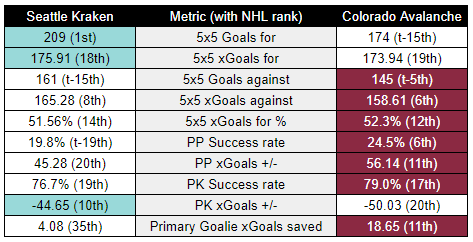
Superficially, the Kraken and Avalanche can look similar on paper. Colorado ended with 109 standings points and Seattle took 100. Per Evolving Hockey statistics, the Kraken are 18th in expected goals for at five-on-five and the Avalanche at 19th. The Kraken are eighth in five-on-five expected goals against and the Avalanche are sixth. Neither fares well on the face-off dot. Both do well controlling transition play. Both are middling on the penalty kill. The Avalanche have the more efficient power play, ranking sixth in conversion rate, whereas the Kraken rank tied for 19th. But the Kraken have fared better in five-on-five scoring, ranking first compared with the Avs, who are tied for 15th. It looks close.
Yet, when we dig a little deeper, we find two teams that stand in stark contrast, both in terms of how they are built and how they navigated the regular season.
The Avalanche ended the season in familiar rarefied air: first in the Central Division and tied for second in the Western Conference. But it did not start that way. The Avalanche began slowly by their standards, hampered by injuries.
On March 5, 2023, the Avalanche lost to the Seattle Kraken 3-2 in overtime when a Yanni Gourde snap shot became a memorable game winner. At that time, the Avs stood at just 34-21-6.
Since then Colorado has been a runaway boulder down hill–an Avalanche, if you will. The Avs went 17-3-1 to finish the season, taking full advantage of a weak stretch of opponents and holding their own against playoff teams, going 4-2-1 against postseason qualifiers. The Avs are third in goals for percentage (GF%) and fifth in expected goals for percentage (xGF%) since March 5, and no team has scored more goals on the power play during that stretch than the Avs (20).
During the same timeframe, Seattle’s pace plateaued. The Kraken tallied a record of 10-7-2 and accumulated most of their points against weaker competition. Seattle went just 1-6-1 against playoff teams, with the one win being Larsson’s overtime golden goal in Dallas. Under the hood, the shot metrics continue to be solid enough; Seattle is ninth in GF% and seventh in xGF%. But it is hard to ignore that Seattle has not beaten a 2022-23 Stanley Cup Playoff team in regulation since Jan. 12. In these tougher matchups, where one goal can make all the difference, Seattle has struggled in Andre Burakovsky’s absence.
Take the number: Avalanche players to watch
As I’ll breakdown further below, the Colorado Avalanche will go as far as superstar forward Nathan MacKinnon (No. 29) can take them. MacKinnon had 42 goals and 69 assists in just 71 games this season, surpassing the 100-point threshold for the first time as a 27-year-old. And he has typically elevated his production in the postseason. Since making his debut in the Stanley Cup Playoffs in 2014, he has played in 70 playoff contests, tallying 41 goals and 52 assists. With 93 playoff points, he leads all Colorado skaters and ranks fifth in the NHL during that span.
Mikko Rantanen (No. 96) somewhat quietly scored 55 goals for Colorado on MacKinnon’s wing this season. Adding in fifty assists, he too topped 100 points for the first time in his career at 26 years old. He and MacKinnon give Colorado two of only 11 players in the NHL to top 100 points this season and a potent one-two punch at the top of the lineup. Rantanen piled up 20 assists and five goals during Colorado’s Stanley Cup-winning run last season.
Remarkably, the most talented player on the Avalanche might not be MacKinnon or Rantanen but Cale Makar (No. 8). The 24-year-old blueliner piled up 66 points in 60 games this season. Makar can skate, creatively make offense, and finish as well as a top-tier forward while also keeping his defense above par. He led the reigning champion Avalanche with 29 points in 20 games in the playoffs last year. The only question on Makar coming into this series was health, but it sounds like he should be ready to go in the first round against Seattle.
Visualization by HockeyViz
Valeri Nichuskin (No. 13) is 6-foot-4 power forward who bulldozed his way through competition in the 2021-22 Stanley Cup Playoffs en route to 15 playoff points, fifth on the team. Artturi Lehkonen (No. 62) is a strong defensive player who also scored 21 goals this season. Devon Toews (No. 7) scored 50 points from the blue line and would qualify as a bona fide No. 1 defenseman on most teams lacking Makar.
Missing from the lineup, though, is Gabriel Landeskog (No. 92), a top-line player and Colorado’s captain. He was fourth on the team in playoff scoring last season, tallying 11 goals and 11 assists across 20 contests. Landeskog is not expected back this postseason.
Finally, in net for Colorado will be Alexandar Georgiev (No. 40). A smaller stature goaltender like Philipp Grubauer, Georgiev has had a productive season, posting above-average numbers against all varieties of shots–close and from distance, slap shots, wrist shots, and deflections. His 19 goals saved above expected put him just outside the top 10 goalies in the league, per Evolving Hockey.
Key to the series: matching Nathan MacKinnon’s line
The Colorado Avalanche are a different team when MacKinnon’s line is on the ice. In particular, MacKinnon’s ability to drive play into the offensive zone, create scoring chance volume, and improve the probability that his teammates finish scoring chances by delivering pin point, high-danger passes put him in the small handful of superstar players in this league.
With elite scorer Rantanen attached to MacKinnon on his right wing, Colorado generated 81 goals in 1191 minutes of five-on-five time with MacKinnon on the ice (4.08 goals per 60 minutes). During that time, Colorado generated 26 percent above-average shot quality.
Visualization by HocekyViz
What happens to Colorado’s offense when MacKinnon (and usually Rantanen) are off the ice? Half of its offensive potency simply vanishes. The team struggles to generate scoring chances five-on-five, registering shot quality 7 percent worse than league average. And even more troubling than that, Colorado’s remaining lines have lacked the finishing skill and creativity to turn the chances they do get into goals. In 2753 minutes without MacKinnon on the ice at five-on-five, Colorado has generated just 93 goals (2.02 goals per sixty minutes).
Visualization by HocekyViz
This lack of depth scoring is in contrast with the 2021-22 Stanley Cup winning Avalanche team. Last season, Colorado was similarly productive with MacKinnon on the ice, scoring 3.96 goals per sixty minutes at five-on-five. But the team’s middle-six scorers were able to keep the boulder moving when MacKinnon was on the bench. The 2021-22 Avalanche scored 130 five-on-five goals over 2862 minutes without MacKinnon on the ice (2.73 goals per sixty minutes).
Injuries (Gabriel Landeskog) and free-agent departures (Nazem Kadri, Burakovsky) have shortened the offensive lineup this year. All of this leaves Colorado much more reliant on MacKinnon, both at even strength and on the power play, where his isolated impacts improve Colorado’s scoring chances by 8 percent according to HockeyViz.
Colorado recognizes its scoring limitations with MacKinnon off the ice and compensates by playing more conservatively to avoid scoring chances against. The Avalanche tighten up the defensive structure, and look to slow down opposing rush chances, particularly through the neutral zone and at the blue line. When MacKinnon is on the ice, Colorado is willing to live with the risk that its aggressive rush offense and forecheck will yield some counter-strike offense. The team concedes shot quality 2 percent worse than average with MacKinnon on the ice, shots worth 2.63 xG per sixty minutes at five-on-five.
Visualization by HocekyViz
With MacKinnon off the ice, Colorado suppresses opponent shot quality 12 percent better than average and yields just 2.27 xG per sixty minutes. For reference, this is similar to the defensive work done by the Kraken at five-on-five overall.
Visualization by HocekyViz
For these reasons, how the Kraken matchup against MacKinnon’s line is one of the key strategic questions I have going into this particular matchup. While in Colorado, the Kraken will not have the benefit of the “last change,” of course. But “last change” often receives undo emphasis given that the majority of line matchups come during the run of play anyway, rather than after stoppages. Coaches can push play toward specific matchups regardless of the arena.
If I were in Kraken coach Dave Hakstol’s shoes, I’d be looking to get a lineup on the ice that is strong defensively, but also capable of counterpunching with transition offense after successfully disrupting the MacKinnon line into a turnover. That potential for offensive production is important because Colorado tends to make itself most vulnerable and cheats in favor of offense when MacKinnon is circling the offensive zone.
Alex Wennberg’s line has taken the toughest matchups for much of the season. But I do not believe the current version of the Wennberg line is a good candidate to match MacKinnon’s group because it lacks the offensive firepower to make Colorado pay for its overcommitment to offense. Burakovsky’s absence hurts there.
Instead, to the extent it can be managed, I would put out Jared McCann, Matty Beniers, and Jordan Eberle as the forward grouping to combat MacKinnon during “on the fly” changes, along with the Vince Dunn and Adam Larsson defensive pair. The forward group is sound defensively. And then McCann and Beniers, in particular, can produce with speed on the counterattack, particularly when supported by Dunn. Then, if there is a critical defensive-zone draw, I would lean toward the Eeli Tolvanen-Yanni Gourde-Oliver Bjorkstrand line matching MacKinnon, given Gourde’s superior production obtaining possession off the draw and that group’s strong defensive play.
These groupings are unlikely to outproduce MacKinnon’s line, but if they could limit the goal deficit, it would give Seattle’s depth scoring a chance to turn the tide. It could be the key to the series.
Prediction time
“This is it, the most lopsided series of the opening round.” – The Athletic
Here we go, folks! Game 1 of the first playoff appearance in the history of the Seattle Kraken has arrived. The boys in deep-sea blue are in Denver to take on the defending Stanley Cup champs, and nobody is giving them a chance. There are certainly reasons to fear this Colorado team, but we’ve liked this potential Avalanche matchup for the Kraken for some time.
Still, for the Kraken to get through this opening round, it will take a close-to-perfect performance for four out of seven games. The Kraken will need to limit the damage done by Avalanche superstars Nathan MacKinnon, Cale Makar, and Mikko Rantanen, and they will need to have their balanced scoring show up, as it has for most (but not all) of the season.
Let’s dig into the storylines surrounding Game 1 of this intriguing series and consider what Seattle is facing.
Storylines
Daniel Sprong injury woes
It’s no secret Seattle’s depth is its biggest strength. Sure, there is a 40-goal scorer on the top line in Jared McCann, but realistically, the Kraken have two second lines and two third lines (or three second lines and a third line, depending on how you want to slice it). The Kraken do not beat teams by having their top trio take over games. Instead, they win by attacking in waves with all four lines, and when the right matchup presents itself, any of the four can break through on a given night.
A huge piece of that depth scoring this season has been Daniel Sprong, who racked up 21 goals and 25 assists while playing exclusively in a fourth-line role and mixing in as a power-play specialist.
He missed practice both Saturday and Sunday, and coach Dave Hakstol called him day to day. The team listed Sprong in their injury report Monday and called up Tye Kartye from the Coachella Valley Firebirds for the first time in his pro career.
We are hopeful Kartye’s recall is just insurance in case Sprong can’t go, but if Sprong is out, that would hurt Seattle’s chances in Game 1 and perhaps Game 2. Aside from adding to the team’s five-on-five offensive prowess, Sprong has been one of the main reasons for Seattle’s recent power play improvement. Playing on the left half wall, Sprong has brought a mix of creativity and a wicked shot to the second unit.
At Sunday’s practice, the second unit had been shuffled around a bit, with Yanni Gourde serving in the middle “bumper” role, with Oliver Bjorkstrand moving from the bumper spot to Sprong’s usual spot on the left wall.
Tye Kartye up with the big club
If Sprong can’t go, we’re curious to see if Kartye will make his NHL debut in Seattle’s first ever playoff game or if Hakstol will go with the more known quantity in Jesper Froden. Froden has played 14 games with the Kraken this season, and although he hasn’t been a liability for Seattle, he also hasn’t produced much offensively. The 28-year-old winger has four assists and zero goals at the NHL level after notching 25 goals and 22 assists in 44 games in the AHL.
Kartye, meanwhile, is an interesting story. After going undrafted, Seattle signed him as a free agent from the OHL’s Soo Greyhounds. Kartye was invited to Kraken training camp in 2021 and made a good impression, then went back to Sault Ste. Marie for his 20-year-old season and amassed 45 goals and 34 assists in 63 games. That landed him a three-year entry-level deal.
In his first pro season with Coachella Valley, Kartye has caught fire in the second half and blossomed into one of the Firebirds’ best players. He was named the AHL’s rookie of the month for March with 11 goals and six assists in 15 games. With 57 points on the season, Kartye is also strong candidate for rookie of the year in the AHL.
It would be a big ask to thrust a 21-year-old rookie into the Stanley Cup Playoffs without any NHL experience or practice with the Kraken. But if Sprong can’t play, and Hakstol is hoping to keep an offensive punch from his fourth line, Kartye may be seen as a better fit for the role than Froden.
UPDATE: Sprong did skate at morning skate today, according to our good friend, Piper Shaw.
A month ago, we loved the idea of Seattle playing Colorado in the first round, largely because the Kraken had matched up well with the Avalanche during the season. Seattle went 2-0-1 in its three games against the Avs, and Philipp Grubauer showed good confidence in all three of his outings against his former club.
The most recent win came on March 5, a memorable overtime victory that culminated in a Yanni Gourde breakaway, after Vince Dunn hit him with an exquisite stretch pass.
Things have changed in the last month, though. Seattle got it done against bad teams in the home stretch, but since losing Andre Burakovsky just after the All-Star break, the Kraken have not beaten any playoff teams in regulation.
The Avs, meanwhile, have found their championship mojo that seemed to be missing in the earlier stages of the season. They had a near-perfect 6-0-1 month of April to quickly climb into the top spot in the Central Division, and in their last 10 games, they are 8-1-1. That success came mostly without reigning Norris Trophy winner, Cale Makar, who got injured on April 1. Makar is reportedly ready to go for the playoffs, but it remains to be seen if he will be playing at 100 percent. Meanwhile, Gabriel Landeskog has missed the entire season and has been ruled out for the playoffs.
Still, even with Makar potentially playing through injury and Landeskog out, the Avalanche have elite skill and one of the best players in the world in MacKinnon.
Their top players will get their chances against Seattle. The key for the Kraken will be limiting how dangerous and how plentiful those chances are capitalizing on their own opportunities.
It’s been a hard week for Sound Of Hockey. Our good friend, Andy Eide, one third of the Sound Of Hockey Podcast, passed away Friday after suffering a stroke on March 18. In this episode, Darren and John pay tribute to their friend.
Andy would want the show to go on, and he would want the guys to talk about the Kraken and their upcoming playoff run, so that’s what happens next.
On this show, SOH also has interviews with Alex Wennberg and Seattle Thunderbirds coach Matt O’Dette.
If you can get through the sad parts at the beginning, it’s a pretty great episode.
This is the first story we’ve published on soundofhockey.com since the passing of our dear friend, Andy Eide, on Friday. There will be Kraken talk in this article—that’s what Andy would have wanted to see if he had clicked on it—but it feels important that we first touch on what Andy meant to us and to the Pacific Northwest hockey community.
The outpouring of love and support you’ve all shown for our pal has been heartwarming and unforgettable, and it is a testament to just how many lives Andy touched throughout his journey. He embodied hockey in the region and dedicated his life to a sport he loved more than anything. He helped it grow along the way simply by letting his passion and kindness shine through in his work and his relationships.
John Barr, Andy, and I have been doing the Sound Of Hockey Podcast together since 2018. In our latest episode, John and I did our best to verbalize how big of a loss this is, both for us as his friends and for the community, so we invite you to give that a listen. But I also wanted to share a memory that we didn’t mention on the episode.
At the 2019 NHL Entry Draft in Vancouver, I got to witness firsthand how much covering hockey meant to Andy. While John and I were there on “NHLtoSeattle” business, just hoping to get closer to the league in some way, Andy was there with a specific mission; to get the inside scoop on the Seattle Thunderbirds players that got selected by NHL teams.
From the AirBNB the three of us were sharing, Andy chatted on the phone with Henrik Rybinski, Matthew Wedman, and Roddy Ross, asking them about their big day for the story he was writing. He would ask a question, then feverishly scribble down their responses in his notebook. All the while, Andy was beaming with pride talking to the players, and we could hear in his voice that he had developed a real connection with these young men over the prior couple of seasons. He was overjoyed to see them achieve their dreams, and when you read the story he wrote that day, his deep understanding of their skillsets as players shines through.
That was the approach Andy always took to his writing, his podcasting, and his TV and radio broadcasting. He cared deeply about his craft and the players he was covering—no matter the level or league—and even when nobody else in the market was consistently talking about hockey, he found a way to do that.
Andy was a kind, gentle soul who always greeted you with a smile and a story about a Thunderbirds player of yore or something funny he overheard in a press scrum at Climate Pledge Arena.
We’re so thankful for the time we got to spend with Andy and the knowledge he shared with us. We will miss our friend.
—
Kraktice
Andy loved calling Kraken practice “Kraktice,” so we too will be calling it that moving forward, as a subtle tribute to our buddy.
The atmosphere at Sunday’s Kraken practice—Kraktice, if you will—at Kraken Community Iceplex was quite different from that of Saturday’s on-ice session. That first skate of the weekend was jam packed with fans looking to catch a glimpse of their favorite players before the team jets off to Denver on Monday to start its first playoff adventure. On Sunday, the doors were closed to the public, and only a select few members of the local media were in attendance.
It made for a quieter, more focused approach to the practice, in which coach Dave Hakstol put his players through drills that seemed to center on activating defensemen off the rush and creating quick transitions.
“You can only do so much,” Hakstol said. “The biggest thing is to make sure we have pace. And then we’ve tried to pick a couple of different elements each day just to touch on.”
The team also walked through power play and penalty kill situations, but did so without Daniel Sprong, who missed both of the weekend’s practices. Hakstol said Sprong was day to day after Saturday’s skate.
Next up, the Kraken will have a morning skate at Ball Arena in Denver on Tuesday before taking on the Colorado Avalanche for Game 1 that evening.
“I think we’ve had a good couple days of practice here,” Jamie Oleksiak said. “I think everyone’s excited to get going and I think you feel energy around here.”
Drawing off past experience
While the Kraken have not made the playoffs before this season, it’s no secret there are plenty of players with deep postseason experience in the dressing room. Vince Dunn and Jaden Schwartz each won a Stanley Cup with St. Louis, Yanni Gourde won it twice with Tampa Bay, and Philipp Grubauer and Martin Jones have both been on Cup-winning teams as backup goalies.
Meanwhile, several other players have had extended playoff runs and have come close to winning hockey’s biggest prize.
Jordan Eberle went to the Eastern Conference Final with the Islanders in the bubble in 2020 and again in 2021, losing both times to Gourde’s Lightning. He said that team’s strength was its defensive structure and ability to frustrate opposing teams into making mistakes.
Eberle sees some similarities between the Kraken and his old team in New York, though their strengths are slightly different.
“The structure that we have and the way that we play [are similar],” Eberle said. “I wouldn’t say we’re as defensively minded, but I think we’re also a lot better probably offensively.”
During the 2020 bubble, Oleksiak was a key cog in the Dallas Stars defensive machine, helping them to a surprise appearance in the Stanley Cup Final. They too were defeated by Gourde and the Lightning.
That experience gave Oleksiak a good understand of the mindset Seattle needs as it enters the postseason.
“You have to accept the fact that you’re not gonna go 16-0,” Oleksiak said. “I mean, there’s going to be some ups and downs, there’s going to be times when somebody makes a mistake or you’re down a goal, and it’s really a matter of not losing that mentality and not losing that next-shift-up [approach] and having a really short memory.”
As a member of the Blue Jackets, Oliver Bjorkstrand never got “deep” into the playoffs, per se, but he was a part of the Columbus group that upset Tampa Bay with a four-game sweep in 2019. He said the biggest key to success for that team was the way it came together and didn’t waiver in its approach, even when it got behind.
“I think in Game 1, we got behind a few goals,” Bjorkstrand said. “And in the locker room, we stuck with it, kept going, and we got a goal. And we kind of fed off of it and never gave up.”
That led to four straight wins and an indelible series victory.
As Seattle heads off to face the defending Stanley Cup champions, the Kraken players know it is an uphill battle. Yet, Bjorkstrand and others in the room have proven on previous teams that even underdogs can win in the playoffs.
“We went in as underdogs,” Bjorkstrand said of that Tampa Bay series. “We knew that, but we didn’t really care. We just went out there and gave it our all, and that’s kind of what gave us success when I was there.”
A potential boost for Seattle hockey
Playoff hockey is unlike anything else in sports. Each series has a unique character and a level of intensity that starts with the drop of the puck in Game 1 and doesn’t subside until one team wins its fourth game and moves on. It’s the kind of thing that can really help the sport grow in popularity in a new market, especially if the team can have some success. Once fans start believing in their squad and hating the opposition, they will be hooked for life.
“You look at Seattle and the sports fans and how they support the Seahawks and Sounders and everything, I think they’re really invested in their teams,” Oleksiak said. “And we hope that we get the same atmosphere here. I think they’ve been great for us all year, and I think they definitely deserve a good playoff experience.”
Bjorkstrand recalls the fervor surrounding Columbus after the Blue Jackets took down the mighty Lightning in 2019.
“That was huge,” he said. “I mean, we never won one playoff series in Columbus, so I could feel the excitement, and it was the most fun I’ve had in the NHL, winning that series. I wish [our playoff run] could have gone longer. We gave it a good push in the next round, but I felt it in the city. So it was definitely a special moment.”
Will there be a “special moment” or two over these next few weeks? If so, the Kraken fanbase could grow astronomically.
Can the Kraken beat the Avalanche?
We know the odds are stacked high against Seattle in this series against the Avs. That said, there is a path to victory for this team in the opening round. This is an interesting matchup on paper, because Colorado boasts some elite, high-end players at the top of their lineup, both at forward and defense. Seattle, on the other hand, rolls four dangerous lines that come at you in waves and can produce goals from anywhere.
So how can Seattle win?
“We have to try and get to our four-line-rolling mentality and winning those matchups,” Eberle said. “I think obviously you want to try and shut down their big key players. They have a couple 100-point guys there that are pretty dangerous, so we have to try and limit the chances that they create and then create offense out of that.”
Added Oleksiak, “We’re obviously a team that has some good depth, and we play well when we play structured and we don’t give up too many chances. And I think we just have to focus on that, and I think the results will come.”
It will be a tough series against a great team. Can Seattle do the damn thing?
Darren Brown
Darren Brown is the Chief Content Officer at soundofhockey.com and the host of the Sound Of Hockey Podcast. He is a member of the PHWA and is also usually SOH’s Twitter intern (but please pretend you don’t know that). Follow him @DarrenFunBrown and @sound_hockey or email darren@soundofhockey.com.
It’s been a hard week for Sound Of Hockey. Our good friend, Andy Eide, one third of the Sound Of Hockey Podcast, passed away Friday after suffering a stroke on March 18. In this episode, Darren and John pay tribute to their friend.
Andy would want the show to go on, and he would want the guys to talk about the Kraken and their upcoming playoff run, so that’s what happens next.
On this show, SOH also has interviews with Alex Wennberg and Seattle Thunderbirds coach Matt O’Dette.
If you can get through the sad parts at the beginning, it’s a pretty great episode.
And with that, the second regular season in the history of the Seattle Kraken is in the books. The team is headed to the Stanley Cup Playoffs for the first time, and although the Kraken got beaten by the Golden Knights at Climate Pledge Arena Thursday, they looked good in their last tune up before the postseason.
“We played pretty damn hard,” said coach Dave Hakstol.
As we expected, there was a fantastic atmosphere for Fan Appreciation Night, which got us even more excited for the upcoming playoff run. The fans were boisterous and showing their love for the Kraken all night long.
Here are our Three Takeaways from the last Kraken regular-season game of the year, a 3-1 loss to the Vegas Golden Knights.
Takeaway #1: Vegas has Seattle’s number
With the loss Thursday, Seattle’s all-time record against Vegas is now a dismal 1-7-0 with the lone win coming Nov. 25. The Kraken outplayed the Golden Knights in every metric Thursday. Yet, they were only able to beat Laurent Brossoit once, despite racking up 3.21 expected goals in all situations, according to Natural Stat Trick.
There’s something about the VGK’s that might be creating a mental block for Seattle’s players, and we feel it when we watch games between the two teams. Even when the Kraken are the better squad, as they were Thursday, there’s a little voice in the back of the brain telling us Vegas is going to score and eventually win.
Despite the Golden Knights having a decent amount of offensive-zone time in the first 10 minutes, the Kraken didn’t allow a shot through to Philipp Grubauer in that time. They were getting sticks in lanes and blocking everything before it got to their netminder, yet somehow, we still knew a goal against was coming.
Sure enough, in classic Vegas-versus-Seattle fashion, Reilly Smith scored at 9:56 of the first period after kicking a Vince Dunn breakout pass attempt. The puck skittered into the feet of Grubauer and trickled over the line for a lucky icebreaker.
Vegas scores a cheesy one. Reilly Smith redirects it with his foot, and it squeaks through Grubauer.
Then, as the Kraken dominated the second period with Grade-A chance after Grade-A chance, it was the Golden Knights that capitalized on one of their few opportunities. The teams had been trading penalties, and with another delayed call coming against Seattle and an extra skater on for Vegas, the Golden Knights worked it around until they got their preferred look. Jack Eichel shot from the top of the slot, and Grubauer couldn’t control the rebound. Alec Martinez jumped on it for the eventual game-winning goal.
…And Vegas makes Seattle pay for not scoring at the other end.
With a delayed penalty coming and an extra skater on, Alec Martinez finally gets a bouncing puck past Grubauer. Technically it’s a shorthanded goal.
Heck, even the empty-net goal to make it 3-1 late in the game was irksome. Chandler Stephenson didn’t even shoot the puck; he just poked it off Jared McCann’s stick inside the Vegas blue line, and it somehow slid all the way down the ice and right into the Seattle net.
A win would have been nice for the fans on this night, but the Kraken should feel pretty good about the way they played in their final dress rehearsal before the playoffs. Sometimes a team just has your number.
Takeaway #2: Central Division opponent incoming
Trying to figure out who the Kraken would play in the first round of the playoffs was downright mind boggling Thursday, with a stupid number of teams still in the running. Los Angeles narrowly beat Anaheim to hold the third spot in the Pacific Division and give the Ducks the best chance at landing Connor Bedard in the draft.
That solidified Seattle’s first wild card spot and means the Kraken will cross over to play a team from the Central Division, either Dallas or Colorado.
Remarkably, we still don’t know who it will be, because the Avalanche could jump over the Stars and win the Central with a victory over Nashville on Friday. If that happens, the Kraken would open against the Avs with Games 1 and 2 coming on Tuesday and Thursday. If Colorado loses in any fashion, Seattle would face the Stars, opening the series with games on Monday and Wednesday.
After we informed Morgan Geekie that it was down to those two Central teams, he said, “They’re good teams, obviously. I like our team. I think we match up well with anyone, and I know what we can do in this room. Guys are fully capable of competing night in and night out, so it’s going to be lots of fun. We’re ready for the opportunity, and we’re going to be ready for [whichever opponent we get].”
It is nuts that it is taking until the very last game on the very last day of the regular season to learn who Seattle will face in the opening round, but it has added a nice layer of intrigue for games around the NHL these last couple weeks. We’re thankful the Kraken won’t face Edmonton or Vegas to start.
Takeaway #3: Andre Burakovsky out for a while
Hakstol rarely says much about injuries, but Andre Burakovsky had been noticeably absent from team activities since his one appearance in a morning skate on April 3. At Thursday’s morning practice, we asked the coach if he had any news he could share on Martin Jones or Burakovsky. Hakstol said Jones was “just day to day,” and then said an update would be coming on Burakovsky before the playoffs.
Knowing Hakstol, since he did give a status on Jones but not on Burakovsky, we had a feeling the pre-playoff Burakovsky update wouldn’t be good news. We were correct. The team announced late Thursday that Burakovsky underwent surgery to repair the lower-body ailment that has been lingering since the All-Star break. Geoff Baker of the Seattle Times reported the recovery from the procedure will take about six weeks. So, unless the Kraken go on a long run, perhaps even to the Western Conference Final, Seattle will not get help from Burakovsky.
That’s a big blow for a team that has surely felt the winger’s absence. Burakovsky was the team’s leading scorer at the time of his injury, and Seattle has been inconsistent since he exited the lineup.
The good news here is that Geekie seems to have found a home in Burakovsky’s spot next to Jaden Schwartz and Alex Wennberg and has filled in well there. Geekie had a great game Thursday and helped create Jaden Schwartz’s goal, the only one the Kraken scored.
“He’s been great for us,” said Schwartz. “I think he’s helped me and Wenny out a lot, does a lot of little things right, wins battles, good on face-offs, and he can kind of play anywhere in the defensive or offensive zone. And he’s a big body.”
Added Geekie of his linemates, “They’re good players. I’m just trying to get them pucks; I think you saw that. On the goal, I was trying to get it to Wenny, and Wenny made a great play to Schwartzy, and he got it off. We had a couple good looks tonight, I thought. It’s just about creating those, whether we’re trying to play shutdown against somebody or trying to create offense, I think we created a lot of opportunities tonight, and hopefully we keep it rolling.”
It looks like Geekie will continue to play a huge roll for this team as it heads into the postseason.
Darren Brown
Darren Brown is the Chief Content Officer at soundofhockey.com and the host of the Sound Of Hockey Podcast. He is a member of the PHWA and is also usually SOH’s Twitter intern (but please pretend you don’t know that). Follow him @DarrenFunBrown and @sound_hockey or email darren@soundofhockey.com.
I am a product of playoff hockey, so when the Seattle Kraken punched their ticket to the 2023 Stanley Cup Playoffs last week, it meant a bit more to me than just seeing my favorite team compete in the postseason. The Stanley Cup Playoffs are known for throwing gasoline on an existing fire, which is particularly important for a new NHL market. Playoffs become appointment television for hardcore, casual, and new fans alike. It will be a jumping off point into hockey for a quarter of a million sports fans. This playoff appearance will have a huge impact on the Seattle fan base and will expedite the growth of the game in the region.
Speaking of the playoffs, I have always had a soft spot for the first players who came to Seattle before the first season. Specifically, Adam Larsson, Jamie Oleksiak, and Chris Driedger opted out of free agency and chose Seattle by signing contracts during the Expansion Draft negotiation window. Similarly, Alex Wennberg, Jaden Schwartz and Philipp Grubauer signed with Seattle just a week later in 2021 free agency. I would like to think that clinching the franchise first playoff berth was just a little more meaningful to them.
The underrated play of Alex Wennberg
Alexander Wennberg is one of the unsung heroes of the Seattle Kraken this season. I’ve always enjoyed his slick puck handling skills in tight spaces, and it was not until I read this article by Alison Lukan that I really changed the way I watch him. It felt like he never gave up the puck over the last week, despite commonly in high-traffic areas of the ice. It turns out that he did have one giveaway in the Chicago game, but that was his only giveaway the entire month of April. In the article, Alison talked about the takeaway-giveaway differential, so I looked at the numbers across the entire league to see where Wenny and the other boys stood.
The numbers match the eye test. Next time you watch a game, just keep an eye on No. 21 for the Kraken; he has been a treat to watch this season.
Shane Wright headed to Coachella Valley
The Windsor Spitfires were eliminated from the OHL playoffs last week, which marks the end of Shane Wright’s OHL season. As expected, the Kraken assigned Wright to the Coachella Valley Firebirds on Monday. This will be an excellent opportunity for Wright to continue to develop while playing against higher-caliber players in the AHL.
The bigger question comes next season.
Wright will be just 19 years old, and according to the CHL-NHL development agreement, he will need to either play in the NHL or return to the OHL vs playing in the AHL next season. However, the development agreement states that 19-year-olds that play four seasons in their respective league can be assigned to the AHL. Wright would have played four seasons, but the OHL did not have a season in 2020-21.
The Kraken could probably get that requirement reduced to three seasons because the OHL did not offer a season for Wright to play. Another wrinkle is the agreement defines a season as playing 25 games or more. Wright only played 24 in 2022-23. The entire discussion could be moot as Wright likely makes the Kraken out of training camp and could remain with the team all season.
In the meantime, seeing what Shane Wright does in the AHL in their remaining games and into the postseason will be fun.
Other Kraken musings:
Last Saturday’s 7-3 win over the Chicago Blackhawks was the fourth time this season that the Kraken at seven or more players scored goals in one game.
That Chicago Blackhawks game reminded me of the lowest moment of the Kraken season. It was October 23rd when the Kraken allowed two goals in the final 10 minutes of a game to lose in regulation to the Blackhawks. The Kraken were 2-3-2 after that game and the feeling was this team was on the path to repeat the 2021-22 season.
Watching the last few games has been the least amount of stress I have felt all season. That will change next week.
If you were in the building for either of the last two home games, you could already feel the buildup for the playoffs. The energy is palpable, and it will escalate in the playoffs.
Tremendous forecheck by Beniers. McCann joins the battle, gains possession and returns the favor – setting up Eberle who's all alone net front. pic.twitter.com/SGTcgjX0YK
With two games remaining on the schedule, the goal should be to stay healthy and focused. A couple of scenarios could still determine who the Kraken play in the first round, but the team should keep rolling as long as they play. The common narrative is that no one wants to play the Oilers, but I think that is a defeatist mentality. This team should not be afraid of playing against anyone. The only team they did not beat this season was the Tampa Bay Lightning, so they have literally proven they can beat anyone in the Western Conference, including the Colorado Avalanche, twice.
Player Performance /Stick Taps
Jared McCann (SEA) – Scored his 40th goal of the season last night and has 10 points in his last five games.
Jordan Eberle (SEA) – Four goals and four assists in his last five games.
Kyle Jackson (NBB/SEA) – The Seattle Kraken’s seventh-round selection from the 2022 NHL entry draft had three goals and three assists in the North Bay Batallion’s opening-round series victory over the Mississauga Steelheads in the OHL playoffs.
Goal of the week
Who doesn’t love a big cat breakaway goal?
NHL Video Highlight – Adam Larsson scores against the Chicago Blackhawks to make it 4-2. pic.twitter.com/mc5QUOJVzi
— Seattle Kraken Gamebot (@KrakenGameBot) April 9, 2023
Tremendous forecheck by Beniers. McCann joins the battle, gains possession and returns the favor – setting up Eberle who's all alone net front. pic.twitter.com/SGTcgjX0YK
The Kraken logged their 100th point in the standings last night with a 4-1 victory over the Coyotes. This is a 40-point increase over last season. This is only the 6th time since the league went to an 82-game schedule that an NHL team has improved by 40 points season-over-season.
Thank you all for reading, and if you have any topics you want me to explore, please leave them in the comments section below.