Welcome to your new home for hockey coverage in the Pacific Northwest, where passionate fans, writers, and content creators can convene to discuss all things Seattle Kraken and beyond. We are thrilled to be here with you, on our new-look and fully re-branded site, Sound Of Hockey.
As you may know, NHLtoSeattle was founded in 2010, with the hope of building a grassroots hockey community strong enough to one day land our city the 32nd NHL franchise. The mission was a success, and we are now fast approaching a day when our Kraken will take the ice for their inaugural season at what will certainly be a shiny new Climate Pledge Arena.
With the success of that mission came a need for change within our humble organization, a change that would allow us to expand our coverage of the sport we love so deeply, while also making what we do sustainable.
In addition to your familiarity with the NHLtoSeattle brand, we hope that you have also had some interaction with the Sound Of Hockey Podcast, which has now been steadily and organically growing its audience for more than two years. With the existing recognition of the podcast, and the understanding that we simply couldn’t call ourselves “NHLtoSeattle” forever, we decided that re-focusing our two separate channels into one cohesive and sustainable brand built for the long haul was the way to go.
This site is as much yours as it is ours, and we hope to see you here often. So poke around, give us feedback, and make yourself at home. Because together, we can prove to the world that Seattle truly is a hockey city.
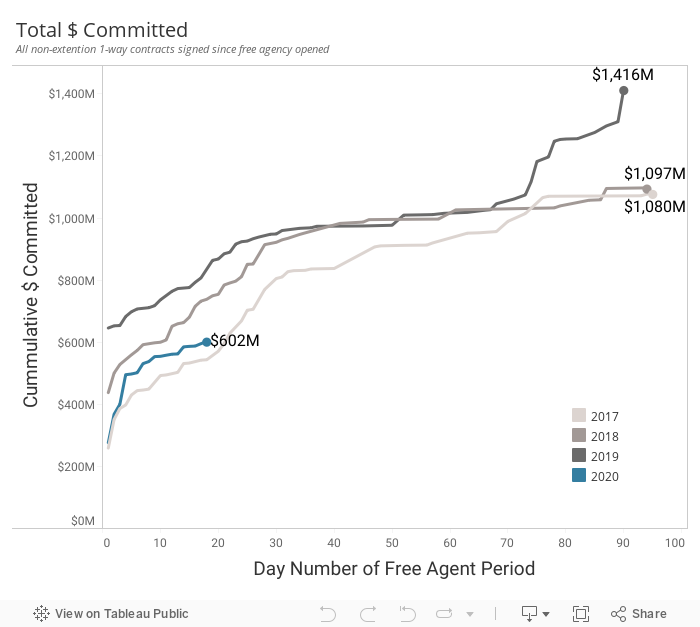
We’ve already talked about the impending cap crunch that most of the teams in the league will be facing. The impact has been very evident during the first 18 days of NHL Free Agency where the teams aren’t spending as much as they have in the past couple of years.
Here is the breakdown of the current dollars committed through day #18 of the free agent period and how it stacks up to the prior 3 years.
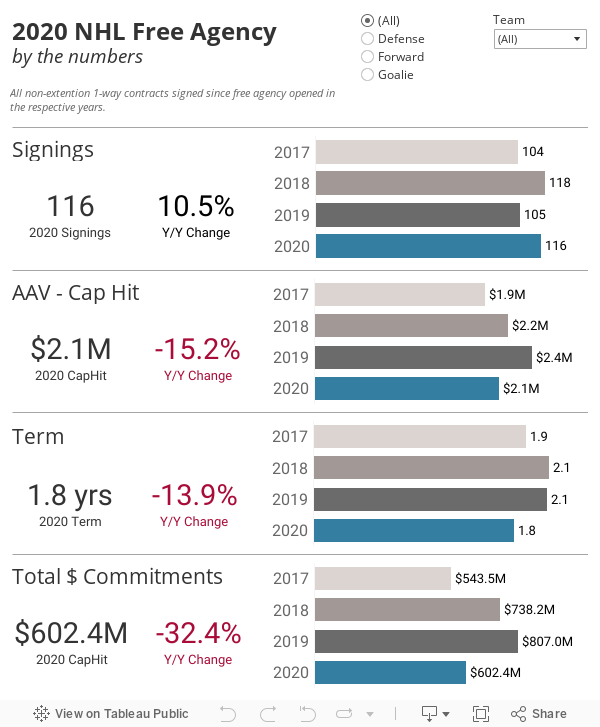
Of course, the total committed dollars is not the whole story. It’s also important to view the average annual value (Cap Hit) and average term of the contracts. Both are down double digits from last year at this point in time. Here is an interactive dashboard to let you explore the numbers by team.
So teams are signing roughly the same amount of players in the same timeframe, but signing them for less money and for shorter term deals.
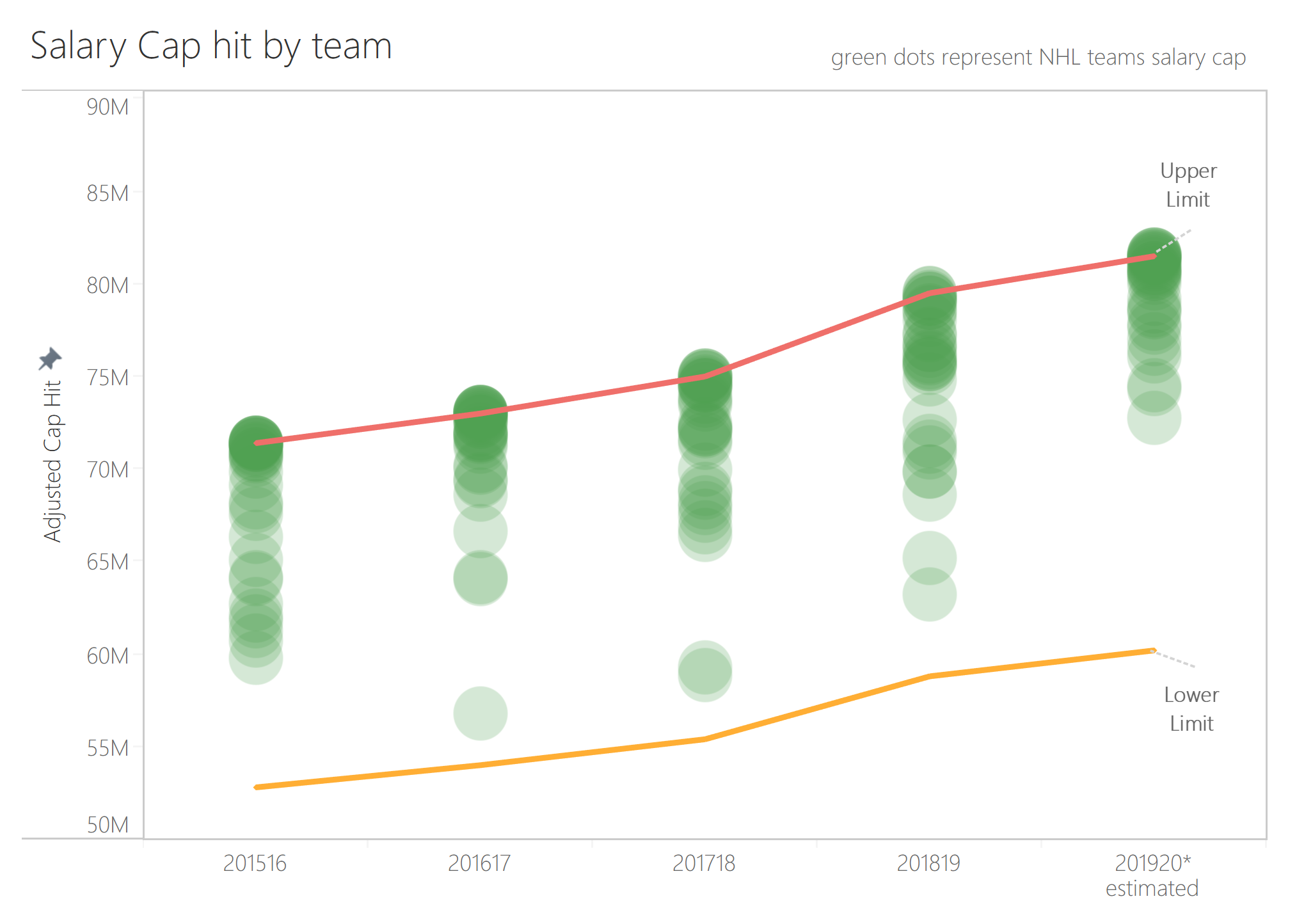
And for the heck of it, here is a comparable to how each team is spending and the number of players they have signed this free agent period.
The shorter deals and cap crunch are all good news for the Kraken as they get ready for the Expansion Draft next summer. This won’t be a one-year trend as the cap is projected to stay flat next year as well due to lost revenue of partial season with optimistically, limited fans in the buildings.
Free agency is upon us and, even though the Seattle Kraken will not be participating, there are still things to keep an eye on this year that could impact the Kraken down the road.
Here are my top 5 things to keep an eye on during free agency.
The NMC
Look for any players signing deals that have a Full No-Move Clause (NMC). NMC’s are generally reserved for the cream of the crop of free agent players. A NMC means that the team must protect the player in next summer’s Expansion Draft. It is highly likely that these players would be protected without the NMC, but the NMC will limit teams’ options. Anything that restricts other teams’ options and flexibility should be considered a good thing for Seattle.
Cap Crunch teams
All teams will be impacted by the flat salary cap related to COVID-19 lost revenues, but the more teams spend to the cap, then the more vulnerable these teams will be during the Expansion Draft. This could benefit Seattle during the Expansion Draft in 2 ways:
Teams could expose some high-value, high-cap-hit players with the hopes that Seattle selects these players to shed some salary cap. Of course, this doesn’t mean Seattle will select this player, so let’s go to #2.
Similar to what happen in the Vegas Expansion Draft, teams could negotiate side deals with Seattle to shed some high salary players in an effort to create more salary cap space to sign pending RFAs or other UFAs in 2021. Anaheim traded Shea Theodore to Vegas for taking Clayton Stoner and Winnipeg traded a 1st round pick and a 3rd round pick for in exchange for Vegas selecting Chris Thorburn Bottom line we want teams to spend to their limit.
Shea Theodore was traded to Vegas from Anaheim as compensation for Vegas selecting Clayton Stoner in the 2017 Expansion Draft. (Photo by Jeff Speer/Icon Sportswire)
Goalies Carousel
This is certainly the trendy topic leading into the free agency period and for good reason. This year will probably see the most goalies change teams that the league has ever seen in any prior offseason. There are some high-profile goalies that will change teams this year. Corey Crawford (CHI), Jacob Markstrom (VAN), and Braden Holtby (WAS) are likely to change homes. For the 30 teams participating in the 2021 Expansion Draft (Vegas is exempt), each team will only be able to protect one goalie, so goalie signings this free agent period should give us a better sense of which goalies get exposed in the upcoming expansion draft next summer.
Short Term Deals
Keep an eye out for short term deals, as in really short. The scenario here is that a big time free agent signs a one-year deal with the hopes of either winning a championship with a well-positioned team or the player might take a one-year deal with the hope that they can sign a more lucrative deal with a team that has a lot of cap space…as in Seattle. This would be the Taylor Hall to Colorado on a 1-year deal.
Crowded Blue Lines
Alex Pietrangelo (STL), Torey Krug (BOS), Tyson Barrie (TOR), Kevin Shattenkirk (TBL), TJ Brodie (CGY), and Sami Vatanen (CAR) are all likely to find new homes in free agency. Wherever they sign, odds are decent that they will be protected, which means that some other defender will be exposed. There are several teams that already have some interesting decisions to make regarding who to protect on the blue line in the upcoming Expansion Draft. Having more teams with crowded blue lines will expose more talent and will be better for Seattle.
Several of these scenarios might not play out and we still expect some more roster movement leading up to the 2021 Expansion Draft, but we are starting to put the cake in the oven. We should have a better idea how it will turn out very shortly during this free agency period.
It didn’t take long for Dustin Donaghy to realize his Spokane Chiefs teammate Tyler Johnson was just one of those guys.
You know, one of those guys.
The type of person imbued with so much swagger and subtle confidence that winning just seemed easy.
Whether it was 3-on-3 games, shinny hockey, or games of Halo, Donaghy found out quickly during both of their rookie seasons in the Western Hockey League that Johnson was that type of slightly trusting, but mostly awe-inspiring person.
“He was just clutch, just with everything,” said Donaghy, who is now entering his second year on the Chiefs bench as an assistant coach. “… Tyler, in my mind, he always had his hand in something in a positive manner.”
Winning has been a constant for Johnson, a Spokane, Washington native, in all levels of hockey.
Johnson and the Chiefs won the Memorial Cup, one of the two most coveted championships in junior hockey, and won a Gold Medal with Team USA at the 2010 World Junior Championships in Saskatoon and Regina, Saskatchewan, the second most coveted.
He won a Calder Cup Trophy with the Norfolk Admirals in his first season in the American Hockey League. Johnson was named to the NHL All-Rookie Team and a finalist for the Calder Memorial Trophy in 2014.
And for the second time, Johnson and the Lightning are on the verge of the most prodigious accomplishment in hockey: the Stanley Cup.
The Journey
In the WHL, teams are allowed a 50-player protected list. It includes active players, bantam draft picks and other prospects.
Yes, that same player valuable enough to sign a seven-year, $35 million contract for a Stanley Cup Finalist wasn’t even deemed worthy of being one of the 1,100 players protected by the WHL.
Some of that may have been because of his size — he’s listed at only 5-foot-8 and 185 pounds, but the Spokane native proved to be somewhat of a late bloomer, too.
After failing to make the Chiefs team as a 16-year-old rookie, he erupted with a 120-point season for the Coeur d’Alene Lakers, a Junior ‘B’ team, and helped junior hockey decision-makers notice him.
It didn’t take long for his Chiefs teammates to notice him, either.
“Just looking at him, he kind of had his boyband haircut. You’d look at him and you’d think, is he really a hockey player?” Donaghy said of his first impressions of Johnson in 2007, their rookie seasons. “Then we’d get on the ice, and we’d say, ‘Wow, he’s way more than what he looks like on the outside.”
Of course, Johnson made his way back on to the Chiefs’ list and not only cracked the Chiefs’ Memorial Cup-winning roster as a 17-year-old rookie but was named playoff MVP after totaling five goals and eight points in 23 games.
“He fit in right from the get-go,” Donaghy said.
Johnson had his doubters because he was so unassuming, but it only took a couple of skates for his teammates to buy-in to Johnson being an influential player.
His impact in Junior Hockey was gradual, and while the undersized forward was one of the league’s top scorers as a 19-year-old, no draft buzz followed that production.
Johnson was even looking at playing USports hockey in Canada — or even just attending college in the U.S., where he wasn’t able to play varsity hockey due to the NCAA’s ridiculous amateurism rules, he told The Spokesman-Review, before his 20-year-old season, where he exploded for 53 goals and 115 points as an overage player.
Johnson ended his tenure in Spokane is a hell-of-a-lot of points, a gold medal with Team USA at the 2010 World Junior Championships and, of course, a Memorial Cup run that started it all.
Still, Johnson never attracted much, if any, draft buzz, likely due to his diminutive size.
But Tampa Bay was eventually convinced and inked him as an undrafted free agent.
That’s paid off big time for Tampa Bay, especially early on.
Johnson was a key cog in the Lightning’s 2015 Playoff run, forming ‘The Triplets’ line with Nikita Kucherov and Ondrej Palat. Johnson led the postseason with 13 goals and tied Patrick Kane for first with 23 points as the Lightning finished as Stanley Cup Finalists.
The Lightning fell to Chicago in six games in the 2015 Stanley Cup Final, the franchise’s second appearance.
Currently tied 1-1 with the Stars entering Wednesday’s Game 3, Johnson and the Lightning are presented with another bite at the apple.
A Spokane Kid
Johnson was born into a hockey family of sorts.
His parents, Ken and Debbie Johnson, met playing a rec-league hockey game at Spokane’s Eagle’s Ice-A-Rena. Debbie was a skating coach, who not only taught Tyler how to skate, but the Yamamoto brothers, Kailer and Keanu, as well.
Johnson is a cornerstone, along with Derek Ryan and Kailer Yamamoto, of an underground hockey community in Spokane and Northern Idaho that’s never been confused as a hockey hotbed, but has a burgeoning player pool and a passionate, underground fanbase.
A yearbook photo of Tyler Johnson from Central Valley High School
It’s been a tradition for all three to attend high school in the Spokane area — Johnson attended Central Valley in Spokane Valley — and, of course, play for the Chiefs as a hometown kid, an enriching experience that also comes with the burdens of unrealistic expectations.
Johnson cut through any concerns from the jump.
“He was the one that had to decide of enjoying the fame of being a hometown kid or really pursuing a career,” Donaghy said. “Obviously, that’s what he’s done and he’s a huge impact in Tampa’s lineup right now in the Stanley Cup Final.”
Let us first have a look at how the players were acquired on their respective teams.
No surprise that “Drafted” is how a good chunk of all teams are built.
Development Path to the NHL
Next, we will look at these players development path. Development Path can be subjective since several players had multiple stops in their development. I used rational assessments to determine which league had a more prominent role in these players early development between the ages of 17 to 20.
Age
The average ages are similar, but it is interesting to look at the different clusters of players that make up the average. Dallas has a group around 34 years old; while Tampa Bay has a large group of players between 29 and 32.
Nationality
And finally, we peek at the nationality mix of the two different rosters.
For more info on nationality, check out this post from last December that gives a broader view on nationality trends across the NHL.
I hope this gives you a bit more understanding of the teams vying for the Stanley Cup.
Every playoff I enjoy digging into the rosters of the playoff teams to see how they compare across relatively basic demographic information such as Nationality & Age. This year I have added ‘acquired type”, thanks to CapFriendly. Quick bit of disclosure, data is grabbed from CapFriendly and NHL.com.
For a player to be counted in these numbers, they must have played a second of ice time of the playoffs. (i.e. Thatcher Demko has been the back up goalie for Vancouver in all their games but has yet to play a second on the ice and will not be counted.)
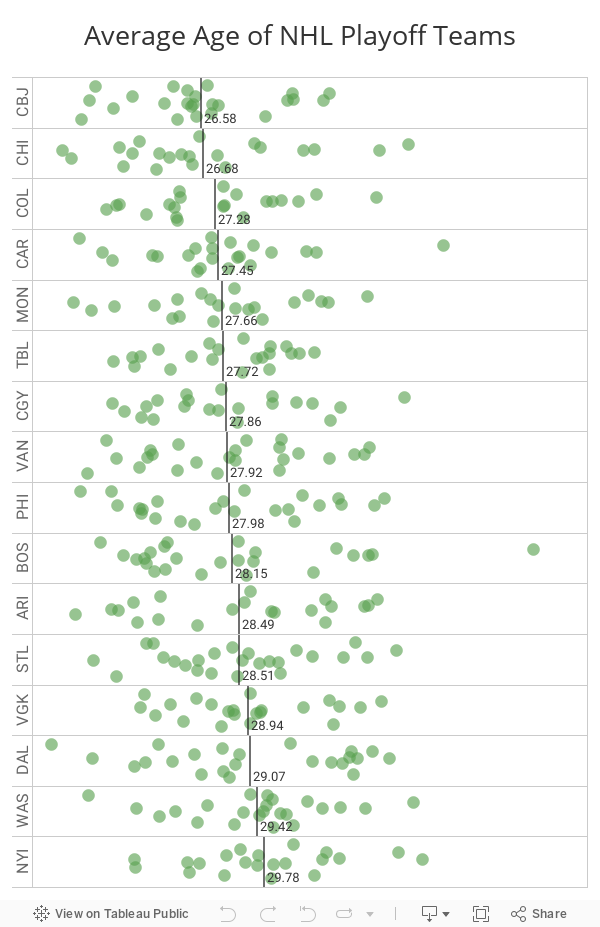
Age
Nationality
For a comparison, ~48% of the league is Canadian.
Here is a distribution by team
How acquired
This is a fun view on how these teams were built.
As you can see, the Vegas Golden Knights do not have one of their draft picks playing on their team….but their 2nd pick in their history is playing for Montreal.