Newly promoted Seattle Kraken general manager Jason Botterill has stated on several occasions that he intends to be active this summer as he attempts to reshape the team’s roster into a playoff contender. While his promotion into the GM chair and Ron Francis’s simultaneous move to a president of hockey ops position may have felt like a half measure at the time, there is a distinct advantage for an executive moving up within an organization in which he has been immersed since Day 1.
“It’s exciting for sure,” Botterill said in his interview with the Sound Of Hockey Podcast last week. “It’s great to be back in the GM chair; certainly it’s what I aspired to do again. But it’s such a different experience, this time, knowing the entire organization.
“When you go to a new organization like I did from Pittsburgh to Buffalo [in 2017], you certainly have ideas of what goes on, ideas of the staff, ideas of the players. But it literally takes you a couple of years to figure it all out and figure out the nuances and the chemistry that goes on. That’s my big advantage here is just being a part of this since Day 1, being a part of all the discussions with Ron on different things.”
In short, Botterill came into the new role expecting to hit the ground running.
Indeed, he made two notable trades in a span of 72 hours last week, first taking advantage of the impending cap crunch in Dallas and snagging sizable, gritty winger Mason Marchment for a bargain return of a third-round draft pick in 2026 and a fourth-rounder in this weekend’s draft. (That fourth-rounder originally belonged to Dallas and was acquired by former GM Francis in the Alex Wennberg trade to the Rangers in March 2024.) The Marchment deal was—as they say—a nice bit of business.
If these trades were to happen in a vacuum and be Seattle’s only moves of the offseason, then they wouldn’t be enough to move the needle and get the Kraken back into contention next season. But I do believe Botterill is going to be aggressive in retooling the personnel this summer, and these moves are just the first steps in that process.
Marchment is a good fit
One thing we’ve heard from Botterill is that the team wants to be better at getting to the inside in the offensive zone while also doing a better job protecting the dangerous areas in the defensive end. Marchment certainly brings size (he’s 6-foot-5, 212 pounds) and grit and should be able to help his linemates by digging out pucks and barreling his big body into the crease.
“That is my game,” Marchment said in his introductory press conference on Tuesday. “I like to get in on the forecheck, get inside, get pucks back, strip guys on the backcheck. That’s stuff I take pride in and like to do well. So if I can help out that way, it’s going to be great. Getting to the net front, getting in the goalie’s eyes, that’s huge. Small things like that are things that help win games and help you get to the playoffs.”
While they’re different players at different stages of their careers, this acquisition reminds me of the Kaapo Kakko trade, in which Seattle brought in a big-bodied winger who was viewed as a player capable of creating space for his linemates. Sure enough, Matty Beniers—who had another slow start to the season—took off in the second half after Kakko arrived and was placed on his wing.
Can Marchment, 30, bring a similar impact for other players? I can’t help but envision Marchment alongside Chandler Stephenson, a center who prefers to play on the perimeter and utilize his deft passing skills, drawing attention from defenders at the top of the crease, while somebody like Jared McCann tees up a one-timer from the other side.
That’s what excites me most about Marchment’s profile: he brings a package of size and skill that could help unlock other Kraken players next season and get them scoring more steadily.
What I haven’t even mentioned yet is that—although I see him as a complementary piece to help create space—Marchment can also put the puck in the net. He’s had 22 goals in each of the last two seasons, notching that number in 81 games in 2023-24 and matching it in 2024-25 despite missing 20 games with injury. So, there’s some skill there, which means he’s not only replacing some of the grit lost when the Kraken traded Brandon Tanev and Yanni Gourde at the 2025 NHL Trade Deadline, but in a way, Marchment also replaces a good chunk of the offensive production lost when Oliver Bjorkstrand was dealt.
Considering what Botterill had to give up to bring in Marchment, my initial reaction was that this was a big win for the Kraken.
As for Marchment’s contract, he signed a reasonable four-year, $18 million deal to remain in Dallas in 2022. So, Seattle gets him at just a $4.5 million cap hit for 2025-26, and if the team doesn’t extend him, he will surely be a hot commodity at the trade deadline if the Kraken once again find themselves in a seller’s position.
A creative solution to the Burakovsky issue
As the season came to a close, we circled two players as buyout candidates for the Kraken. One of those was Philipp Grubauer, who remains on the roster as of the writing of this story, though the first buyout window has been open since Friday and will remain open until June 30.
The other was Burakovsky, who never fully returned to form after tearing his groin midway through his first season with Seattle in 2022-23. He showed flashes but just never got back to any semblance of consistent play.
After a second straight season of minimal offensive production from Burakovsky—he had 10 goals and 27 assists in 79 games—while carrying a significant salary, we assumed Seattle would have few options in getting Burakovsky’s $5.5 million cap hit off the books. One option would be to attach assets and/or retain significant salary in a trade.
The only alternative was a buyout. A buyout of Burakovsky’s contract would have been expensive, though, carrying a $1.96 million cap hit next season, $3.2 million in 2026-27, and then two more penalty years of $1.46 million per season. (Worth noting, a Grubauer buyout would be similar at $1.98 million, $3.08 million, then $1.68 million for the two penalty years.)
But, remarkably, Botterill pulled a rabbit out of his hat and got the Blackhawks to take Burakovsky with no salary retention in exchange for Veleno.
From Chicago’s point of view, taking Burakovsky’s contract actually helps the Blackhawks get to the cap floor for the next two seasons, and there is a chance he could flourish in a top-six role with a rebuilding team that features Connor Bedard. Meanwhile, Veleno was also viewed as a buyout candidate for Chicago, so it solves that problem as well.
Back to the Kraken perspective: Veleno has one year left on his contract at a $2.275 million cap hit before he becomes a restricted free agent. He could still be a buyout candidate and would be way cheaper to buy out than Burakovsky. Still just 25 years old, Veleno can be bought out for one-third of his 2025-26 salary. This means just $795K this season and $295K next season. He could also be stashed in the AHL, which would decrease his cap hit to $1.125 million while keeping him in the organization.
I’m guessing they’ll keep him on the roster, though, to backfill the fourth-line center spot that was vacated by Gourde’s trade to Tampa Bay.
Veleno has never quite hit his NHL stride, despite showing tons of promise as a youngster, earning exceptional status to join the QMJHL’s Saint John Sea Dogs at 15 years old. With that in mind, there is some speed, size, and talent in there, making Veleno’s inclusion at the bottom of the forward corps for next season very low-risk and, again, a nice bit of business for Botterill. Perhaps the right role and setting could unlock more of the promise that once showed for Veleno.
Projected depth chart
With Burakovsky out and Marchment and Veleno in, we can start to piece together a way-too-early depth chart for the Kraken next season. Botterill reminded us in his interview with the Sound Of Hockey Podcast that he does expect to give Berkly Catton a look on the NHL roster, and he doesn’t want to “block out” young players in the organization from having a chance to make the team.
So, I’m penciling in Catton and Jani Nyman on the fourth line for now (I know, neither belongs in that role), but the roster will surely continue to evolve throughout the summer.
Forwards
Jaden Schwartz // Matty Beniers // Kaapo Kakko Jared McCann // Chandler Stephenson // Mason Marchment Eeli Tolvanen // Shane Wright // Jordan Eberle Jani Nyman // Berkly Catton // Joe Veleno Tye Kartye
Defense
Vince Dunn // Adam Larsson Ryker Evans // Brandon Montour Jamie Oleksiak // Josh Mahura Ville Ottavainen
Goalies
Joey Daccord Philipp Grubauer
Darren Brown
Darren Brown is the Chief Content Officer at soundofhockey.com and the host of the Sound Of Hockey Podcast. He is a member of the PHWA and is also usually SOH’s Twitter intern (but please pretend you don’t know that). Follow him @DarrenFunBrown and @sound_hockey or email darren@soundofhockey.com.
We’ve entered draft week across the NHL, and as fans feverishly study up on this year’s class of eligible prospects, I thought it would be fun to look back and give grades to the Seattle Kraken’s four NHL Entry Drafts to date. Grading their drafts at this point is a little like judging a cooking competition halfway through meal prep. Sure, you can see where it’s going, but there’s still plenty of time for things to come together… or fall apart.
The Kraken are only four drafts into their existence, and many of the players they’ve selected are still in college, junior hockey, or just starting to scratch the surfaces of their pro careers. Still, with a few seasons of development in the books, we can start to evaluate trends, hits, misses, and what those drafts tell us about the Kraken’s performance to date. So, keeping in mind that there’s a lot of runway left for all the players they’ve selected, here’s a look at how the Kraken’s first four NHL Entry Drafts are shaping up.
2021 NHL Entry Draft
The Kraken’s first draft year featured the fewest picks they’ve ever had in a single draft, with just the seven standard selections. Matty Beniers looked like a smash hit after his 2022-23 Calder Trophy season but has cooled off since. He’s still very young and has another season or two before we’ll know whether he’s a true first-line center or if he’ll settle into a secondary role. Beniers did show some progress after the arrival of Kaapo Kakko, and it will be interesting to see how things play out next season. A few players from that class—Wyatt Johnston, Dylan Guenther, Matthew Knies, Luke Hughes—have shown flashes, but nobody has pulled away as a bona fide superstar just yet.
Outside of the first round, Ryker Evans is showing a lot of promise. He hasn’t established himself as a high-end defenseman, but he’s only had one full NHL season. Ryan Winterton looked to be on a great trajectory in 2023-24, and while expectations were high that we’d see more of him in the NHL, he’s technically ahead of schedule. He’s already played 21 NHL games, 19 more than the next-most games played by a third-round pick from that draft.
Both Ville Ottavainen and Jacob Melanson made their NHL debuts during the 2024-25 season, each appearing in one game. Meanwhile, Semyon Vyazovoi, a longshot seventh-round goalie from Russia, is starting to look less like a longshot after a strong year in the KHL that included some big-time performances. Lastly, Justin Janicke, another seventh-rounder, signed an AHL deal with Coachella Valley. The odds are always long for players taken after Round 2, but at this point, every Kraken pick from this draft has exceeded expectations.
Overall Grade: B+ Beniers’ future as a top center remains TBD, but the overall draft class is tracking well above average, especially for the later rounds.
2022 NHL Entry Draft
The 2022 draft was a busy one for the Kraken, and the most memorable moment was Shane Wright unexpectedly falling to them at No. 4. In Wright’s first full NHL season (2024-25), he showed encouraging progression. He finished with 19 goals and 25 assists, but the real optimism comes from his growth as the season went on—averaging just 0.25 points per game in his first 20 games, and 0.66 the rest of the way. Even with hindsight, the Kraken would still take him at No. 4.
Outside of Wright, Jani Nyman was the only other player to appear in more than one NHL game, putting up three goals in 12 games late in the season. He looked the part of an NHLer, and it’d be a surprise if he doesn’t play at least 60 games next season. Jagger Firkus, Niklas Kokko, and Ty Nelson all had strong seasons with Coachella Valley and remain on solid development paths.
Folks. Jani Nyman's First NHL Goal. It's a beauty set up by the captain (his third primary helper of the game) #SeaKrakenpic.twitter.com/caLxRtKnYo
David Goyette, meanwhile, had a bit of a rollercoaster first pro season. After two 40-goal seasons in the OHL, fans hoped to see more than six goals in his AHL rookie year. That said, nothing was particularly concerning—he’s just on a learning curve.
NCAA prospects Ben MacDonald (Harvard) and Barret Hall (St. Cloud) are both producing steadily at the collegiate level.
Overall Grade: B Most picks are tracking nicely, and 2025-26 will be a telling year for this class.
2023 NHL Entry Draft
Even the most optimistic Kraken fan has to feel a little nervous about Eduard Šalé, Seattle’s first-rounder in 2023. Nobody expected him to have reached the NHL yet, but his 2023-24 OHL season was underwhelming, and while he had a strong start to his 2024-25 AHL campaign, his performance tapered off later in the season. To be fair, he was a 19-year-old in the AHL, extremely young for that league, so it’s way too early to write him off. He also was outstanding in the IIHF World Junior Championship, scoring six goals and two assists as the captain of Team Czechia, so there is still plenty of potential.
Seattle’s second- and third-rounders, however, are trending nicely. Carson Rehkopf capped a fantastic OHL career and is poised to take a big step this season. Oscar Fisker Mølgaard had another excellent year in the SHL and is coming to North America for 2025-26.
Further down the draft board, most players are developing as expected, but it’s still too early to make firm calls either way.
Overall Grade: C+ Rehkopf and Mølgaard help the grade, but concern about Šalé weighs heavily. You have to hit on first-rounders.
2024 NHL Entry Draft
Okay, yes, it’s extremely premature to assign a grade to the 2024 draft class. But we’re doing it anyway. Kraken fans have to love what they’ve seen from Berkly Catton. It’s not just the points or goal scoring—he’s showing signs of becoming a well-rounded, play-driving center who takes pride in his game at both ends of the ice. He’s done all he can do in the WHL, and since the AHL isn’t an option, most expect him in the NHL this season.
Julius Miettinen showed a ton of promise in the first half of the season with Everett, but an injury at World Juniors kept him out most of the second half. He looked good when he returned, but it would’ve been nice to see a full campaign.
One big early surprise is Nathan Villeneuve, a physical, fearless player who stood out in preseason. In fact, in four years of watching Kraken prospects in exhibition games, Villeneuve was one of the first who looked like he actually belonged.
Wow! Nathan Villeneuve with a rocket one-timer! 🚀
Bjorkstrand sets him up, and the youngster gets a pretty goal and a nice little “sheath the sword” celly. 🗡️ #SeaKraken
Further down the list, Alexis Bernier and Kim Saarinen took strong steps forward, while Oliver Josephson, Clarke Caswell, and Jakub Fibigr all had solid seasons.
Overall Grade: A- Yes, it’s early. But Catton’s play and Villeneuve’s trajectory have Kraken fans rightfully excited.
Final thoughts
Four drafts in, it’s clear the Kraken are building with patience and purpose. They’ve managed to find value in nearly every round and haven’t missed wildly on any picks, though Šalé’s trajectory will be important to monitor. The foundation is there. The real question now is how Seattle can turn its impressive group of prospects into regular NHL contributors and a contending roster in the future.
As the 2025 draft approaches, the pipeline is in a healthy spot, but the next wave needs to start arriving in full. The Kraken don’t just need young players, they need young impact players. Time will tell which names from these early drafts step into that spotlight.
The Seattle Kraken made another move to reshape their forward group on Friday, trading winger Andre Burakovsky to the Chicago Blackhawks in exchange for 25-year-old center Joe Veleno.
The trade closes the book on Burakovsky’s up-and-down tenure in Seattle, which began with plenty of promise. When he signed as a free agent in the summer of 2022, Burakovsky was expected to be a key offensive driver, and early returns were strong. He led the Kraken in scoring with 39 points in 49 games during the 2022-23 season before suffering a groin injury that ended his year prematurely. Unfortunately, he was never quite the same after that.
In the two seasons following the injury, Burakovsky tallied 53 points in 128 games, struggling to recapture the confidence and touch that made him such a dangerous top-six winger at previous junctures in his career. Whether it was lingering effects of the injury or simply an ill-fitting role, a change of scenery feels like the right move for both player and team. He was widely viewed as a buyout candidate this offseason, so getting a useable player in return at a lower cap hit is another nice bit of business for general manager Jason Botterill, after he also snagged Mason Marchment on Thursday.
For the Kraken, the return is Joe Veleno, a speedy, defensively responsible center who played parts of five seasons for the Detroit Red Wings before being moved to Chicago at the trade deadline in this most recent season. Veleno has 81 points in 306 career games, and while he’s unlikely to put up eye-popping numbers, his value lies in his versatility and skating ability.
Veleno gives the Kraken the option of filling the fourth-line center role vacated when they dealt Yanni Gourde at the deadline, but he can also slide up and down the lineup on wing. Veleno brings a more budget-friendly cap hit of $2.375 million average annual value than Burakovsky’s $5.5 million (Burky also has two years left on his deal, compared to Veleno’s one), and is a restricted free agent next summer, giving the team some control if things work out.
Veleno doesn’t shy away from the dirty areas, either. He’s not exactly a bruiser, but he’s got enough grit to hold his own on the forecheck and along the boards. Think of him as a modern fourth-line pivot—fast, defensively sound, and capable of chipping in offense when needed.
As for Burakovsky, the move to Chicago might just give him the reset he needs. He’s still only 29, and if he can stay healthy and find chemistry in a younger, rebuilding Blackhawks lineup, don’t be surprised if he regains some of the offensive flair that made him a two-time Stanley Cup winner.
For Seattle, it’s another small-but-meaningful step in retooling the roster heading into what should be a pivotal 2025-26 season. And for Veleno, it’s a chance to carve out a consistent role on a Kraken team that values depth, speed, and flexibility down the middle.
The Seattle Kraken have made a notable addition to their forward group, acquiring winger Mason Marchment from the Dallas Stars in exchange for a fourth-round pick in 2025 and a third-round pick in 2026.
The fourth-round pick involved in the deal originally belonged to Dallas, but Seattle obtained it last season in the trade that sent Alexander Wennberg to the New York Rangers at the Trade Deadline. Now, that pick returns to the Stars as part of this transaction.
At first glance, this is a strong move for Seattle. Marchment adds a combination of size, scoring touch, and grit that the Kraken have been lacking in their middle six. Standing 6-foot-5 and weighing 212 pounds, the 30-year-old winger (he turned 30 on Wednesday) plays a heavy, physical game, but he also brings more than just muscle.
Marchment is coming off one of the best seasons of his career, matching a personal high with 22 goals and finishing with 47 points in 62 games during the 2024-25 campaign. That point total would have ranked him fourth on the Kraken last season, behind only Jared McCann, Chandler Stephenson, and Jaden Schwartz. Perhaps more impressively, Marchment put up those numbers while averaging just 15:20 of ice time per game—more than two minutes fewer than Seattle’s top forwards, and missing significant time due to injury.
He also contributed on the power play, chipping in 10 points (five goals, five assists) with the man advantage. His presence in front of the net and willingness to win puck battles along the boards should complement Seattle’s current power-play setup.
Where Marchment fits into the Kraken lineup remains to be seen, but he offers versatility. He has shown the ability to move up and down the lineup, depending on need. He spent much of his time down the stretch in Dallas on a line with Mikael Granlund and Matt Duchene.
Marchment has one season remaining on his current contract with a cap hit of $4.5 million, which is manageable for Seattle, especially if he can continue to produce at or near his current level. The Kraken entered the offseason with ample cap space and a clear goal of adding more scoring punch and physical presence to their forward group. This move checks both boxes.
It’s not yet clear whether this trade signals further moves on the horizon for general manager Jason Botterill, but it’s the kind of targeted addition that should help the Kraken be more competitive next season. Seattle fans can expect to get their first look at Marchment in a Kraken jersey this fall when training camp opens.
Blaiz Grubic
Blaiz Grubic is a contributor at Sound Of Hockey. A passionate hockey fan and player for over 30 years, Blaiz grew up in the Pacific Northwest and is an alumni of Washington State University (Go Cougs!). When he’s not playing, watching, or writing about hockey, he enjoys quality time with his wife and daughter or getting out on a golf course for a quick round. Follow @blaizg on BlueSky or X.
With Game 6 of the Stanley Cup Final set for Tuesday, the Florida Panthers are on the verge of winning their second straight championship. The Edmonton Oilers are once again facing elimination and must win to force a Game 7—just like last year. This article isn’t about the teams currently battling for the Cup, though. It’s about Seattle’s unique ties to the most iconic trophy in sports, both through its early hockey history and the Cup’s visits to the city.
The magic of the Stanley Cup
Every year, when there’s a chance the Stanley Cup might be awarded, excitement takes hold. The on-ice celebration, the tradition, the prestige—it all feels magical. I don’t have a strong rooting interest between Florida or Edmonton, but I’ll be watching. If Edmonton wins tonight and we get another Game 7? Even better.
A quick Stanley Cup primer
The current version of the Stanley Cup was redesigned in 1948 and features five bands, each engraved with past champions. Up to 52 names—players and staff—can be engraved with each winning team. The Cup has only gone unawarded twice: in 2005 due to the NHL lockout, and in 1919 due to the Spanish flu.
Every 13 years, the top band is removed and retired to the Hockey Hall of Fame (HHOF) in Toronto, and a new one is added to the bottom. Three bands have been retired so far, covering the years 1927 to 1964.
There are actually three Stanley Cups:
The original bowl, donated in 1892 by Lord Stanley, began being phased out in 1963 and was fully retired in 1970.
The presentation cup was created in 1963 and awarded to champions each year.
The permanent cup is a replica that remains on display at the HHOF when the presentation cup is on the road.
Seattle and the Stanley Cup
Most Kraken fans know the Seattle Metropolitans were the first U.S.-based team to win the Stanley Cup, beating the Montreal Canadiens 3-1 in a best-of-five series in 1917. Seattle reached the Cup Final three times (1917, 1919, and 1920).
Back then, the championship was played between the winners of the Pacific Coast Hockey Association (PCHA) and the National Hockey League (NHL). Each league had different rules, most notably: the PCHA allowed seven players on the ice (six skaters and a goalie), while the NHL allowed only six. The home team’s rules were used for Game 1, and the leagues alternated rules for each game after that.
Seattle went 4-2 under PCHA rules and 3-4-1 under NHL rules in its 14 Stanley Cup Final games.
1917
The Canadiens didn’t even bring the Cup with them on the five-day train ride to Seattle, assuming they’d win. After losing Game 1, the Metropolitans rolled off three straight wins and took the championship. Montreal’s goalie? George Vezina—yes, that Vezina. Seattle scored 23 goals on him in four games.
Engraving is worn, but reads “Seattle / World’s Champions / Defeated Canadians / 1917”
1919
Seattle and Montreal met again. Seattle led the series 2-1 before Game 4 ended in a thrilling 0-0 double-overtime tie. With players fatigued and the Spanish flu outbreak worsening, the game was declared a draw. Montreal then won Game 5 in overtime, coming back from a 3-0 deficit. Because Game 4 ended in a tie and did not produce a winner, Game 5 was played under NHL rules. A Game 6 was planned to decide the series under PCHA rules, but it was never played due to the outbreak.
The Spanish flu ravaged Montreal’s roster, and the teams agreed to cancel Game 6. Canadiens defenseman Joe Hall died in Seattle days later.
Seattle also played the series without its top scorer, Bernie Morris, a Canadian citizen who had been arrested for draft evasion. While the legal battle played out, Morris remained incarcerated and missed the entire series. Maybe, just maybe, Seattle could have had a second Stanley Cup championship if Morris had been allowed to play.
1920
Seattle traveled to Ottawa for a best-of-five series. Warm weather produced poor ice conditions, and after the first three games in Ottawa, the final two were moved to Toronto. The Metropolitans pushed the series to a deciding Game 5 and even led 1-0 before surrendering six straight goals to the Senators. Despite Ottawa winning the Cup, Ottawa chose not to engrave its name on the trophy. The Senators were retroactively added to the Cup’s collar in the 1948 redesign.
The Stanley Cup in Seattle
The Stanley Cup has visited Seattle multiple times in the modern era:
2004: Tampa Bay Lightning amateur scout Glen Zacharias, a former Seattle Thunderbirds scout, brought the Cup to a Thunderbirds game at KeyArena. I’ve played hockey recreationally for more than 30 years, so when I got a chance to touch the Cup, I absolutely did. Some NHL players hold a superstition that they will not touch the Stanley Cup unless they win it, so if Seattle never wins it, you can blame me. This means, though, that the Stanley Cup has been under the roof of Climate Pledge Arena.
2017: On the 100th anniversary of Seattle’s 1917 championship, the Cup returned to the city. It toured multiple locations, including the original site of the Seattle Ice Arena at 5th and University.
2024 Winter Classic: During the Kraken’s 3-0 shutout win over Vegas, the NHL fan village hosted the Cup. The longest line in the village? A photo opportunity with Lord Stanley’s Cup.
I’ve seen the Cup three times: once at the HHOF in Toronto, once after the Anaheim Ducks won in 2007, and once at a Thunderbirds game. Every time, it takes my breath away.
Blaiz touching the Stanley Cup at Key Arena in 2004
Anaheim Ducks hoisting the Stanley Cup in 2007
If you plan to watch the Cup presentation this year, a tip for Xfinity users: Canadian channel CBUT usually carries extended coverage of the presentation.
Wrap-up trivia
Here are a few trivia questions on the Stanley Cup. Comment below with your answers:
How many times is Seattle engraved on the Stanley Cup?
What U.S. city was the first to be engraved on the Stanley Cup?
What was the nickname for the cup design used from 1932-1947, before the current version created in 1948?
Now that the Seattle Kraken exist, seeing them lift the Stanley Cup live is officially a bucket list goal.
Comment below with your stories and memories of the Stanley Cup.
Blaiz Grubic
Blaiz Grubic is a contributor at Sound Of Hockey. A passionate hockey fan and player for over 30 years, Blaiz grew up in the Pacific Northwest and is an alumni of Washington State University (Go Cougs!). When he’s not playing, watching, or writing about hockey, he enjoys quality time with his wife and daughter or getting out on a golf course for a quick round. Follow @blaizg on BlueSky or X.
It’s a very special episode of the Sound Of Hockey Podcast this week with not one, but TWO fantastic interviews with the head coach of the Seattle Kraken, Lane Lambert, and the general manager of the Seattle Kraken, Jason Botterill.
With Lambert, the guys talk X’s and O’s, his expectations for the upcoming season, and his background. With Botterill, the guys talk about the changing tides in the NCAA and CHL, exciting prospects, and much more.
It’s been a relatively busy week in the Seattle hockey sphere, with Lane Lambert being officially introduced as the next head coach of the Seattle Kraken and the PWHL Expansion Draft having been held on Monday.
On this episode of the Sound Of Hockey Podcast, the guys share some central themes from the presser and give their thoughts on what PWHL Seattle is building.
They also fielded lots of Mailbag questions before moving into segments, which include Bad Boys, Weekly One-Timers, and What’s Good?
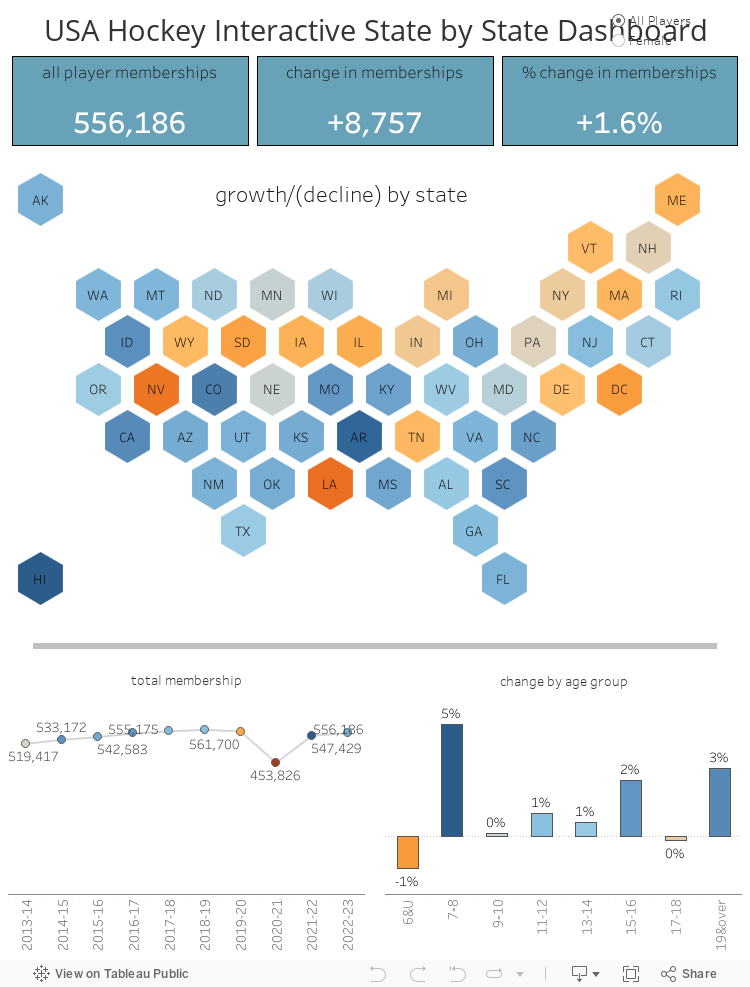
It’s become an annual tradition at the Sound Of Hockey to dive into the latest USA Hockey registration numbers, and the 2024-25 season brings plenty to talk about. We like using this data as a proxy for the popularity and growth of the sport as a whole. Here’s what we learned about membership trends over the last year.
Year-over-year growth
USA Hockey hit an all-time high in player memberships during the 2024-25 season, adding 13,396 new players compared to last year. That’s a stronger jump than the 8,282 gained in 2023-24, and it marks three straight years of steady growth. The sport is clearly bouncing back from the pandemic lull. For context, the previous record was 567,908 members back in 2018-19, the last full season before COVID disruptions, and we’ve now officially surpassed that milestone.
Youth numbers keep climbing
Youth hockey is setting records for the third year in a row. USA Hockey added 6,705 new youth members, bringing the 2024-25 total to 396,525—a new all-time high. In an era when youth sports overall are facing participation challenges, it’s exciting to see hockey bucking that trend.
Female participation keeps rising
Female participation continues to be one of the brightest growth areas for USA Hockey. The 2024-25 season saw 4,784 more girls and women register, a 5.1 percent increase year-over-year. That’s the largest non-pandemic bounce the female category has seen since USA Hockey began breaking out female-specific data. With sustained momentum like this, the pipeline for women’s hockey at all levels is getting stronger each year. You have to imagine that female participation will continue to increase as the rise and growth of the Professional Women’s Hockey League (PWHL) continues.
State-by-state highlights
Looking at where the growth is happening, two states really stood out this season. Florida led the country with an 8.4 percent increase in memberships, fueled by the Florida Panthers’ Stanley Cup win. Meanwhile, Utah posted the second-highest percentage growth, boosted by the buzz of the NHL’s arrival in Salt Lake City. It’s early, but the impact is already visible. With Utah Mammoth owner Ryan Smith publicly committing to growing the game at the grassroots level, Utah could be hockey’s next big expansion story.
Washington State
Washington added 711 new player memberships in 2024-25, a 5.8 percent increase over last season. That’s a healthy jump, and most of the growth came from youth hockey—467 of those new members were under 18. That said, the state continues to run up against a familiar roadblock: ice time. Since the Kraken opened Kraken Community Iceplex with three ice sheets back in 2021-22, no new rinks have been built, and most facilities are operating at or near capacity.
The Kirkland Kraken facility still appears to be moving forward, but with no shovel in the ground yet, it’s hard to imagine it opening before the 2027-28 season. Until then, Washington’s growth will likely be capped more by rink availability than by interest.
Explore the numbers yourself
As always, I’ve put together an interactive dashboard where you can explore USA Hockey membership by state, age group, or gender.
If you have questions, feel free to reach out—I love digging into the details.
The Seattle Kraken officially introduced Lane Lambert as the third head coach in franchise history with a press conference at Kraken Community Iceplex on Monday. Sitting side by side with new general manager Jason Botterill, Lambert said he was “ecstatic” about the opportunity and spoke at length about his plans for getting the Kraken back into contention next season.
“Being a coach in the National Hockey League is a privilege at any level, and being a head coach in the National Hockey League is an honor,” Lambert said. “It’s one of 32 positions, and I’m greatly honored to take this position. So thank you very much.”
Lambert, 60, is set to embark on his second stint as a head coach in the NHL after spending a season and a half as the bench boss of the New York Islanders from 2022-23 until being let go on Jan. 20, 2024. At the time of his firing, the Islanders were outside of the playoff picture but had a “winning” record at 19-15-11 (I say “winning” in quotes because they had lost a lot more than they had won but kept losing in overtime) after returning the Isles to the playoffs the season prior, following a miss in 2021-22. He then returned to an associate head coach role with the Toronto Maple Leafs last season, running the defense for head coach Craig Berube.
With the presser, Lambert has officially begun his time as the Kraken coach and got right to work Monday on sharing his vision for the group and his approach. Here are some themes from Lambert’s introduction to Seattle.
Structure and details
Playing a structured style and paying close attention to detail were recurring themes of the presser on Monday. Lambert’s commentary echoed what Botterill has said several times this summer about taking care of the important areas of the ice.
“We’ll be strong structurally, but we will also create offense, and we’ll play fast, we’ll be aggressive, we’ll be at the net in the offensive zone, we’ll shoot pucks,” Lambert said. “These are things that— if you look at the balance and you look at stressing offense or stressing defense, there’s both in there.”
Even in the midst of Seattle’s unsuccessful 35-41-6 season under Dan Bylsma in 2024-25, we could already sense that former GM and now president of hockey ops Ron Francis didn’t like the way the team was playing. Bylsma spoke on several occasions about giving players the freedom to play and make mistakes, a stark departure from how the group went about its business under previous head coach Dave Hakstol. It is now obvious that a coach’s ability to clearly articulate to Francis and Botterill how he would re-tighten the screws—particularly in Seattle’s end of the ice—was paramount in choosing a new coach.
With that in mind, and hearing Lambert and Botterill speak Monday, I understand why Lambert’s approach resonated with Seattle’s front office. His style is more similar to that of Hakstol—a coach who valued structure and detail—than that of Bylsma, who was willing to sacrifice some of that structure to attempt to create offense (though the Kraken really didn’t have the horses to outscore teams).
“Lane’s track record as a really good defensive coach, PK coach, is certainly there,” Botterill said. “And when we started getting into the details of it, we certainly saw that.”
Lambert also spoke about players having accountability and eliminating bad habits before they start.
“You set a standard and you don’t deflect from that standard, you don’t deviate from that standard. It’s an everyday thing. You do the same things every day, repetition, and if something isn’t right, you take care of it. You have to nip it. That is the key to the accountability. You can’t turn a blind eye and let something slide.”
Lambert has a reputation as a strong defensive-minded coach, so I do believe him when he says the Kraken will have better structure, which will theoretically make them a harder team to beat in 2025-26. Is that enough to get them back into the playoff picture, though? I still think that depends heavily on what kinds of personnel upgrades Botterill is able to make this summer, but Lambert fits the mold of what the front office was seeking.
Helping the young guns along
Another common theme Monday was that the Kraken see a need for a coach who will help their young players—and players coming up in the system—continue to progress once they reach the NHL level.
“It became very evident that Lane presented the attributes that we’re looking for,” Botterill said. “The combination of having a presence and knowledge to work with our veteran players, yet also be dedicated to interact with our young players for our organization to take the next step.”
Botterill clarified that he was specifically speaking about young players who are truly ready for NHL hockey and reminded us that developing junior players and prospects rising through the minor leagues is not Lambert’s job.
“We have young players in the National Hockey League that are clearly National Hockey League players in Matty Beniers, Shane Wright, and Ryker Evans. They’ve proven that they certainly can be here. It’s our job—our staff in Coachella Valley, led by Derek Laxdal, and our player development staff, led by Jeff Tambellini—to now prepare these players to be ready for National Hockey League games so that they’re ready to be inserted into the lineup.”
Still, the goal of this team has always been to build through drafting and developing. With the expectation of adding more young talent this offseason—both from outside the organization and within—this was clearly a focus in the hiring process as well. Potential arrivals of Berkly Catton, Jani Nyman, and others reinforce that direction.
Can players like Beniers and Wright become key contributors to a playoff-caliber team next season? Botterill and Francis clearly liked what they heard enough to hand Lambert those reins, though he will still have the support of Jessica Campbell, who Lambert reaffirmed will be back next season and will continue working with the young players.
Will the Kraken win in 2025-26 under Lambert?
It is true that Lambert has consistently been around winning teams, whether that’s as an assistant or associate head coach, and his time on Long Island was cut shorter than he perhaps deserved. And since he was let go, the Islanders haven’t exactly dominated; they ended up making the playoffs after Lambert was fired in 2023-24 but lost 4-1 in the opening round to the Carolina Hurricanes. They then missed the playoffs and finished sixth in the Metropolitan Division this past season, leading to Lou Lamoriello’s ouster.
I did ask Lambert what he learned from his previous head coaching gig and what he would do similarly or differently with Seattle.
“That’s a great question,” Lambert said (I couldn’t agree more… GREAT question). “You go through an experience like that, and you get let go, and you have a lot of time to reflect. And if you don’t have an ego, you can certainly say, ‘Gee, I’d do this a little bit differently, or I’d do that a little bit differently, or I’d do this about the same.’ I mean, from my standpoint, our defensive structure, the identity that we that had, the identity that we played with, I’m proud of that. There’s certain little things that I will look at and look into changing, but at the end of the day, I’m proud of what happened in New York.”
Looking back at how things have played out the last four Kraken seasons, Hakstol built a foundation of a team that played tight, structured hockey that could be competitive even without elite talent. Bylsma took a different approach, one that requires high-end offensive players (that he didn’t have) to be successful, and that didn’t jive with the mindset of the front office. So, now they will get back to having a tighter style of play, one that values defense first and looks to create opportunistic offensive chances.
History has shown (once) that the Kraken can win playing that way, and Lambert has proven he knows how to get players to go along with that strategy. Here’s hoping Botterill can bring in some skaters who will capitalize on the opportunities created by stouter defensive structure.
—
One last thought that has been rattling around in my brain over the last week. It’s impossible not to wonder if the Kraken were kicking themselves when news broke that Pete DeBoer had been fired by the Dallas Stars on Friday, one day after they announced Lambert as their hire.
But even if that news had broken a couple of days earlier, I’m not convinced DeBoer would have considered Seattle as his next landing spot, when he will surely have opportunities with teams on the precipice of winning in the near future. And who knows? Maybe the Stars were intentionally waiting to fire DeBoer until every vacancy had been filled (Pittsburgh was the other remaining open job, which had also just been filled by Dan Muse). Why they would do that, I’m not exactly sure, but the timing of DeBoer’s firing is interesting.
Regardless, that ship has sailed, and the Kraken will march ahead with Lambert. If we remove DeBoer from the conversation completely (since he really wasn’t expected to ever be a part of it), I think it is safe to say Lambert fits perfectly into the vision that Francis and Botterill have for the organization.
Will that vision finally start working in 2025-26?
Darren Brown
Darren Brown is the Chief Content Officer at soundofhockey.com and the host of the Sound Of Hockey Podcast. He is a member of the PHWA and is also usually SOH’s Twitter intern (but please pretend you don’t know that). Follow him @DarrenFunBrown and @sound_hockey or email darren@soundofhockey.com.
It’s no secret the Seattle Kraken’s future hinges on the growth of two young centers: Matty Beniers and Shane Wright. Both were high draft picks expected to become cornerstone players, and while their development paths have looked very different so far, each offers plenty of intrigue for fans playing the long game. Beniers jumped straight into a top-six role, won the Calder Trophy, and then, like many young NHLers, hit a bit of turbulence in his second season. Wright, meanwhile, has taken the scenic route, with some starts and stops in the AHL, World Juniors, and limited NHL time, leaving some fans wondering where exactly he stacks up against his peers.
So where are these two trending? And how do they compare to players drafted in similar spots? Let’s take a look at some early production metrics, with the full understanding that player development is anything but a straight line.
Data and methodology
Before we dive in, a quick note on how we’re measuring things. For this piece, we’re sticking to some good ol’ hockey basics: goals scored, points per game (PPG), and average time on ice (TOI). These are straightforward, digestible stats that give us a snapshot of how Matty Beniers and Shane Wright are progressing so far in their young NHL careers.
Now, we fully acknowledge there are far more advanced ways to evaluate player performance, things like expected goals, possession metrics, other impact models, and more. And those tools absolutely have value. But for this early career comparison, we’re keeping it simple. Why? Because sometimes it’s helpful to start with the surface-level numbers before diving into the more technical aspects of evaluation. These are the stats fans know, broadcasters talk about, and young players often get judged by (fair or not).
To create a relevant group of comparable players, I looked only at centers who made their NHL debut since the 2010–11 season and played 50 or more games before turning 21 years old. Breaking it down: 578 centers have debuted since 2010–11, but just 80 have hit that 50-game mark before their 21st birthday. With a few exceptions, this filter effectively narrows the list to the NHL’s best young centers over the past decade-plus, so even being average in this group is still very good.
It’s also worth noting that I’m not factoring in draft position for this analysis. While expectations are obviously higher for top picks, the goal here is to understand the kind of trajectory Beniers and Wright are on, regardless of the expectations attached to where they were drafted.
This isn’t a perfect science, of course. Player development is messy, and everyone’s timeline is a little different. Some guys get top-line minutes from day one; others marinate in the AHL or get eased in more slowly. But hopefully, this gives us a rough idea of where things stand today—and maybe where they’re headed next.
The analysis
Beniers has played 249 career regular-season games, and Wright has played 95. To look at different stages of development, I’ve broken the analysis into 50-game segments and used rate stats (like per-game production) where appropriate. This avoids nitpicking things like the one game Matty is short of a full 250, or Shane being five games shy of a full 100. The idea is to look at trends, not obsess over perfect math.
Points per game
The first metric we’ll look at is points per game. The visual I’m using is a box plot that shows the distribution among the 80 centers who met the criteria. The box plot breaks the data into quartiles, which helps us get a sense of where players fall relative to their peers.
As you might expect, Matty came out flying, his points-per-game metric in his first 50 NHL games was outstanding, with only a handful of centers posting better production. In games 51–100, though, his output dipped closer to the median of the peer group. That decline continued in the 101–150 segment, landing Matty in the second quartile. It’s worth pointing out that now that he’s in the 201-250 range, he’s still one of the younger players in that dataset.
To add context, I pulled the names of the five centers directly above and below Matty’s points per game in the 201–250 segment to see the types of players he’s grouped with.
Based on that group, you could argue there’s some reason to doubt if Matty will become the bona fide No. 1 center we all envisioned after his rookie season. But there are a few top-line guys in that range, so it’s certainly still in play.
Conversely, Shane’s points-per-game numbers in his first 50 games sit just above the average for this peer group. Then, in the next 45 games (remember, he’s only played 95 total), his production climbs close to the top quartile. It’s too early to throw a parade, but the trajectory is encouraging, especially when you see names like Sebastian Aho, Sam Reinhart, Robert Thomas, and Leon Draisaitl showing up around him.
Goals per game
Next up: goals per game, using the same box plot format.
Matty’s trend here mirrors what we saw with points per game. There’s a noticeable dip after his first 50 games, but an encouraging uptick in the 201–250 segment, where he jumps to the top of the third quartile. This recent bump in goal scoring also aligns with the arrival of Kaapo Kakko, giving him more offensive support.
Shane’s goals-per-game trend is similarly encouraging. He tracks a little higher than Matty in both of his segments, which is another good sign that he’s making the most of his limited minutes so far.
Time on ice per game
Out of curiosity, I also looked at average time on ice per game. This isn’t a perfect stat, since it doesn’t account for quality of minutes, special teams usage, or game situations, but it can be a loose indicator of how much trust a player has earned from the coaching staff.
What jumps out immediately is how low Shane’s ice time has been compared to Matty’s. We know Beniers has solid defensive metrics, which naturally makes him a candidate for more ice time in high-leverage situations—like when the Kraken are trying to protect a lead.
Under head coach Dan Bylsma, we saw late-game center deployments lean heavily on Chandler Stephenson, Yanni Gourde, and Beniers. That kind of trust doesn’t come overnight, and it shows where Matty stands in the pecking order.
Some key observations
Matty Beniers’ early career arc is actually pretty typical for young NHL centers. He burst onto the scene with a great first 50 games, but his production dipped in the 101–200 range—something we’ve seen from a lot of young players adjusting to more responsibilities. The recent jump in goal scoring in games 201–250 is a good sign that he might be finding his groove again, especially with more consistent linemates and offensive-zone usage.
Shane Wright’s trajectory is subtle but encouraging. While his overall NHL experience is limited, his per-game production puts him in strong company. The fact that he’s already tracking above average in points and goals in this peer group suggests there’s real upside here.
Usage really matters. Wright’s low ice time is the biggest contextual flag in this entire analysis. Less time means fewer opportunities to score, but it also reflects how the team is bringing him along—deliberately and patiently. Meanwhile, Beniers has been leaned on in all situations from the start.
Limitations of the analysis
Let’s be real for a second; no single stat (or even a bundle of them) can tell the whole story of a young player’s development. Ice time quality, linemates, team systems, special teams roles, none of that is captured in simple rate stats. Some guys get sheltered early, others get thrown into the deep end, some stick right away, and others bounce around before finding their footing.
And of course, development is not linear. A dip in production doesn’t necessarily mean regression; it might mean a new role, a rough patch, or just the natural learning curve of playing in the best league in the world.
The point of this analysis isn’t to define a player’s ceiling, it’s to offer a snapshot of how things are trending.
Wright and Beniers continuing on different paths
For a team still building its identity and core, having two young centers like Matty Beniers and Shane Wright developing side by side is a pretty good place to be.
The numbers tell us their paths are different; Matty got the fast start and is working through a midstream recalibration, while Shane had the slower start but is showing a clear upward trend. Both are holding their own among the NHL’s best young centers at this stage of their respective careers.
Whether either of them becomes a true first-line center is still an open question. But the foundation is there, and there’s every reason to believe that both players can be big parts of the Kraken’s long-term success.