The doors of the Sno-King Ice Arena in Snoqualmie, Wash., opened on June 17 and 18 as players warmed up to get involved in the 2023 Seattle Puckathon event. The event consisted of a series of eight teams playing against each other to help raise money to give younger generations a way to live and enjoy the sport, worry-free. All funds raised will go to The One Roof Foundation’s programs that help support underrepresented youth and get them involved with hockey.
Tournament director David Mosbach organized the event himself. According to Mosbach, the event ran about 16 hours, including games, ice cuts, and warmup times.
“I love hockey, and it’s given me a lot in my life, my friends, my health, my mental health,” Mosbach said. “I figured the best thing I could do was organize a tournament for charity.”
According to Mosbach, he was introduced to the One Roof Foundation by Sound Of Hockey‘s own John Barr. Barr was the team organizer for Team Sound Of Hockey in the event. He is also a member of the One Roof Foundation’s board.
“Getting access to hockey for kids is a challenge,” Barr said. “I love hockey, and it’s given me a lot of return and joy in my life.” Team Sound Of Hockey played seven periods in the event.
“I think it’s a great opportunity and a great event, and we can make it bigger and better,” Barr said. “It’s a good time for a good cause.”
Overall, the game slot was for two hours and had a total of 18 players between both teams. Jordan Fitzgibbon was one of the players also involved in the charity event on Barr’s team.
“I hope it gives other people some other outlet or something interesting to do and makes everyone feel welcome to play hockey,” Fitzgibbon said. “Thanks David for organizing the event, it’s been a lot of fun so far.”
The One Roof Foundation is helping the community in more ways than one. Jas Baziuk, the program manager for social impact operations for the Seattle Kraken, attended the event.
“It’s been really different and really fun,” Baziuk said. “A lot of the work that we’ve been doing so far has been towards people who maybe didn’t know what hockey was. It’s a big part of what One Roof does, is introducing kids and even adults to hockey for the first time.”
This year’s Seattle Puckathon was the first such event organized in conjunction with One Roof, according to Baziuk, but there is a chance for more opportunities to come up in the future.
“Ultimately I’d like to see the participation double in 10 years… it would require more ice and it would require more families participating, but I think there’s an opportunity there,” Barr said. “I didn’t grow up with hockey, and I fell in love with it as an adult. I’m hoping other people have the opportunity to fall in love with it.”
With the Seattle Kraken now in the National Hockey League for two full seasons, there have been a lot of new and old hockey fans joining together to see where the team will go next. The One Roof Foundation, started by the Seattle Kraken and Climate Pledge Arena, has a goal to ensure all people in the region have a roof over their heads, the ability to enjoy hockey, and fresh air to breathe.
“We’re also working on youth homeless work and environmental justice work and just making everybody in the area feel like they’re a part of our family and have access to the things that everybody else has access to,” Baziuk said. “We’re just trying to be a home for everyone.”
As of the time of writing, the Seattle Puckathon 2023 has raised $11,688.53. Their fundraiser website can be found here.
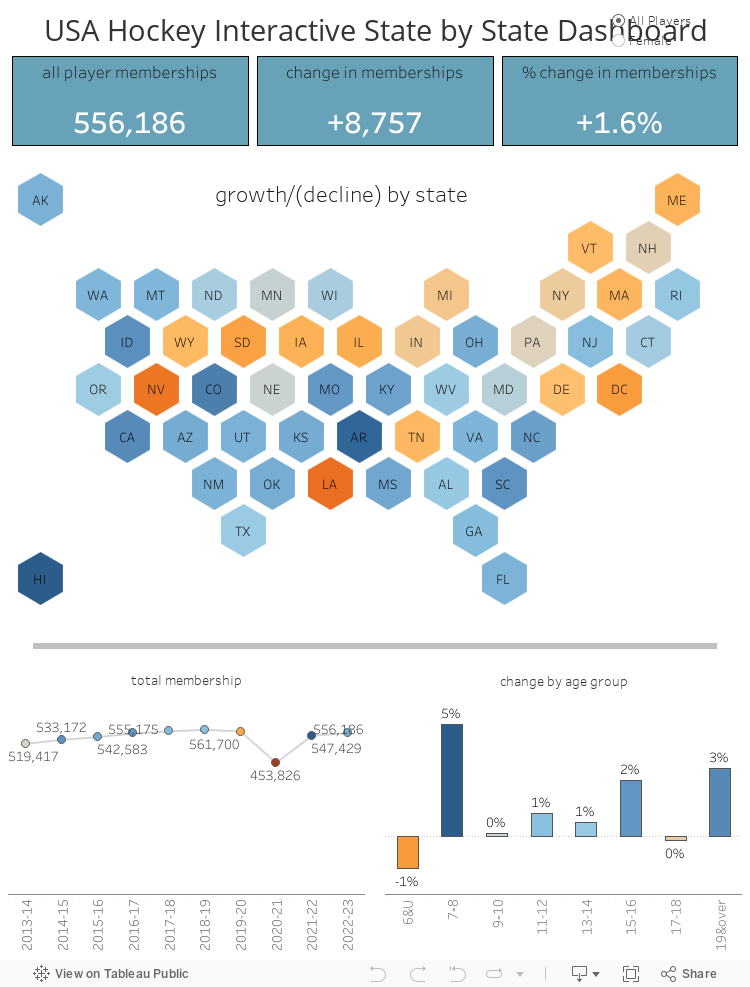
Late last week, USA Hockey released its annual player membership report that breaks down total memberships by state and age group. Over the years, I’ve used this report as a barometer to check on the overall growth or decline of hockey participation across the United States. Let’s break down the numbers.
Nationwide USA Hockey player memberships
Overall player memberships were up a modest 1.6 percent season over season, adding over 17,000 registered players during the 2022-23 hockey season compared to 2021-22. It is a positive sign that there was an increase season over season, but overall memberships have not fully recovered to pre-pandemic numbers.
Where hockey is growing
As we dig into the numbers a bit deeper, we can see that Colorado is the only state that saw double-digit percentage growth season over season. This is generally expected considering the Colorado Avalanche won the Stanley Cup in June, 2022. Playoff success tends to create an influx of hockey memberships in the following season.
What is also fascinating is that Nevada had the largest decline season over season, down 7 percent from 2021-22. This is probably in part due to the Vegas Golden Knights’ failure to make the 2022 Stanley Cup Playoffs for the first time in franchise history. We should expect a significant increase of memberships during the 2023-24 season in that market after the Golden Knights were crowned the Stanley Cup champions of 2023.
It should also be noted that the success of NHL teams is not the only way states see increases or decreases in their USA Hockey player memberships. Other factors may include the number of hockey facilities opening or closing, plus and the leadership and marketing capabilities of youth hockey organizations that can really drive growth or decline in player memberships.
If you look at the growth and decline by age group, you can see the seven-to-eight-year-old category had the largest increase season over season, but six and under saw the largest decline.
Female hockey continues to outpace overall memberships
Looking specifically at the female category, we see that the growth across female USA Hockey memberships is up almost 4 percent season over season. Over the last 10 years, female hockey has tended to be the most consistent contributor in the overall growth of USA Hockey memberships. Female hockey memberships represent about 16 percent of all USA Hockey player memberships per season.
When evaluating the female category by age group, all but the six-and-under age group saw substantial growth season over season.
Washington State USA Hockey members
As illustrated above, we saw that Washington state had the 16th-highest increase season over season from a percentage standpoint, but when we look at it by volume, we see Washington state had the eighth-highest growth with 473 additional hockey players enrolled in 2022-23.
Except for the pandemic season of 2020-21, Washington state’s player membership growth has remained consistent over the last 10+ seasons.
In terms of percentages, you can see growth up and down the age categories, but the largest volume growth was from the adult category. This also happens to be the biggest number of registrants.
Overall, the growth of USA Hockey memberships in Washington state is good news, but it is a bit underwhelming considering the Seattle Kraken are in just their second season in the state. As we have seen in other states, we should expect another growth spurt next season due to the success of the Kraken’s 2022-23 NHL season and playoff run.
Interactive dashboard
If you’d like to look at a state-by-state breakdown of the USA Hockey memberships, I’ve created an interactive dashboard where you can drill down by state. If you have any problems or have any questions, please let me know.
If you have questions, thoughts, or theories on the USA Hockey memberships, please leave them in the comment section.
On this week’s episode of the Sound Of Hockey Podcast, Chris Peters returns to give his expectations for the upcoming NHL Entry Draft and to talk through the Kraken prospect pool. As always, tons of great insights from Chris, a *very good* friend of the pod.
Aside from the interview with Chris Peters, there’s plenty of great conversation on this show between John and Darren, who open the episode by breaking down William Karlsson’s phenomenal Stanley Cup parade performance, before shifting into Kraken news.
They then go Down on the Farm, give a robust WHL Update, and eventually give some tidbits about the Stanley Cup Final.
The Seattle Thunderbirds raised eye brows all across the hockey world this season when they acquired star player after star player, making no bones about the fact they were all in to win a WHL championship and—perhaps—a Memorial Cup as the best team in the entire CHL.
To the surprise of nobody, the T-Birds rolled through the WHL Playoffs before coming up just one game short of major junior hockey’s ultimate prize; the Quebec Remparts got that glory, beating Seattle 5-0 in the Memorial Cup Final. Still, the 2022-23 Thunderbirds will go down in history as one of the best junior hockey teams ever assembled.
“We’ve had really special groups of people in the past, and this was a special group of people too,” said Thunderbirds general manager Bil La Forge. “But I think that talent level on the ice every night was beyond anything I’ve seen in my years in this league.”
“Special” is an understatement. By the end of the season, La Forge had constructed a roster that featured 10 players who had already been drafted by NHL teams, including a whopping five players that had been selected in the first round of the NHL Entry Draft. The team went 54-11-3 in the regular season, then cruised through the playoffs, losing just three games en route to hoisting the Ed Chynoweth Cup.
How did the Thunderbirds go about building such an exceptional roster? Sound Of Hockey spoke with La Forge to find out.
A powerhouse five years in the making
La Forge and his staff begin planning their depth charts five years in advance. With the ages of players in the WHL ranging from 16 to 20, and a limit of three 20-year-old players on each team, the proverbial prime of a junior hockey player’s career comes when he hits age 19. So when Seattle is able to draft a group of talented, young players that are all going to turn 19 in the same season, La Forge knows that core of players could have a chance to make a run at a championship.
La Forge saw early in their WHL careers that 2003-born forwards like Lucas Ciona, Reid Schaefer, Sam Popowich, and Mekai Sanders, plus defenseman Jeremy Hanzel and goalie Thomas Milic, had potential as a group to grow into a winner.
Thomas Milic posted a .928 save percentage in 33 regular-season games for the Thunderbirds. (Photo/Brian Liesse)
“I think you really start to target a group when you see them enter their 16-year-old season,” said La Forge. “We thought that was a really impressive draft, and that was something that we could build off of going forward and target that team to be a championship team when they were 19.”
Success can’t just come from one age group, though, so to build a strong foundation, a team needs to find success in the WHL Bantam Draft multiple years in a row. La Forge’s scouting staff did just that by layering in ’04-born players like Jordan Gustafson, Nico Myatovic, and Kevin Korchinski to support that class of ’03-born players.
La Forge’s early assessment of the ’03 group bore out during their 18-year-old seasons. In 2021-22, the Thunderbirds rolled all the way to the WHL Championship Series before losing to the Edmonton Oil Kings, who were led by Dylan Guenther and Luke Prokop.
“I think last year was probably a year earlier than most expected,” said La Forge. “We were confident in our group, but it’s tough to win in this league with a group of 18-year-olds.”
Making such a deep playoff run at that stage proved to La Forge that the time was nigh to go all in for 2022-23.
All the pieces “fall into place”
The series loss to Edmonton in 2021-22 also taught La Forge a valuable lesson about what his club had and what it needed to get over the hump. He saw the Oil Kings rolling out three lines of players that could theoretically play on a top line in the WHL, and he didn’t think the Thunderbirds quite had that kind of depth.
Dylan Guenther had 28 points in 19 playoff games for the Thunderbirds. (Photo/Brian Liesse)
So, in 2022-23, he set out to add star power to the top of his lineup, both on offense and defense, through a series of low-risk, potentially high-reward trades. He targeted a trio of players that had already moved on to the pro ranks but still had WHL eligibility in Prokop, Guenther, and Brad Lambert, hoping at least one or two of the three might get sent back to juniors.
Being that there was a real possibility the players would never play for the Thunderbirds, La Forge was able to swing conditional deals. For example, on the Guenther trade, Seattle sent the rights to 2007-born forward Koji Gibson and a fourth-round pick in the 2024 bantam draft regardless of if Guenther got sent back by the Arizona Coyotes. Once he did get sent back, then Edmonton received six additional draft picks spread over the next four seasons.
Lo and behold, all three players ended up with the Thunderbirds before the end of the season.
“We felt that in those deals, we got maybe a better price point than we would have, had those guys already been in the league,” said La Forge. “I think a lot of things had to fall into place for us, and they did, so that was really exciting.”
During the season, La Forge also swung trades for forward Colton Dach, who had gotten injured in the World Junior Championship but was expected to return before the end of the season, and star defenseman Nolan Allan. After all these deals had been done, La Forge knew his group—which now featured 10 forwards that could play in the top six—had perhaps even more depth than what he had seen from Edmonton the year prior.
“With Lambert, Guenther and Dach, we brought in an entire top line,” said La Forge. “And they didn’t play together, but they were three guys that were first-line players.”
Pro-caliber players join the mix
Lambert and his blazing speed came to the T-Birds after turning heads at Winnipeg Jets training camp and playing 14 games with the Manitoba Moose of the AHL. Prokop—one of the keys to Edmonton’s success in 2021-22—had played for the ECHL’s Norfolk Admirals to start the season.
Luke Prokop went to the Memorial Cup for his second consecutive season after being acquired by the Thunderbirds from Edmonton. (Photo/Brian Liesse)
The jewel in the crown, though, was Guenther. The No. 9 overall pick by the Arizona Coyotes in 2021 racked up 91 points in 59 games for the Oil Kings last season, then made Arizona’s NHL roster out of training camp.
La Forge had his eye on Guenther at the beginning of the season, in case any indicators popped up that he might be headed back to the WHL. It is common for star WHL players to play nine games in the NHL, then get sent back before a team burns the first year of the player’s entry-level contract. Guenther was proving he belonged in the NHL, though, so the Coyotes kept him around.
But there is a second 40-game marker that accelerates a player’s path to unrestricted free agency. La Forge had no firsthand knowledge of what the plan was with Guenther, but he had heard rumblings that maybe the Coyotes didn’t want to hit that 40-game threshold. So he pulled the trigger on the conditional deal with the Oil Kings, just in case. Sure enough, after 39 games and 15 points in the NHL, Guenther joined the Thunderbirds, primed to make a run at the Memorial Cup.
WHL Champions, one game short of the Memorial Cup
The end of the junior hockey season is always interesting. Teams battle through four rounds of playoffs within their own league, and then the winners go on to a rapid-fire round-robin tournament to try to earn the title for all of Canada. Winning the WHL then coming up one game short of the Memorial Cup leaves a bittersweet taste.
“Obviously, we wanted to get one more win,” said La Forge. “That’s the goal at the start of every year is to win the Memorial Cup, but to get there, you have to accomplish all the things we did in advance of that. So I’m still really proud of everything we accomplished, but there’s still one more piece we want to go get eventually.”
While La Forge is proud of the many achievements, he isn’t satisfied with the work his club did this season. He said after they lost the final game to Quebec on a Sunday, he and his staff went back to work planning for the future that Monday.
The Thunderbirds will lose a lot of outstanding players before next season, as Prokop, Guenther, Allan, Dach, Milic, Ciona, Jared Davidson, Kyle Crnkovic, and others will all move on to the next stages of their respective careers. But that’s junior hockey. It’s a developmental league that continues to cycle players through to help them get to the next level.
La Forge still has confidence that his team can be competitive next season, with players like Korchinski, Gustafson, Gracyn Sawchyn, and Scott Ratzlaff returning. He also has high hopes for up-and-comers like Coster Dunn and Simon Lovsin.
“They’re going to be the next group that carries us,” La Forge said.
Darren Brown
Darren Brown is the Chief Content Officer at soundofhockey.com and the host of the Sound Of Hockey Podcast. He is a member of the PHWA and is also usually SOH’s Twitter intern (but please pretend you don’t know that). Follow him @DarrenFunBrown and @sound_hockey or email darren@soundofhockey.com.
Welcome to year two of the Sound Of Hockey Big Board for the NHL Entry Draft. It’s back and better than ever.
What is the Big Board? It’s a compilation of reputable draft analyst and public scouting service lists and an overall composite ranking built on those lists. We gathered ranking data from 19 sources.
Then we consolidated those various ranks into a single composite ranking by a weighted geometric mean calculation. Why do we use geomean? Read up here. Weights were assigned based on our assessment of the depth of experience, sourced reporting, or scouting insight factored into the component lists themselves. Bob McKenzie’s list will be weighted heavily when it is added, for example.
In addition we have compiled rankings from several data and analytics sources. By a similar weighted geomean process, we then tabulated those into a separate “analytics” ranking for each of these prospects. The main composite ranking referenced above is built from the primary scouting sources only.
I included my own rough NHLe calculations as a source on the Big Board, but those numbers are factored into these rankings at very low weight and only become significant for prospects who are unranked by any other source. I explained why I did this in an earlier post.
Finally, the Sound Of Hockey Big Board provides information on each player’s measurements, statistics, and playing experience in the 2022-23 season, mostly drawn from Elite Prospects, NHL Central Scouting, and the NHL Draft Combine. In fact, based on what we have seen, we believe the Big Board is the most comprehensive single source in providing this information anywhere.
And the Big Board provides all of this for almost 7000 draft eligible prospects. (That is not a typo. Last year the Big Board covered almost 700 prospects. This year it is almost 7000.)
So, without further ado, you can find the Sound Of Hockey Big Board in Google Sheets HERE.
Important note on using the Sound Of Hockey Big Board: If you want to filter the data by various categories, highlight row 3, then select “Data,” “Filter Views,” and “Create New Temporary Filter View.” This will allow you to manipulate the data in a way visible only to you.
Here is a snapshot of top 64 prospects in the 2023 NHL Entry Draft, sorted by the overall composite rank:
Rank
Name
2023 Team
2023 League
Position
Hand
1
Connor Bedard
Regina Pats
WHL
C
R
2
Adam Fantilli
Univ. of Michigan
NCAA
C
L
3
Leo Carlsson
Örebro HK
SHL
C
L
4
Matvei Michkov
SKA St. Petersburg
KHL
RW
L
5
Will Smith
USNTDP
USNTDP
C
R
6
Zach Benson
Winnipeg Ice
WHL
LW
L
7
Ryan Leonard
USNTDP
USNTDP
RW
R
8
Dalibor Dvorsky
AIK
HockeyAllsvenskan
C
L
9
Oliver Moore
USNTDP
USNTDP
C
L
10
David Reinbacher
EHC Kloten
NL
D
R
11
Axel Sandin Pellikka
Skellefteå AIK
SHL
D
R
12
Matthew Wood
Univ. of Connecticut
NCAA
RW
R
13
Colby Barlow
Owen Sound Attack
OHL
LW
L
14
Gabe Perreault
USNTDP
USNTDP
RW
L
15
Nate Danielson
Brandon Wheat Kings
WHL
C
R
16
Dmitri Simashev
Lokomotiv Yaroslavl
KHL
D
L
17
Eduard Sale
HC Kometa Brno
Czechia
LW
L
18
Brayden Yager
Moose Jaw Warriors
WHL
C
R
19
Samuel Honzek
Vancouver Giants
WHL
LW
L
20
Tom Willander
Rögle BK J20
J20 Nationell
D
R
21
Quentin Musty
Sudbury Wolves
OHL
LW
L
22
Calum Ritchie
Oshawa Generals
OHL
C
R
23
Daniil But
Lokomotiv Yaroslavl
KHL
LW
R
24
Otto Stenberg
Frölunda HC
SHL
C
L
25
Andrew Cristall
Kelowna Rockets
WHL
LW
L
26
Gavin Brindley
Univ. of Michigan
NCAA
C
R
27
Mikhail Gulyayev
Omskie Yastreby
MHL
D
L
28
Riley Heidt
Prince George Cougars
WHL
C
L
29
Bradly Nadeau
Penticton Vees
BCHL
LW
R
30
Oliver Bonk
London Knights
OHL
D
R
31
Ethan Gauthier
Sherbrooke Phoenix
QMJHL
RW
R
32
David Edstrom
Frölunda HC J20
J20 Nationell
C
L
33
Lukas Dragicevic
Tri-City Americans
WHL
D
R
34
Gracyn Sawchyn
Seattle Thunderbirds
WHL
C
R
35
Michael Hrabal
Omaha Lancers
USHL
G
L
36
Jayden Perron
Chicago Steel
USHL
RW
R
37
Tanner Molendyk
Saskatoon Blades
WHL
D
L
38
Oscar Fisker Molgaard
HV71
SHL
C
L
39
Kasper Halttunen
HIFK
Liiga
RW
R
40
Nick Lardis
Peterborough Petes
OHL
LW
L
41
Anton Wahlberg
Malmö Redhawks
SHL
C
L
42
Theo Lindstein
Brynäs IF
SHL
D
L
43
Charlie Stramel
Univ. of Wisconsin
NCAA
C
R
44
Koehn Ziemmer
Prince George Cougars
WHL
RW
R
45
Trey Augustine
USNTDP Juniors
USHL
G
L
46
William Whitelaw
Youngstown Phantoms
USHL
RW
R
47
Beau Akey
Barrie Colts
OHL
D
R
48
Carson Rehkopf
Kitchener Rangers
OHL
LW
L
49
Luca Cagnoni
Portland Winterhawks
WHL
D
L
50
Caden Price
Kelowna Rockets
WHL
D
L
51
Danny Nelson
USNTDP
USNTDP
C
L
52
Etienne Morin
Moncton Wildcats
QMJHL
D
L
53
Alex Ciernik
Södertälje SK
HockeyAllsvenskan
LW
L
54
Carson Bjarnason
Brandon Wheat Kings
WHL
G
L
55
Hunter Brzustewicz
Kitchener Rangers
OHL
D
R
56
Lenni Hameenaho
Ässät
Liiga
RW
R
57
Aram Minnetian
USNTDP
USNTDP
D
R
58
Maxim Strbak
Sioux Falls Stampede
USHL
D
R
59
Kalan Lind
Red Deer Rebels
WHL
LW
L
60
Aydar Suniev
Penticton Vees
BCHL
LW
L
61
Luca Pinelli
Ottawa 67’s
OHL
C
L
62
Nico Myatovic
Seattle Thunderbirds
WHL
LW
L
63
Easton Cowan
London Knights
OHL
RW
L
64
Roman Kantserov
Stalnye Lisy Magnitogorsk
MHL
RW
L
Rankings sources
Here are the scouting sources sources we used (so far) in building the Big Board:
NHL Central Scouting (link): 453 prospects split into 4 separate lists
Elite Prospects (link) (top 32 free; full list $$): 136 ranked prospects
McKeen’s (link) (top 32 free; full list $$): 224 ranked prospects
At this point, a few more words on the Big Board and its uses are likely in order.
First, when you click through to the full composite draft board (here is another link), you will see that many of the individual rankings are grayed out beyond the top handful. This is because those rankings are behind a paywall. To get to Corey Pronman’s full ranking of prospects, for example, a subscription to The Athletic is required. While we utilized all of the individual rankings listed above to develop our composite list, we will not be sharing subscriber-only individual rankings in the public version of the composite big board.
Second, the Big Board does not reflect our view on these prospects. We at Sound Of Hockey have read reports, watched some videos, and crunched a few numbers. I’ll be putting up a few thoughts of my own before the draft, but that is not what this exercise is about. The Big Board is simply a tabulation of the rankings of others. A player’s ranking has nothing to do with whether any of us here “like” the player or not. (I can assure you that, personally, I like Thunderbirds goalie Thomas Milic very much, for example.)
Third, and finally, it bears emphasis that a “composite” ranking is not the be-all and end-all. In many ways, finding the “best” public list and trusting it is preferable. A consensus board cannot explain why one prospect is ranked higher than another, and it certainly cannot displace the work of scouts or draft reporters.
But a composite ranking can provide some added information. Think of it as the cherry on top of the sundae, not the sundae itself.
How so? Last year I used the case of Brad Lambert as an example. This year Andrew Cristall could be an instructive case. Both players are talented but viewed as risky and had widely varying rankings on individual public boards. How do we synthesize that information? A composite approach can exploit the wisdom of the crowd. Cristall’s final ranking may blend the upside and risk, placing him in a “fair” or “expected” position.
Local connections in the draft
For a team already loaded with drafted prospects, the Sound Of Hockey Big Board sees six more Seattle Thunderbirds having their names called during the 2023 NHL Draft:
C Gracyn Sawchyn (ranked No. 34 on the Big Board)
LW Nico Myatovic (No. 62)
G Scott Ratzlaff (No. 88)
G Thomas Milic (No. 171)
LD Jeremy Hanzel (No. 175)
LD Sawyer Mynio (No. 198)
This projection of six drafted players would trail only the U.S. National Team Development Program in total draftees. This is yet further confirmation of the remarkable team GM Bil La Forge has assembled. (More coming on that soon. Yes, that’s a tease.)
Beyond the Thunderbirds, there should be no shortage of local connections in the draft. One of the top defensemen in the draft is Lukas Dragicevic of the Tri-City Americans (No. 33). G Tomas Suchanek (No. 151) also has chance to get drafted from the Americans. C Tommaso De Luca (No. 168) and D Sage Weinstein (No. 206) of the Spokane Chiefs have a shot. And, from the Everett Silvertips, C Austin Roest (No. 172) is a good bet to be drafted as well.
Final thoughts
The 2023 NHL Draft kicks off in just two weeks, on June 28, 2023, at 4:00 p.m. PT. In the meantime, here again is a link to the 2023 Sound Of Hockey Big Board. Bookmark it, share it, and consult it between now and the draft. Keep it close by during the draft itself because the data in it is a pretty strong indicator of what the Kraken (and other teams) will do. In the meantime, similar to last year, we’ll return before the draft with some opinions on Big Board value targets and with a Seattle Kraken mock draft.
The 2023 NHL Scouting Combine took place in Buffalo, N.Y., from Monday through Saturday of last week. 106 draft-eligible prospects attended. One aspect of the combine is a battery of physical measurements and tests that afford teams further data on these top prospects. The information can be useful for teams in cross-referencing their existing evaluations of a player’s on-ice physicality and athleticism.
Unfortunately, the NHL does not disseminate the full results. Annually, Mark Scheig of The Hockey Writers does Herculean work tabulating as many height and weight measurements as he can. (This year he captured more than 100.) For the other measurement (wing span) and all of the physical tests, the NHL publishes to the public only top-25 rankings (and even then in relatively difficult-to-use format). Only the teams know the full results below that.
We collected all publicly available combine data and built a sortable chart,HERE. As far as we know, this information is not available in this comprehensive, searchable form anywhere else.
Important note on using this combine data: If you want to filter the data by various categories, highlight row 3, then select “Data,” “Filter Views,” and “Create New Temporary Filter View.” This will allow you to manipulate the data in a way visible only to you
For each test listed, you will see the available results and the rank position among combine participants. (For a primer on the tests themselves, check out this recent article.)
In addition, we included two composite score rankings for each of the combine participants, derived on the geomean of the player’s ranking in the various tests. The overall ranking includes all size measurements and athletic testing. The “athletic testing only” rank gives a ranking that excludes the size measurements.
Now, a word on the limits of this dataset: Since we only have top-25 results for most tests, we do not even know if all prospects participated in each test. A player may be dealing with an injury, for example, or simply decline to participate, and we would have no way to distinguish that in the publicly available data from a player who participated but performed around group average or worse. I would imagine the full data is most useful to teams in identifying players with “red flags” in their athletic profile. But since we have only top-25 data in most categories, this data is most useful in identifying positive outliers. Who were the players that performed exceptionally well? (Beyond that, I would caution against parsing the results too closely, as I am not sure there is any indicative difference between a top-30 performer and a top-50 performer, for example.)
Let’s get into a few of the top performers and some Seattle Kraken-related takeaways.
Combine is most useful for the interviews
The bulk of the week in Buffalo is allocated to meeting time between teams and players. More so than the athletic testing, this is by far the most important aspect of the combine. Teams have long studied the players on the ice, but may not have had the opportunity for in-depth conversations with the person. This is their chance, with many top prospects reporting that they speak with twenty-plus teams during the week.
As an example, according to Mark Scheig, the Kraken spoke with Kitchener Rangers right-handed defender Hunter Brzustewicz, a player projected to go in the mid-second round. (A strong performer in my analytics ranking, it happens I have been mock drafting him to the Kraken frequently.)
Hunter Brzustewicz spoke to 18 teams this week which include Seattle and #CBJ. He says his shot mentality is his biggest area of focus for improvement. pic.twitter.com/Lqvf3OdrHp
Guelph Storm (OHL) right-handed defenseman Cameron Allen and Vancouver Giants (WHL) winger Samuel Honzek stood out as the two top-of-class athletic performers at the combine.
Allen was a highly touted defender coming into this season, but an up-and-down year sent him tumbling down draft boards. He is currently ranked 77th on the forthcoming Sound Of Hockey Big Board, and his analytics ranking is even lower. This was a necessary performance for Allen to prompt teams to think back to the raw, talented prospect they had envisioned at the beginning of the season. I will be watching to see if this performance halts his slide down draft boards.
Unlike Allen, Honzek has seen his stock on the rise this year. A hulking winger with some scoring touch, he is currently ranked No. 22 on the Sound Of Hockey Big Board (and No. 21 in my personal analytics ranking).
For the Seattle Kraken and the 20th overall pick, Honzek’s profile is intriguing in comparison with Andrew Cristall, the current No. 25 player on the Big Board (and No. 10 in my personal analytics ranking). Honzek is a big, loud, toolsy player with strong production.
Cristall, on the other hand, is relatively small at 5-foot-9.5, possesses just average speed, and did not place in the top 25 in any of the athletic tests at the combine. Yet, his CHL production was elite, far outpacing Honzek, and Cristall is generally viewed as something of an offensive savant. Indeed, consensus No. 1 pick Connor Bedard has called Cristall the smartest player he’s ever played with.
If the Seattle pick came down to Honzek or Cristall, which player would Seattle prefer? The combine got me thinking about that question.
Some smaller players may have answered questions
It is a common refrain when we hear from team scouts that smaller players without elite speed or athletic traits often are ranked lower by NHL franchises internally than they are on public lists. These players are viewed as less likely to successfully transition their game to the NHL level if they cannot be counted on to win with either speed or physicality.
Accordingly, a sterling combine could be a boon to a smaller player. This year a pair of sub-5-foot-11 players posted strong results. Bradly Nadeau of the Penticton Vees (BCHL) and Easton Cowan of the London Knights (OHL) stood out positively. Nadeau is currently ranked 31st on the Sound of Hockey Big Board and Cowan is ranked 72nd.
Nadeau’s performance, in particular, piqued my interest from a Seattle Kraken vantage point. There likely won’t be a player (short of Cristall, perhaps) who carries as much offensive upside as Nadeau when the Kraken pick in the first round.
Nadeau absolutely obliterated the BCHL this season, posting more than two points per game. Yet, the lower level of competition (when compared with the WHL, for example) leaves many scouts with unanswered questions about just how well his game will translate. And these questions were magnified by questions about how well his skating and athletic traits would translate at his smaller size. The combine may have at least partially answered some concerns falling in the latter category.
The draft’s top-ranked goaltender may also be its most athletic
Michael Hrabal of the Omaha Lancers (USHL) has emerged as the top goaltender in this class on many public draft boards, and he ranks as the first goalie, and No. 38 overall, on the current iteration of the Sound Of Hockey Big Board. He may have added some fuel to the fire in Buffalo by posting impressive athletic numbers to go with a 6-foot-6.75 frame. At this point, a pick at the end of the first round or early in the second round seems likely for Hrabal.
Next up: The Sound Of Hockey Big Board
Next you hear from me, we’ll be publishing version 1.0 of the 2023 Sound Of Hockey Big Board. Not every scouting or analytics list is available yet, but there is a critical mass at this point, and we can’t wait to share the results. As we did last year, we will continue to update the Big Board as more data roles in.
The Sound Of Hockey Podcast is thrilled to welcome back Joey Daccord for his third appearance on the show, as he prepares for the AHL Calder Cup Final with the Coachella Valley Firebirds. The always affable Daccord shares his memories from his stints with the Kraken this season and talks about how exciting this run through the AHL playoffs has been. You won’t want to miss this interview.
Aside from the conversation with Joey, John and Darren welcome Curtis back to the studio for the remainder of the show. The trio meanders through various topics on this episode, from the Thunderbirds and their exciting trip to the Memorial Cup to what’s happening in the Stanley Cup Final. Plus, talk about coach hirings, the recent Gary Bettman presser, and more.
The Sound Of Hockey Podcast is thrilled to welcome back Joey Daccord for his third appearance on the show, as he prepares for the AHL Calder Cup Final with the Coachella Valley Firebirds. The always affable Daccord shares his memories from his stints with the Kraken this season and talks about how exciting this run through the AHL playoffs has been. You won’t want to miss this interview.
Aside from the conversation with Joey, John and Darren welcome Curtis back to the studio for the remainder of the show. The trio meanders through various topics on this episode, from the Thunderbirds and their exciting trip to the Memorial Cup to what’s happening in the Stanley Cup Final. Plus, talk about coach hirings, the recent Gary Bettman presser, and more.
The buzzer rang. Streamers cascaded down at American Airlines Center in Dallas. It was May 15, 2023, and the Seattle Kraken’s chase for the Stanley Cup had come to a sudden end upon a 2-1 loss in Game 7 of the second playoff round to the Dallas Stars. The Kraken had exceeded every expectation set for them, but the story of their 2022-23 season was at its end (at least at the NHL level).
As that book closed, however, a new one opened: the 2023 offseason. Three days later, at the team’s end-of-season press availability, Seattle Kraken GM Ron Francis said the front office would soon start meeting to evaluate the team’s internal free agents. “We’ve got some decisions to make there,” said Francis. “We’ll work through those over the next few days here to make sure that we’re all comfortable with the direction we want to go and address it accordingly.”
Then, at the May 31 press conference to announce his own contract extension, Francis followed up to say, “We’re rolling up our sleeves and getting into [discussion on Seattle’s players] now, and hopefully we’ll have a much clearer picture by July 1st.”
What are the key decisions that need to be made on Seattle’s own players? What will inform those decisions? And when is the deadline for actions to be taken? Let’s dive in.
The state of the Seattle Kraken roster
The Kraken enter this offseason with 10 forwards projected to be on the 2023-24 opening night roster already under contract. That number rises to 11 if you include Tye Kartye, whose postseason run made quite the impression on fans and the front office alike.
Ryan Donato and Joonas Donskoi are unrestricted free agents. Morgan Geekie and Daniel Sprong are restricted free agents with arbitration rights. (For an explainer on these free agent classifications and the logistics of NHL free agency, see the appendix at the bottom of this post.)
Matty Beniers, Eeli Tolvanen, Alex Wennberg, and Jordan Eberle will be entering into the final years of their existing contracts in 2023-24, which means that those players will be eligible to receive extensions to their current contracts on July 1, 2023.
On the blue line there is a little more uncertainty, but still a number of players under team control; Adam Larsson, Jamie Oleksiak, Justin Schultz, and Jaycob Megna are all signed, though Megna is not necessarily a certainty to be on the opening night roster. Vince Dunn, Will Borgen, and Cale Fleury are all restricted free agents with arbitration rights. And Carson Soucy is an unrestricted free agent. Schultz and Megna are entering their final seasons and theoretically could be extended.
In goal, Philipp Grubauer and Chris Driedger are signed for 2023-24, with Driedger entering his final year and eligible to be extended. Martin Jones is an unrestricted free agent, as is Joey Daccord, who qualifies as a “Group 6” unrestricted free agent. (More on this in the appendix below.)
Assuming Driedger is on the NHL roster, based on the list of signed players above only (i.e., not counting Tye Kartye, for example), the Kraken have $19,193,424 in cap space going into the 2023-24 season to sign additional players.
Finally, here is a look at the offseason contract status of key players on the Calder Cup Final-bound Coachella Valley Firebirds. Kole Lind is a restricted free agent with arbitration rights. Alex True and Carsen Twarynski are “Group 6” unrestricted free agents, like Daccord. Shane Wright is listed here, but his immediate future remains murky.
The offseason timeline
For each restricted free agent, the Kraken have until Monday, June 30, at 2 p.m. PT to extend a qualifying offer. If an offer is extended, the player may sign the offer or continue to negotiate a different deal with the team.
Alternatively, the player may negotiate and accept an offer with another team (this is often called an “offer sheet”). The Kraken are afforded the opportunity to match an offer sheet from another team. If the Kraken decline that option, the team would likely receive some draft pick compensation based on the value of the contract signed. Right now, I don’t expect any Kraken restricted free agents to receive an offer sheet.
Since each Kraken restricted free agent this year is arbitration eligible, if Seattle extends a qualifying offer, the player(s) have the option to trigger an arbitration hearing to set their salaries. The hearing serves as a backstop to negotiations. The deadline for a player to invoke arbitration is July 5, at 2 p.m. PT. The team may itself trigger arbitration if it chooses before or after that date. Club-requested arbitration is far less frequent and can happen if the team is looking to obtain a salary decrease for a player. I don’t expect that with any of the Kraken restricted free agents.
If Seattle declines to extend a qualifying offer by the June 30 deadline, the player becomes an unrestricted free agent eligible to sign with any other club immediately.
All other unrestricted free agents become eligible to negotiate and sign a deal with a new club on July 1, at 9 a.m. PT. If an unrestricted free agent signs with another club there is no compensation to Seattle or required opportunity for Seattle to match the contract.
The decisions on Kraken free agents
How the Kraken elect to proceed with their free agents is informed by a number of variables, including the player’s market value, and, for restricted free agents with arbitration rights, the player’s likely award at an arbitration hearing. Let’s take a look at some projected numbers and then make some early predictions on what happens with these Kraken free agents.
First, amethodology note regarding my “Deep Sea Hockey” projections below: I used CapFriendly’s contract comparable tool to produce a list of comparable contracts for each Kraken free agent based on the following variables: position, age, points, and games played. This doesn’t capture the entirety of a player’s value, of course, but points tend to be predictive of free agent value. I then made minor manual adjustments to sync the values to the Kraken free agent’s statistical profile on a point-per-game basis. I then prorated the value of the contracts to the current salary cap environment, projected at $83.5 million for 2023-24. I then also used the sample of comparable contracts to predict a contract length.
Vince Dunn | LD | RFA (UFA in 2024) | 26 years old | 201 points in 421 NHL games
Vince Dunn is a restricted free agent with arbitration rights. He is one year from unrestricted free agency and coming off a year in which he was second in points for Seattle and 10th in points among all defenseman in the NHL. He is in line to ask for a very large contract, which makes him one of the important questions facing the front office this offseason.
Qualifying offer amount: one-year, one-way contract worth $4 million
Evolving Hockey free agent contract projection: 8 years, $8.15 million AAV
Deep Sea Hockey negotiated contract projection: 7 years, $8.35 million AAV
Deep Sea Hockey projected arbitration ruling: 1 year, $8 million AAV
Deep Sea Hockey gut prediction: Qualified. Negotiated deal at 7 years, $7.5 million AAV with Seattle.This will be a lengthy negotiation and both sides will need to give if they are going to reach this outcome. I suspect the Kraken aren’t comfortable with the full market projection contract for Dunn given his up-and-down production with the team. The highs have been No. 1 worthy but the lows remain troubling. $8 million (Dunn’s likely target) would put him t-15th in AAV in the league among defensemen. The Kraken would likely prefer the number to be lower. If they can’t see eye-to-eye, I don’t think anything is off the table. Dunn’s agent is notorious for driving a hard bargain. Still, I tentatively think both parties bend at the end of the day to get this contract signed.
Vince Dunn handles the puck at Climate Pledge Arena. (Photo/Brian Liesse)
Daniel Sprong | RW | RFA (UFA in 2024) | 26 years old | 116 points in 268 NHL games
Daniel Sprong is a restricted free agent with arbitration rights. He is one year from unrestricted free agency and coming off a year in which he was tied for third in goals for Seattle with 21. On a per-minute basis, he was one of Seattle’s most productive offensive players, though critiques of his 200-foot game remain.
Qualifying offer amount: one-year, one-way contract worth $787,500
Evolving Hockey free agent contract projection: 3 years, $3.2 million AAV
Deep Sea Hockey negotiated contract projection: 2 years, $3 million AAV
Deep Sea Hockey projected arbitration ruling: 1 year, $3 million
Deep Sea Hockey gut prediction: Not qualified or traded to a team interested in Sprong in a top-nine role, Sprong ultimately signs a 1 year, $2.25 million with another team. It won’t be easy to replace Sprong’s goal production, particularly on the power play, but I keep bumping against the fact that he was not able to crack a top-nine role with Seattle with any regularity. That is where his skill would deliver the most value and Seattle never did it, which suggests to me that they still don’t see an elevated future for him, given the current depth chart. At the number he’s likely to command this offseason, it’s just too difficult to fit him in the salary structure and still improve the team.
Morgan Geekie | C | RFA (UFA in 2026) | 24 years old | 116 points in 268 NHL games
Morgan Geekie is a restricted free agent with arbitration rights. He is three years from unrestricted free agency and coming off a year in which he played a fourth-line center role for much of the season, though he elevated to a top-nine right wing role late in the season and in the playoffs with Andre Burakovsky injured. He was one of Seattle’s better players in the face-off circle and their only reliable righty in that role. He remains one of the younger players on the roster.
Qualifying offer amount: one-year, one-way contract worth $1.4 million
Evolving Hockey free agent contract projection: 2 year, $1.69 million AAV
Deep Sea Hockey negotiated contract projection: 2 years, $2.1 million AAV
Deep Sea Hockey projected arbitration ruling: 1 year, $1.8 million
Deep Sea Hockey gut prediction: 1 year, $1.8 million with Seattle. This is a tricky one too, as Geekie likely believes he has earned a raise over his previous salary, and he serves in a five-on-five role (right handed center) for which the Kraken don’t have another ready made alternative (except for perhaps Andrew Poturalski). He also has talent. That is clear. On the other hand, the production hasn’t taken a leap forward, and he hasn’t found a regular special teams role. Still only 24 years old, I don’t think the Kraken would prefer to move on, but it really depends on Geekie’s demands. If I were Seattle I’d go to him early and offer something along the lines of 2 years, $1.45 million AAV, or 1 year, $1.6 million AAV, with the implication that he may not be qualified otherwise due to arbitration risk. The production may not justify it, but it’s one more bet on his upside. That said, if push comes to shove, I think the team ultimately would qualify him to keep him for at least one more year.
Will Borgen | RD | RFA (UFA in 2024) | 26 years old | 28 points in 132 NHL games
Will Borgen is a restricted free agent with arbitration rights. He is one year from unrestricted free agency and coming off a year in which he moved up the lineup from a third-pair role to a second-pair role midway through the season. He does not reliably create offense but is a sound defender with flashes of puckhandling skill.
Qualifying offer amount: one-year, two-way contract worth $945,000
Evolving Hockey free agent contract projection: 2 year, $1.66 million AAV
Deep Sea Hockey negotiated contract projection: 2 years, $1.5 million AAV
Deep Sea Hockey projected arbitration ruling: 1 year, $1.8 million
Deep Sea Hockey gut prediction: Qualified. Signs 2 year, $1.8 million AAV deal with Seattle. (Author’s note: I edited this AAV upward after additional reflection.) GM Ron Francis already indicated to Ian Furness on JKR that Borgen will be qualified. That is an easy decision. Borgen’s metrics plateaued in the second half of last season, and I think he might be best deployed as the more physical, defensive-minded half of a third pair moving forward (perhaps with Ryker Evans?), but he also won’t break the bank. A two-year deal would give Borgen some stability and financial security. It would also allow him to hit the market again at 28 years old, an age at which defensemen are still at or near the prime of their defensive abilities and can be well compensated on the open market (see Soucy, Carson).One thing to keep an eye on: these projected financial values could be underselling Borgen’s market. Daily Faceoff has him projected at $2.5 – 3 million AAV, for example. I remember thinking Dunn’s last deal would be more like 2 years, $2.5 million AAV, and it came in much higher. Could history repeat?
Cale Fleury | RD | RFA (UFA in 2026) | 24 years old | 2 points in 62 NHL games
Cale Fleury is a restricted free agent with arbitration rights. He remains buried on the depth chart, seeing only 12 games worth of ice time this entire season. His ongoing value is as depth at position, right defense, where the organization does not have any other ready answers in the event of an injury.
Qualifying offer amount: one-year, two-way contract worth $787,500
Evolving Hockey free agent contract projection: 1 year, $778,500 (below the qualifying amount)
Deep Sea Hockey negotiated contract projection: 1 year, $787,500 (qualifying amount)
Deep Sea Hockey projected arbitration ruling: 1 year, $787,500 (qualifying amount)
Deep Sea Hockey gut prediction: Qualified. 1 year, $787,500 with Seattle. I suspect that the Kraken still like this player given his presence on the roster all season. When he has been in the lineup, he has looked like an “extra defenseman” level player out there, which is not a bad piece to have but also one that can be replaced. Still, he’s useful depth and a potentially a necessary piece for next season if (a) the team does not retain Carson Soucy, (b) the team does not sign a free agent defenseman, or (c) at camp it becomes clear Ryker Evans needs one more year in Coachella Valley.
Kole Lind | RW | RFA (UFA in 2026) | 24 years old | 8 points in 30 NHL games
Kole Lind has 37 goals (and counting) across 91 total AHL games this season. He leads the entire AHL in scoring in the Calder Cup playoffs with 23 points. He is potentially under team control for three more seasons, but if he doesn’t get regular NHL playing time next season (50+ games), he will qualify as a Group 6 unrestricted free agent next offseason.
Qualifying offer amount: one-year, two-way contract worth $892,500
Deep Sea Hockey negotiated contract projection: N/A
Deep Sea Hockey projected arbitration ruling: 1 year, $892,500
Deep Sea Hockey gut prediction: Qualified.2 year, $875,000 AAV with Seattle.Kole Lind was productive in the AHL this year and showed that he has the tools to be useful at the NHL level if he can consistently keep up with NHL pace (and if he keeps his agitator tendencies under control). At the least, I think he is worthy of a shot in a 12th or 13th forward role at the NHL level. A two-year deal rewards Lind for his season and could protect Seattle from losing him as a Group 6 free agent next offseason if he continues to be a borderliner NHL/AHL player.
Ryan Donato | LW | UFA | 27 years old | 135 points in 325 NHL games
Ryan Donato is an unrestricted free agent. He was part of a productive “fourth line” for the Kraken, tallying 14 goals in 71 games. Across his two-year stint with the team, he has 30 goals.
Evolving Hockey free agent contract projection: 2 year, $2.03 million AAV
Deep Sea Hockey negotiated contract projection: 2 year, $2.35 million AAV
Deep Sea Hockey gut prediction: 1 year, $1.5 million deal with another team.Unfortunately, Ryan Donato continues to find himself right on the margins of NHL status since he is not a conventional fourth line player but his skill level is just barely below what teams would want in their top-nine for a playoff push. If his market again does not materialize, I can imagine him coming back, but I suspect a “rebuilding” team will give him a contract to fill out their roster as a bridge to younger players. I don’t think he’ll actually get a contract at the level projected by me or Evolving Hockey.
Carson Soucy | LD | UFA | 28 years old | 68 points in 250 NHL games
Carson Soucy is an unrestricted free agent. He was Seattle’s third-pair left defenseman, a stalwart on the penalty kill, and the third defenseman in line to take a role on the power play.
Evolving Hockey free agent contract projection: 3 years, $2.59 million AAV
Deep Sea Hockey negotiated contract projection: 2 year, $2.4 million AAV
Deep Sea Hockey gut prediction: 4 year, $4 million AAV deal with another team.If his market is actually more in line with the projections, particularly mine, I think Seattle should be interested to bring Soucy back. But I think Soucy is a prime candidate to be “overpaid” on the free agent market. Soucy generated significant buzz at two consecutive trade deadlines, so it appears there is legitimate interest in the player around the league. Ultimately, I think he gets an offer that prices him out of Seattle’s desired range.
Joey Daccord | G | UFA | 26 years old | .884 save percentage in 19 NHL games
Joey Daccord is a “Group 6” unrestricted free agent. (For more on that status, check out the appendix below.) Daccord has not been able to generate strong results at the NHL level yet, but he is having a great season in the AHL. He was fifth in that league with .918 save percentage across 38 regular-season games. And he has been even better in the playoffs, recording a .924 save percentage in 19 playoff games. This run should help him in free agency.
Evolving Hockey free agent contract projection: 1 year, $775,000
Deep Sea Hockey negotiated contract projection: N/A
Deep Sea Hockey gut prediction: 2 year, $1,150,000 AAV one-way deal with Seattle. This projection is a bit out there, but here is my thought process: Joey Daccord has shown that, at the least, he can be a very good player and leader at the AHL level. Heading into free agency, the Kraken don’t have a clearly defined third goaltender on the depth chart. Signing Daccord to this deal gives the Kraken necessary depth in goal in the short term. If, ultimately, Daccord is sent back to Coachella Valley next year at cutdown time, the size of the commitment would make other teams more hesitant to claim him. And if he is sent down his salary can be completely “buried” and will not count on the NHL salary cap. On the other hand, if Daccord beats out Chris Driedger for the backup job in camp, Driedger could be sent through waivers; if unclaimed, the salary cap implications would be neutral since $1,150,000 of Driedger’s deal can be “buried” at the AHL level. On Daccord’s side of the equation, he gets significant security even if he has to wait one more year for a clear shot at a backup role.
Joey Daccord warms up at Climate Pledge Arena. (Photo/Brian Liesse)
Appendix: Free agency in the NHL
As discussed above, not all NHL “free agents” are the same. A player may be “unrestricted” or “restricted” and there are certain nuances to the player’s rights or eligibility under either status. Need a primer? Let’s get into those rules here.
Unrestricted free agency
An “unrestricted free agent” (UFA) is free to sign with any team without any compensation or right of first refusal held by the player’s former club. A player becomes an unrestricted free agent on July 1 if the player’s current contract has expired *and* the player qualifies under any one of three other criteria:
27 years old. The player is 27 years old as of the last day of the expiring contract (i.e., June 30).
OR
Seven accrued seasons. The player has seven “accrued” seasons of NHL experience as of the expiration of the contract. An “accrued” season is defined as a season in which the player was on an NHL club’s active roster for 40 regular season games (or 30 regular-season games for a goaltender). Time lost on injured reserve to injury incurred at the NHL level counts toward this “active roster” requirement for games during the season of the injury and the season thereafter.
OR
“Group 6” status. The player (i) is 25 years old as of the last day of the expiring contract (i.e., June 30), (ii) has completed three or more “professional seasons,” with “professional seasons” being defined as 11 games played or more games played if 18 or 19 years old and one or more games played if 20 years old or older in the NHL, AHL, or on loan in another European professional league, and (iii) the player, if a skater, has played fewer than 80 NHL games, or, if a goaltender, has played fewer than 28 games of 30-or-more minutes TOI. Players in this category are referred to as “Group 6” unrestricted free agents.
Additionally, a player may qualify as a UFA if the player is a restricted free agent, but the current NHL club does not tender that player a qualifying offer. Let’s get into what that means now.
Restricted free agency
If the player’s contract expires but the player does not meet one of the three numbered criteria set forth above to qualify for unrestricted free agency, the player is a “restricted free agent” (RFA).
The first decision point on a RFA is made by the NHL club, which must decide whether to extend the player a “qualifying offer.” A qualifying offer is an offer of a one-year contract, which remains open for 30 days, with the following minimum values at the NHL level:
If base salary in last year of expiring contract is less than or equal to $660,000: 110% of the last year base salary
If base salary in the last year of an expiring contract is greater than $660,000 or less than $1,000,000: 105% of the last year base salary, but not greater than $1,000,000.
If the base salary in the last year of an expiring contract is greater than $1,000,000: 100% of the last year base salary
The only potential exception to the rules above is, if the contract was signed on or after July 10, 2020, the qualifying offer may not exceed 120% of the *average* annual value of the expiring contract. This rule only becomes relevant for back-loaded contracts and is presumably designed to disincentivize contracts structured like Timo Meier’s deal moving forward.
The qualifying offer must be a “one-way” contract, meaning the player is paid the same salary whether at the NHL or AHL level if the player has played 180 NHL games within the last three years, 60 NHL games within the last year, or was claimed on waivers within the past year. Otherwise, the qualifying offer may be a “two-way” contract providing for a lower salary if the player plays at the AHL level.
If the current NHL club does not make the player a qualifying offer by June 25 at 2 p.m. PT, or the first Monday after the NHL Entry Draft at 2 p.m. PT, whichever is later, the player becomes an unrestricted free agent immediately. This year, the deadline is Monday, June 30, at 2 p.m. PT.
The consequence of the qualifying offer depends on the experience level of the player receiving the offer. There are three scenarios.
1. 10.2(c) Player. If the player has minimal professional experience, a qualifying offer renders the player ineligible to negotiate or sign with any other clubs. This is so-called “10.2(c)” status. The 10.2(c) player may sign the qualifying offer or negotiate a different deal with his current club only. What is the experience threshold? A player falls under 10.2(c) if he (a) signed his first contract at ages 18-21 and has played two or fewer seasons of “professional experience,” (b) signed his first contract between ages 22-23 and played one or fewer seasons of “professional experience,” or (c) signed his first contract at age 24 or older and has no seasons of “professional experience.” “Professional experience” is defined as 10 or more NHL games for 18-19-year-olds or 10 or more games in any professional league for players 20 years old or older.
2. RFA without arbitration rights. If the player has more experience than the 10.2(c) threshold, but less experience than is necessary to qualify for salary arbitration (see below), the player is an RFA without arbitration rights. The player may sign the qualifying offer, negotiate a different deal with his own club, or negotiate with other clubs. If the player accepts an offer of a contract from another club, the player’s current club is afforded the opportunity to match the contract and retain the player. If the current club declines to do so, it receives compensation from the signing team in the form of draft picks. The draft picks received (if any) are based on the value of the contract signed.
3. RFA with arbitration rights. If the player has significant professional experience, he may qualify for salary arbitration. Arbitration may then be elected either by the team or the player. Arbitration is a process by which a third party neutral will receive information from the team and the player and decide the contract that the player should receive. In most instances it is a one-year deal. A player qualifies for arbitration if he: (a) signed his first contract at ages 18-20 and has four or more seasons of “professional experience” (as that term is defined above), (b) signed his first contract at age 21 and has three or more seasons of “professional experience,” (c) signed his first contract at ages 22-23 and has two or more seasons of “professional experience,” or (d) signed his first contract at ages 24 or older and has one or more seasons of “professional experience.” An arbitration eligible player in receipt of a qualifying offer has until July 5 at 2 p.m. PT to notify the team he is electing arbitration. (There are different deadlines for the clubs to elect arbitration.) In the meantime, the player has all of the same rights to negotiate with his own team or other teams as described above, and if he should sign with another team, again, his team would have the opportunity to match or receive draft pick compensation for the player. This negotiation process is cut off only when the arbitrator makes a ruling. The arbitrator’s ruling becomes the value for the contract between the team and the player, except in certain high contract value scenarios in which the team may opt to disclaim the ruling and allow the player to become an unrestricted free agent.
We are now within four weeks of the NHL Entry Draft. This means we are close to the return of the Sound Of Hockey Big Board. Last year, we compiled public rankings from 19 draft reporters and scouting services and ranked 675 prospects.
In the coming weeks, I’ll have a bit more information on how the Big Board performed last year as a predictive tool. In short: It was a strong indicator of consensus in the top 100, but less so after that. The Big Board was particularly strong predicting first-round prospects. It accurately “predicted” 28 of 32 first-rounders, and the player the Big Board listed No. 32, Owen Beck, was selected with the first pick of the second round (No. 33). The other three players that “fell” out of the Big Board’s top 32 were No. 26 Jagger Firkus (whom Seattle scooped up at pick 35), No. 29 Ryan Chesley (drafted at pick 37 by the Capitals), and No. 30 Calle Odelius (drafted at pick 65 by the New York Islanders).
I’m hoping that the Sound Of Hockey Big Board will be better than ever this year. One respect in which I have tried to improve it is by lengthening the board. The board missed almost two dozen drafted players last year, and I wanted to get that number down into the single digits this year. That meant going beyond the players ranked on public lists and directly gathering data on players from more than 20 leagues around the world from Elite Prospects.
After gathering that data, I encountered a question: How was I going to “rank” the players that don’t appear on any public rankings? The best solution I could come up with was to create a purely data-driven ranking of my own to supplement the public rankings and provide some type of order for the additional prospects.
My baseline for this work was the concept of an “NHL equivalency.” What is an equivalency? To oversimplify, an equivalency is projected point production at the NHL level based on a conversion of the player’s point production in another league, such as the WHL. By studying the performance of players historically, analysts can come up with relative league strengths and then use those strengths for a per-game conversion. This is a very crude metric, but a draft pick’s historical point production has been proven again and again to be a strong indicator of future NHL point production. (For goaltenders, save percentage tends to be the metric used.)
While many have worked in this space, I built off of the work of TopDownHockey. I then tweaked the gross equivalencies I created with directional adjustments based on the draft eligible player’s (1) age, (2) height, and (3) redraft status. I did not choose these factors at random–all have been proven significant in projecting draft prospect success or failure. I also made position-based adjustments, since a point-per-game defenseman is rarer and arguably more valuable than a point-per-game forward.
This gave me a crude data-only “ranking” of thousands of draft eligible prospects. While it’s primary purpose will be, as I mentioned, to supplement the Big Board, I figured it would be fun to share it as a stand-alone list too, since we are in draft ranking season.
Before I get to that ranking, three more notes. First, this list does not contain any qualitative evaluations or adjustments from me. I have watched some of these players and have personal preferences, but I haven’t incorporated those here. Would I personally rank Connor Bedard No. 1? Yeah. When it comes to the draft, data is only a piece of the puzzle. Most importantly, the team needs scouting conviction on the player.
Second, the aspect of all of this I feel least confident about is the positioning of goaltenders relative to skaters. I normalized the goaltender scores so that the number of goaltenders ranked within the top 224 would approximate historical norms, but this process won’t account for whether this is a “good” goalie class or not. So, at the end of the day, the order of the goaltenders may be illuminating, but perhaps take their placement relative to the skaters with a grain of salt.
Third, before sharing this, I ran last year’s Big Board through the same equivalency process. The sample size of last year’s Big Board was smaller, but it still captured the vast majority of top prospects. The results were intriguing, particularly with respect to the Seattle Kraken.
Seattle had six picks in the top three rounds of the 2022 draft. Five of those six picks ranked within the top 40 overall in my equivalency calculation, with goalie Niklas Kokko being the only outlier. Later in the draft Tucker Robertson and Kyle Jackson were two of the very highest ranked re-entry candidates too. Beyond that, only the high schoolers (Barrett Hall and Ben MacDonald) were, somewhat predictably, not data-driven picks since their competition level was so low compared with other draft-eligible prospects.
All of this gives me confidence that the Kraken, at least, are using similar data to support their draft process. I’ll be keeping a close eye on the top-100 in this equivalency ranking on draft day when it comes time for selections by the Seattle Kraken.
Without further preamble, here is our data-only top 250 for the 2023 NHL Draft:
The full list will be part of the Big Board, but if you have a question about where a player not listed here is ranked, feel free to reach out in the comments below or on Twitter @deepseahockey.