
NHL Draft Dashboard


NHL DRAFT DAY IS UPON US!
Sound of Hockey is here to get you fully prepared for the NHL Draft, which will take place virtually on the evening of Tuesday, 10/6. Even if you get to this after the Draft, though, it should hold up pretty well, as you will learn about the guys that get selected.
The best way that Andy, John, and Darren know how to help bring you up to speed is to welcome back their best friend and ESPN prospect/draft guru, Chris Peters. Chris once again dazzles with his unmatched wealth of knowledge, and will leave you feeling like an expert.
On this episode, the guys also welcome Matthew Rempe, a 6’8″ prospect from the Seattle Thunderbirds who has a solid shot at getting selected. Matthew brings some serious bulletin board material in his interview.
Plenty of NHL transactions to discuss this week as well.
Segments include Weekly One-Timers and Tweets of the Week.
SUBSCRIBE! ENJOY! REVIEW!

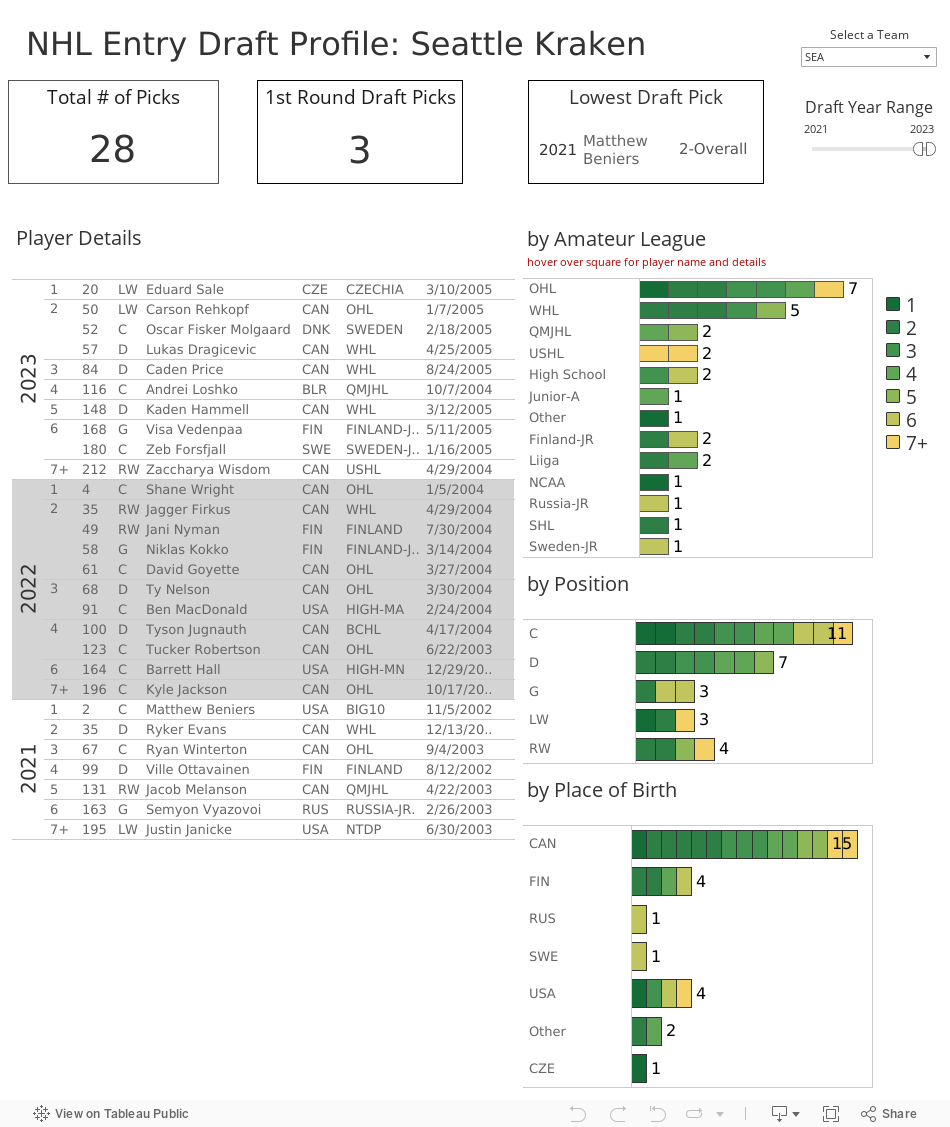
The NHL Entry Draft is this Tuesday (First Round) & Wednesday (Rounds 2-7). For all the new hockey fans out there, I thought it would be a good idea to lay out how the NHL Entry Draft works. The NHL Draft works similarly to the NFL, NBA, or MLB drafts. It consists of seven rounds, with each round consisting of the same number of selection choices as there will be teams in the League in the following season. The draft order is generally determined based on a “Worst to First” order of the most recent completed season. However, the top 3 teams of the draft order are determined by a weighted lottery system of teams that did not qualify for the playoffs.
The NHL Entry draft is for top hockey players 18 – 20 years of age. Last year there were 217 players selected by NHL teams across 138 teams and 33 leagues that can be classified as amateur, development, or other international professional leagues. The most prominent leagues are the United States Hockey League (USHL), Ontario Hockey League (OHL), Quebec Major Junior Hockey League (QMJHL), and the Western Hockey League (WHL). The WHL should sound familiar to Washington and Oregon residents because that is the league where the Spokane Chiefs, Tri-City Americans, Everett Silvertips, Seattle Thunderbirds, and Portland Winterhawks play.
You can expect that over 50% of the players drafted will come from these 4 leagues with the other 50% spread across ~30 other leagues.
From a ‘Place of Birth’ perspective, most of the draft picks are born in the US or Canada but that overall % is decreasing as Finland, Russia, and Swedish born players have been increasing in number over the last couple of years.

Not all draft picks will play in the NHL and it will be several years before we see some of these players in the NHL. The vast majority of draft picks will be sent to club affiliates or back to their amateur, development, or college teams to develop further until which time they are called up.


Here is a look at how those games are played for skaters over a career based on year after draft.

And here is a look at those games spread over a career for goalies based on year after the draft.

Given that draft picks may not be seen playing in the NHL for several seasons after the draft, the draft is a reflection of the future state of NHL teams. I hope this gives you a little bit more appreciation and understanding for the NHL Entry Draft.

By Andy Eide
When NHL Commissioner Gary Bettman opens the NHL Draft this coming Tuesday it will look different than ever before.
Instead of addressing the gathered NHL clubs and fans from a stage, serenaded by boos from the cheap seats, he’ll start the proceedings via an online stream. The cutaways to young players in the stands sweating it out in their newly pressed suits alongside their families will be replaced with web cams of prospects’ living rooms as they gather around a television.
That won’t assuage the excitement of the draft as hundreds of young players wait to have their dreams fulfilled. It will be a long couple of days for prospects but filled with hope of hearing an NHL team announce that they’ve been drafted.
Every draft has its unexpected or unpredictable elements. There will be risers and fallers, trades, and a number of surprises over the two-day event.

What we do know is that the New York Rangers have the first pick and will draft Alexis Lafreniere to kick off the opening round. With the QMJHL’s Rimouski Oceanic, Lafreniere has been dominant. He played in 173 games over his three-year career with Rimouski and scored 114 goals with 297 points.
As NHL scouts might say, ‘that’s decent’.
The goals and points are impressive, and he’s got speed, skill, and the all-important hockey sense which makes him the clear pick. His major-junior days are in the past as the Rangers will add him to their roster next season.
The NHL will conduct the first round of the draft on Tuesday with the remaining six rounds conducted Wednesday. Here’s what to watch for over both days.
Often resembling a marquee horse race, the ‘battle’ between Quinten Byfield and Tim Stutzle to be the second overall pick has been fun to watch this season. Who goes number two depends on who you talk to, or which draft ranking you believe in.
The general consensus among the online scouts lean Byfield’s way but none of that matters. All that does is what the Los Angeles Kings – holders of the number two pick – think of the two prospects.
Both are great players and worthy of being selected at number two.
Byfield plays for the OHL’s Subdury Wolves and is coming off a monster year that saw him pile up 82 points in 45 games. He’s 6-foot-4 and 215 pounds and while he looks like a power forward, he has the skill of a smaller player.
The collector of bow ties can skate with the best of them and has the speed to pressure the defense. He’s also got a big shot, is a play-maker, and physically is ready for the NHL game now.
There was an outside chance that Stutzle could have played here in the Pacific Northwest during the past WHL season. Drafted by the Seattle Thunderbirds in the 2019 CHL Import Draft out of Germany, Stutzle weighed his options briefly and chose to play in the German pro DEL last year with Manheim.
Rather than play against his age group, he was able to compete against men in a pro league at 17-years-old and posted 34 points in 41 games. He doesn’t have the size of Byfield – listed at 6-foot-1 and 187 pounds – but he’s got speed, dekes, and the potential to be a dynamic scorer.
Stutzle played on the wing last year but has the ability to switch to center, something he did in his younger days and something that makes him a more valuable prospect.
Last year’s draft was a boom for both the U.S. National Team Development players and the WHL. The American program set a new record by having seven players selected in the first round while the WHL led all amateur leagues with 28 players taken overall.
Who’s going to lead the way this year?
After a down year in 2019, the OHL looks poised to have a big draft, especially in the first round. NHL’s Central Scouting has nine OHL players ranked among the top 31 of North American players. Byfield leads the way but look for Jamie Drysdale (Erie Otters), Cole Perfetti (Saginaw Spirit), and Marco Rossi (Ottawa 67’s) to be potential top ten picks.
Stutzle’s selection will be the second German-born player to go in the first round in as many drafts after Moritz Seider went sixth overall to Detroit last year. Stutzle may not be the only German taken in the first round this season. Germany has another high ranked prospect, John-Jason Peterka, who could end up selected in the top 31 slots. Like Stutzle, Peterka played professional last year, in the DEL, with Munchen.
Drafting a goalie is an adventure. It’s a position that develops on a different trajectory than others and its rare that they end up in the first round, especially early on.
During last year’s Draft in Vancouver, Spencer Knight of the USTD was taken by the Florida Panthers 13th overall, which was the highest goalie taken since Tampa Bay nabbed Andrei Vasilevsky at 19 during the 2012 Draft. That pick worked out well for the Lightning.
The first goalie to go in next week’s draft will be Yaroslav Askarov. The Russian has already begun his season, playing with St. Petersburg in the KHL, and is off to a great start by sporting a .974 save-percentage. Not bad for an 18-year-old playing in a professional league with older, veteran guys.
🚫🚨ASKAROV SHUTOUT🚨🚫
Yaroslav Askarov shuts out Spartak with a 33 save performance as SKA takes the game 2-0 in his first KHL start of the season!
Askarov is a top 6 prospect for the #2020NHLDraft. pic.twitter.com/3DphE0x9bi
— TPEHockey (@TPEHockey) September 17, 2020
Will the team that takes him have the same outcome as the Lightning have with Vasilevsky?
Under normal conditions, all 31 NHL teams are at the draft. Tables are set up on the main floor and with that many general managers in close proximity to each other, trades happen, often completed with face-to-face conversations.
Teams will be hunkered down at their home offices this time around. Will that limit trades?
Not likely.
With a tight salary cap situation due to the flat cap, there will be trades next week. Teams will either look to unload a current player to stockpile picks and free cap space, or cash in draft assets for a player to improve their roster.
It can be hard to predict, but there are six teams who have 10 or more picks this draft year. Montreal has 14 selections and Ottawa has 13 picks on the books. They could be candidates to wheel and deal and pick up an NHL player who will help right away in exchange for a prospect who may never make it to the league.
A year ago, seven players from the WHL’s US Division were selected in the draft led by the Seattle Thunderbirds who had three guys picked.
The Portland Winterhawks and Everett Silvertips will have the most players off the board this time around. Portland’s Seth Jarvis will be the first US Division player taken as the speedy forward (who scored 98 points last season) is projected to be a first-round selection.

Portland’s Seth Jarvis vaulted himself into a top NHL Draft prospect this year. (Brian Liesse)
Everett’s Ronan Seely and Kasper Puutio will go in the next couple of rounds while Spokane’s Jack Finley could be a second or third rounder. Seattle should see defensemen Simon Kubicek and Tryel Bauer taken as well while it doesn’t look like the rebuilding Tri-City Americans will have a player drafted this year.
He’s not in the U.S. Division but Medicine Hat Tigers forward Lukas Svejkovsy, who hails from Point Roberts, Wa, should hear his name called in day two.

The Tampa Bay Lightning are your Stanley Cup Champions, and the guys from Sound Of Hockey have a lot of opinions about it.
On this week’s episode, John, Andy, and Darren dig deep into what it took for Tampa Bay to reach the promised land, before turning their attention to the upcoming NHL Draft. To do so, they welcome Seth Jarvis of the Portland Winterhawks and Gage Goncalves of the Everett Silvertips, two players expecting to hear their names called by an NHL team in October. Both interviews are fun, quick listens that give you a good idea of what it’s like to wait for your opportunity to get drafted in the midst of a pandemic.

Also in this episode, the guys discuss their takeaways from the event that was the Stanley Cup Final, as well as recent transactions in the NHL.
Segments this week include You Don’t See That Every Day, Weekly One-Timers, and Tweets of the Week.
SUBSCRIBE! ENJOY! REVIEW!


It didn’t take long for Dustin Donaghy to realize his Spokane Chiefs teammate Tyler Johnson was just one of those guys.
You know, one of those guys.
The type of person imbued with so much swagger and subtle confidence that winning just seemed easy.
Whether it was 3-on-3 games, shinny hockey, or games of Halo, Donaghy found out quickly during both of their rookie seasons in the Western Hockey League that Johnson was that type of slightly trusting, but mostly awe-inspiring person.
“He was just clutch, just with everything,” said Donaghy, who is now entering his second year on the Chiefs bench as an assistant coach. “… Tyler, in my mind, he always had his hand in something in a positive manner.”
Winning has been a constant for Johnson, a Spokane, Washington native, in all levels of hockey.
Johnson and the Chiefs won the Memorial Cup, one of the two most coveted championships in junior hockey, and won a Gold Medal with Team USA at the 2010 World Junior Championships in Saskatoon and Regina, Saskatchewan, the second most coveted.
He won a Calder Cup Trophy with the Norfolk Admirals in his first season in the American Hockey League. Johnson was named to the NHL All-Rookie Team and a finalist for the Calder Memorial Trophy in 2014.
And for the second time, Johnson and the Lightning are on the verge of the most prodigious accomplishment in hockey: the Stanley Cup.
The Journey
In the WHL, teams are allowed a 50-player protected list. It includes active players, bantam draft picks and other prospects.
And according to John Blanchette of The (Spokane) Spokesman-Review, there was a time when the Spokane Chiefs dropped their hometown 11th-round draft pick for another prospect.
Yes, that same player valuable enough to sign a seven-year, $35 million contract for a Stanley Cup Finalist wasn’t even deemed worthy of being one of the 1,100 players protected by the WHL.
Some of that may have been because of his size — he’s listed at only 5-foot-8 and 185 pounds, but the Spokane native proved to be somewhat of a late bloomer, too.
After failing to make the Chiefs team as a 16-year-old rookie, he erupted with a 120-point season for the Coeur d’Alene Lakers, a Junior ‘B’ team, and helped junior hockey decision-makers notice him.
It didn’t take long for his Chiefs teammates to notice him, either.
“Just looking at him, he kind of had his boyband haircut. You’d look at him and you’d think, is he really a hockey player?” Donaghy said of his first impressions of Johnson in 2007, their rookie seasons. “Then we’d get on the ice, and we’d say, ‘Wow, he’s way more than what he looks like on the outside.”
Of course, Johnson made his way back on to the Chiefs’ list and not only cracked the Chiefs’ Memorial Cup-winning roster as a 17-year-old rookie but was named playoff MVP after totaling five goals and eight points in 23 games.
“He fit in right from the get-go,” Donaghy said.
Johnson had his doubters because he was so unassuming, but it only took a couple of skates for his teammates to buy-in to Johnson being an influential player.
His impact in Junior Hockey was gradual, and while the undersized forward was one of the league’s top scorers as a 19-year-old, no draft buzz followed that production.
Johnson was even looking at playing USports hockey in Canada — or even just attending college in the U.S., where he wasn’t able to play varsity hockey due to the NCAA’s ridiculous amateurism rules, he told The Spokesman-Review, before his 20-year-old season, where he exploded for 53 goals and 115 points as an overage player.
Johnson ended his tenure in Spokane is a hell-of-a-lot of points, a gold medal with Team USA at the 2010 World Junior Championships and, of course, a Memorial Cup run that started it all.
Still, Johnson never attracted much, if any, draft buzz, likely due to his diminutive size.
But Tampa Bay was eventually convinced and inked him as an undrafted free agent.
That’s paid off big time for Tampa Bay, especially early on.
Johnson was a key cog in the Lightning’s 2015 Playoff run, forming ‘The Triplets’ line with Nikita Kucherov and Ondrej Palat. Johnson led the postseason with 13 goals and tied Patrick Kane for first with 23 points as the Lightning finished as Stanley Cup Finalists.
The Lightning fell to Chicago in six games in the 2015 Stanley Cup Final, the franchise’s second appearance.
Currently tied 1-1 with the Stars entering Wednesday’s Game 3, Johnson and the Lightning are presented with another bite at the apple.
A Spokane Kid
Johnson was born into a hockey family of sorts.
His parents, Ken and Debbie Johnson, met playing a rec-league hockey game at Spokane’s Eagle’s Ice-A-Rena. Debbie was a skating coach, who not only taught Tyler how to skate, but the Yamamoto brothers, Kailer and Keanu, as well.
Johnson is a cornerstone, along with Derek Ryan and Kailer Yamamoto, of an underground hockey community in Spokane and Northern Idaho that’s never been confused as a hockey hotbed, but has a burgeoning player pool and a passionate, underground fanbase.

It’s been a tradition for all three to attend high school in the Spokane area — Johnson attended Central Valley in Spokane Valley — and, of course, play for the Chiefs as a hometown kid, an enriching experience that also comes with the burdens of unrealistic expectations.
Johnson cut through any concerns from the jump.
“He was the one that had to decide of enjoying the fame of being a hometown kid or really pursuing a career,” Donaghy said. “Obviously, that’s what he’s done and he’s a huge impact in Tampa’s lineup right now in the Stanley Cup Final.”
