The Seattle Kraken are set to sign Brandon Montour, one of the top defensemen on the free agent market, to a seven-year, $50 million contract, as reported by Pierre Lebrun of The Athletic.
👀
Assuming accurate, Brandon Montour is one of the bigger free agent defensemen on the market. Was a key part of the Panthers' Stanley Cup win.
Puck-moving, right-shot defenseman will quarterback the power play. Fascinating signing at $7+ million per year. #SeaKrakenhttps://t.co/V0oh1lmMWn
Montour, 30, had a career year in 2022-23 with the Florida Panthers, racking up an impressive 73 points (16 goals, 57 assists) in 80 games. He missed the beginning of the 2023-24 season after offseason shoulder surgery, but still posted 33 points (8-25=33) in 66 games and added three goals and eight assists in the postseason, helping the Panthers win the Stanley Cup. Despite the injury and late start, he maintained a significant role, averaging over 23 minutes of ice time.
Originally from Ohsweken, Ontario, and a member of the Mohawk First Nations of the Grand River community, Montour was drafted by the Anaheim Ducks in the second round of the 2014 NHL Draft. After stints with Anaheim and Buffalo, he was traded to the Panthers in April 2021, where he became a key cog and a power play quarterback.
Montour is known for his offensive prowess, compete level, speed, and ability to creatively distribute with the manpower advantage, which addresses several areas of need for Seattle.
How Montour fits
I did surmise a while back on the Sound Of Hockey Podcast that the Kraken might consider looking to improve offensively by adding an offensive defenseman. But after plenty of discussion about it, we decided they would focus on adding scoring forwards, so admittedly, we did not see this signing coming.
This acquisition dramatically changes the look of Seattle’s defense corps. It does bring right-shot/left-shot balance again, but it also creates several new questions. Does Montour box out Ryker Evans from a full-time role next season? Does Brian Dumoulin get pushed out of the lineup? Or, is there another move coming that would make the existing pieces fit?
Here’s how things could theoretically shape up, if there isn’t a subsequent defense move coming.
Vince Dunn // Adam Larsson Jamie Oleksiak // Brandon Montour Brian Dumoulin // Will Borgen Ryker Evans
I only put Montour on the second pairing because I’m not a fan of having two offensive defensemen playing together, hence why I would leave Vince Dunn and Adam Larsson together.
Cap situation
In terms of salary cap management, Montour becomes the second-highest-paid player on the team after Vince Dunn’s $7.35 million AAV. By total dollars, it is the biggest contract on the Kraken and the largest deal ever signed by general manager Ron Francis.
According to Cap Friendly, the Kraken currently have $16.28 million in cap space before factoring in new deals for Matty Beniers and Eeli Tolvanen, who both received qualifying offers on Sunday. If those two take up, say, $10-$11 million (that’s a total guess) of the remaining space, that leaves Seattle with approximately $5-$6 million to strengthen its forward group. That’s not nearly enough to upgrade up front, so we have to think there’s a trade or two coming to create some additional room.
This is a huge deal for the Kraken to dish out, no question, especially considering that Montour will be 37 years old when this contract ends, and it more than doubles his previous $3.5 million cap hit. But, that’s the cost of doing business in unrestricted free agency. If you want to make a splash, you have to overpay.
Stay tuned. This could be an exciting day.
Darren Brown
Darren Brown is the Chief Content Officer at soundofhockey.com and the host of the Sound Of Hockey Podcast. He is a member of the PHWA and is also usually SOH’s Twitter intern (but please pretend you don’t know that). Follow him @DarrenFunBrown and @sound_hockey or email darren@soundofhockey.com.
Welcome to the Sound Of Hockey NHL Draft Live Blog. Assuming no trades, the Kraken will have eight draft picks today. We will continue to add information about their selections here throughout the day. The most recent updates will appear at the top, so scroll down to see earlier news. If you want to catch up on the Kraken’s first-round selection of Berkly Catton, check out Curtis Isacke’s breakdown here or Cameron Rigger’s profile on Catton from back in February.
—
12:39 PM
That wraps up the 2024 NHL Draft. The Kraken ended up with eight picks in total. As a reminder, most of the players will be in Seattle this week as part of the Seattle Kraken Development Camp. Keep an eye on SoundOfHockey.com for deeper draft analysis and dev camp coverage.
Additionally, free agency opens Monday morning, and we anticipate some aggressive moves by the Kraken. We will cover it all right here.
12:22 PM
It appears the Seattle Kraken are done of the day. Here is how their picks shook out at the 2024 NHL Draft.
Here’s how Round 7 played out.
12:12 PM
Assuming no more trades, the Seattle Kraken use their last pick on defenseman Jakub Fibigr from the Mississauga Steelheads in the OHL. Fibigr is from Czechia but played his draft year in North America. Let’s let him give you his own scouting report and a bit more info on his background.
12:05 PM
Home stretch for the draft. Here are the results from Round 6.
11:55 AM
Everett Silvertips defenseman Eric Jamieson was selected by the Calgary Flames with their sixth-round pick. Jamieson is the third Silvertip to be selected so far.
11:35 AM
Round 5 is in the books. Lots of WHL players selected in this round.
11:19 AM
With that newly acquired selection, the Kraken have taken Clarke Caswell from the Swift Current Broncos. This was their fourth selection from the WHL this draft. This seems like a good value pick, as Caswell was ranked 79th on the SOH Big Board.
The #SeaKraken have acquired the 141st-overall pick in the 2024 NHL Draft from the Florida Panthers in exchange for Seattle’s 169th and 201st picks in this year’s draft.
— Seattle Kraken PR (@SeattleKrakenPR) June 29, 2024
11:18 AM
The Kraken made a trade to move up in the draft. They traded their sixth-round pick (169) and seventh-round pick (201) for Florida’s fifth-round pick (141).
11:01 AM
With the addition of center Oliver Josephson, the Kraken have now selected 15 centers since they came into the league. This is the second-most centers selected by any team since 2021, behind only the Chicago Blackhawks, who have taken 17. Several of these players will be converted to wing should they make the NHL, but it is an interesting data point in the Kraken’s draft strategy.
10:58 AM
Here are the results from Round 4.
10:24 AM
The Seattle Kraken selected another center, Oliver Josephson, with their fourth-round selection. Josephson is another shutdown-type forward. He plays for Red Deer in the WHL, so there should be plenty of opportunities to see him roll through Washington State when Red Deer plays the US teams.
10:20 AM
Round 3 is a wrap.
10:05 AM
With the 88th overall pick, the Kraken selected goalie Kim Saarinen from the HPK U20 team. Saarinen was predicted by Curtis in his Seattle Kraken mock draft earlier this week. This is the third Finnish goalie the team has selected over the last three drafts.
9:45 AM
With their first selection in the third round, the Seattle Kraken select defenseman Alexis Bernier from Baie-Comeau Drakkar of the QMJHL. This is the first defenseman the Kraken have selected.
Ma révélation québécoise des dernières semaines chez les espoirs 2024: Alexis Bernier, du @DrakkarBAC.
Il vient d'inscrire son 4e de la saison sur cette magnifique séquence.
With their second selection of the second round and 63rd overall, the Seattle Kraken selected centerman Nathan Villeneuve from the Sudbury Wolves of the OHL. As you might recall, one of Seattle’s top prospects, David Goyette, also played with Sudbury this season.
“Villeneuve’s a feisty, high-pace attacker with a lockdown defensive game. When he’s not throwing hits and winning battles, he’s eliminating off-puck threats and pickpocketing the puck carrier. When the puck arrives on his stick, he instantly takes the middle or starts a give-and-go to attack the zone with speed.” – Elite Prospects
9:15 AM
Another trade. We identified Tanner Jeannot as a good trade target for the Seattle Kraken, and at this price, it seemed reasonable, but it was not meant to be.
Utah acquired defenseman Mikhail Sergachev from the Tampa Bay Lightning in exchange for defenseman JJ Moser, center Conor Geekie, a 2025 second-round pick, and their 2024 seventh-round pick (No. 199 overall).
Utah also acquired defenseman John Marino from New Jersey in exchange for their 49th overall pick of the 2024 Draft and a 2025 second-round pick.
8:45 AM
The Seattle Kraken selected Julius Miettinen from the Everett Silvertips. Miettinen, an import from Finland, is known as a strong two-way center. He really shined in the back half of the season with Everett.
We also got a few firsts in the 2024 Draft. The first Swedish player was selected 35th overall, and the first goalie of the draft, Ilya Nabokov, was taken 38th overall.
8:30 AM – Round 2
Let’s begin Day 2! The Kraken will be selecting 40th and 63rd in this round.
8:00 AM
The Kraken will start the day with eight picks remaining in the 2024 NHL draft.
A couple things from Round 1 that I wanted to call out from yesterday before we get going:
For the third time ever, NCAA players went first and second overall in the NHL Draft. The last time this happened was in 2021 when Owen Power and Matty Beniers were selected back-to-back. The only other time was in 2000 when Rick DiPietro and Dany Heatley went first and second, respectively.
The run on defensemen did not occur as early as many analysts predicted. Most people expected a group of blueliners to start hearing their names called around the fifth overall pick.
This is the first time since 2010 that no Swedes were taken in the first round. Last year, six Swedes were selected on Day 1 of the draft, including second overall Leo Carlsson.
The 19 Canadian players selected in the first round Friday tied a mark set in 2020 for the most Canadians selected in the first round.
Here are the full results of the first round:
On a personal note, Marshawn Lynch is probably my favorite athlete of all-time.
The Seattle Kraken selected forward Berkly Catton of the Spokane Chiefs with the No. 8 overall pick during the first round of the 2024 NHL Draft Friday. Catton joins Lukas Dragicevic (Tri-City; 2023 second-round pick) and Kaden Hammell (Everett; 2023 fifth-round pick) as in-state WHL players drafted by Seattle.
“[Catton] has got elite hockey sense, real good speed, [and] high compete level. He’s a very high-end offensive player,” Ron Francis said Friday after the team made the selection. “That was the guy we wanted, so we’re excited.”
Catton led all CHL first-time draft-eligible prospects in points and was fourth overall in the WHL in scoring during the 2023-24 season.
Quick thoughts on the pick
This pick is at once unexpected and not surprising. It’s unexpected because a few high-end blueliners were still on the board at No. 8. The vast majority of industry analysts had Seattle taking a defenseman, even if it meant dropping into what I’d consider the second tier of players at that position, such as Carter Yakemchuk.
On the other hand, Berkly Catton was ranked No. 6 on the final Sound Of Hockey Big Board. And if you only remember one stat about Berkly Catton, try this one: he is one of four first-time draft eligible CHL players since 2000 to post 115-plus points and 50-plus goals. The other three? Sidney Crosby, Patrick Kane, and Connor Bedard.
Furthermore, we should not discount the position value if Catton can stick at center. In my mind, I had been projecting Catton as a play-driving winger in the longer term, but many scouts disagree, and Ron Francis spoke about Catton as a center prospect after the pick.
Elite Prospects, which grades the individual skills of draft-eligible prospects, had Catton as the third-best puckhandler, fourth-best skater, fifth-best passer, and 10th-best shooter in the draft. They also deemed him to have the fourth-best “hockey sense” in the draft, which is a stand-in for on-ice intelligence and gameplay instincts. All told, Elite Prospects gave Catton the sixth-highest average skill grade among skaters in the draft, with only his physicality grading below average.
In my pre-draft piece, I wrote that “Berkly Catton [] is a deadly offensive package, combining skill, skating, and offensive instincts. If he stood 6-foot-2 instead of 5-foot-10.25 with the same skill level, he’d be considered as early as the second overall pick.”
Chris Peters compared Catton toTim Stutzle. Corey Pronman though Catton reminded him of 2022 No. 3 overall pick Logan Cooley. For Elite Prospects, Catton brings shades of Cooley or Troy Terry.
So, Catton is a not a “reach” or “off-the-board” pick at all. Particularly given that Seattle has shown a willingness to take shorter forwards and is still looking for high-end offensive firepower in the organization, the pick makes plenty of sense and good pay significant dividends into the future.
At the time the Kraken drafted, Catton was the second-highest ranked remaining player on the Sound Of Hockey Big Board at No. 6 overall. Only Zeev Buium was ranked higher at No. 5. (Buium ultimately fell to Minnesota at No. 12, so it seems the league did not agree with the Big Board on him.) I had Catton as the No. 10 overall player in the draft based on my data-only approach. Tony Ferrari of The Hockey News, Smaht Scouting, and Scouching all had Catton ranked as the No. 3 prospect in this class, his highest position on any public draft board we tracked.
How does he look on the ice?
What are scouts saying?
Strengths:
“Berkly Catton is one of the most fun players to watch in this draft. Give him time and space, and he’ll make you pay; try to take it away, and he’ll cut through your formation anyway like a hot knife through butter.
“It’s on the rush where he’s most effective. A series of crossovers allows him to build speed as he plans his attack, reading and reacting to what’s in front of him, using a series of weight shifts and handling moves to navigate the neutral zone as he drives play toward the opposition goal. With this ability comes cunning in the form of a sophisticated delay game that allows him to level up and attack with support or connect with trailing linemates as they enter the play.” – Elite Prospects
“Catton may be the best transition forward in the draft class, thanks to his combination of skating and intelligence. He can gash a defensive unit through the middle of the ice with ease. Catton identifies skating lanes and plays to his opponent’s weaknesses. He knows where to put the puck when attacking a defender 1-on-1, forcing them to defend in uncomfortable and compromising positions.
“Catton is arguably the smartest player in the NHL draft class, constantly looking to create small advantages, chain them together and eventually create a big advantage. Catton makes life easy on his teammates, allowing them to play to their strengths while he fills in their gaps. He is a playmaker at heart, but he showed this season he can make goalies pay if they don’t respect his shot, especially when he gets into the home plate area.” – Ferrari
“I value players who elevate others greatly. Players who can move the puck themselves, move the puck to others, find targets, hit them accurately, and finish chances they get from others. Catton checks every one of those boxes in my books. His tracked data is outstanding almost across the board… Brilliant with the puck with his pass lane creation skill and one of the few players I trust to run a line this year as he is, he’ll almost certainly be drafted too late and someone is going to be very happy.” – Scouching
Weaknesses:
“The Spokane center isn’t the biggest player, and he will need to bulk up, but he’s not some 5-foot-8, 150-pound forward who gets intimidated easily. Catton has the potential to stick at center long-term despite his size. He is the exception to the rule because of his mobility and smarts.” – Ferrari
“The only hangup is that he isn’t the most physical centre out there, but he’s so smart with his positioning and such a great support player that surrounding him with players that can fill that gap should give him the space to be [himself at the NHL level].” – Scouching
“Of course, there’s always a catch with any prospect, and this is true of Catton. In his case, it’s one of efficiency. He’s prone to throwing pucks away with hope passes and lacks that extra layer of patience that defines most top playmakers. One can wonder to what extent playing on a team with as little firepower as Spokane helped foster these bad habits, but they’re there all the same.
“There’s also the question of how well he will handle the rigors of the NHL game. His ability to take pucks off the wall and get inside was inconsistent across many of our viewings, and there’s a chance he struggles to generate offense when he’s not attacking in space or off the rush, which says nothing of whether he’ll stick at center or not.” – Elite Prospects
Expert reaction
“I’m a huge fan of Catton’s game. I thought he was one of the most dynamic players in the draft. Given how much Seattle needed a premier defense prospect, it’s a bit surprising that they went and took a forward, but if they were going to take one, Catton is more than reasonable at this slot. He has top-line forward potential and could be a star if he truly hits. Teams were worried by his size, but everything else about his game was a major positive.” – Corey Pronman, The Athletic
What’s next for Berkly Catton?
Catton will very likely return to the WHL next season and figures to compete for a WHL scoring title in a high-ice-time, first-line role for Spokane. After that, he will likely get a longer look with Seattle, but, as a January, 2006 birthdate, he’ll be in the position of returning to the WHL again for the 2025-26 season if he doesn’t make the NHL roster.
I’d still project him to slot on the wing eventually, particularly if Matty Beniers and Shane Wright remain in the fold, but he looks like a solid bet to produce 60-plus points annually as a top-six forward when he reaches his prime in about three years.
Final thoughts
While a team doesn’t go into the draft looking for a player at a “need” position in the first round like an NFL team might do, the organizational picture matters. So I can’t help but wonder whether the team might have more strongly considered taking a swing on a high-upside blueliner like Zeev Buium or Zayne Parekh if Eduard Sale were looking like the dynamic offensive player the team expected him to be when making him the 20th overall pick in 2023. I know Catton projects (for some) as a center, and Sale is a pure winger, but both are offense-first forwards.
On the other hand, the Kraken are a very analytically inclined organization, and macro studies of first-round pick success rates indicate that forwards hit at a better rate than defensemen. This likely factored into the team’s decision-making process too.
Kraken general manager Ron Francis has often said in the past the he looks to his scouts and analytics department to support each other before making a move. This looks like a pick where both sides of the front office were able to find common ground, even if it bucked the common wisdom that Seattle may look to add to their blue line.
The team figures to have opportunities to add a defenseman in the second round. Henry Mews, Spencer Gill, and Leon Muggli are three blueliners who could represent good value for Seattle at that point.
Curtis Isacke
Curtis is a Sound Of Hockey contributor and member of the Kraken press corps. Curtis is an attorney by day, and he has read the NHL collective bargaining agreement and bylaws so you don’t have to. He can be found analyzing the Kraken, NHL Draft, and other hockey topics on Twitter and Bluesky @deepseahockey.
Everything is happening this week. The Florida Panthers held on by the tips of their claws to claim the Stanley Cup. The Coachella Valley Firebirds got mired in Hershey mud tantalizingly close to an AHL Championship for the second straight postseason.
Off the ice, former Firebirds coach Dan Bylsma must immediately turn his attention to building out his Kraken coaching staff. Meanwhile, the Kraken professional scouts and front office are focused on acquiring some scoring to boost Seattle’s floundering offense as the calendar year turns on July 1.
Today, we adjust our focus squarely onto the Kraken and preview the 2024 NHL Draft from the team perspective, reviewing the front office’s historical approach, where the team stands, what opportunities it has, and where it may go when the 2024 NHL Draft kicks off on Friday at 4:00 p.m. PT. With a hat tip to John Barr for data visualizations and the Seattle Kraken PR Department for additional historical draft information, let’s dive in.
Drafter Ron, a history
This is the fourth NHL Draft in Seattle Kraken history, all led by general manager Ron Francis and the current front office. Overall, this draft will be the eighth helmed by Francis, after he managed four drafts as the GM in Carolina.
Ron Francis
Francis made 33 total draft picks in Carolina from 2014 to 2017, with 14 of those drafted players surpassing 100 NHL games played. 12 of those draft picks logged at least one NHL game played during the 2023-24 season.
The Hurricanes utilized their top draft pick in each of Francis’ first three drafts on rangy (6-foot-1 or taller), two-way blue line prospects: Haydn Fleury (No. 7 overall in 2014), Noah Hanifin (No. 5 overall in 2015), and Jake Bean (No. 13 overall in 2016). After that, Francis’ Hurricanes took two forwards with mid-to-late first-round picks: Julien Gauthier (No. 21 overall in 2016) and Martin Necas (No. 12 overall in 2017). Two of those first-rounders qualify as success stories in Hanifin and Necas, with Bean an additional solid defenseman. Fleury and Gauthier remain in the league as depth options.
2015 was a banner year for Francis as a drafter. As mentioned, the Hurricanes drafted Hanifin at No. 5 overall that year–the highest Francis has selected a defenseman–and followed that up by selecting Sebastian Aho at No. 35 near the top of the second round. Hanifin has played in 678 NHL games, the most of any Francis pick. Aho has scored 557 points, the most of any player drafted by a Francis team. Hanifin and Aho join Seattle’s Matty Beniers as Francis’ three draft picks to have been named to a NHL All-Star Team.
Francis’ Carolina teams found above-average success uncovering NHL players in the second and third rounds. Aho is joined by Warren Foegle (67 overall in 2014), Eetu Luostarinen (42 overall in 2017), and Morgan Geekie (67 overall in 2017) as regular NHL contributors with 200-plus NHL games played, having been drafted in the second or third rounds of Francis’ four Carolina drafts. Francis’ four-for-nine, 44 percent hit rate in generating players logging 200-plus games played in this range dwarfs the league average of approximately 20 percent from this time period.
The early returns from Francis’ Seattle drafts suggest that Francis and his staff may have continued that run of success drafting between the 30’s and 90’s. In my data-only ranking of 2023-24 NHL-affiliated prospects, I had six of Seattle’s second- and third-round picks within the top 125 of prospects in the NHL: Jani Nyman (49 overall in 2022), Carson Rehkopf (50 overall in 2023), David Goyette (61 overall in 2022), Jagger Firkus (35 overall in 2022), Ryan Winterton (67 overall in 2022), and Ryker Evans (35 overall in 2021).
And credit the Seattle Kraken PR Department for this tidbit: Winterton is one of only two third-round draft picks selected in the last three years to play in a regular-season NHL game so far. Indeed, his nine games played is most by a player drafted in the third round over the last three years, ahead of Columbus Blue Jacket Stanislav Svozil who registered two NHL games in 2022-23.
With the arguable exception of Evans, none of Seattle’s second- and third-round picks have yet established themselves as NHL regulars, so the jury is still out. But I’d wager the run of above-average success will continue.
Unlike in Carolina, though, Francis’ Seattle drafts have clearly tilted toward offense early. Each of Seattle’s first-round picks have been forwards: Matty Beniers (2 overall in 2021), Shane Wright (4 overall in 2022), and Eduard Sale (20 overall in 2023). Drawing back further, Seattle has drafted eight forwards against only two defensemen, and one goaltender in the first two rounds in Francis’ three drafts.
(Author’s note: The charts above cover drafted skaters only.)
Finally, while Francis and his staff have been active in making trades at the trade deadline during his Carolina and Seattle tenures–adding 14 draft picks in eight different trades–the same cannot be said for his teams’ draft day approach.
Francis’ teams tend to stick-and-pick, having completed only one trade during his seven drafts–a 2022 deal that saw the Kraken send fourth- and fifth-round picks to the Boston Bruins for a third-round pick the team used to select Ben MacDonald. (The Kraken continue to hold MacDonald’s rights as he plays at Harvard University, but the forward has not signed a contract with the team.)
Furthermore, Francis’ teams have never traded a current year’s draft pick for a player in the run up to a draft. (The Oliver Bjorkstrand trade happened after the 2022 draft, using 2023 draft picks.) Context is important here, though. Francis’ teams in Carolina and Seattle have been in the building phase during his tenures. That is a fact worth knowing given the sense among fans that there is urgency for the Kraken to add to the NHL roster now using draft or prospect assets. This would be a departure for Francis.
The Kraken system, deep with NHL-caliber forward talent, lacks the same depth on the blue line
Public analyst opinions on the Kraken prospect pool vary, ranging from approximately average to elite. My data-only evaluation is fond of Seattle’s prospect pool, placing it among the best in the league.
All agree that the Kraken are remarkably deep in the forward ranks, particularly for an organization that has only existed for three years. Rankings that have the Kraken lower tend to emphasize the lack of depth on the blue line and in goal, as well as the absence of players that project as high-end scorers at the NHL level.
While the latter point is not entirely unfounded, I think it undersells Shane Wright’s 2023-24 season, which was quietly excellent (and continued on a historic pace in the AHL postseason). Even beyond Wright, Jani Nyman, David Goyette, Jagger Firkus, and Carson Rehkopf all turned in high-scoring seasons that ought not be discounted entirely merely due to scouting and projection questions.
I also think public analysts may be sleeping on the potential of goalie Niklas Kokko, whose combined regular season and postseason save percentage (.921) was second in Liiga, behind only 36-year-old goaltender Niko Hovinen. Indeed, his strong postseason play led Pelicans to the Liiga Finals. He may be hurt by the fact that his worst few weeks of the season fell during the World Junior Championships, when the most eyes were on him. I tend to subscribe to the view with goalies that you believe it when you see it at the NHL level, but Kokko is checking every box so far. He’ll likely be part of a goalie tandem in Coachella Valley in 2024-25.
As far as blue line depth goes, I think the critique is fair, though Seattle’s short history is important context. Drafted players typically follow a two-to-five-year timeline to the NHL, and the Kraken are still toddler-aged as a franchise.
It appears likely the team’s highest-drafted blueliner, left defenseman Ryker Evans (35 overall in 2021), will surpass our 200 games played threshold. Beyond Evans, though, questions emerge.
Ryker Evans
Righty Ty Nelson (No. 68 overall in 2022) has produced at the junior level but plateaued slightly and faces developmental questions surrounding his height. Righty Lukas Dragicevic (57 overall in 2023) has one standout junior season under his belt, scoring 75 points in 2022-23, but his offensive production regressed in 2023-24, and his defensive game remains suspect. Left defenseman Tyson Jugnauth (100 overall in 2022) has been on a slower development path, but he provided high-end production after joining the Portland Winterhawks in December, 2023. Finally, right-shot Ville Ottavainen (99 overall in 2021) impressed with his height-speed-skill package in Coachella Valley this past season but will search for a bit more consistency in the coming years.
All told, there are more questions than answers on defense. A couple defensemen–perhaps Evans and Ottavainen–could emerge as bottom-half NHL contributors, but the odds of a top-of-the-lineup player emerging seem slim. Dragicevic may have that potential, but he has a long, long way to go.
Teams are allocated seven draft picks for each entry draft. But for the third straight year, the Kraken will exceed that standard allocation by virtue of accumulating draft picks in trades. Here is a snapshot of Seattle’s draft capital entering Friday night:
The No. 8 overall pick is the third-highest assigned pick in Kraken history. Seattle traded its own fifth-round draft choice (No. 137 overall) to Colorado on Dec. 15, 2023, for Tomas Tatar.
The strength of the 2024 NHL Draft is in a handful of high-end blue line prospects
As detailed in our Sound Of Hockey Big Board post, our data-only analysis sees four standout defense prospects after consensus top-choice Macklin Celebrini: Zeev Buium (No. 2), Zayne Parekh (No. 3), Artyom Levshunov (No. 4), and Sam Dickinson (No. 5). The scouts largely agreed, ranking all four within the top-eight: Buium (No. 4 on the Big Board), Parekh (No. 8), Levshunov (No. 3), and Dickinson (No. 7).
For my money, I see a group of seven players at the top of the draft: the four defensemen mentioned above, and forwards Celebrini, Cayden Lindstrom, and Ivan Demidov. After that I see a second tier that drops off in talent in the teens, and a third tier that tails off around No. 40. From the Kraken perspective, the hope would be to secure a player in the top group and then another in the third tier with the team’s first two picks.
Projecting Seattle’s approach in the 2024 NHL Draft
Based on the confluence of organizational need and players likely to be available, I’d lean toward Seattle selecting its first-ever first-round defenseman on Friday.
In particular, Buium and Dickinson stand out to me as players that meet the high-end, two-way profile Francis sought at the top of the draft in Carolina. Dickinson has even been compared to Noah Hanifin by several analysts, including by friend of the SOH Pod, Chris Peters, and is probably the “best” fit for the “Francis profile,” given his 6-foot-3 frame.
Buium is just a bit shorter than Francis’ previous picks at 6-foot-0, but his frame isn’t so far off from Vince Dunn, whom Francis signed to the largest contract, on annual average value basis, ever awarded by a Francis team.
Levshunov is an intriguing fit who checks all of the boxes like Dickinson, but he’s almost certain to be off the board as early as the second overall pick.
Parekh is a bit less conventional and may not fit the two-way profile Francis has drafted early in the past. But that is not to say Parekh wouldn’t be the pick if he were available at No. 8. He has been compared by some to Erik Karlsson, and I’ll simply tease that we have some content coming on Parekh tomorrow.
In the past I have voiced caution against overdrafting defensemen in the first round. Macro analyses of draft success rates suggest that forwards drafted high tend to hit at a higher rate than their counterparts on defense. It strikes me that most of this differential is likely attributable to overvaluing the defensive defenseman profile. Such prospects often fail because they can never add competent offensive capacity to their game. I’m not as concerned about the four blueliners listed above in this regard because each potentially profiles as a play-driving offensive defenseman.
What else can we predict? We should see the team select a goaltender at some point in the draft. In each of Francis’ drafts, his team has tabbed a goalie somewhere in the second-to-sixth rounds: Visa Vedenpää (168 overall in 2023), Niklas Kokko (58 overall in 2022), Semyon Vyazovoi (163 overall in 2021), Eetu Mäkiniemi (104 overall in 2017), Jack Lafontaine (75 overall in 2016), Callum Booth (93 overall in 2015), and Alex Nedeljkovic (37 overall in 2014). I’d expect that trend to continue since the team has only signed Kokko to a contract to date. (The team also signed undrafted goalie Victor Ostman this spring.)
Could we see a trade? As we recounted above, history suggests that it is unlikely. But a few contextual factors lead me to believe that a trade is still possible.
I don’t view the 2024 NHL Draft as particularly deep through the second and third rounds where the Kraken have four picks. If Seattle sees one of its last highly ranked players slipping towards the end of the first round or in the middle of the second round between its picks, could the Kraken package multiple selections to move up? It’s not inconceivable.
For the same reason, if there is an appealing veteran on offer for a second- or third-round pick that could deliver on the team’s urgent NHL need for scoring, the Kraken would at least need to consider it.
Finally, the team has now built out a solid prospect pipeline, which it could not legitimately say as recently as one year ago. This could alter the team’s calculus on the volume of draft selections it needs to make.
Parting thoughts
We have one more pre-draft post coming on Friday morning. Do you have any last minute draft thoughts, predictions, or questions? Let us know in the comments below or on X @sound_hockey or @deepseahockey.
Curtis Isacke
Curtis is a Sound Of Hockey contributor and member of the Kraken press corps. Curtis is an attorney by day, and he has read the NHL collective bargaining agreement and bylaws so you don’t have to. He can be found analyzing the Kraken, NHL Draft, and other hockey topics on Twitter and Bluesky @deepseahockey.
With a thrilling Stanley Cup Final Game 7 concluded, the Florida Panthers crowned NHL champions, and the Coachella Valley Firebirds finishing two wins short of a Calder Cup, the hockey world will now swiftly pivot from playoff mode to offseason wheeling and dealing. Some moves have already begun, with players like Pierre-Luc Dubois, Darcy Kuemper, Jacob Markstrom, and Linus Ullmark traded by their former clubs, but activity is set to escalate quickly.
Believe it or not, the 2024 NHL Draft is just three days away, with the first round on Friday and rounds two through seven on Saturday. Kraken Development Camp and the opening of unrestricted free agency also loom on July 1.
It’s no secret that Seattle aims to upgrade this summer and return to playoff contention for 2024-25. The Kraken’s most significant offseason moves are likely to occur over the next week or two, amid these tentpole events.
While we will cover the draft extensively in the coming days, discussing projections and Seattle’s plans to bolster its prospect pipeline, my current focus is on how the Kraken will enhance their team for next season. In the “Offseason To-Do List” article I wrote a few weeks ago, I proposed a hypothetical depth chart. I’m going to use that depth chart, fill in open spots with players I think the Kraken could target, and then compare how much of an impact those individuals could have for 2024-25.
Depth chart
My prediction remains that General Manager Ron Francis will seek to improve the team’s offense by acquiring two 20-plus goal scorers this offseason, either through trades or free agency. Assuming unrestricted free agents Pierre-Edouard Bellemare, Kailer Yamamoto, and Tomas Tatar do not return next season (though I would be in favor of Tatar returning, he saw reduced ice time under former coach Dave Hakstol and even landed in healthy scratch territory toward the end of the season), there are two spots in the lineup open for offensive upgrades.
Here’s a hypothetical forward lineup with placeholders for the aforementioned added 20-goal scorers:
Jared McCann // Matty Beniers // NEW 20-GOAL WINGER Jordan Eberle // NEW 20-GOAL CENTER // Andre Burakovsky Eeli Tolvanen // Shane Wright // Oliver Bjorkstrand Tye Kartye // Yanni Gourde // Jaden Schwartz Brandon Tanev
Recent rumors suggested Brandon Tanev and his one remaining year at a $3.5 million cap hit might be traded. If the team does add two players toward the top of the lineup, then having that big of a contract potentially filling the 13th forward role does not make sense. Meanwhile, Ryan Winterton’s standout performance in the Calder Cup Finals may have made Tanev even more expendable. This doesn’t mean I’m cementing Winterton into the Kraken lineup for next season, but younger, cheaper players than Tanev could fill the 12th or 13th forward roles.
On defense, we at Sound Of Hockey anticipate minimal changes, except for Justin Schultz likely departing via free agency after two seasons in the Pacific Northwest. Ryker Evans is expected to move onto the third pair full-time, though there’s potential for the team to add a depth defenseman to backfill for Schultz.
Vince Dunn // Adam Larsson Jamie Oleksiak // Will Borgen Brian Dumoulin // Ryker Evans NEW SEVENTH DEFENSEMAN
With Seattle’s fourth line in 2023-24 proving mostly docile, and several players higher in the lineup experiencing reduced output, the Kraken scored a total of 214 goals, good for 29th in the league.
Filling open spots
Francis and company have various options to enhance the forward corps. Our own John Barr highlighted potential trade candidates such as Trevor Zegras, Martin Necas, Patrik Laine, Nikolaj Ehlers, and Tanner Jeannot in Monday Musings. My personal favorites from this list are Necas and Ehlers. John suggested Necas, a restricted free agent, might command north of $8 million AAV in his next contract, which could be more than Seattle is willing to pay. But at 25 years old, Necas is hitting his prime and could justify that kind of investment.
On the other hand, acquiring Ehlers, a 28-year-old winger who has been plagued by injuries at times, could lead to another type of financial risk. While speculative and potentially farfetched, I’ll pencil in Necas for the Kraken next season with an estimated $8 million salary.
If the Kraken acquire one scoring forward via trade, I anticipate the second coming through free agency, akin to what Francis swung two summers ago when he signed Andre Burakovsky and traded for Oliver Bjorkstrand.
This brings us to available UFAs, where players like Teuvo Teravainen, Jake DeBrusk, Sean Monahan, Anthony Duclair, and Warren Foegele could all make varying levels of sense for Seattle. Here, I’ll select DeBrusk, estimating a $5.5 million contract, a reasonable $1.5 million increase from his previous cap hit of $4 million.
Regardless of the forwards acquired, if the Kraken unload Tanev’s contract, re-sign Matty Beniers and Eeli Tolvanen (both RFA’s due for significant raises), and add approximately $14 million in total between the two forward additions, then Seattle should remain right around next season’s $88 million salary cap.
Impact of acquisitions
Adding two effective forwards isn’t just about the 40 or so goals they might contribute. It’s also about the ripple effect on the lineup when you strengthen the top end of your roster.
Let’s incorporate these forwards into the depth chart and consider the expected goal output for the Kraken in 2024-25, factoring in goal totals from the 2023-24 season and conservative estimates for rookies like Shane Wright, Winterton, and Evans.
Jared McCann (29) // Matty Beniers (15) // Jake DeBrusk (19) Jordan Eberle (17) // Martin Necas (24) // Andre Burakovsky (7) Eeli Tolvanen (16) // Shane Wright (12*) // Oliver Bjorkstrand (20) Tye Kartye (11) // Yanni Gourde (11) // Jaden Schwartz (13) Ryan Winterton (2*)
Vince Dunn (11) // Adam Larsson (4) Jamie Oleksiak (2) // Will Borgen (3) Brian Dumoulin (6) // Ryker Evans (5*)
(* = Rookie projection)
If the Kraken maintain the same mostly paltry production from returning players, add two forwards with 24 and 19 goals respectively, and get 22 goals from the three rookies I think could make the full-time NHL roster, that would bring Seattle’s goal total to 227. That would have only bumped the Kraken up one spot to 28th in the NHL in 2023-24.
However, this projection dramatically oversimplifies goal-scoring dynamics. Strengthening the top lines should also facilitate better matchups for other scorers throughout the lineup. This depth could potentially revive the offensive balance we saw in Seattle two seasons ago, not just by adding 13 goals over 82 games, but by encouraging offensive improvement from the whole team.
What are your thoughts? Could this offseason plan get the Kraken back into playoff contention?
Darren Brown
Darren Brown is the Chief Content Officer at soundofhockey.com and the host of the Sound Of Hockey Podcast. He is a member of the PHWA and is also usually SOH’s Twitter intern (but please pretend you don’t know that). Follow him @DarrenFunBrown and @sound_hockey or email darren@soundofhockey.com.
USA Hockey player memberships grew by 1.5 percent over the 2023-24 season compared to the previous season. While this growth is a positive sign for hockey participation, the numbers have not yet reached the pre-pandemic levels of the 2018-19 season. Let’s dive into the details of the report to understand where hockey is growing and identify potential opportunities for further growth.
USA Hockey player memberships by year
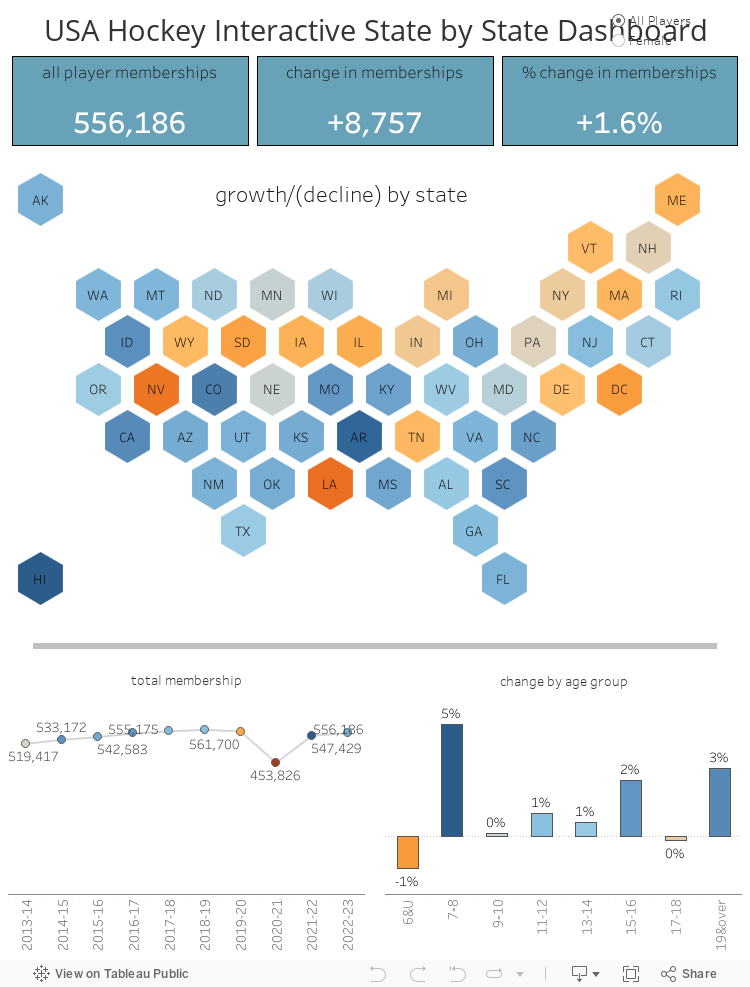
USA Hockey reported 564,468 player members during the 2023-24 season. This represents an increase of 8,262 members from the previous season, although it is slightly lower than the 8,757 new members added in 2022-23.
Despite the increase, the 564,468 memberships are still below the pre-pandemic peak of 567,908. However, another year of modest growth could help surpass that number next season. These figures encompass all player memberships, including both adult and youth hockey players. Let’s take a closer look at the youth membership numbers.
Examining individual state growth reveals that Florida experienced the highest percentage increase in hockey players, with an 8.4 percent rise last season. Michigan added the most memberships, with 2,966 new players. Florida’s growth is likely driven by the success of the Florida Panthers and the Tampa Bay Lightning over the past decade. Historically, states with NHL teams that are not traditionally hockey-centric tend to see a measurable impact when their regional NHL teams perform well in the Stanley Cup Playoffs.
Michigan’s situation is somewhat different. Despite having the fourth-highest number of USA Hockey members, Michigan has been experiencing a steady decline since its peak in 2010-11. Anecdotal evidence suggests that many leagues and rinks in Michigan are not affiliated with USA Hockey, so their numbers are not reflected in the USA Hockey membership data. The recent spike could be due to one of these non-USA Hockey leagues transitioning to require USA Hockey memberships.
I expected Nevada to add more than the modest increase of 116 members this season, especially after the Vegas Golden Knights won the Stanley Cup last June. However, it is challenging to account for that state’s capacity for hockey, meaning that the current ice rinks in Nevada might be at full capacity. Limited rink availability continues to be one of the biggest constraints to growing the game.
Age groups
Breaking down the data by age categories reveals that adult hockey is growing at the highest rate, but there is also growth in the age categories from nine to 18 years old.
Female hockey driving growth
Although smaller in overall numbers, USA Hockey membership among females is increasing at a higher rate than the total memberships.
Unpacking Washington State
Following the Seattle Kraken’s first Stanley Cup Playoff appearance and subsequent playoff round victory, Washington State added 406 player memberships this season, making it the sixth-highest increase in the US.
While this is promising, I would have expected more, given the excitement that gripped the city during the playoffs. Kraken Community Iceplex tends to be fully utilized during all operating hours, so it could be that they are already at capacity.
Examining the growth and decline by age group in Washington State reveals a concerning trend: declines in the under-eight age category. Ideally, we could dig deeper to identify if specific regions or associations are struggling to attract these younger age groups. While the arrival of the Kraken has been fantastic for hockey’s growth, smaller associations might find it harder to promote their youth programs under the shadow of the Kraken Youth Hockey Association.
Interactive Dashboard
For a state-by-state breakdown of USA Hockey memberships, I’ve created an interactive dashboard where you can drill down by state. If you encounter any issues or have questions, please let me know.