The holiday season winding down means the World Junior Championship is also soon coming to a close.
The IIHF World Junior Championship is an annual, two-week tournament featuring the world’s premier under-20 players. Many current and former NHLers have become household names after playing in this event, ringing especially true for Kraken captain Jordan Eberle.
Four Seattle Kraken prospects have participated in this year’s tournament: Julius Miettinen and Kim Saarinen for Finland, Loke Krantz for Sweden, and Jakub Fibigr for Czechia.
While the participating players have been showing out for their home nations, things haven’t been going swimmingly in the Twin Cities when it comes to attendance.
Group A, which included the U.S., played at Grand Casino Arena in St. Paul, home of the Minnesota Wild. Canada’s Group B competed at 3M Arena in Minneapolis, home of the NCAA’s Minnesota Golden Gophers.
Games involving the United States drew relatively strong crowds, averaging about 13,500 fans per game, but attendance for other nations has lagged. Some games have drawn just 28 percent of capacity, prompting online questions about the future of the event in the United States.
The U.S. has hosted the tournament three times since 2005, twice in Buffalo, N.Y., and once split between North Dakota and Minnesota.
The 2018 tournament in Buffalo saw Canada outdraw U.S. games at KeyBank Center, with the Canada–Sweden gold medal game the only contest to draw more than 10,000 spectators (not counting the USA–Canada outdoor game).
What might be contributing is the tournament being predominantly CHL-driven. In a historically college-dominated region like Minnesota, it might be difficult for local fans to keep track of all of the players and teams involved, since many top prospects play in Canadian markets with less U.S. media coverage.
No U.S. market will ever truly match the intensity and devotion of Canadian markets, which have hosted the tournament a record 17 times and will host two of the next three.
But if there’s a region in the U.S. with the junior hockey foothold and infrastructure to replicate that atmosphere, it’s Seattle and the Pacific Northwest, which has previously attempted to attract the tournament.
The U.S. won’t host the tournament again for at least three years, with host locations set through the 2028–29 season, which leaves ample time to begin building the case for the Pacific Northwest as the next host region.
The Seattle area venues
There are many great venues in the region that could be enticing host sites. The obvious flagship would have to be Climate Pledge Arena in downtown Seattle (home of the Kraken and Torrent), which holds 17,151 spectators for hockey. It would bring in the NHL and WHL crowds, as the Seattle Thunderbirds called it home from 1989 to 2008, and the two local WHL teams have played each other there once a year for the last five years.
Typically, the host country’s group plays in the larger venue, with the other group playing in the secondary venue. The U.S. at CPA sure would be a sight to behold.
The two other WHL venues would offer similar amenities for the other group as well.
Angel of the Winds Arena in Everett is an unmatched setting for WHL games, with a seating capacity of 8,149. About 45 minutes north of Seattle, Silvertips fans consistently pack the arena during the season. Complete with deafening cowbells that add to the intimate experience, it’s a unique environment in which to watch a game.
Everett is also about an hour south of the Canadian border, well located to draw fans in the Vancouver metro area and beyond to make their way down.
There’s also a second ice rink attached to the arena that could be used for team practices.
Accesso ShoWare Center in Kent is another facility that could be used for the event. About 30 minutes south of Seattle, the Thunderbirds always have the venue rocking no matter the year.
The horseshoe-like footprint of ShoWare might make it challenging for visiting fans to maneuver, but given its proximity to Sea-Tac Airport, it would offer added ease of access for visiting fans and media flying in.
Practice venues include the aforementioned rink attached to Angel of the Winds Arena, Kraken Community Iceplex, and various other rinks throughout the Seattle metro area.
Other possible hosts
The IIHF doesn’t strictly limit itself when it comes to proximity of the buildings used. The event usually stays within the same general region, but it does branch out from time to time and utilize venues that are farther away from each other. Right now, it’s in the Minneapolis–St. Paul region, with the two cities about 15 minutes apart, but in 2026, Edmonton and Red Deer, Alb. will share hosting duties despite being almost two hours apart.
Strong arguments also exist for other venues, such as Numerica Veterans Arena in Spokane or the Toyota Center in Kennewick. Both cities offer excellent facilities and top-tier fanbases who consistently show their support. There’s also a compelling case to include Portland, or even having the Rose City serve as the primary host city on its own, given its two venues and the strength of its fan base.
But Seattle and Everett makes the most sense. It would offer ease of coordination for the event, with other factors to consider like transportation accessibility, arena availability, and things to do in the area.
There are some challenges and work-arounds too with hosting a tournament like this. If done in an NHL city, often the NHL team goes on a prolonged road trip. The Wild had a seven-game road trip to accommodate the tournament this season. That would be something to consider for the Kraken.
But what do you think? Where would you like to see World Juniors games played if they came here?
With the Professional Women’s Hockey League set to play a regular-season game at Climate Pledge Arena in Seattle on Sunday, now is a good time to evaluate Seattle’s viability as a location for an expansion team. Key factors to consider include the availability of a team, a suitable arena, and a willing ownership group.
Key requirement #1: An available team
In the fall, the PWHL announced plans to expand by adding two new teams for the 2025–26 season. This presents an opportunity for Seattle to be considered as a viable market. However, the league’s current footprint is predominantly regional, with its westernmost team located in St. Paul, Minnesota. Expanding to Seattle would introduce added costs and logistical complexities, including increased travel expenses and scheduling challenges.
Despite these hurdles, a western expansion appears inevitable if the PWHL aims for national representation and sustained growth. A comparable precedent is the American Hockey League’s 2015 relocation of five teams to California, marking the league’s first western presence. This move was strategically aligned with NHL Pacific Division teams for proximity to parent organizations, demonstrating how logistical challenges can be mitigated with proper planning.
For the PWHL, team locations are not tied to NHL affiliations, offering greater flexibility in placing teams where they are most viable. This opens the door for Seattle and other cities in the western U.S. and Canada.
A phased expansion approach could also be considered, gradually extending westward from the current league footprint. Calgary, Alberta, emerges as a strong candidate due to its history of hosting professional women’s hockey, abundance of arenas, and passionate hockey fanbase. Denver is another city generating interest, evidenced by its inclusion in the PWHL’s Takeover Tour. Female hockey participation data further highlights Denver’s potential, with approximately 3,400 registered female players compared to Washington’s 2,100. Vancouver, British Columbia, also merits consideration, offering a location with fewer logistical challenges compared to Seattle.
Seattle’s inclusion in a western expansion would require overcoming logistical hurdles but could set a precedent for future league growth into untapped markets.
Key requirement #2: A suitable arena
Identifying a suitable arena is one of the more complex challenges for establishing a PWHL team in Seattle. The league’s existing venues vary widely in size and usage, with no clear standard. For example, two of the three U.S.-based PWHL teams play in NHL arenas, operating at 20–40 percent of capacity, while the Canadian teams share facilities with AHL or major junior hockey teams, averaging approximately 8,000 fans per game. Based on these trends and the history of professional women’s hockey, an ideal venue would seat between 5,000 and 10,000 fans.
While Seattle’s Climate Pledge Arena could host a PWHL team, its 17,151-seat capacity would likely lead to low occupancy rates, potentially dampening the game-day atmosphere and fan experience. Additionally, with the anticipated return of the NBA’s Seattle SuperSonics, scheduling conflicts might limit Climate Pledge Arena’s availability for another professional team.
Alternative venues include Angel of the Winds Arena in Everett (capacity: 8,149) and accesso ShoWare Center in Kent (capacity: 7,141). Both align closely with the PWHL’s preferred arena size, but their distance from Seattle’s population core could pose challenges for attracting consistent fan attendance.
On the surface, Seattle has existing venues capable of hosting a team, but none feel like a perfect long-term solution. One potential pathway could involve using one of these secondary arenas for a few seasons while planning for a new, purpose-built facility in Bellevue or North Seattle. However, constructing a new arena is a complex, time-consuming process requiring significant financial and political investment, making it an unlikely short-term solution.
Key requirement #3: A willing ownership group
The most elusive aspect of establishing a PWHL franchise in Seattle may be identifying a committed ownership group. Ownership in professional sports often requires significant due diligence, with prospective investors evaluating financial models, market conditions, and long-term prospects before publicly expressing interest.
It is reasonable to assume that potential owners are already analyzing what it would take to bring a PWHL team to Seattle, factoring in the time, capital, and effort required to build a successful franchise. Like many business ventures, owning a sports franchise demands significant upfront investment with uncertain short-term returns. Success typically comes from patient, methodical owners willing to invest in the team’s development and long-term growth.
One advantage of a PWHL franchise is its relatively lower cost compared to an NHL team, reducing financial barriers and increasing the pool of potential investors. However, any ownership group must consider the complexities of establishing a sustainable business model, including addressing the challenge of securing a long-term arena solution. While the initial years might see the team playing in existing venues, a purpose-built arena could become essential for sustained success.
Current challenges exist
Seattle appears to be a promising market for a PWHL team, especially given the success of other professional women’s sports teams in the city, such as the Seattle Storm (WNBA) and OL Reign (NWSL). These teams have demonstrated the community’s enthusiasm for women’s sports and its ability to rally around professional franchises. The excitement surrounding Sunday’s game between the Montreal Victoire and Boston Fleet further underscores the potential fan interest in women’s hockey in Seattle.
However, significant challenges remain. Seattle’s geographic isolation from the current PWHL footprint presents logistical and financial hurdles, such as increased travel costs and scheduling complexities. Additionally, while the city has viable venues, none currently provide an ideal long-term solution. The absence of a mid-sized, centrally located arena tailored to PWHL needs could complicate efforts to establish a sustainable franchise.
While Seattle is likely to be a strong candidate for a PWHL expansion team in the future, these challenges suggest it might be better suited for a later expansion round. Addressing the logistical and infrastructure issues will be critical to ensuring the success of a potential franchise in this market.
USA Hockey player memberships grew by 1.5 percent over the 2023-24 season compared to the previous season. While this growth is a positive sign for hockey participation, the numbers have not yet reached the pre-pandemic levels of the 2018-19 season. Let’s dive into the details of the report to understand where hockey is growing and identify potential opportunities for further growth.
USA Hockey player memberships by year
USA Hockey reported 564,468 player members during the 2023-24 season. This represents an increase of 8,262 members from the previous season, although it is slightly lower than the 8,757 new members added in 2022-23.
Despite the increase, the 564,468 memberships are still below the pre-pandemic peak of 567,908. However, another year of modest growth could help surpass that number next season. These figures encompass all player memberships, including both adult and youth hockey players. Let’s take a closer look at the youth membership numbers.
Examining individual state growth reveals that Florida experienced the highest percentage increase in hockey players, with an 8.4 percent rise last season. Michigan added the most memberships, with 2,966 new players. Florida’s growth is likely driven by the success of the Florida Panthers and the Tampa Bay Lightning over the past decade. Historically, states with NHL teams that are not traditionally hockey-centric tend to see a measurable impact when their regional NHL teams perform well in the Stanley Cup Playoffs.
Michigan’s situation is somewhat different. Despite having the fourth-highest number of USA Hockey members, Michigan has been experiencing a steady decline since its peak in 2010-11. Anecdotal evidence suggests that many leagues and rinks in Michigan are not affiliated with USA Hockey, so their numbers are not reflected in the USA Hockey membership data. The recent spike could be due to one of these non-USA Hockey leagues transitioning to require USA Hockey memberships.
I expected Nevada to add more than the modest increase of 116 members this season, especially after the Vegas Golden Knights won the Stanley Cup last June. However, it is challenging to account for that state’s capacity for hockey, meaning that the current ice rinks in Nevada might be at full capacity. Limited rink availability continues to be one of the biggest constraints to growing the game.
Age groups
Breaking down the data by age categories reveals that adult hockey is growing at the highest rate, but there is also growth in the age categories from nine to 18 years old.
Female hockey driving growth
Although smaller in overall numbers, USA Hockey membership among females is increasing at a higher rate than the total memberships.
Unpacking Washington State
Following the Seattle Kraken’s first Stanley Cup Playoff appearance and subsequent playoff round victory, Washington State added 406 player memberships this season, making it the sixth-highest increase in the US.
While this is promising, I would have expected more, given the excitement that gripped the city during the playoffs. Kraken Community Iceplex tends to be fully utilized during all operating hours, so it could be that they are already at capacity.
Examining the growth and decline by age group in Washington State reveals a concerning trend: declines in the under-eight age category. Ideally, we could dig deeper to identify if specific regions or associations are struggling to attract these younger age groups. While the arrival of the Kraken has been fantastic for hockey’s growth, smaller associations might find it harder to promote their youth programs under the shadow of the Kraken Youth Hockey Association.
Interactive Dashboard
For a state-by-state breakdown of USA Hockey memberships, I’ve created an interactive dashboard where you can drill down by state. If you encounter any issues or have questions, please let me know.
With Team USA showcasing dominance in the IIHF World Junior Championship so far, a compelling narrative has emerged, highlighting the United States as a burgeoning hockey superpower. This shift challenges the traditional mindset, and we’re beginning to expect momentous victories from USA Hockey teams.
I have been consistently documenting the growth of USA Hockey, using it as a justification for NHL expansion into new markets. To visually represent the progression, it seems timely to share another data analysis on the prevalence of American hockey players in the NHL, showcasing the remarkable journey we’ve undergone.
Nationalities of NHL players
The number of US-born players in the NHL has reached an all-time high this season, at 29.3 percent of the league. In contrast, the percentage of Canadian players has dropped to 41.2 percent, the lowest of all time. It’s worth noting that these figures might undergo slight changes due to factors such as injuries, call-ups, and other scenarios between now and the end of the season, but this is a good look at how the countries are trending.
As the chart indicates, this trend has been going on for quite some time.
Here is a different way to look at the data, which makes clearer how many NHL players come from each nation in the 2023-24 season to date:
To delve deeper into the analysis, I also examined the nationalities of current NHL players based on their birth year to determine if there is any indication of an upcoming trend. For instance, I compared the age distribution of US players in the NHL to that of their Canadian counterparts with the same birth year.
In my opinion, there was nothing noteworthy when examining this year’s NHL players by birth year. Generally, the percentage of Canadians by birth year fluctuates randomly between 38 percent and 50 percent across the entire range of birth years. Similarly, the percentages of US players vary between 20 percent and 40 percent throughout the birth years.
The growth of US players in the NHL
As mentioned earlier, the number US-born players in the NHL has been trending up for a long time.
Digging a bit deeper on that, here is an overview of the birth states of US-born NHL players. The below visualization may not be perfect for illustrating the growth of some states, but it’s worth noting that the category labeled as “Other” now includes 95 players in the NHL this season. This category encompasses states with fewer than 10 players represented in the current season. That tells you some non-traditional markets have seen growth.
Another perspective to consider on the data is to observe the number of states being represented by at least one NHL player throughout the season.
Most analyses attribute the growing interest in hockey among Americans to three main themes: 1) the Miracle on Ice in the 1980 Olympics, 2) Wayne Gretzky being traded to the LA Kings, and 3) NHL expansion. While the first two are challenging to validate definitively, the impact of NHL expansion aligns with the growth in USA Hockey memberships by state over the years.
To illustrate this transformation, I compared a map of NHL players from the 1990-91 season to the current 2023-24 season. The discernible impact of “southern expansion” becomes rather evident in the comparison.
Nationality by team
As a fun bonus piece of content, here is a look at the nationality breakdown by NHL team this season. The Kraken are 48 percent Canadian and 23 percent American. The team with the highest percentage of American players is the New York Rangers at 50 percent.
If you have any questions, feedback, or suggestions for further exploration, leave a comment below and I will get back to you.
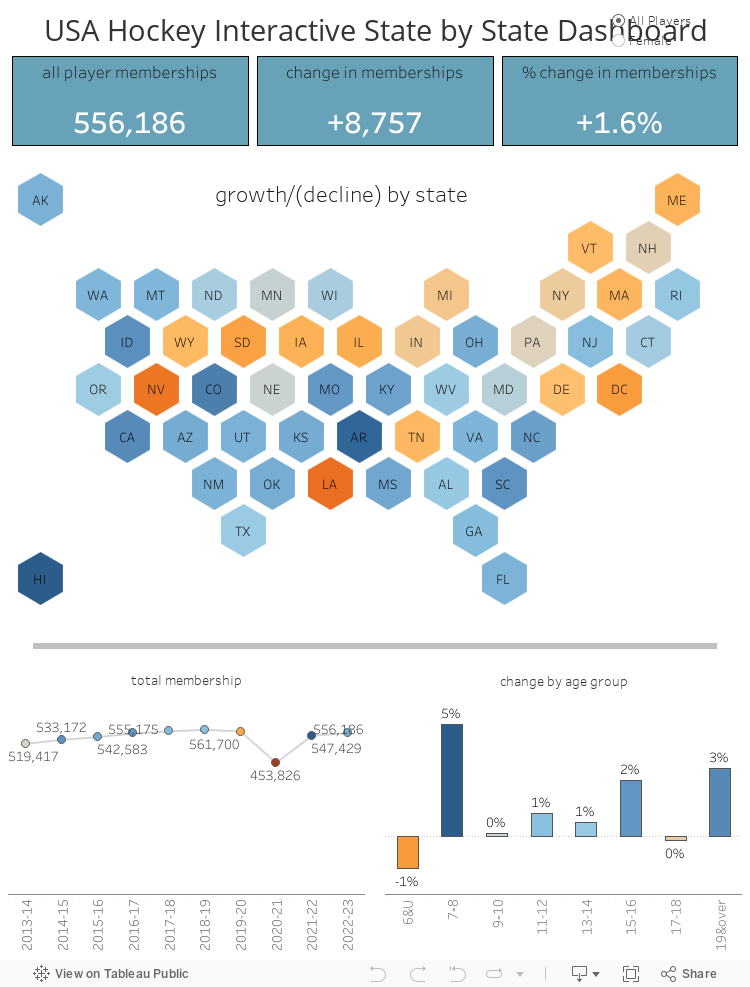
Late last week, USA Hockey released its annual player membership report that breaks down total memberships by state and age group. Over the years, I’ve used this report as a barometer to check on the overall growth or decline of hockey participation across the United States. Let’s break down the numbers.
Nationwide USA Hockey player memberships
Overall player memberships were up a modest 1.6 percent season over season, adding over 17,000 registered players during the 2022-23 hockey season compared to 2021-22. It is a positive sign that there was an increase season over season, but overall memberships have not fully recovered to pre-pandemic numbers.
Where hockey is growing
As we dig into the numbers a bit deeper, we can see that Colorado is the only state that saw double-digit percentage growth season over season. This is generally expected considering the Colorado Avalanche won the Stanley Cup in June, 2022. Playoff success tends to create an influx of hockey memberships in the following season.
What is also fascinating is that Nevada had the largest decline season over season, down 7 percent from 2021-22. This is probably in part due to the Vegas Golden Knights’ failure to make the 2022 Stanley Cup Playoffs for the first time in franchise history. We should expect a significant increase of memberships during the 2023-24 season in that market after the Golden Knights were crowned the Stanley Cup champions of 2023.
It should also be noted that the success of NHL teams is not the only way states see increases or decreases in their USA Hockey player memberships. Other factors may include the number of hockey facilities opening or closing, plus and the leadership and marketing capabilities of youth hockey organizations that can really drive growth or decline in player memberships.
If you look at the growth and decline by age group, you can see the seven-to-eight-year-old category had the largest increase season over season, but six and under saw the largest decline.
Female hockey continues to outpace overall memberships
Looking specifically at the female category, we see that the growth across female USA Hockey memberships is up almost 4 percent season over season. Over the last 10 years, female hockey has tended to be the most consistent contributor in the overall growth of USA Hockey memberships. Female hockey memberships represent about 16 percent of all USA Hockey player memberships per season.
When evaluating the female category by age group, all but the six-and-under age group saw substantial growth season over season.
Washington State USA Hockey members
As illustrated above, we saw that Washington state had the 16th-highest increase season over season from a percentage standpoint, but when we look at it by volume, we see Washington state had the eighth-highest growth with 473 additional hockey players enrolled in 2022-23.
Except for the pandemic season of 2020-21, Washington state’s player membership growth has remained consistent over the last 10+ seasons.
In terms of percentages, you can see growth up and down the age categories, but the largest volume growth was from the adult category. This also happens to be the biggest number of registrants.
Overall, the growth of USA Hockey memberships in Washington state is good news, but it is a bit underwhelming considering the Seattle Kraken are in just their second season in the state. As we have seen in other states, we should expect another growth spurt next season due to the success of the Kraken’s 2022-23 NHL season and playoff run.
Interactive dashboard
If you’d like to look at a state-by-state breakdown of the USA Hockey memberships, I’ve created an interactive dashboard where you can drill down by state. If you have any problems or have any questions, please let me know.
If you have questions, thoughts, or theories on the USA Hockey memberships, please leave them in the comment section.
Last week, we shared analysis on the 20 percent increase in USA Hockey player memberships over last season. This week, we are looking into the numbers reported on female memberships to evaluate the growth (or decline) of female participation in USA Hockey.
Before the pandemic, female participation had been on a steady increase over the previous 10 years, averaging around a 5 percent annual increase from 2013-14 to 2019-20. Like in all sports, the pandemic severely impacted female participation in a good chunk of 2020 and 2021.
Here is how the female participation numbers have looked since 2012-13.
Like the trends we reported last week, female memberships are also seeing a huge recovery with an increase of 25 percent season over season. One of the storylines for the “all players” numbers reported by USA Hockey was that memberships are up significantly but have yet to return to the pre-pandemic numbers of 2019-20 season. This is not the case with female memberships, as they are up more than 5 percent compared to the 2019-20 season, an all-time high.
State-by-state USA Hockey female memberships
When we break it down by state, we see some relatively consistent numbers compared to the overall numbers we analyzed last week. Massachusetts, California, New York, Michigan, and Minnesota added the most memberships since last season. They were all some of the most severely hit during the pandemic-impacted season in 2021-22.
In terms of percentages, the top states for growth among female participants are consistent with the total membership reported. Here is a look at the top 10 states by percentage change.
This consistency makes sense, since if a state is recovering, it would be likely that all people are returning to hockey at the same rate.
Female hockey in Washington State
In Washington State, female hockey memberships are up 87 percent from last year, and what might be more impressive is that memberships are up 20 percent compared to 2019-20. This is more than just a recovery from the pandemic-impacted season of 2020-21.
These are really encouraging trends for female hockey players in Washington State. The more players there are, the more opportunities this will provide for girls to play at an older age, as participation has tended to wane in the older age groups. If you can grow the game at a young age, there will be more players at the older age groups, even if the retention rate stays the same. Here is a breakdown of the players by age group and percentage growth of each category.
Again, the reasons for the growth in girls and women’s hockey is the same as it was for all members: 1) return from pandemic-impacted season. 2) Kraken emphasis on the Adult Learn to Play, NHL Learn to Play and Sealeague programming at Kraken Community Iceplex.
The growth in girls and women’s hockey in the area is encouraging, as even more growth is expected in the coming years. Next year the Seattle Kraken will be adding girls-only teams in the 8U, 10U, and 12U age groups, and the Kraken will inspire plenty of youth and adults to give hockey a try.