Prospects to watch in the 2023 NHL Draft

Prospects to watch in the 2023 NHL Draft

Last week, we published the 2023 Sound Of Hockey Big Board. Give it a read. It compiles player information, statistics, and public draft rankings from reporters and scouting services for thousands of prospects in the 2022 NHL Draft.

Today, with the draft just days away, we return with a breakdown of prospects that caught our eye as potential targets for the Seattle Kraken, listed in Big Board order. I built the first draft of this list based on a review of the player’s NHL equivalency and Big Board analytics ranking relative to the player’s projected draft position. The analytics sources consulted included:

  • Chace MacCallum (link): 75 ranked prospects
  • Scouching (link): 82 ranked prospects
  • Hockey Prospecting (link) ($$): 403 ranked prospects split into 2 separate lists
  • Thibaud Chatel (link): 794 ranked prospects
  • Rachel Doerrie (link): 64 ranked prospects
  • TopDownHockey (link): 200+ ranked prospects

After this narrowed the field of potential candidates, I included a player in the final list only if there was also a scouting reason to believe in the player. A few of my own subjective perspectives influenced adding a few players on the margins. The players I like the most from a Big Board rank-to-value perspective are indicated with an asterisk. But, for the most part, I’ll save my thoughts for a mock draft planned for later in the week.

Using a similar approach to last year, I highlighted four players the Kraken ultimately drafted–Jani Nyman, David Goyette, Ty Nelson, and Tyson Jugnauth. I certainly would have written on Shane Wright and Jagger Firkus too, but I mistakenly assumed the Kraken would have no chance at getting either player with their first and second draft picks respectively. I’ve tried to be a little more flexible this year by including players a bit outside of Big Board range for the Kraken in case those players fall. That said, you still won’t see me digging into many high first-round prospects, for example.

Let’s dive in.

First-round prospects

Matty Beniers was a first-round pick of the Seattle Kraken in 2021 (Photo/Brian Liesse)

6. Zach Benson, LW, Winnipeg Ice, WHL

LH | Age: 18 | HT: 70 | WT: 159 | 43 G | 72 A | 75 GP

Benson is no. 6 in our overall analytics ranking. He is no. 11 in our NHLe calculation.

Scout’s view: “What always stands out to me about Benson’s overall game is his incredible tenacity off the puck. He challenges opposing players with aggressive stick checks and body position. What makes that skill even more effective is how quickly he can force turnovers and immediately make a dangerous play off a pass or shot. His awareness is high end and he anticipates as well as any player in this draft.” – Chris Peters

Notes: Benson is a skilled winger with all of the tools to be a top line play driver in the NHL. There have been some rumblings that NHL teams are lower on him than the public lists and mock drafts due to his size. Bob McKenzie and Corey Pronman, two well-connected draft reporters, had Benson ranked well below his Big Board position. Chris Peters–a very good friend of the Sound Of Hockey Podcastmocked Benson at pick no. 17. Even so, he is so skilled, particularly as a playmaker, that I view it as highly unlikely he falls into trade-up territory for Seattle.

10. David Reinbacher, RD, EHC Kloten, NL

RH | Age: 18 | HT: 74 | WT: 187 | 4 G | 20 A | 49 GP

Reinbacher is no. 9 in our overall analytics ranking. He is no. 5 in our NHLe calculation.

Scout’s view: “His game rests on a projectable, rock solid defensive foundation. As opponents attack through the neutral zone, he gaps up early, builds speed going backward to match that of the puck carrier, takes away the middle of the ice with his stick, and closes with force once he’s registered support. Standing at 6-foot-2 and equipped with a skating stride that’s already a cut-above-average with room to get better – even when you’ve got Reinbacher beat in space, you don’t really.” – Elite Prospects Draft Guide

Notes: Again, this is a player almost certainly out of trade-up reach for Seattle at pick no. 20, but should he fall into range, his data profile is the best of any defender in the draft. He is a righty with good size and a strong season in a very good professional league. The floor seems very high on Reinbacher.

12. Matthew Wood, RW, University of Connecticut, NCAA

RH | Age: 18 | HT: 76 | WT: 197 | 11 G | 23 A | 35 GP

Perreault is no. 10 in our overall analytics ranking. He is no. 12 in our NHLe calculation.

Scout’s view: Matthew Wood, the youngest player in college hockey this year, . . . demonstrated his ability to control the game and effectively lead the team’s powerplay. His shooting technique is exceptional, often overpowering goalies with long-distance shots. Additionally, his passing abilities are solid, effortlessly executing no look passes. . . . While his skating may be slower compared to others, his strong hockey sense compensates by positioning himself appropriately at crucial moments.” – Tait Borst

Notes: Near point-per-game production at the NCAA level is similar to Matty Beniers’s draft season at the University of Michigan. He’s more physically mature but doesn’t boast the same well-rounded profile of the Kraken center. Wood’s power forward potential could appeal to the Kraken if he falls unexpectedly to no. 20.

14. Gabe Perreault, RW, USNTDP, USNTDP

LH | Age: 18 | HT: 71 | WT: 165 | 53 G | 79 A | 63 GP

Perreault is no. 7 in our overall analytics ranking. He is no. 7 in our NHLe calculation.

Scout’s view: “There were times he flashed an amazing ability to one-touch pass and spring his linemates open, as well as he possesses a high level of skill to create passing lanes through sudden puck manipulation moves that darted by the defenders stick. However, when the pace of play picked up I found Perreault’s impact on the game began to diminish.” – Austin Garret

Notes: The production is undeniable. He broke Auston Matthews’s record for total points in a season for the U18 U.S. National Team Development Program. The question is whether he has the physical tools to translate that production to the professional level. I would place the bet. There was a time when it seemed like Perreault could slide into the bottom half of the first round, but now it seems like he will remain out of reach for the Kraken at no. 20.

19. Samuel Honzek, LW, Vancouver Giants, WHL

LH | Age: 18 | HT: 75 | WT: 195 | 24 G | 36 A | 47 GP

Honzek is no. 20 in our overall analytics ranking. He is no. 21 in our NHLe calculation.

Scout’s View: “Briefly derailed by injury, Honzek’s season was one that saw him consistently rise. Earlier in the year, he was generating a lot of buzz with his play as a 6-foot-3.5 forward who can drive the net and make plays in the hard areas of the ice. He doesn’t necessarily have any one stand out trait, but he does everything pretty well. You don’t have to worry about his work ethic on the ice and he absolutely battles against opposing defenders, giving them all they can handle.” – Chris Peters

Notes: He strikes me as a high-end athlete playing hockey more than a high-end hockey player, if that makes sense. But his athleticism is special. He turned in perhaps the best combine performance of any player. He has potentially dominant tools, but he hasn’t linked them up into truly excellent performance just yet. He may never be much of a playdriver but could thrive on the wing of a puck dominant center. Even if it seems like there is untapped potential with Honzek, his data supports a selection in the range of Seattle’s first pick. He’d also inject a bit more size into Seattle’s prospect pipeline.

21. Quentin Musty, LW, Sudbury Wolves, OHL*

LH | Age: 17 | HT: 73.5 | WT: 200 | 27 G | 55 A | 57 GP

Musty is no. 12 in our overall analytics ranking. He is no. 9 in our NHLe calculation.

Scout’s view: “Musty has an excellent shot from range, distributes quite well off of the rush and does a great job of creating space for himself. His ability to create consistently at 5v5 is a credit to how well he handles pressure. Musty will take advantage of tight lanes when looking to thread the needle and will look to complete drop passes when hitting a wall.” – Josh Tessler

Notes: Musty would check a lot of boxes for the Kraken. His point production stacks up against past high draft picks from the OHL. He has the size, shot, and playmaking ability to thrive in the top half of an NHL lineup. He is also one of the youngest players in the draft. Some scouts faulted his engagement and defense, though others reported that these aspects of his game improved as his draft season progressed. His skating may be the biggest question mark, but his physical profile and skill creates an avenue to a bottom-six role in the NHL even if the skating doesn’t come around.

25. Andrew Cristall, LW, Kelowna Rockets, WHL*

LH | Age: 18 | HT: 69.5 | WT: 175 | 40 G | 56 A | 58 GP

Cristall is no. 8 in our overall analytics ranking. He is no. 10 in our NHLe calculation.

Scout’s View: “Andrew Cristall might be one of the most skilled puckhandlers in this draft class. He’s an absolute wizard with the puck, as he is able to put defenders on their asses. Cristall is able to set the pace of play with his hockey sense as he’s an excellent puck distributor too. He’s able to find open teammates and feed them an excellent tape to tape pass, to create high danger scoring chances. However, his Skating is an issue. He’s skating stride is pretty wonky, and he’s not the fastest guy out there, despite being 5’10.”” – Rayan Tubecc

Notes: Cristall is a tough one. He has true high-end hockey sense and puck skill, particularly in the offensive zone. But he is small, not particularly mobile, and doesn’t provide much in the way of defense. To draft him in the first round, a team will need to be confident the playmaking will translate. His data suggests he is worthy of the gamble. If a few higher-ranked players aren’t available for the Kraken in the late first round, Cristall is intriguing, but scouts suggest he needs to make progress with his skating to have any chance. If he hits, the reward could be huge because he is good at helping his team do the hardest thing in the sport: score.

26. Gavin Brindley, C, University of Michigan, NCAA

RH | Age: 18 | HT: 68 | WT: 168 | 12 G | 26 A | 41 GP

Brindley is no. 14 in our overall analytics ranking. He is no. 29 in our NHLe calculation.

Scout’s view: “Brindley is a high-motor player who excels on the defensive side of the puck. He’s a tenacious forechecker and reliable in defensive zone coverage.” – Joey Padmanabhan

Notes: Brindley excelled at a higher level of competition by impacting the small areas of the game all over the ice. And, beyond that, his scoring production at the University of Michigan is not far off from what Matty Beniers produced. The question about Brindley is whether he can generate these results at the NHL level at his small stature without high-end foot speed. I like the player, but his profile has more questions than I would like for a first-round prospect.

27. Mikhail Gulyayev, LD, Omskie Yastreby, MHL

LH | Age: 18 | HT: 70 | WT: 170 | 4 G | 31 A | 39 GP

Gulyayev is no. 11 in our overall analytics ranking. He is no. 18 in our NHLe calculation.

Scout’s view: “A dynamic skater with good puck skills and high-end passing ability, Gulyayev is one of the better puck movers in this draft. The fact he’s under 5-foot-11 and the Russian risk factor are going to come into consideration as to where he goes. . . . On skill, there’s enough of a dynamic element there to make him look like the undersized defensemen that find a role in the NHL, likely in the back half of an NHL rotation.” – Chris Peters

Notes: Gulyayev produced at nearly a point-per-game pace in the MHL. Across the board, scouts raved about his mobility, but he faces questions about his size. To a lesser extent there were also questions about his hockey sense, since it seemed he should be able to dominate his league more than he did with his physical skill set. There is also the uncertainty associated with being a Russian player. If he can survive the NHL game at his size, he may be a strong value for whoever selects him in the late first (or early second) round.

28. Riley Heidt, C, Prince George Cougars, WHL*

LH | Age: 18 | HT: 70.5 | WT: 180 | 27 G | 78 A | 77 GP

Heidt is no. 18 in our overall analytics ranking. He is no. 14 in our NHLe calculation.

Scout’s view: “Riley Heidt is an extremely dynamic and exciting playmaker to watch. He’s an explosive skater with great agility and strong edges, being a factor in transition and in the offensive zone. He’s a remarkable puck distributor as he has the vision to find the passing lanes with ease and is very deceptive with the puck. He has an underrated shot and has the presence and mindset to always pressure defenders to force them into making a mistake, allowing him to pounce on the loose puck and create a counterattack. His work ethic shows every shift and is always making a difference.” – Peter Baracchini

Notes: The production was there at the junior level to be a mid-first-round pick. He is a very good playmaker and elite power-play producer. But Heidt isn’t imposing in stature, nor does he strike fear into his opponents with blazing outside speed, so there is some concern about whether he has necessary carrying skills. Some scouts doubt his ability to stay at center, but others see a physical player and a hard worker with a detailed game that could get the most out of his physical tools and stick there. Heidt strikes me as a strong fallback option for the Kraken in the first round if other preferred targets have been selected.

29. Bradly Nadeau, LW, Penticton Vees, BCHL*

RH | Age: 18 | HT: 70.25 | WT: 160 | 62 G | 86 A | 71 GP

Nadeau is no. 28 in our overall analytics ranking. He is no. 27 in our NHLe calculation.

Scout’s view: “[Nadeau] has a top 5 shot in the class, good handling, improvable skating, a good motor, and high-end awareness at both ends of the ice, not to mention an improving playmaking game featuring frequent one-touch passes, or flashes of a high pace of play, or even his late birthday which gives him a long runway. I see a path for Nadeau to become a needle-moving top-six forward, but it will require patience and a proactive development staff.” – Sebastian High

Notes: Nadeau is an intriguing boom option for a team drafting in the late first round. He has everything a team could want in a wing scorer, including a shot that might trail only Connor Bedard for the finest in the class. Questions on his projection return to his lower level of competition in the BCHL and his decision to commit to the University of Maine, which has not turned out many successful NHL players recently. He is also a smaller player, checking in at only 160 pounds. But he tested well athletically at the combine, which may be an indicator he is a strong enough athlete to succeed at the NHL level at his size.

33. Lukas Dragicevic, RD, Tri-City Americans, WHL*

RH | Age: 18 | HT: 73 | WT: 194 | 15 G | 64 A | 74 GP

Dragicevic is no. 19 in our overall analytics ranking. He is no. 8 in our NHLe calculation.

Scout’s view: “When it comes to offensive defensemen, he’s the cream of the crop. There simply aren’t any others who are as dangerous as he is from the offensive blueline onward. When he gets the puck on his stick opposing defenders often start to second guess themselves because there are so many different ways that they might get beat. Dragicevic possesses elusive footwork and slick hands . . . . It’s his off puck play that is by far the most concerning, though. He can get absolutely lost in his own end at times, and worse yet, will often completely shut off his effort engine, failing to play the body or get his stick in lanes at key times.” – McKeen’s Draft Guide

Notes: His offensive production from the blue line has been elite. Critiques of his game focus on his defense, particularly his rush defense, but he is relatively new to the position, and it strikes me he has a solid chance to improve there given his solid size and skating. My hesitation on targeting Dragicevic (or Gulyayev) in the first round relates back to positional value. High-end forwards are hard to find and typically deliver the most value in the game. Setting aside a few truly transcendent players, a team is capping its upside by drafting on defense in the first round. Add in the significant probability that Dragicevic settles in as a bottom-four guy and a bit of a defensive liability and I can see the arguments against using a first-round pick on the player. If better options are selected, or the Kraken trade back, I could see it. He is the (attainable) defenseman I like the most for Seattle. The offensive potential is significant.

Second-round prospects

Jagger Firkus was a second-round pick of the Seattle Kraken in 2022 (Photo/Brian Liesse)

36. Jaydon Perron, RW, Chicago Steel, USHL

RH | Age: 18 | HT: 69 | WT: 166 | 28 G | 50 A | 67 GP

Scout’s view: Perron is no. 30 in our overall analytics ranking. He is no. 37 in our NHLe calculation.

Scout’s view: “Jayden Perron . . . displays great speed, patience and IQ with the puck, making moves at a quick pace to constantly fool opponents. He’s great at drawing them in to free up space and connect with teammates in the open ice. He needs to add more strength, but his upside and skillset is definitely there.” – Peter Baracchini

Notes: Another on a long list of undersized, scoring forwards at the top of this draft, Perron strikes me as perhaps a half step below Brindley, but a half step above Pinelli, Barkey, and others. The production was very good. If he slips into the mid-second round, the Kraken should have keen interest because his upside outstrips most forwards who could be available there (save perhaps for Koehn Ziemmer). But I don’t view him as a first-round option for Seattle.

44. Koehn Ziemmer, RW, Prince George Cougars, WHL*

RH | Age: 18 | HT: 72.25 | WT: 210 | 44 G | 52 A | 78 GP

Ziemmer is no. 22 in our overall analytics ranking. He is no. 28 in our NHLe calculation.

Scout’s view: “Sniper’s release, small-area skill, off-puck instincts, and off-the-pass shooting – Ziemmer looks the part of an NHL goalscorer. He zips shots around defenders, pump-faking and toe-dragging to create that little extra space for the release. With perfect timing, he spins off checks and gets open for deflections, rebounds, and flashy in-tight moves. . . . [Ziemmer] will have a much smaller margin for error than his peers because of skating. His stride is wide, hunched, and generates little power. His edges suffer.” – Elite Prospects Draft Guide

Notes: As a high-end offensive talent, he is a prime target in the second round should he slide down the board a bit. There is a red flag in his profile–his skating–but some scouts think he could still make it to the NHL in a bottom-six and power play role with only moderate progress in that area.

47. Beau Akey, RD, Barrie Colts, OHL

RH | Age: 18 | HT: 72 | WT: 175 | 13 G | 39 A | 79 GP

Akey is no. 43 in our overall analytics ranking. He is no. 56 in our NHLe calculation.

Scout’s view: “While not overly physical, which is something he needs to work on, Akey has become one of the most successful defenders in this draft in all areas of the ice. Starting defensively, Akey has a good defensive stick and awareness to position himself well and push players to the outside. He’s always aware of developing plays and boasts good defensive hockey sense. In transition, Akey has no problem skating through the neutral zone and taking it wide to get an entry, but he’s also made a lot of great stick to stick passes in high-pace situations for clean entries too.” – Gavin Chiasson

Notes: Akey has been praised as one of the best rush defenders in the class. Also successful in transitions to offense, with plus skating, he has strengths that match up well with the offensive game. His point production isn’t quite at the level of some other options on defense in this range, but his other strengths make him a viable option here, particularly given Seattle’s lack of depth at right defense.

49. Luca Cagnoni, LD, Portland Winterhawks, WHL*

LH | Age: 18 | HT: 69 | WT: 182 | 18 G | 53 A | 76 GP

Cagnoni is no. 23 in our overall analytics ranking. He is no. 22 in our NHLe calculation.

Scout’s view: “Cagnoni is one of the top offensive talents on the blue line this year, and possesses multiple plus assets that you look for in a top offensive defenseman. Cagnoni is a very mobility and shifty skater, able to cut through the neutral zone with possession of the puck or jump into the attack from the offensive blue line with ease. He’s a field general at the top of the powerplay . . . with his ability to command the play in the offensive zone and find teammates with difficult passes. Cagnoni is also a very strong shooter, as he can get the puck through from the blue line or bury pucks from distance . . . .” – Brandon Holmes

Notes: Cagnoni could slide on draft day due to his size. At 5-foot-9, he will be off draft boards for some teams. On the other hand, scouts have indicated he is a legitimate defensive player at the junior level. Scouts said the same thing about the 5-foot-10 Ty Nelson last year before Seattle drafted Nelson at no. 68 in 2022. Seattle does not appear philosophically opposed to drafting smaller defensemen, but drafting Cagnoni would mean a significant investment in undersized blueliners in back-to-back drafts. I think it is a legitimate question whether you could have both Nelson and Cagnoni in the same defense corps long term. That said, I’m firmly in the camp of drafting the best player available. And if Cagnoni is still there for Seattle in the second round, particularly at no. 57, I would strongly support selecting him. His movement and puck skills are borderline high end.

52. Etienne Morin, LD, Moncton Wildcats, QMJHL

LH | Age: 18 | HT: 72 | WT: 180 | 23 G | 66 A | 79 GP

Morin is no. 57 in our overall analytics ranking. He is no. 17 in our NHLe calculation.

Scout’s view: “Morin in the offensive zone is fantastic. He has great deception on the blue line and creates passing lanes with the puck on his stick. He’s super offensive and operated as almost a fourth forward when he was on the ice in terms of creating offense. However, Morin trying to escape forechecking pressure or making a pass under the threat of being hit was cringeworthy. His gap control wasn’t great and didn’t separate players from the puck at the QMJHL level, which made me feel like he’d struggle to be a positive defensive player in the NHL.”  – Austin Garret

Notes: The production was elite from the blue line, but, similar to evaluations of Ty Nelson last year, there is some “go it yourself” in his game that leaves scouts questioning whether his production will translate against tighter checking in the NHL. If he can make adjustments, he seems like a reasonable bet as a lower-pair offensive defenseman and power play quarterback. If he hits, his high-end upside might be similar to Vince Dunn with a bit less defense.

53. Alex Ciernik, LW, Södertälje SK, HockeyAllsvenskan

LH | Age: 18 | HT: 70.25 | WT: 174 | 3 G | 9 A | 28 GP

Ciernik is no. 35 in our overall analytics ranking. He is no. 59 in our NHLe calculation.

Scout’s view: “[T]he multifaceted winger is most notable for his combination of straightaway and shifty speed, and stickhandling skills that make the most of rushing attacks. He clearly has a lot of confidence in his wrist shot, making heavy use of it. . . . Always happy to shoot while adept at setting up teammates, Ciernik is still trying to find a proper balance between the two, sometimes making poor decisions that lead to turnovers. Otherwise, it’s clear Ciernik understands that hitting and physicality are part of the game, and he has no problem engaging himself in that capacity.”  – McKeen’s Draft Guide

Notes: Ciernik has NHL bloodlines (his father, Ivan, played 89 NHL games) and a solid track record of pre-draft production against higher competition in HockeyAllsvenskan. Scouts differ on how he’ll tolerate the physical game at the NHL level, noting much of his success so far has been speed-driven on larger international rinks. But if he can match NHL physicality, he should have a solid “backup” path to the NHL as a bottom-six speed and energy player, even if his skill game plateaus.

55. Hunter Brzustewicz, RD, Kitchener Rangers, OHL*

RH | Age: 18 | HT: 71.75 | WT: 190 | 6 G | 55 A | 77 GP

Brzustewicz is no. 44 in our overall analytics ranking. He is no. 30 in our NHLe calculation.

Scout’s view: “The four way mobility (especially his edgework and lateral quickness) is excellent . . . . As a puck mover, Brzustewicz stands out because of his vision and decision making. Poised under pressure, he always seems to make the correct play with the puck on his stick. . . . I’m a little leary of the projection, but he passed the eye test almost every night in the second half showing great progression.” – Brock Otten

Notes: Scouts describe a well-rounded profile that was trending up toward the end of the 2022-23 season. Scouting critiques point to his underlying athleticism and engagement level, but his skating skill seems solid enough for him to project as solid in the transition game. While he may not have a dynamic element that makes a top-of-the-lineup projection likely, he checks a lot of boxes for Seattle both from a position (right defense) and value perspective in the mid-second round. He’s a player I’m watching closely for the Kraken at pick no. 50 or 52.

56. Lenni Hameenaho, RW, Ässät, Liiga*

RH | Age: 18 | HT: 73 | WT: 185 | 12 G | 13 A | 59 GP

Hameenaho is no. 54 in our overall analytics ranking. He is no. 24 in our NHLe calculation.

Scout’s view: “[T]here’s no doubt about Hämeenaho’s best quality being his intelligence. He’s an extremely smart off-puck player at both ends of the rink. . . . His instincts around the net are simply unmatched in this year’s class of Finnish prospects. The same qualities also allow him to break up plays defensively, foreseeing the developing plays in advance and positioning himself accordingly. On the other side of the coin is Hämeenaho’s skating. It’s a problem with both the mechanics and the output. There’s a notable lack of ankle flexion and an ugly tilt at the hips, resulting in a hunched posture. Both the top speed and the acceleration are lacking.”  – Elite Prospects Draft Guide

Notes: Hameenaho is routinely lauded for strong intelligence and hockey sense, making the right plays without the puck consistently. Otherwise he has a solid-but-not-superlative skill set across the board and is burdened by below-average skating.  Several scouts suggest he’s close to being ready to take on a third-line role in the NHL right now, but doubt he has much more upside beyond that. While this is seemingly meant as a criticism, I don’t see it that way. If Hameenaho caps out as a third-line player, that is an excellent result for a second-round pick. His production at the highest level Finnish pro league at his age makes him a prime target in my NHLe calculation. At the very least he’d be a high-floor counterbalance against other high-upside picks if the Kraken selected him in the second round.

59. Kalan Lind, LW, Red Deer Rebels, WHL

LH | Age: 18 | HT: 72.5 | WT: 158 | 18 G | 31 A | 53 GP

Lind is no. 40 in our overall analytics ranking. He is no. 68 in our NHLe calculation.

Scout’s view: “Despite average size, Lind plays with jump and edge. He’s a fierce competitor and there’s a real nastiness to his game . . . . The question will be if his offensive skillset is high-end enough to warrant a high pick. There’s no doubt his hard-nosed play and ability to get to the interior is going to win him some fans, but the upside projection is a bit more difficult given than Lind does not have natural high-end puck skills.”  – Chris Peters

Notes: He is the brother of Kraken forward Kole Lind. Some scouts question his proper role, as he’s been used as a bottom-six center and as a top-six wing with mixed results. Regardless, as McKeen’s summarizes, he gets credit for “his speed, versatility, hockey sense, physicality and pest-like edge.” That last attribute will sound familiar to anyone who watched Kole at the AHL level these last two years.

60. Aydar Suniev, LW, Penticton Vees, BCHL

LH | Age: 18 | HT: 73.5 | WT: 192 | 54 G | 59 A | 65 GP

Suniev is no. 29 in our overall analytics ranking. He is no. 58 in our NHLe calculation.

Scout’s view: “One of the craftiest playmakers in the entire draft, Suniev is a physical monster, operating at 6-foot-2, 205 pounds. . . . [He is] able to layer a puck through even the thickest of coverages . . . . He wasn’t a one-dimensional playmaker, though. A proactive processor, Suniev always has the next pass option hardwired in his brain before he even collects the puck. . . . Suniev’s chest-to-ground stride is the biggest caveat of his entire game. The stride is so prohibitive that it turns a player who honestly has first-round quality tools into a later option in the draft. Will he be able to use all the protection and little adaptations to beat professionals without improving his mechanics? It’s a valid question.”  – Elite Prospects Draft Guide

Notes: His skating seems like an almost disqualifying red flag, and I omitted him on an initial draft of this list, but his offensive package of skills gets strong enough reviews, despite the projection from a lower level of competition, that he may be a worthy gamble at the end of the second round, depending on the other options available. 

61. Luca Pinelli, C, Ottawa 67’s, OHL

LH | Age: 18 | HT: 68.75 | WT: 167 | 36 G | 45 A | 78 GP

Pinelli is no. 46 in our overall analytics ranking. He is no. 45 in our NHLe calculation.

Scout’s view: “Despite his 5-foot-9, 167-pound frame, Luca Pinelli shows no fear in his game as he’s always competing and going into the hard areas to battle for the puck. He’s always engaging for possession and digging for loose pucks and when he gets a hold of it, he’s always driving hard to the middle of the ice. He has a great shot and is a smart and crisp playmaker as he’s always creating plays and generating chances. ” – Peter Baracchini

Notes: According to scouts, Pinelli brings a plus shot and a relentless attitude hunting the puck and getting into scoring positions. Each attribute provides him an avenue to an NHL role, even if his size is well below standard and his skating is just passable.

64. Roman Kantserov, RW, Stalnye Lisy Magnitogorsk, MHL

LH | Age: 18 | HT: 69 | WT: 176 | 28 G | 29 A | 48 GP

Kantserov is no. 34 in our overall analytics ranking. He is no. 40 in our NHLe calculation.

Scout’s view: “Kantserov is a creative winger that excels in a playmaking role. He has a knack for dishing the puck out and creating opportunities for his teammates. His vision stands out in every game, making cross-ice passes and feeding the slot with regularity. While he’s not a powerful, overly fast skater, he is extremely light on his feet, dancing around opponents and showing off quick cuts to create space. He’s a good puckhandler as well, navigating traffic, and protecting the puck well from attackers.” – McKeen’s Draft Guide

Notes: One of a half-dozen middle-round options out of Russia who will likely be pushed down the board more so than their data justifies. The Kraken haven’t gone into this pool of prospects yet, particularly since the war in Ukraine began, but have also said Russian players aren’t off their board necessarily. It will be interesting to see if the Kraken take the plunge this year.

66. Denver Barkey, C, London Knights, OHL

LH | Age: 18 | HT: 68 | WT: 174 | 33 G | 50 A | 81 GP

Barkey is no. 51 in our overall analytics ranking. He is no. 53 in our NHLe calculation.

Scout’s view: “Barkey is an incredibly fun player to watch. He has a constantly running motor as he plays a quick, high-tempo game every night. He is a strong slayer with above-average speed and edgework, making him a shifty forward. Barkey has also shown he can be a reliable two-way centerman through his retrievals, active stick, and neutral zone defence. However, like most scouts, I see him as a winger at the next level. Barkey’s size is obviously going to raise a red flag. However, with his skill set, I do not see it being as big of an issue as it is for some other undersized players. It does affect his stride with shorter extensions, but he has shown the ability to work around that and still be an effective skater.” – Curtis Rines

Notes: He was a linemate of Ryan Winterton in London this season. Reading Barkey’s scouting reports alone is a joy. He’s reported to play with a non-stop motor that probably would resonate with a fanbase used to rooting for Yanni Gourde. Compared with Pinelli, another smaller OHL forward ranked in this range, most scouts give Pinelli the edge in offensive skill and Barkey the edge in skating. He seems like he might have a narrower road to the NHL unless his offensive game takes a step forward, but I’ll be watching.

68. Coulson Pitre, RW, Flint Firebirds, OHL

RH | Age: 18 | HT: 72.75 | WT: 170 | 27 G | 38 A | 65 GP

Pitre is no. 41 in our overall analytics ranking. He is no. 54 in our NHLe calculation.

Scout’s view: “Looking for a wrecking ball? Pitre hits everything, fights for body positioning with every limb, and never gives up on a play. How about a finisher? He’s always in the right place at the right time, able to capitalize with a wrister that blends the pass reception, toe drag around the defender, and release in one smooth motion. What about a down low playmaker? That’s Pitre, who uses those physical skills to possession before sliding a backhand pass to the slot.

“Pitre also brings defensive value with his endless energy and aggression, as well as some transition skills through his place-and- chase game, handling skills, and flashes of deception.

“The other side is that while Pitre is well rounded, he might not have that one special dimension. His passes are inaccurate and often reactionary. An upright stance limits just about everything, from his agility to puck protection. Without improving the skating, there’s a chance his physical game will be rendered ineffective in the NHL.” – Elite Prospects Draft Guide

Notes: Scouts remark on a power forward game paired with strong skating skill and seem to call for patience on the production, but his draft season justifies a pick in the back half of the second round based on my NHLe calculation, and other data analysts have him even higher. Scouts hint at a ceiling on his upside, but he has a range of tools that could open paths to a variety of NHL roles, including as a bottom-line grinder if his other skills don’t continue to develop. This sounds like a worthwhile bet in the second or third round.

70. Andrew Strathmann, LD, Youngstown Phantoms, USHL

LH | Age: 18 | HT: 70.75 | WT: 185 | 6 G | 39 A | 65 GP

Strathmann is no. 64 in our overall analytics ranking. He is no. 51 in our NHLe calculation.

Scout’s view: “Andrew Strathmann is a lanky, quick-moving defenseman that loves joining the rush. He has strong puck-handling and vision, and a knack for risky plays, making him an exciting piece of any offensive play. He’s helped along on defense by a decent reach, although that aspect of his game is noticeably weaker. If he can boost it up, his exciting playmaking ability could provide a unique pro ceiling.” – Gabe Foley

Notes: Scouts noted a wide variety of skills in Strathmann, but not the desired level of consistency. His scouting reports were a bit frustrating to read, noting high-end skill in some areas, perhaps near the top of the North American class in some respects, but also poor decision making and play that put his team on the backfoot. It reminded me a bit of my feelings about Vince Dunn’s game in 2021-22. Of course, if Strathmann becomes the 2021-22 version of Vince Dunn, it’s a home run pick in the late second (or third) round.

71. Jacob Fowler, G, Youngstown Phantoms, USHL

LH | Age: 18 | HT: 74 | WT: 201 | .927 save % | 49 GP

Fowler is no. 136 in our overall analytics ranking. He is no. 36 in our NHLe calculation.

Scout’s view: “Fowler does an excellent job of widening his stance in the crouch when facing a threat in high danger. He’s also quick with his pads and can slam the door shut in the butterfly by shifting over with his pads. While he does do a good job of widening himself and quickly reseting in butterfly position, I’d like to see him work on extending his glove to take away space top shelf.” – Josh Tessler

Notes: The goaltender position, perhaps more than any other, is a long-term projection game. As a general rule, goalies have a slower developmental road–with many more potholes along the way–than skaters. Studies suggest that drafting a goalie high tends to be a poor investment, whereas drafting a goalie in the middle or late rounds may be a good idea relative to the skaters that remain available. I haven’t gotten a sense of the Kraken approach to identifying and evaluating goaltenders yet, other than to note generally that (1) the team has drafted one in each of its first two drafts and (2) the team’s Finnish scout was a goaltender and likely had a hand in identifying Niklas Kokko (which is looking like a good pick so far). Fowler’s data is good, particularly in my NHLe calculation. He stopped pucks, but some scouts didn’t see a big or athletic player likely to excel. I’m inclined to think the Kraken may lean towards the international goalie pool (more on that below), but Fowler is my favorite of the North American options.

Middle round prospects

Ty Nelson was a third-round pick of the Seattle Kraken in 2022 (Photo/Brian Liesse)

73. Noah Dower Nilsson, LW, Frölunda HC J20, J20 Nationell

LH | Age: 18 | HT: 71.75 | WT: 185 | 26 G | 30 A | 39 GP

Dower Nilsson is no. 55 in our overall analytics ranking. He is no. 61 in our NHLe calculation.

77. Quinton Burns, LD, Kingston Frontenacs, OHL

LH | Age: 18 | HT: 73 | WT: 179 | 2 G | 27 A | 54 GP

Burns is no. 54 in our overall analytics ranking. He is no. 80 in our NHLe calculation.

78. Alexander Rykov, RW, Chelmet Chelyabinsk, VHL*

LH | Age: 17 | HT: 71 | WT: 170 | 4 G | 7 A | 20 GP

Rykov is no. 47 in our overall analytics ranking. He is no. 44 in our NHLe calculation.

Scout’s view: “Rykov is a coach’s player. He plays with high intensity, he plays a very intelligent game, and he brings a strong, two-way presence. He plays a very calm, mature game that may not jump off the ice and certainly won’t jump off the scoresheet, but he’s a player you want to have on the ice with the game on the line. He’s tenacious in his puck pursuit, utilizing his stick to force turnovers. He’s not going to try anything fancy, so you can rely on him to make simple, smart choices when the puck is on his stick.” – McKeen’s Draft Guide

Notes: His point production alone is worthy of a selection in the top two rounds, but it is clear Rykov is more than that. Scouts credit a strong, simple two-way game. As a Russian player he may slip into the middle rounds, which would make him an intriguing value proposition.

80. Tristan Bertucci, LD, Flint Firebirds, OHL*

LH | Age: 17 | HT: 74 | WT: 179 | 12 G | 43 A | 70 GP

Bertucci is no. 37 in our overall analytics ranking. He is no. 19 in our NHLe calculation.

Scout’s view: “Bertucci’s a lockdown defender with a budding transition game. He gets on his check early, matches opponents’ footwork along the boards, and ties up sticks around the net. Physicality and pace kills plays across the rink, and make him a formidable 1-on-1 defender.

“With the puck, Bertucci’s primarily a shooter. He generates offence through point shots for deflections and rebounds with points shots . . . . On breakouts, he shows more advanced skills, like deception, weaving routes, and clever passes through opponents. Bertucci’s limited by his inability to manage pressure at this stage, as Elite Prospects Dir. of North American scouting Mitch Brown explains: ‘With pressure, he makes blind passes, rims pucks to no one, flings them out with passing options. And he struggles to keep positioning on retrievals. Right now, he struggles to get space – and he needs space to be effective.’”  – Elite Prospects Draft Guide

Notes: One of the players I’ll be watching closely for the Kraken, his data supports a selection in the top two rounds. Add to that quality size, young age, and on-ice performance that was trending up toward the end of the season, and there is a lot to recommend selecting Bertucci, even if it needs to be at pick no. 57. Critiques of Bertucci often returned to his performance with the puck under pressure, but some noted improvements as the season moved along.

87. Gavin McCarthy, RD, Muskegon Lumberjacks, USHL*

Age: 18 | HT: 73 | WT: 181 | 8 G | 19 A | 42 GP

McCarthy is no. 77 in our overall analytics ranking. He is no. 49 in our NHLe calculation.

Scout’s view: “The right-handed defender seems to have all the tools in place to become a steady, regular NHLer. He’s solid in his own end, going down to his positioning (most of the time), his active stick, and his impressive four-way mobility. His skating especially stands out as a trait that should carry over extremely well to the next levels. There are times when he can puck chase, but it’s important to note his age here. He has a great deal of development time left. He also brings an excellent level of physicality, not afraid to mix it up with anyone. At 6-foot-1, 180 pounds, he already has a good frame but should continue to bulk up and be even better in this area.” – McKeen’s Draft Guide

Notes: Another defenseman that is high on my list for Seattle (along with Bertucci), he checks the box of being right handed (which is an area of limited depth for Seattle). His data more than justifies his draft position, and scouts saw an emerging physical defenseman with a quality defensive game. Going to college in the fall, he will have plenty of time to develop. 

91. Aiden Fink, RW, Brooks Bandits, AJHL

RH | Age: 18 | HT: 69 | WT: 152 | 49 G | 61 A | 69 GP

Fink is no. 83 in our overall analytics ranking. He is no. 176 in our NHLe calculation.

99. Connor Levis, RW, Kamloops Blazers, WHL

RH | Age: 18 | HT: 74 | WT: 194 | 28 G | 45 A | 82 GP

Levis is no. 66 in our overall analytics ranking. He is no. 77 in our NHLe calculation.

106. Tanner Ludtke, C, Lincoln Stars, USHL*

LH | Age: 18 | HT: 72 | WT: 185 | 37 G | 36 A | 66 GP

Ludtke is no. 72 in our overall analytics ranking. He is no. 38 in our NHLe calculation.

Scout’s view: “The 6’0 forward can look a bit awkward in his skating mechanics and his pace of play is a question mark. . . . He’s very involved as a one-touch puck transporter, is one of the top shot generators in the USHL in my data set, and has enough skill that his pace doesn’t hinder him from making plays. The University of Nebraska-Omaha [where Lutdke is committed for 2023-24] . . . hasn’t produced much in terms of NHL talent recently, but I have a hard time not advocating for him to be on this list given his productivity both in counting and micro stats. – Austin Garret

Notes: The scouting reports paint the picture of an unfinished and uncertain product, but the point production, with size to match it, from the center position is hard to ignore in the middle rounds of the draft.

113. Yegor Sidorov, RW, Saskatoon Blades, WHL

LH | Age: 19 | HT: 72 | WT: 176 | 49 G | 46 A | 69 GP

Sidorov is no. 164 in our overall analytics ranking. He is no. 94 in our NHLe calculation.

116. Yegor Rimashevsky, RW, MHK Dynamo Moskva, MHL

LH | Age: 18 | HT: 75 | WT: 198 | 13 G | 14 A | 36 GP

Rimashevsky is no. 86 in our overall analytics ranking. He is no. 100 in our NHLe calculation.

118. Matthew Soto, RW, Kingston Frontenacs, OHL

RH | Age: 17 | HT: 71 | WT: 168 | 15 G | 27 A | 54 GP

Soto is no. 90 in our overall analytics ranking. He is no. 76 in our NHLe calculation.

127. Daniil Karpovich, LD, Avto Yekaterinburg, MHL*

LH | Age: 18 | HT: 75 | WT: 209 | 11 G | 26 A | 54 GP

Karpovich is no. 79 in our overall analytics ranking. He is no. 46 in our NHLe calculation.

Scout’s view: “He’s a big 6-foot-3, 210-pound blueliner that shined with Avto in the MHL this year. He has produced points everywhere he has gone, and he might even be one of the better skaters above 6-foot-2.” – Sean Ellis

Notes: The offensive tools and size-speed combination seem to be there for Karpovich, but some scouts question his ability to link those skills up with playable hockey sense. The point production at his size is intriguing in the later rounds though.

130. Yegor Klimovich, RW, Sibirskie Snaipery Novosibirsk, MHL*

LH | Age: 18 | HT: 69 | WT: 159 | 20 G | 32 A | 41 GP

Klimovich is no. 56 in our overall analytics ranking. He is no. 23 in our NHLe calculation.

Scout’s view: “He plays bigger than he is; his feet are quick, but he’s not the fastest guy in the world, and he often relies on strength and puck protection mechanics to navigate around pressure, which works at the junior level, but won’t be so easy against better competition. But he’s bursting with offensive creativity and skill . . . . There’s much risk of his game not translating, for sure, but I can also easily see a world where he’s looked at as a massive steal in a few years.” –  Gray Matter

Notes: The point production indicates a top draft pick and scouts report he plays with quality pace, even if he doesn’t have truly high end speed as is desired for a smaller player. Some scouts noted his easy scoring context in the least competitive division of the MHL and questioned whether his game will translate. The high end production makes him a worthwhile gamble in the middle of the draft.

132. Juha Jatkola, G, KalPa, Liiga*

LH | Age: 20 | HT: 73 | WT: 176 | .905 save % | 43 GP

Jatkola is no. 180 in our overall analytics ranking. He is no. 32 in our NHLe calculation.

Scout’s view: “He lacks the massive frame that a lot of scouts look for, but makes up for that with an intelligent, aggressive approach to facing shooters. . . . He understands the importance of staying in the frame and reserves his bold movements for opportunities when he can force shooters into making mistakes. Playing in a professional league for an extended period of time for the first time in his career seems to have paid off dividends for his situational awareness. . . . 

Strong skating ability in regards to both his strength and edgework are also key components to Jatkola’s game.”  – Elite Prospects Draft Guide

Notes: Jatkola is my favorite goalie for the Kraken in this draft for two reasons. First, he is Finnish, which may dovetail with the team’s goalie expertise in its scouting ranks. Second, Jatkola showed that he could perform as an above average regular at a high professional level (Liiga). Junior goalies are years away from reaching that stage. So, theoretically, Jatkola should carry less uncertainty and a shorter development path. Still, he’d likely be a year-or-two away from coming to North America.

Late round prospects

Jacob Melanson was a fifth-round pick of the Seattle Kraken in 2021 (Photo/Brian Liesse)

133. Mazden Leslie, D, Vancouver Giants, WHL*

RH | Age: 18 | HT: 73 | WT: 181 | 12 G | 40 A | 70 GP

Leslie is no. 61 in our overall analytics ranking. He is no. 31 in our NHLe calculation.

Scout’s view: “He’s [an] offensive minded [defenseman] with good shooting instincts and solid tape to tape passer. He’s got the potential to be a PP QB in the NHL, however his defensive game is a weak point. He’s very passive in the defensive zone, and when pressured, makes some ill-advised decisions with the puck.” – Rayan Tubeec

Notes: The point production paints the picture of a pick in the top two rounds, but the hockey sense and defensive play leave a lot to be desired, according to scouts. He’s a worthy mid-to-late round gamble if he remains available, particularly since he brings solid size and a right handed shot to pair with his junior production.

137. Tanner Adams, RW, Tri-City Storm, USHL

RH | Age: 17 | HT: 71 | WT: 183 | 13 G | 25 A | 53 GP

Adams is no. 111 in our overall analytics ranking. He is no. 92 in our NHLe calculation.

138. Cam Squires, RW, Cape Breton Eagles, QMJHL

RH | Age: 18 | HT: 72 | WT: 161 | 30 G | 40 A | 71 GP

Squires is no. 109 in our overall analytics ranking. He is no. 90 in our NHLe calculation.

147. Rodwin Dionicio, LD, Niagara IceDogs, OHL

LH | Age: 19 | HT: 74 | WT: 205 | 16 G | 35 A | 52 GP

Dionicio is no. 286 in our overall analytics ranking. He is no. 81 in our NHLe calculation.

158. Cole Brown, LW, Hamilton Bulldogs, OHL

LH | Age: 18 | HT: 75 | WT: 170 | 19 G | 26 A | 66 GP

Brown is no. 132 in our overall analytics ranking. He is no. 111 in our NHLe calculation.

159. Angus MacDonell, C, Sarnia Sting, OHL

LH | Age: 18 | HT: 70 | WT: 172 | 32 G | 14 A | 70 GP

Brown is no. 118 in our overall analytics ranking. He is no. 146 in our NHLe calculation.

161. Jimmy Clark, LW, Green Bay Gamblers, USHL

LH | Age: 18 | HT: 72 | WT: 179 | 19 G | 29 A | 64 GP

Clark is no. 123 in our overall analytics ranking. He is no. 132 in our NHLe calculation.

168. Tommaso De Luca, C, Spokane Chiefs, WHL

LH | Age: 18 | HT: 72 | WT: 172 | 16 G | 33 A | 65 GP

De Luca is no. 117 in our overall analytics ranking. He is no. 125 in our NHLe calculation.

169. Kalem Parker, RD, Victoria Royals, WHL

RH | Age: 18 | HT: 72 | WT: 187 | 6 G | 32 A | 68 GP

Parker is no. 122 in our overall analytics ranking. He is no. 105 in our NHLe calculation.

171. Thomas Milic, G, Seattle Thunderbirds, WHL

LH | Age: 20 | HT: 72 | WT: 174 | .930 save % | 52 GP

Milic is no. 396 in our overall analytics ranking. He is no. 233 in our NHLe calculation.

Notes: Will this happen with the Kraken? Probably not. But I’m rooting for him.

173. Ryan Conmy, RW, Sioux City Musketeers, USHL*

RH | Age: 18 | HT: 70 | WT: 185 | 34 G | 30 A | 62 GP

Conmy is no. 49 in our overall analytics ranking. He is no. 63 in our NHLe calculation.

Scout’s view: “Conmy’s a precision shooter, crafty playmaker, and inside lane attacker. Give him any gap, however small, and he instantly cuts inside, slipping around opponents as necessary. He enters every board battle with a couple of shoulder checks to plot his escape. If he can’t handle through traffic, he connects with a backhand or slip pass through opponents.

When Conmy’s not on the puck, he’s getting open and creating space. He dips behind defenders and sneaks around traffic to pop into space as the shot comes. With well-timed dashes to the net, he creates space behind him. And he gobbles up every loose puck with a two-metre radius, cementing his 200-foot player status.”  – Elite Prospects Draft Guide

Notes: Perhaps my favorite sleeper draft prospect in this class, his data profile resembles a top pick, and the scouts seem generally complimentary of his play. Critiques focus on his skating mechanics and overall speed, but similar things can be said of prospects ranked much higher.

174. Nikita Nedopyokin, C, SKA-1946 St. Petersburg

LH | Age: 18 | HT: 70 | WT: 187 | 17 G | 22 A | 47 GP

Nedopyokin is no. 80 in our overall analytics ranking. He is no. 84 in our NHLe calculation.

176. Ty Higgins, RD, Acadie-Bathurst Titan, QMJHL

RH | Age: 18 | HT: 72 | WT: 187 | 13 G | 28 A | 68 GP

Higgins is no. 127 in our overall analytics ranking. He is no. 164 in our NHLe calculation.

180. Ivan Anoshko, C, Dinamo-Shinnik Bobruysk, MHL*

LH | Age: 18 | HT: 70 | WT: 168 | 21 G | 33 A | 55 GP

Anoshko is no. 74 in our overall analytics ranking. He is no. 69 in our NHLe calculation.

181. Hudson Thornton, LD, Prince George Cougars, WHL

LH | Age: 19 | HT: 71 | WT: 181 | 25 G | 54 A | 78 GP

Thornton is no. 313 in our overall analytics ranking. He is no. 119 in our NHLe calculation.

183. Vadim Moroz, RW, Dinamo Minsk, KHL*

RH | Age: 19 | HT: 74 | WT: 185 | 5 G | 9 A | 39 GP

Moroz is no. 144 in our overall analytics ranking. He is no. 42 in our NHLe calculation.

184. Konstantin Volochko, RD, Dinamo-Shinnik Bobruysk, MHL

RH | Age: 18 | HT: 72 | WT: 170 | 8 G | 13 A | 48 GP

Volochko is no. 116 in our overall analytics ranking. He is no. 139 in our NHLe calculation.

193. Oliver Tulk, C, Calgary Hitmen, WHL

RH | Age: 18 | HT: 68 | WT: 172 | 25 G | 38 A | 73 GP

Tulk is no. 95 in our overall analytics ranking. He is no. 98 in our NHLe calculation.

195. Artyom Kashtanov, C, Avto Yekaterinburg, MHL

LH | Age: 18 | HT: 78 | WT: 190 | 16 G | 28 A | 49 GP

Kashtanov is no. 94 in our overall analytics ranking. He is no. 60 in our NHLe calculation.

196. Nikita Ishimnikov, RD, Avto Yekaterinburg, MHL

RH | Age: 18 | HT: 75 | WT: 194 | 13 G | 11 A | 48 GP

Ishimnikov is no. 104 in our overall analytics ranking. He is no. 96 in our NHLe calculation.

198. Sawyer Mynio, LD, Seattle Thunderbirds, WHL

LH | Age: 18 | HT: 72.5 | WT: 163 | 6 G | 29 A | 87 GP

Mynio is no. 121 in our overall analytics ranking. He is no. 191 in our NHLe calculation.

203. Justin Kipkie, LD, Victoria Royals, WHL*

LH | Age: 17 | HT: 76 | WT: 190 | 8 G | 25 A | 67 GP

Kipkie is no. 153 in our overall analytics ranking. He is no. 86 in our NHLe calculation.

212. Oskar Asplund, LD, Almtuna IS, HockeyAllsvenskan*

LH | Age: 19 | HT: 71 | WT: 172 | 7 G | 24 A | 51 GP

Asplund is no. 223 in our overall analytics ranking. He is no. 33 in our NHLe calculation.

216. Stanislav Yarovoy, RW, Vityaz Moscow Region, KHL

RH | Age: 19 | HT: 71 | WT: 183 | 9 G | 7 A | 48 GP

Yarovoy is no. 278 in our overall analytics ranking. He is no. 75 in our NHLe calculation.

231. Benjamin Poitras, C, Sioux City Musketeers, USHL

RH | Age: 17 | HT: 71 | WT: 176 | 15 G | 24 A | 63 GP

Poitras is no. 143 in our overall analytics ranking. He is no. 153 in our NHLe calculation.

245. Magomed Sharakanov, LD, MHK Dynamo Moskva, MHL

LH | Age: 18 | HT: 73 | WT: 201 | 8 G | 28 A | 50 GP

Sharakanov is no. 85 in our overall analytics ranking. He is no. 50 in our NHLe calculation.

246. Bogdan Konyushkov, D, Torpedo Nizhny Novgorod, KHL*

RH | Age: 20 | HT: 71 | WT: 176 | 2 G | 28 A | 74 GP

Konyushkov is no. 194 in our overall analytics ranking. He is no. 20 in our NHLe calculation.

251. Yegor Vinogradov, C, Torpedo Nizhny Novgorod, KHL

LH | Age: 20 | HT: 74 | WT: 181 | 7 G | 12 A | 63 GP

Vinogradov is no. 309 in our overall analytics ranking. He is no. 116 in our NHLe calculation.

265. Kaden Shahan, RW, Sioux City Musketeers, USHL

RH | Age: 18 | HT: 71 | WT: 165 | 21 G | 12 A | 57 GP

Shahan is no. 130 in our overall analytics ranking. He is no. 192 in our NHLe calculation.

Notes: Shahan is the only Washington-born player with a decent shot at being drafted in 2023. Shahan is from Everett.

266. German Tochilkin, LW, Spartak Moskva, KHL

LH | Age: 19 | HT: 75 | WT: 179 | 4 G | 2 A | 29 GP

Tochilkin is no. 304 in our overall analytics ranking. He is no. 110 in our NHLe calculation.

268. Ben Robertson, LD, Waterloo Black Hawks, USHL

LH | Age: 18 | HT: 70 | WT: 183 | 4 G | 42 A | 64 GP

Robertson is no. 102 in our overall analytics ranking. He is no. 62 in our NHLe calculation.

274. Maxim Fedotov, RD, Torpedo Nizhny Novgorod, KHL

RH | Age: 21 | HT: 70 | WT: 170 | 11 G | 22 A | 74 GP

Fedotov is no. 247 in our overall analytics ranking. He is no. 52 in our NHLe calculation.

277. Owen Outwater, LW, Kingston Frontenacs, OHL

LH | Age: 18 | HT: 75 | WT: 170 | 16 G | 25 A | 62 GP

Outwater is no. 159 in our overall analytics ranking. He is no. 140 in our NHLe calculation.

285. Matvei Maximov, C, MHK Dynamo Moskva, MHL

LH | Age: 18 | HT: 70 | WT: 179 | 22 G | 24 A | 56 GP

Maximov is no. 124 in our overall analytics ranking. He is no. 99 in our NHLe calculation.

291. Elmeri Laakso, LD, SaiPa, Liiga

LH | Age: 18 | HT: 73 | WT: 185 | 4 G | 7 A | 32 GP

Laakso is no. 250 in our overall analytics ranking. He is no. 66 in our NHLe calculation.

307. Yegor Smirnov, C, Almaz Cherepovets, MHL

LH | Age: 18 | HT: 70 | WT: 163 | 23 G | 21 A | 48 GP

Smirnov is no. 89 in our overall analytics ranking. He is no. 70 in our NHLe calculation.

317. Pier-Olivier Roy, LD, Québec Remparts, QMJHL

LH | Age: 19 | HT: 70 | WT: 170 | 32 G | 58 A | 85 GP

Roy is no. 343 in our overall analytics ranking. He is no. 158 in our NHLe calculation.

323. Lucas Moore, RD, Hamilton Bulldogs, OHL

RH | Age: 18 | HT: 70 | WT: 174 | 5 G | 29 A | 71 GP

Moore is no. 150 in our overall analytics ranking. He is no. 123 in our NHLe calculation.

374. Alexander Suvorov, RW, Severstal Cherepovets, KHL*

LH | Age: 20 | HT: 69 | WT: 159 | 16 G | 12 A | 53 GP

Suvorov is no. 235 in our overall analytics ranking. He is no. 34 in our NHLe calculation.

390. Peteris Bulans, LD, Acadie-Bathurst Titan, QMJHL

LH | Age: 18 | HT: 72 | WT: 181 | 7 G | 17 A | 36 GP

Bulans is no. 140 in our overall analytics ranking. He is no. 97 in our NHLe calculation.

507. Maxim Motorygin, G, HK Tambov, VHL

LH | Age: 20 | HT: 72 | WT: 165 | .918 save % | 47 GP

Motorygin is no. 255 in our overall analytics ranking. He is no. 67 in our NHLe calculation.

523. Antti Virtanen, C, SaiPa U20, U20 SM-sarja*

LH | Age: 18 | HT: 71 | WT: 181 | 25 G | 29 A | 35 GP

Virtanen is no. 78 in our overall analytics ranking. He is no. 87 in our NHLe calculation.

528. Tigran Yarulin, RW, HK Sochi, KHL

LH | Age: 20 | HT: 74 | WT: 203 | 3 G | 6 A | 28 GP

Yarulin is no. 291 in our overall analytics ranking. He is no. 93 in our NHLe calculation.

542. Daniil O. Ivanov, LD, Khimik Voskresensk, VHL

LH | Age: 19 | HT: 77 | WT: 209 | 13 G | 11 A | 56 GP

Ivanov is no. 311 in our overall analytics ranking. He is no. 117 in our NHLe calculation.

551. Matvei Ladutko, F, Dinamo-Shinnik Bobruysk, MHL

LH | Age: 18 | HT: 71 | WT: 183 | 16 G | 22 A | 51 GP

Ladutko is no. 100 in our overall analytics ranking. He is no. 120 in our NHLe calculation.

Next up: projecting the 2023 NHL Entry Draft

The NHL Draft is upon us, beginning Wednesday, June 28, at 4:00 pm PT. Between now and then we will return with even more draft content. John Barr will be supplying you with his expectations for the draft and I’ll be delivering a seven round Kraken mock draft. In the meantime, who are you looking for in the draft? Let us know in the comments below or on Twitter at @sound_hockey and @deepseahockey.

Local hockey players hit the ice for the 2023 Seattle Puckathon event

Local hockey players hit the ice for the 2023 Seattle Puckathon event

The doors of the Sno-King Ice Arena in Snoqualmie, Wash., opened on June 17 and 18 as players warmed up to get involved in the 2023 Seattle Puckathon event. The event consisted of a series of eight teams playing against each other to help raise money to give younger generations a way to live and enjoy the sport, worry-free. All funds raised will go to The One Roof Foundation’s programs that help support underrepresented youth and get them involved with hockey. 

Tournament director David Mosbach organized the event himself. According to Mosbach, the event ran about 16 hours, including games, ice cuts, and warmup times. 

“I love hockey, and it’s given me a lot in my life, my friends, my health, my mental health,” Mosbach said. “I figured the best thing I could do was organize a tournament for charity.” 

According to Mosbach, he was introduced to the One Roof Foundation by Sound Of Hockey‘s own John Barr. Barr was the team organizer for Team Sound Of Hockey in the event. He is also a member of the One Roof Foundation’s board.

“Getting access to hockey for kids is a challenge,” Barr said. “I love hockey, and it’s given me a lot of return and joy in my life.” Team Sound Of Hockey played seven periods in the event.

“I think it’s a great opportunity and a great event, and we can make it bigger and better,” Barr said. “It’s a good time for a good cause.”

Overall, the game slot was for two hours and had a total of 18 players between both teams. Jordan Fitzgibbon was one of the players also involved in the charity event on Barr’s team.

“I hope it gives other people some other outlet or something interesting to do and makes everyone feel welcome to play hockey,” Fitzgibbon said. “Thanks David for organizing the event, it’s been a lot of fun so far.”

The One Roof Foundation is helping the community in more ways than one. Jas Baziuk, the program manager for social impact operations for the Seattle Kraken, attended the event. 

“It’s been really different and really fun,” Baziuk said. “A lot of the work that we’ve been doing so far has been towards people who maybe didn’t know what hockey was. It’s a big part of what One Roof does, is introducing kids and even adults to hockey for the first time.”

This year’s Seattle Puckathon was the first such event organized in conjunction with One Roof, according to Baziuk, but there is a chance for more opportunities to come up in the future. 

“Ultimately I’d like to see the participation double in 10 years… it would require more ice and it would require more families participating, but I think there’s an opportunity there,” Barr said. “I didn’t grow up with hockey, and I fell in love with it as an adult. I’m hoping other people have the opportunity to fall in love with it.”

With the Seattle Kraken now in the National Hockey League for two full seasons, there have been a lot of new and old hockey fans joining together to see where the team will go next. The One Roof Foundation, started by the Seattle Kraken and Climate Pledge Arena, has a goal to ensure all people in the region have a roof over their heads, the ability to enjoy hockey, and fresh air to breathe.

“We’re also working on youth homeless work and environmental justice work and just making everybody in the area feel like they’re a part of our family and have access to the things that everybody else has access to,” Baziuk said. “We’re just trying to be a home for everyone.”

As of the time of writing, the Seattle Puckathon 2023 has raised $11,688.53. Their fundraiser website can be found here.

2022-23 USA Hockey membership report

2022-23 USA Hockey membership report

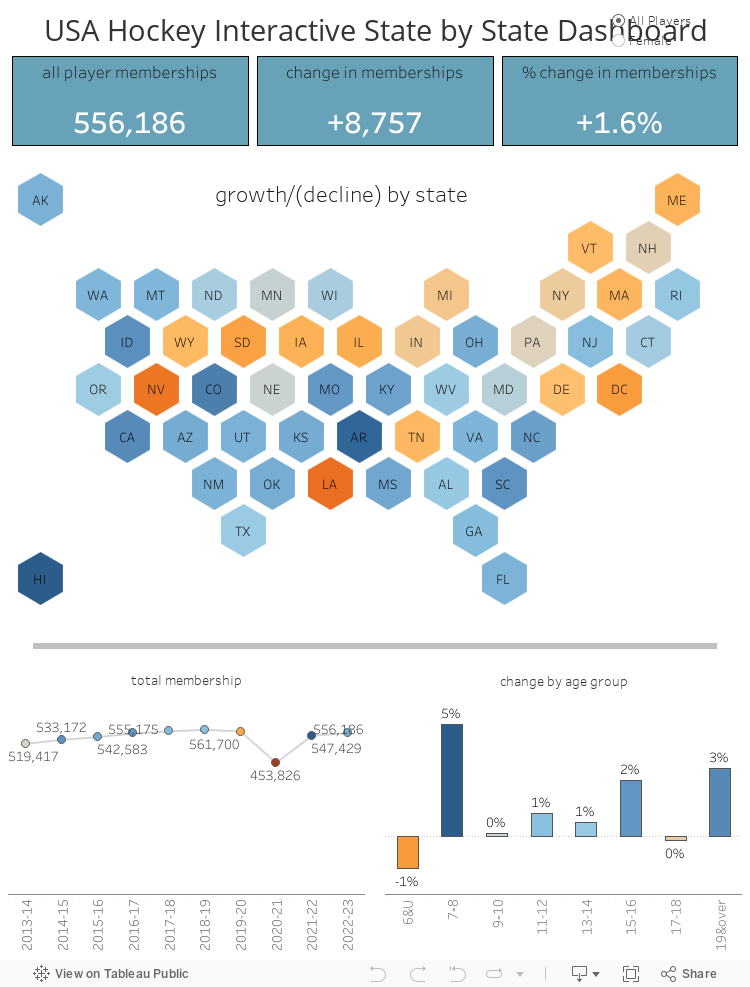
Late last week, USA Hockey released its annual player membership report that breaks down total memberships by state and age group. Over the years, I’ve used this report as a barometer to check on the overall growth or decline of hockey participation across the United States. Let’s break down the numbers.

Nationwide USA Hockey player memberships

Overall player memberships were up a modest 1.6 percent season over season, adding over 17,000 registered players during the 2022-23 hockey season compared to 2021-22. It is a positive sign that there was an increase season over season, but overall memberships have not fully recovered to pre-pandemic numbers.

Where hockey is growing

As we dig into the numbers a bit deeper, we can see that Colorado is the only state that saw double-digit percentage growth season over season. This is generally expected considering the Colorado Avalanche won the Stanley Cup in June, 2022. Playoff success tends to create an influx of hockey memberships in the following season.

What is also fascinating is that Nevada had the largest decline season over season, down 7 percent from 2021-22. This is probably in part due to the Vegas Golden Knights’ failure to make the 2022 Stanley Cup Playoffs for the first time in franchise history. We should expect a significant increase of memberships during the 2023-24 season in that market after the Golden Knights were crowned the Stanley Cup champions of 2023.

It should also be noted that the success of NHL teams is not the only way states see increases or decreases in their USA Hockey player memberships. Other factors may include the number of hockey facilities opening or closing, plus and the leadership and marketing capabilities of youth hockey organizations that can really drive growth or decline in player memberships.

If you look at the growth and decline by age group, you can see the seven-to-eight-year-old category had the largest increase season over season, but six and under saw the largest decline.

Female hockey continues to outpace overall memberships

Looking specifically at the female category, we see that the growth across female USA Hockey memberships is up almost 4 percent season over season. Over the last 10 years, female hockey has tended to be the most consistent contributor in the overall growth of USA Hockey memberships. Female hockey memberships represent about 16 percent of all USA Hockey player memberships per season.

When evaluating the female category by age group, all but the six-and-under age group saw substantial growth season over season.

Washington State USA Hockey members

As illustrated above, we saw that Washington state had the 16th-highest increase season over season from a percentage standpoint, but when we look at it by volume, we see Washington state had the eighth-highest growth with 473 additional hockey players enrolled in 2022-23.

Except for the pandemic season of 2020-21, Washington state’s player membership growth has remained consistent over the last 10+ seasons.

In terms of percentages, you can see growth up and down the age categories, but the largest volume growth was from the adult category. This also happens to be the biggest number of registrants.

Overall, the growth of USA Hockey memberships in Washington state is good news, but it is a bit underwhelming considering the Seattle Kraken are in just their second season in the state. As we have seen in other states, we should expect another growth spurt next season due to the success of the Kraken’s 2022-23 NHL season and playoff run.

Interactive dashboard

If you’d like to look at a state-by-state breakdown of the USA Hockey memberships, I’ve created an interactive dashboard where you can drill down by state. If you have any problems or have any questions, please let me know.

If you have questions, thoughts, or theories on the USA Hockey memberships, please leave them in the comment section.

How the Seattle Thunderbirds built one of the best junior hockey teams ever

How the Seattle Thunderbirds built one of the best junior hockey teams ever

The Seattle Thunderbirds raised eye brows all across the hockey world this season when they acquired star player after star player, making no bones about the fact they were all in to win a WHL championship and—perhaps—a Memorial Cup as the best team in the entire CHL. 

To the surprise of nobody, the T-Birds rolled through the WHL Playoffs before coming up just one game short of major junior hockey’s ultimate prize; the Quebec Remparts got that glory, beating Seattle 5-0 in the Memorial Cup Final. Still, the 2022-23 Thunderbirds will go down in history as one of the best junior hockey teams ever assembled.

“We’ve had really special groups of people in the past, and this was a special group of people too,” said Thunderbirds general manager Bil La Forge. “But I think that talent level on the ice every night was beyond anything I’ve seen in my years in this league.” 

“Special” is an understatement. By the end of the season, La Forge had constructed a roster that featured 10 players who had already been drafted by NHL teams, including a whopping five players that had been selected in the first round of the NHL Entry Draft. The team went 54-11-3 in the regular season, then cruised through the playoffs, losing just three games en route to hoisting the Ed Chynoweth Cup.

How did the Thunderbirds go about building such an exceptional roster? Sound Of Hockey spoke with La Forge to find out.

A powerhouse five years in the making

La Forge and his staff begin planning their depth charts five years in advance. With the ages of players in the WHL ranging from 16 to 20, and a limit of three 20-year-old players on each team, the proverbial prime of a junior hockey player’s career comes when he hits age 19. So when Seattle is able to draft a group of talented, young players that are all going to turn 19 in the same season, La Forge knows that core of players could have a chance to make a run at a championship.

La Forge saw early in their WHL careers that 2003-born forwards like Lucas Ciona, Reid Schaefer, Sam Popowich, and Mekai Sanders, plus defenseman Jeremy Hanzel and goalie Thomas Milic, had potential as a group to grow into a winner. 

Thomas Milic posted a .928 save percentage in 33 regular-season games for the Thunderbirds. (Photo/Brian Liesse)

“I think you really start to target a group when you see them enter their 16-year-old season,” said La Forge. “We thought that was a really impressive draft, and that was something that we could build off of going forward and target that team to be a championship team when they were 19.”

Success can’t just come from one age group, though, so to build a strong foundation, a team needs to find success in the WHL Bantam Draft multiple years in a row. La Forge’s scouting staff did just that by layering in ’04-born players like Jordan Gustafson, Nico Myatovic, and Kevin Korchinski to support that class of ’03-born players. 

La Forge’s early assessment of the ’03 group bore out during their 18-year-old seasons. In 2021-22, the Thunderbirds rolled all the way to the WHL Championship Series before losing to the Edmonton Oil Kings, who were led by Dylan Guenther and Luke Prokop.

“I think last year was probably a year earlier than most expected,” said La Forge. “We were confident in our group, but it’s tough to win in this league with a group of 18-year-olds.”

Making such a deep playoff run at that stage proved to La Forge that the time was nigh to go all in for 2022-23.

All the pieces “fall into place”

The series loss to Edmonton in 2021-22 also taught La Forge a valuable lesson about what his club had and what it needed to get over the hump. He saw the Oil Kings rolling out three lines of players that could theoretically play on a top line in the WHL, and he didn’t think the Thunderbirds quite had that kind of depth. 

Dylan Guenther had 29 points in 20 playoff games for the Thunderbirds. (Photo/Brian Liesse)
Dylan Guenther had 28 points in 19 playoff games for the Thunderbirds. (Photo/Brian Liesse)

So, in 2022-23, he set out to add star power to the top of his lineup, both on offense and defense, through a series of low-risk, potentially high-reward trades. He targeted a trio of players that had already moved on to the pro ranks but still had WHL eligibility in Prokop, Guenther, and Brad Lambert, hoping at least one or two of the three might get sent back to juniors. 

Being that there was a real possibility the players would never play for the Thunderbirds, La Forge was able to swing conditional deals. For example, on the Guenther trade, Seattle sent the rights to 2007-born forward Koji Gibson and a fourth-round pick in the 2024 bantam draft regardless of if Guenther got sent back by the Arizona Coyotes. Once he did get sent back, then Edmonton received six additional draft picks spread over the next four seasons. 

Lo and behold, all three players ended up with the Thunderbirds before the end of the season. 

“We felt that in those deals, we got maybe a better price point than we would have, had those guys already been in the league,” said La Forge. “I think a lot of things had to fall into place for us, and they did, so that was really exciting.”

During the season, La Forge also swung trades for forward Colton Dach, who had gotten injured in the World Junior Championship but was expected to return before the end of the season, and star defenseman Nolan Allan. After all these deals had been done, La Forge knew his group—which now featured 10 forwards that could play in the top six—had perhaps even more depth than what he had seen from Edmonton the year prior. 

“With Lambert, Guenther and Dach, we brought in an entire top line,” said La Forge. “And they didn’t play together, but they were three guys that were first-line players.”

Pro-caliber players join the mix

Lambert and his blazing speed came to the T-Birds after turning heads at Winnipeg Jets training camp and playing 14 games with the Manitoba Moose of the AHL. Prokop—one of the keys to Edmonton’s success in 2021-22—had played for the ECHL’s Norfolk Admirals to start the season. 

Luke Prokop went to the Memorial Cup for his second consecutive season after being acquired by the Thunderbirds from Edmonton. (Photo/Brian Liesse)

The jewel in the crown, though, was Guenther. The No. 9 overall pick by the Arizona Coyotes in 2021 racked up 91 points in 59 games for the Oil Kings last season, then made Arizona’s NHL roster out of training camp. 

La Forge had his eye on Guenther at the beginning of the season, in case any indicators popped up that he might be headed back to the WHL. It is common for star WHL players to play nine games in the NHL, then get sent back before a team burns the first year of the player’s entry-level contract. Guenther was proving he belonged in the NHL, though, so the Coyotes kept him around. 

But there is a second 40-game marker that accelerates a player’s path to unrestricted free agency. La Forge had no firsthand knowledge of what the plan was with Guenther, but he had heard rumblings that maybe the Coyotes didn’t want to hit that 40-game threshold. So he pulled the trigger on the conditional deal with the Oil Kings, just in case. Sure enough, after 39 games and 15 points in the NHL, Guenther joined the Thunderbirds, primed to make a run at the Memorial Cup. 

WHL Champions, one game short of the Memorial Cup

The end of the junior hockey season is always interesting. Teams battle through four rounds of playoffs within their own league, and then the winners go on to a rapid-fire round-robin tournament to try to earn the title for all of Canada. Winning the WHL then coming up one game short of the Memorial Cup leaves a bittersweet taste. 

“Obviously, we wanted to get one more win,” said La Forge. “That’s the goal at the start of every year is to win the Memorial Cup, but to get there, you have to accomplish all the things we did in advance of that. So I’m still really proud of everything we accomplished, but there’s still one more piece we want to go get eventually.” 

While La Forge is proud of the many achievements, he isn’t satisfied with the work his club did this season. He said after they lost the final game to Quebec on a Sunday, he and his staff went back to work planning for the future that Monday. 

The Thunderbirds will lose a lot of outstanding players before next season, as Prokop, Guenther, Allan, Dach, Milic, Ciona, Jared Davidson, Kyle Crnkovic, and others will all move on to the next stages of their respective careers. But that’s junior hockey. It’s a developmental league that continues to cycle players through to help them get to the next level. 

La Forge still has confidence that his team can be competitive next season, with players like Korchinski, Gustafson, Gracyn Sawchyn, and Scott Ratzlaff returning. He also has high hopes for up-and-comers like Coster Dunn and Simon Lovsin.

“They’re going to be the next group that carries us,” La Forge said. 

Darren Brown

Darren Brown is the Chief Content Officer at soundofhockey.com and the host of the Sound Of Hockey Podcast. He is a member of the PHWA and is also usually SOH’s Twitter intern (but please pretend you don’t know that). Follow him @DarrenFunBrown and @sound_hockey or email darren@soundofhockey.com.

The 2023 NHL Entry Draft Big Board – Compiled Rankings

The 2023 NHL Entry Draft Big Board – Compiled Rankings

Welcome to year two of the Sound Of Hockey Big Board for the NHL Entry Draft. It’s back and better than ever.

What is the Big Board? It’s a compilation of reputable draft analyst and public scouting service lists and an overall composite ranking built on those lists. We gathered ranking data from 19 sources.

Then we consolidated those various ranks into a single composite ranking by a weighted geometric mean calculation. Why do we use geomean? Read up here. Weights were assigned based on our assessment of the depth of experience, sourced reporting, or scouting insight factored into the component lists themselves. Bob McKenzie’s list will be weighted heavily when it is added, for example.

In addition we have compiled rankings from several data and analytics sources. By a similar weighted geomean process, we then tabulated those into a separate “analytics” ranking for each of these prospects. The main composite ranking referenced above is built from the primary scouting sources only.

I included my own rough NHLe calculations as a source on the Big Board, but those numbers are factored into these rankings at very low weight and only become significant for prospects who are unranked by any other source. I explained why I did this in an earlier post.

Finally, the Sound Of Hockey Big Board provides information on each player’s measurements, statistics, and playing experience in the 2022-23 season, mostly drawn from Elite Prospects, NHL Central Scouting, and the NHL Draft Combine. In fact, based on what we have seen, we believe the Big Board is the most comprehensive single source in providing this information anywhere.

And the Big Board provides all of this for almost 7000 draft eligible prospects. (That is not a typo. Last year the Big Board covered almost 700 prospects. This year it is almost 7000.) 

So, without further ado, you can find the Sound Of Hockey Big Board in Google Sheets HERE

Important note on using the Sound Of Hockey Big Board: If you want to filter the data by various categories, highlight row 3, then select “Data,” “Filter Views,” and “Create New Temporary Filter View.” This will allow you to manipulate the data in a way visible only to you.

Here is a snapshot of top 64 prospects in the 2023 NHL Entry Draft, sorted by the overall composite rank:

RankName2023 Team2023 LeaguePositionHand
1Connor BedardRegina PatsWHLCR
2Adam FantilliUniv. of MichiganNCAACL
3Leo CarlssonÖrebro HKSHLCL
4Matvei MichkovSKA St. PetersburgKHLRWL
5Will SmithUSNTDPUSNTDPCR
6Zach BensonWinnipeg IceWHLLWL
7Ryan LeonardUSNTDPUSNTDPRWR
8Dalibor DvorskyAIKHockeyAllsvenskanCL
9Oliver MooreUSNTDPUSNTDPCL
10David ReinbacherEHC KlotenNLDR
11Axel Sandin PellikkaSkellefteå AIKSHLDR
12Matthew WoodUniv. of ConnecticutNCAARWR
13Colby BarlowOwen Sound AttackOHLLWL
14Gabe PerreaultUSNTDPUSNTDPRWL
15Nate DanielsonBrandon Wheat KingsWHLCR
16Dmitri SimashevLokomotiv YaroslavlKHLDL
17Eduard SaleHC Kometa BrnoCzechiaLWL
18Brayden YagerMoose Jaw WarriorsWHLCR
19Samuel HonzekVancouver GiantsWHLLWL
20Tom WillanderRögle BK J20J20 NationellDR
21Quentin MustySudbury WolvesOHLLWL
22Calum RitchieOshawa GeneralsOHLCR
23Daniil ButLokomotiv YaroslavlKHLLWR
24Otto StenbergFrölunda HCSHLCL
25Andrew CristallKelowna RocketsWHLLWL
26Gavin BrindleyUniv. of MichiganNCAACR
27Mikhail GulyayevOmskie YastrebyMHLDL
28Riley HeidtPrince George CougarsWHLCL
29Bradly NadeauPenticton VeesBCHLLWR
30Oliver BonkLondon KnightsOHLDR
31Ethan GauthierSherbrooke PhoenixQMJHLRWR
32David EdstromFrölunda HC J20J20 NationellCL
33Lukas DragicevicTri-City AmericansWHLDR
34Gracyn SawchynSeattle ThunderbirdsWHLCR
35Michael HrabalOmaha LancersUSHLGL
36Jayden PerronChicago SteelUSHLRWR
37Tanner MolendykSaskatoon BladesWHLDL
38Oscar Fisker MolgaardHV71SHLCL
39Kasper HalttunenHIFKLiigaRWR
40Nick LardisPeterborough PetesOHLLWL
41Anton WahlbergMalmö RedhawksSHLCL
42Theo LindsteinBrynäs IFSHLDL
43Charlie StramelUniv. of WisconsinNCAACR
44Koehn ZiemmerPrince George CougarsWHLRWR
45Trey AugustineUSNTDP JuniorsUSHLGL
46William WhitelawYoungstown PhantomsUSHLRWR
47Beau AkeyBarrie ColtsOHLDR
48Carson RehkopfKitchener RangersOHLLWL
49Luca CagnoniPortland WinterhawksWHLDL
50Caden PriceKelowna RocketsWHLDL
51Danny NelsonUSNTDPUSNTDPCL
52Etienne MorinMoncton WildcatsQMJHLDL
53Alex CiernikSödertälje SKHockeyAllsvenskanLWL
54Carson BjarnasonBrandon Wheat KingsWHLGL
55Hunter BrzustewiczKitchener RangersOHLDR
56Lenni HameenahoÄssätLiigaRWR
57Aram MinnetianUSNTDPUSNTDPDR
58Maxim StrbakSioux Falls StampedeUSHLDR
59Kalan LindRed Deer RebelsWHLLWL
60Aydar SunievPenticton VeesBCHLLWL
61Luca PinelliOttawa 67’sOHLCL
62Nico MyatovicSeattle ThunderbirdsWHLLWL
63Easton CowanLondon KnightsOHLRWL
64Roman KantserovStalnye Lisy MagnitogorskMHLRWL

Rankings sources

Here are the scouting sources sources we used (so far) in building the Big Board:

  • NHL Central Scouting (link): 453 prospects split into 4 separate lists
  • Elite Prospects (link) (top 32 free; full list $$): 136 ranked prospects
  • McKeen’s (link) (top 32 free; full list $$): 224 ranked prospects
  • FC Hockey (link): 300 ranked prospects
  • Dobber Prospects (link): 100 ranked prospects
  • HockeyProspect.com (link): 32 ranked prospects
  • DraftPro (link) (top 32 free; full list $$): 240 ranked prospects
  • Corey Pronman of The Athletic (link) ($$): 127 ranked prospects
  • Scott Wheeler of The Athletic (link) ($$): 100 ranked prospects
  • Chris Peters of FloHockey (link): 100 ranked prospects
  • Craig Button of TSN (link): 96 ranked prospects
  • Sam Cosentino of Sportsnet (link): 32 ranked prospects
  • Smaht Scouting (link): 100 ranked prospects
  • Tony Ferrari of The Hockey News (link): 100 ranked prospects
  • Peter Baracchini of The Hockey Writers (link): 128 ranked prospects
  • Ryan Kennedy of The Hockey News (link): 120 ranked prospects
  • Recruit Scouting (link): 100 ranked prospects
  • Steven Ellis of Daily Faceoff (link): 150 ranked prospects
  • Bob McKenzie of TSN (link): 96 ranked prospects

We also compiled the following data and analytics sources (so far):

  • Chace MacCallum (link): 75 ranked prospects
  • Scouching (link): 82 ranked prospects
  • Hockey Prospecting (link) ($$): 403 ranked prospects split into 2 separate lists
  • Thibaud Chatel (link): 794 ranked prospects
  • Rachel Doerrie (link): 64 ranked prospects
  • TopDownHockey (link): 200+ ranked prospects

Caveats on using the Big Board 

At this point, a few more words on the Big Board and its uses are likely in order.

First, when you click through to the full composite draft board (here is another link), you will see that many of the individual rankings are grayed out beyond the top handful. This is because those rankings are behind a paywall. To get to Corey Pronman’s full ranking of prospects, for example, a subscription to The Athletic is required. While we utilized all of the individual rankings listed above to develop our composite list, we will not be sharing subscriber-only individual rankings in the public version of the composite big board.

Second, the Big Board does not reflect our view on these prospects. We at Sound Of Hockey have read reports, watched some videos, and crunched a few numbers. I’ll be putting up a few thoughts of my own before the draft, but that is not what this exercise is about. The Big Board is simply a tabulation of the rankings of others. A player’s ranking has nothing to do with whether any of us here “like” the player or not. (I can assure you that, personally, I like Thunderbirds goalie Thomas Milic very much, for example.)

Third, and finally, it bears emphasis that a “composite” ranking is not the be-all and end-all. In many ways, finding the “best” public list and trusting it is preferable. A consensus board cannot explain why one prospect is ranked higher than another, and it certainly cannot displace the work of scouts or draft reporters.

But a composite ranking can provide some added information. Think of it as the cherry on top of the sundae, not the sundae itself.

How so? Last year I used the case of Brad Lambert as an example. This year Andrew Cristall could be an instructive case. Both players are talented but viewed as risky and had widely varying rankings on individual public boards. How do we synthesize that information? A composite approach can exploit the wisdom of the crowd. Cristall’s final ranking may blend the upside and risk, placing him in a “fair” or “expected” position.

Local connections in the draft 

For a team already loaded with drafted prospects, the Sound Of Hockey Big Board sees six more Seattle Thunderbirds having their names called during the 2023 NHL Draft:

  • C Gracyn Sawchyn (ranked No. 34 on the Big Board)
  • LW Nico Myatovic (No. 62)
  • G Scott Ratzlaff (No. 88)
  • G Thomas Milic (No. 171)
  • LD Jeremy Hanzel (No. 175)
  • LD Sawyer Mynio (No. 198)

This projection of six drafted players would trail only the U.S. National Team Development Program in total draftees. This is yet further confirmation of the remarkable team GM Bil La Forge has assembled. (More coming on that soon. Yes, that’s a tease.)

Beyond the Thunderbirds, there should be no shortage of local connections in the draft. One of the top defensemen in the draft is Lukas Dragicevic of the Tri-City Americans (No. 33). G Tomas Suchanek (No. 151) also has chance to get drafted from the Americans. C Tommaso De Luca (No. 168) and D Sage Weinstein (No. 206) of the Spokane Chiefs have a shot. And, from the Everett Silvertips, C Austin Roest (No. 172) is a good bet to be drafted as well.

Final thoughts

The 2023 NHL Draft kicks off in just two weeks, on June 28, 2023, at 4:00 p.m. PT. In the meantime, here again is a link to the 2023 Sound Of Hockey Big Board. Bookmark it, share it, and consult it between now and the draft. Keep it close by during the draft itself because the data in it is a pretty strong indicator of what the Kraken (and other teams) will do. In the meantime, similar to last year, we’ll return before the draft with some opinions on Big Board value targets and with a Seattle Kraken mock draft.

2023 NHL Scouting Combine player testing results and takeaways

2023 NHL Scouting Combine player testing results and takeaways

The 2023 NHL Scouting Combine took place in Buffalo, N.Y., from Monday through Saturday of last week. 106 draft-eligible prospects attended. One aspect of the combine is a battery of physical measurements and tests that afford teams further data on these top prospects. The information can be useful for teams in cross-referencing their existing evaluations of a player’s on-ice physicality and athleticism.

Unfortunately, the NHL does not disseminate the full results. Annually, Mark Scheig of The Hockey Writers does Herculean work tabulating as many height and weight measurements as he can. (This year he captured more than 100.) For the other measurement (wing span) and all of the physical tests, the NHL publishes to the public only top-25 rankings (and even then in relatively difficult-to-use format). Only the teams know the full results below that. 

We collected all publicly available combine data and built a sortable chart, HERE.  As far as we know, this information is not available in this comprehensive, searchable form anywhere else.

Important note on using this combine data: If you want to filter the data by various categories, highlight row 3, then select “Data,” “Filter Views,” and “Create New Temporary Filter View.” This will allow you to manipulate the data in a way visible only to you

For each test listed, you will see the available results and the rank position among combine participants. (For a primer on the tests themselves, check out this recent article.)

In addition, we included two composite score rankings for each of the combine participants, derived on the geomean of the player’s ranking in the various tests. The overall ranking includes all size measurements and athletic testing. The “athletic testing only” rank gives a ranking that excludes the size measurements. 

Now, a word on the limits of this dataset: Since we only have top-25 results for most tests, we do not even know if all prospects participated in each test. A player may be dealing with an injury, for example, or simply decline to participate, and we would have no way to distinguish that in the publicly available data from a player who participated but performed around group average or worse. I would imagine the full data is most useful to teams in identifying players with “red flags” in their athletic profile. But since we have only top-25 data in most categories, this data is most useful in identifying positive outliers. Who were the players that performed exceptionally well? (Beyond that, I would caution against parsing the results too closely, as I am not sure there is any indicative difference between a top-30 performer and a top-50 performer, for example.)

Let’s get into a few of the top performers and some Seattle Kraken-related takeaways.

Combine is most useful for the interviews

The bulk of the week in Buffalo is allocated to meeting time between teams and players. More so than the athletic testing, this is by far the most important aspect of the combine. Teams have long studied the players on the ice, but may not have had the opportunity for in-depth conversations with the person. This is their chance, with many top prospects reporting that they speak with twenty-plus teams during the week.

As an example, according to Mark Scheig, the Kraken spoke with Kitchener Rangers right-handed defender Hunter Brzustewicz, a player projected to go in the mid-second round. (A strong performer in my analytics ranking, it happens I have been mock drafting him to the Kraken frequently.)

A couple skaters stand out at the top of the pack

Guelph Storm (OHL) right-handed defenseman Cameron Allen and Vancouver Giants (WHL) winger Samuel Honzek stood out as the two top-of-class athletic performers at the combine.

Allen was a highly touted defender coming into this season, but an up-and-down year sent him tumbling down draft boards. He is currently ranked 77th on the forthcoming Sound Of Hockey Big Board, and his analytics ranking is even lower. This was a necessary performance for Allen to prompt teams to think back to the raw, talented prospect they had envisioned at the beginning of the season. I will be watching to see if this performance halts his slide down draft boards.

Unlike Allen, Honzek has seen his stock on the rise this year. A hulking winger with some scoring touch, he is currently ranked No. 22 on the Sound Of Hockey Big Board (and No. 21 in my personal analytics ranking). 

For the Seattle Kraken and the 20th overall pick, Honzek’s profile is intriguing in comparison with Andrew Cristall, the current No. 25 player on the Big Board (and No. 10 in my personal analytics ranking). Honzek is a big, loud, toolsy player with strong production. 

Cristall, on the other hand, is relatively small at 5-foot-9.5, possesses just average speed, and did not place in the top 25 in any of the athletic tests at the combine. Yet, his CHL production was elite, far outpacing Honzek, and Cristall is generally viewed as something of an offensive savant. Indeed, consensus No. 1 pick Connor Bedard has called Cristall the smartest player he’s ever played with

If the Seattle pick came down to Honzek or Cristall, which player would Seattle prefer? The combine got me thinking about that question.

Some smaller players may have answered questions

It is a common refrain when we hear from team scouts that smaller players without elite speed or athletic traits often are ranked lower by NHL franchises internally than they are on public lists. These players are viewed as less likely to successfully transition their game to the NHL level if they cannot be counted on to win with either speed or physicality.

Accordingly, a sterling combine could be a boon to a smaller player. This year a pair of sub-5-foot-11 players posted strong results. Bradly Nadeau of the Penticton Vees (BCHL) and Easton Cowan of the London Knights (OHL) stood out positively. Nadeau is currently ranked 31st on the Sound of Hockey Big Board and Cowan is ranked 72nd. 

Nadeau’s performance, in particular, piqued my interest from a Seattle Kraken vantage point. There likely won’t be a player (short of Cristall, perhaps) who carries as much offensive upside as Nadeau when the Kraken pick in the first round.

Nadeau absolutely obliterated the BCHL this season, posting more than two points per game. Yet, the lower level of competition (when compared with the WHL, for example) leaves many scouts with unanswered questions about just how well his game will translate. And these questions were magnified by questions about how well his skating and athletic traits would translate at his smaller size. The combine may have at least partially answered some concerns falling in the latter category.

The draft’s top-ranked goaltender may also be its most athletic

Michael Hrabal of the Omaha Lancers (USHL) has emerged as the top goaltender in this class on many public draft boards, and he ranks as the first goalie, and No. 38 overall, on the current iteration of the Sound Of Hockey Big Board. He may have added some fuel to the fire in Buffalo by posting impressive athletic numbers to go with a 6-foot-6.75 frame. At this point, a pick at the end of the first round or early in the second round seems likely for Hrabal.

Next up: The Sound Of Hockey Big Board

Next you hear from me, we’ll be publishing version 1.0 of the 2023 Sound Of Hockey Big Board. Not every scouting or analytics list is available yet, but there is a critical mass at this point, and we can’t wait to share the results. As we did last year, we will continue to update the Big Board as more data roles in.

Sound Of Hockey Podcast Ep. 234 – Featuring Joey Daccord

Sound Of Hockey Podcast Ep. 234 – Featuring Joey Daccord

The Sound Of Hockey Podcast is thrilled to welcome back Joey Daccord for his third appearance on the show, as he prepares for the AHL Calder Cup Final with the Coachella Valley Firebirds. The always affable Daccord shares his memories from his stints with the Kraken this season and talks about how exciting this run through the AHL playoffs has been. You won’t want to miss this interview.

Aside from the conversation with Joey, John and Darren welcome Curtis back to the studio for the remainder of the show. The trio meanders through various topics on this episode, from the Thunderbirds and their exciting trip to the Memorial Cup to what’s happening in the Stanley Cup Final. Plus, talk about coach hirings, the recent Gary Bettman presser, and more. 

Segments on this episode include: 

  • Goalie Gear Corner
  • Shame On Us (new segment)
  • Weekly One-Timers
  • Tweets of the Week
  • Three Stars

SUBSCRIBE! ENJOY! REVIEW!

Apple Podcasts

Spotify

Stitcher

The Seattle Kraken have decisions to make on their internal free agents

The Seattle Kraken have decisions to make on their internal free agents

The buzzer rang. Streamers cascaded down at American Airlines Center in Dallas. It was May 15, 2023, and the Seattle Kraken’s chase for the Stanley Cup had come to a sudden end upon a 2-1 loss in Game 7 of the second playoff round to the Dallas Stars. The Kraken had exceeded every expectation set for them, but the story of their 2022-23 season was at its end (at least at the NHL level). 

As that book closed, however, a new one opened: the 2023 offseason. Three days later, at the team’s end-of-season press availability, Seattle Kraken GM Ron Francis said the front office would soon start meeting to evaluate the team’s internal free agents. “We’ve got some decisions to make there,” said Francis. “We’ll work through those over the next few days here to make sure that we’re all comfortable with the direction we want to go and address it accordingly.”

Then, at the May 31 press conference to announce his own contract extension, Francis followed up to say, “We’re rolling up our sleeves and getting into [discussion on Seattle’s players] now, and hopefully we’ll have a much clearer picture by July 1st.”

What are the key decisions that need to be made on Seattle’s own players? What will inform those decisions? And when is the deadline for actions to be taken? Let’s dive in.

The state of the Seattle Kraken roster

The Kraken enter this offseason with 10 forwards projected to be on the 2023-24 opening night roster already under contract. That number rises to 11 if you include Tye Kartye, whose postseason run made quite the impression on fans and the front office alike. 

Ryan Donato and Joonas Donskoi are unrestricted free agents. Morgan Geekie and Daniel Sprong are restricted free agents with arbitration rights. (For an explainer on these free agent classifications and the logistics of NHL free agency, see the appendix at the bottom of this post.)

Matty Beniers, Eeli Tolvanen, Alex Wennberg, and Jordan Eberle will be entering into the final years of their existing contracts in 2023-24, which means that those players will be eligible to receive extensions to their current contracts on July 1, 2023.

On the blue line there is a little more uncertainty, but still a number of players under team control; Adam Larsson, Jamie Oleksiak, Justin Schultz, and Jaycob Megna are all signed, though Megna is not necessarily a certainty to be on the opening night roster. Vince Dunn, Will Borgen, and Cale Fleury are all restricted free agents with arbitration rights. And Carson Soucy is an unrestricted free agent. Schultz and Megna are entering their final seasons and theoretically could be extended.

In goal, Philipp Grubauer and Chris Driedger are signed for 2023-24, with Driedger entering his final year and eligible to be extended. Martin Jones is an unrestricted free agent, as is Joey Daccord, who qualifies as a “Group 6” unrestricted free agent. (More on this in the appendix below.)

Assuming Driedger is on the NHL roster, based on the list of signed players above only (i.e., not counting Tye Kartye, for example), the Kraken have $19,193,424 in cap space going into the 2023-24 season to sign additional players.

Finally, here is a look at the offseason contract status of key players on the Calder Cup Final-bound Coachella Valley Firebirds. Kole Lind is a restricted free agent with arbitration rights. Alex True and Carsen Twarynski are “Group 6” unrestricted free agents, like Daccord. Shane Wright is listed here, but his immediate future remains murky

The offseason timeline

For each restricted free agent, the Kraken have until Monday, June 30, at 2 p.m. PT to extend a qualifying offer. If an offer is extended, the player may sign the offer or continue to negotiate a different deal with the team.

Alternatively, the player may negotiate and accept an offer with another team (this is often called an “offer sheet”). The Kraken are afforded the opportunity to match an offer sheet from another team. If the Kraken decline that option, the team would likely receive some draft pick compensation based on the value of the contract signed. Right now, I don’t expect any Kraken restricted free agents to receive an offer sheet.

Since each Kraken restricted free agent this year is arbitration eligible, if Seattle extends a qualifying offer, the player(s) have the option to trigger an arbitration hearing to set their salaries. The hearing serves as a backstop to negotiations. The deadline for a player to invoke arbitration is July 5, at 2 p.m. PT.  The team may itself trigger arbitration if it chooses before or after that date. Club-requested arbitration is far less frequent and can happen if the team is looking to obtain a salary decrease for a player. I don’t expect that with any of the Kraken restricted free agents.

If Seattle declines to extend a qualifying offer by the June 30 deadline, the player becomes an unrestricted free agent eligible to sign with any other club immediately. 

All other unrestricted free agents become eligible to negotiate and sign a deal with a new club on July 1, at 9 a.m. PT. If an unrestricted free agent signs with another club there is no compensation to Seattle or required opportunity for Seattle to match the contract. 

The decisions on Kraken free agents

How the Kraken elect to proceed with their free agents is informed by a number of variables, including the player’s market value, and, for restricted free agents with arbitration rights, the player’s likely award at an arbitration hearing. Let’s take a look at some projected numbers and then make some early predictions on what happens with these Kraken free agents.

First, a methodology note regarding my “Deep Sea Hockey” projections below: I used CapFriendly’s contract comparable tool to produce a list of comparable contracts for each Kraken free agent based on the following variables: position, age, points, and games played. This doesn’t capture the entirety of a player’s value, of course, but points tend to be predictive of free agent value. I then made minor manual adjustments to sync the values to the Kraken free agent’s statistical profile on a point-per-game basis. I then prorated the value of the contracts to the current salary cap environment, projected at $83.5 million for 2023-24. I then also used the sample of comparable contracts to predict a contract length.

Vince Dunn | LD | RFA (UFA in 2024) | 26 years old | 201 points in 421 NHL games 

Vince Dunn is a restricted free agent with arbitration rights. He is one year from unrestricted free agency and coming off a year in which he was second in points for Seattle and 10th in points among all defenseman in the NHL. He is in line to ask for a very large contract, which makes him one of the important questions facing the front office this offseason.

  • Qualifying offer amount: one-year, one-way contract worth $4 million
  • Evolving Hockey free agent contract projection: 8 years, $8.15 million AAV
  • Deep Sea Hockey negotiated contract projection: 7 years, $8.35 million AAV
  • Deep Sea Hockey projected arbitration ruling: 1 year, $8 million AAV
  • Deep Sea Hockey gut prediction: Qualified. Negotiated deal at 7 years, $7.5 million AAV with Seattle. This will be a lengthy negotiation and both sides will need to give if they are going to reach this outcome. I suspect the Kraken aren’t comfortable with the full market projection contract for Dunn given his up-and-down production with the team. The highs have been No. 1 worthy but the lows remain troubling. $8 million (Dunn’s likely target) would put him t-15th in AAV in the league among defensemen. The Kraken would likely prefer the number to be lower. If they can’t see eye-to-eye, I don’t think anything is off the table. Dunn’s agent is notorious for driving a hard bargain. Still, I tentatively think both parties bend at the end of the day to get this contract signed.
Vince Dunn handles the puck at Climate Pledge Arena. (Photo/Brian Liesse)

Daniel Sprong | RW | RFA (UFA in 2024) | 26 years old | 116 points in 268 NHL games

Daniel Sprong is a restricted free agent with arbitration rights. He is one year from unrestricted free agency and coming off a year in which he was tied for third in goals for Seattle with 21. On a per-minute basis, he was one of Seattle’s most productive offensive players, though critiques of his 200-foot game remain.

  • Qualifying offer amount: one-year, one-way contract worth $787,500
  • Evolving Hockey free agent contract projection:  3 years, $3.2 million AAV
  • Deep Sea Hockey negotiated contract projection: 2 years, $3 million AAV
  • Deep Sea Hockey projected arbitration ruling: 1 year, $3 million
  • Deep Sea Hockey gut prediction: Not qualified or traded to a team interested in Sprong in a top-nine role, Sprong ultimately signs a 1 year, $2.25 million with another team. It won’t be easy to replace Sprong’s goal production, particularly on the power play, but I keep bumping against the fact that he was not able to crack a top-nine role with Seattle with any regularity. That is where his skill would deliver the most value and Seattle never did it, which suggests to me that they still don’t see an elevated future for him, given the current depth chart. At the number he’s likely to command this offseason, it’s just too difficult to fit him in the salary structure and still improve the team.

Morgan Geekie | C | RFA (UFA in 2026) | 24 years old | 116 points in 268 NHL games

Morgan Geekie is a restricted free agent with arbitration rights. He is three years from unrestricted free agency and coming off a year in which he played a fourth-line center role for much of the season, though he elevated to a top-nine right wing role late in the season and in the playoffs with Andre Burakovsky injured. He was one of Seattle’s better players in the face-off circle and their only reliable righty in that role. He remains one of the younger players on the roster.

  • Qualifying offer amount: one-year, one-way contract worth $1.4 million
  • Evolving Hockey free agent contract projection: 2 year, $1.69 million AAV
  • Deep Sea Hockey negotiated contract projection: 2 years, $2.1 million AAV
  • Deep Sea Hockey projected arbitration ruling: 1 year, $1.8 million
  • Deep Sea Hockey gut prediction: 1 year, $1.8 million with Seattle. This is a tricky one too, as Geekie likely believes he has earned a raise over his previous salary, and he serves in a five-on-five role (right handed center) for which the Kraken don’t have another ready made alternative (except for perhaps Andrew Poturalski). He also has talent. That is clear. On the other hand, the production hasn’t taken a leap forward, and he hasn’t found a regular special teams role. Still only 24 years old, I don’t think the Kraken would prefer to move on, but it really depends on Geekie’s demands. If I were Seattle I’d go to him early and offer something along the lines of 2 years, $1.45 million AAV, or 1 year, $1.6 million AAV, with the implication that he may not be qualified otherwise due to arbitration risk. The production may not justify it, but it’s one more bet on his upside. That said, if push comes to shove, I think the team ultimately would qualify him to keep him for at least one more year.

Will Borgen | RD | RFA (UFA in 2024) | 26 years old | 28 points in 132 NHL games

Will Borgen is a restricted free agent with arbitration rights. He is one year from unrestricted free agency and coming off a year in which he moved up the lineup from a third-pair role to a second-pair role midway through the season. He does not reliably create offense but is a sound defender with flashes of puckhandling skill.

  • Qualifying offer amount: one-year, two-way contract worth $945,000
  • Evolving Hockey free agent contract projection: 2 year, $1.66 million AAV
  • Deep Sea Hockey negotiated contract projection: 2 years, $1.5 million AAV
  • Deep Sea Hockey projected arbitration ruling: 1 year, $1.8 million
  • Deep Sea Hockey gut prediction: Qualified. Signs 2 year, $1.8 million AAV deal with Seattle. (Author’s note: I edited this AAV upward after additional reflection.) GM Ron Francis already indicated to Ian Furness on JKR that Borgen will be qualified. That is an easy decision. Borgen’s metrics plateaued in the second half of last season, and I think he might be best deployed as the more physical, defensive-minded half of a third pair moving forward (perhaps with Ryker Evans?), but he also won’t break the bank. A two-year deal would give Borgen some stability and financial security. It would also allow him to hit the market again at 28 years old, an age at which defensemen are still at or near the prime of their defensive abilities and can be well compensated on the open market (see Soucy, Carson). One thing to keep an eye on: these projected financial values could be underselling Borgen’s market. Daily Faceoff has him projected at $2.5 – 3 million AAV, for example. I remember thinking Dunn’s last deal would be more like 2 years, $2.5 million AAV, and it came in much higher. Could history repeat?

Cale Fleury | RD | RFA (UFA in 2026) | 24 years old | 2 points in 62 NHL games

Cale Fleury is a restricted free agent with arbitration rights. He remains buried on the depth chart, seeing only 12 games worth of ice time this entire season. His ongoing value is as depth at position, right defense, where the organization does not have any other ready answers in the event of an injury.

  • Qualifying offer amount: one-year, two-way contract worth $787,500
  • Evolving Hockey free agent contract projection: 1 year, $778,500 (below the qualifying amount)
  • Deep Sea Hockey negotiated contract projection: 1 year, $787,500 (qualifying amount)
  • Deep Sea Hockey projected arbitration ruling: 1 year, $787,500 (qualifying amount)
  • Deep Sea Hockey gut prediction: Qualified. 1 year, $787,500 with Seattle. I suspect that the Kraken still like this player given his presence on the roster all season. When he has been in the lineup, he has looked like an “extra defenseman” level player out there, which is not a bad piece to have but also one that can be replaced. Still, he’s useful depth and a potentially a necessary piece for next season if (a) the team does not retain Carson Soucy, (b) the team does not sign a free agent defenseman, or (c) at camp it becomes clear Ryker Evans needs one more year in Coachella Valley.

Kole Lind | RW | RFA (UFA in 2026) | 24 years old | 8 points in 30 NHL games

Kole Lind has 37 goals (and counting) across 91 total AHL games this season. He leads the entire AHL in scoring in the Calder Cup playoffs with 23 points. He is potentially under team control for three more seasons, but if he doesn’t get regular NHL playing time next season (50+ games), he will qualify as a Group 6 unrestricted free agent next offseason.

  • Qualifying offer amount: one-year, two-way contract worth $892,500
  • Evolving Hockey free agent contract projection: N/A
  • Deep Sea Hockey negotiated contract projection: N/A
  • Deep Sea Hockey projected arbitration ruling: 1 year, $892,500
  • Deep Sea Hockey gut prediction: Qualified. 2 year, $875,000 AAV with Seattle. Kole Lind was productive in the AHL this year and showed that he has the tools to be useful at the NHL level if he can consistently keep up with NHL pace (and if he keeps his agitator tendencies under control). At the least, I think he is worthy of a shot in a 12th or 13th forward role at the NHL level. A two-year deal rewards Lind for his season and could protect Seattle from losing him as a Group 6 free agent next offseason if he continues to be a borderliner NHL/AHL player.

Ryan Donato | LW | UFA | 27 years old | 135 points in 325 NHL games

Ryan Donato is an unrestricted free agent. He was part of a productive “fourth line” for the Kraken, tallying 14 goals in 71 games. Across his two-year stint with the team, he has 30 goals.

  • Evolving Hockey free agent contract projection: 2 year, $2.03 million AAV
  • Deep Sea Hockey negotiated contract projection: 2 year, $2.35 million AAV
  • Deep Sea Hockey gut prediction: 1 year, $1.5 million deal with another team. Unfortunately, Ryan Donato continues to find himself right on the margins of NHL status since he is not a conventional fourth line player but his skill level is just barely below what teams would want in their top-nine for a playoff push. If his market again does not materialize, I can imagine him coming back, but I suspect a “rebuilding” team will give him a contract to fill out their roster as a bridge to younger players. I don’t think he’ll actually get a contract at the level projected by me or Evolving Hockey.

Carson Soucy | LD | UFA | 28 years old | 68 points in 250 NHL games

Carson Soucy is an unrestricted free agent. He was Seattle’s third-pair left defenseman, a stalwart on the penalty kill, and the third defenseman in line to take a role on the power play. 

  • Evolving Hockey free agent contract projection: 3 years, $2.59 million AAV
  • Deep Sea Hockey negotiated contract projection: 2 year, $2.4 million AAV
  • Deep Sea Hockey gut prediction: 4 year, $4 million AAV deal with another team. If his market is actually more in line with the projections, particularly mine, I think Seattle should be interested to bring Soucy back. But I think Soucy is a prime candidate to be “overpaid” on the free agent market. Soucy generated significant buzz at two consecutive trade deadlines, so it appears there is legitimate interest in the player around the league. Ultimately, I think he gets an offer that prices him out of Seattle’s desired range.

Joey Daccord | G | UFA | 26 years old | .884 save percentage in 19 NHL games

Joey Daccord is a “Group 6” unrestricted free agent. (For more on that status, check out the appendix below.) Daccord has not been able to generate strong results at the NHL level yet, but he is having a great season in the AHL. He was fifth in that league with .918 save percentage across 38 regular-season games. And he has been even better in the playoffs, recording a .924 save percentage in 19 playoff games. This run should help him in free agency. 

  • Evolving Hockey free agent contract projection: 1 year, $775,000
  • Deep Sea Hockey negotiated contract projection: N/A
  • Deep Sea Hockey gut prediction: 2 year, $1,150,000 AAV one-way deal with Seattle. This projection is a bit out there, but here is my thought process: Joey Daccord has shown that, at the least, he can be a very good player and leader at the AHL level. Heading into free agency, the Kraken don’t have a clearly defined third goaltender on the depth chart. Signing Daccord to this deal gives the Kraken necessary depth in goal in the short term. If, ultimately, Daccord is sent back to Coachella Valley next year at cutdown time, the size of the commitment would make other teams more hesitant to claim him. And if he is sent down his salary can be completely “buried” and will not count on the NHL salary cap. On the other hand, if Daccord beats out Chris Driedger for the backup job in camp, Driedger could be sent through waivers; if unclaimed, the salary cap implications would be neutral since $1,150,000 of Driedger’s deal can be “buried” at the AHL level. On Daccord’s side of the equation, he gets significant security even if he has to wait one more year for a clear shot at a backup role.
Joey Daccord warms up at Climate Pledge Arena. (Photo/Brian Liesse)

Appendix: Free agency in the NHL

As discussed above, not all NHL “free agents” are the same. A player may be “unrestricted” or “restricted” and there are certain nuances to the player’s rights or eligibility under either status. Need a primer? Let’s get into those rules here.

Unrestricted free agency

An “unrestricted free agent” (UFA) is free to sign with any team without any compensation or right of first refusal held by the player’s former club. A player becomes an unrestricted free agent on July 1 if the player’s current contract has expired *and* the player qualifies under any one of three other criteria:

  1. 27 years old. The player is 27 years old as of the last day of the expiring contract (i.e., June 30).

OR

  1. Seven accrued seasons. The player has seven “accrued” seasons of NHL experience as of the expiration of the contract. An “accrued” season is defined as a season in which the player was on an NHL club’s active roster for 40 regular season games (or 30 regular-season games for a goaltender). Time lost on injured reserve to injury incurred at the NHL level counts toward this “active roster” requirement for games during the season of the injury and the season thereafter.

OR

  1. “Group 6” status. The player (i) is 25 years old as of the last day of the expiring contract (i.e., June 30), (ii) has completed three or more “professional seasons,” with “professional seasons” being defined as 11 games played or more games played if 18 or 19 years old and one or more games played if 20 years old or older in the NHL, AHL, or on loan in another European professional league, and (iii) the player, if a skater, has played fewer than 80 NHL games, or, if a goaltender, has played fewer than 28 games of 30-or-more minutes TOI. Players in this category are referred to as “Group 6” unrestricted free agents.

Additionally, a player may qualify as a UFA if the player is a restricted free agent, but the current NHL club does not tender that player a qualifying offer. Let’s get into what that means now.

Restricted free agency

If the player’s contract expires but the player does not meet one of the three numbered criteria set forth above to qualify for unrestricted free agency, the player is a “restricted free agent” (RFA).

The first decision point on a RFA is made by the NHL club, which must decide whether to extend the player a “qualifying offer.” A qualifying offer is an offer of a one-year contract, which remains open for 30 days, with the following minimum values at the NHL level:

  • If base salary in last year of expiring contract is less than or equal to $660,000: 110% of the last year base salary
  • If base salary in the last year of an expiring contract is greater than $660,000 or less than $1,000,000: 105% of the last year base salary, but not greater than $1,000,000.
  • If the base salary in the last year of an expiring contract is greater than $1,000,000: 100% of the last year base salary

The only potential exception to the rules above is, if the contract was signed on or after July 10, 2020, the qualifying offer may not exceed 120% of the *average* annual value of the expiring contract. This rule only becomes relevant for back-loaded contracts and is presumably designed to disincentivize contracts structured like Timo Meier’s deal moving forward.

The qualifying offer must be a “one-way” contract, meaning the player is paid the same salary whether at the NHL or AHL level if the player has played 180 NHL games within the last three years, 60 NHL games within the last year, or was claimed on waivers within the past year. Otherwise, the qualifying offer may be a “two-way” contract providing for a lower salary if the player plays at the AHL level.

If the current NHL club does not make the player a qualifying offer by June 25 at 2 p.m. PT, or the first Monday after the NHL Entry Draft at 2 p.m. PT, whichever is later, the player becomes an unrestricted free agent immediately. This year, the deadline is Monday, June 30, at 2 p.m. PT.

The consequence of the qualifying offer depends on the experience level of the player receiving the offer. There are three scenarios. 

1. 10.2(c) Player. If the player has minimal professional experience, a qualifying offer renders the player ineligible to negotiate or sign with any other clubs. This is so-called “10.2(c)” status. The 10.2(c) player may sign the qualifying offer or negotiate a different deal with his current club only. What is the experience threshold? A player falls under 10.2(c) if he (a) signed his first contract at ages 18-21 and has played two or fewer seasons of “professional experience,” (b) signed his first contract between ages 22-23 and played one or fewer seasons of “professional experience,” or (c) signed his first contract at age 24 or older and has no seasons of “professional experience.” “Professional experience” is defined as 10 or more NHL games for 18-19-year-olds or 10 or more games in any professional league for players 20 years old or older.

2. RFA without arbitration rights. If the player has more experience than the 10.2(c) threshold, but less experience than is necessary to qualify for salary arbitration (see below), the player is an RFA without arbitration rights. The player may sign the qualifying offer, negotiate a different deal with his own club, or negotiate with other clubs. If the player accepts an offer of a contract from another club, the player’s current club is afforded the opportunity to match the contract and retain the player. If the current club declines to do so, it receives compensation from the signing team in the form of draft picks. The draft picks received (if any) are based on the value of the contract signed.

3. RFA with arbitration rights. If the player has significant professional experience, he may qualify for salary arbitration. Arbitration may then be elected either by the team or the player.  Arbitration is a process by which a third party neutral will receive information from the team and the player and decide the contract that the player should receive. In most instances it is a one-year deal.  A player qualifies for arbitration if he: (a) signed his first contract at ages 18-20 and has four or more seasons of “professional experience” (as that term is defined above), (b) signed his first contract at age 21 and has three or more seasons of “professional experience,” (c) signed his first contract at ages 22-23 and has two or more seasons of “professional experience,” or (d) signed his first contract at ages 24 or older and has one or more seasons of “professional experience.” An arbitration eligible player in receipt of a qualifying offer has until July 5 at 2 p.m. PT to notify the team he is electing arbitration. (There are different deadlines for the clubs to elect arbitration.) In the meantime, the player has all of the same rights to negotiate with his own team or other teams as described above, and if he should sign with another team, again, his team would have the opportunity to match or receive draft pick compensation for the player. This negotiation process is cut off only when the arbitrator makes a ruling. The arbitrator’s ruling becomes the value for the contract between the team and the player, except in certain high contract value scenarios in which the team may opt to disclaim the ruling and allow the player to become an unrestricted free agent.

A Data-driven look at the top 250 prospects in the 2023 NHL Draft

A Data-driven look at the top 250 prospects in the 2023 NHL Draft

We are now within four weeks of the NHL Entry Draft. This means we are close to the return of the Sound Of Hockey Big Board. Last year, we compiled public rankings from 19 draft reporters and scouting services and ranked 675 prospects. 

In the coming weeks, I’ll have a bit more information on how the Big Board performed last year as a predictive tool. In short: It was a strong indicator of consensus in the top 100, but less so after that. The Big Board was particularly strong predicting first-round prospects. It accurately “predicted” 28 of 32 first-rounders, and the player the Big Board listed No. 32, Owen Beck, was selected with the first pick of the second round (No. 33). The other three players that “fell” out of the Big Board’s top 32 were No. 26 Jagger Firkus (whom Seattle scooped up at pick 35), No. 29 Ryan Chesley (drafted at pick 37 by the Capitals), and No. 30 Calle Odelius (drafted at pick 65 by the New York Islanders).

I’m hoping that the Sound Of Hockey Big Board will be better than ever this year. One respect in which I have tried to improve it is by lengthening the board. The board missed almost two dozen drafted players last year, and I wanted to get that number down into the single digits this year. That meant going beyond the players ranked on public lists and directly gathering data on players from more than 20 leagues around the world from Elite Prospects.

After gathering that data, I encountered a question: How was I going to “rank” the players that don’t appear on any public rankings? The best solution I could come up with was to create a purely data-driven ranking of my own to supplement the public rankings and provide some type of order for the additional prospects.

My baseline for this work was the concept of an “NHL equivalency.” What is an equivalency? To oversimplify, an equivalency is projected point production at the NHL level based on a conversion of the player’s point production in another league, such as the WHL. By studying the performance of players historically, analysts can come up with relative league strengths and then use those strengths for a per-game conversion. This is a very crude metric, but a draft pick’s historical point production has been proven again and again to be a strong indicator of future NHL point production. (For goaltenders, save percentage tends to be the metric used.)

While many have worked in this space, I built off of the work of TopDownHockey. I then tweaked the gross equivalencies I created with directional adjustments based on the draft eligible player’s (1) age, (2) height, and (3) redraft status. I did not choose these factors at random–all have been proven significant in projecting draft prospect success or failure. I also made position-based adjustments, since a point-per-game defenseman is rarer and arguably more valuable than a point-per-game forward. 

This gave me a crude data-only “ranking” of thousands of draft eligible prospects. While it’s primary purpose will be, as I mentioned, to supplement the Big Board, I figured it would be fun to share it as a stand-alone list too, since we are in draft ranking season.

Before I get to that ranking, three more notes. First, this list does not contain any qualitative evaluations or adjustments from me. I have watched some of these players and have personal preferences, but I haven’t incorporated those here. Would I personally rank Connor Bedard No. 1? Yeah. When it comes to the draft, data is only a piece of the puzzle. Most importantly, the team needs scouting conviction on the player.

Second, the aspect of all of this I feel least confident about is the positioning of goaltenders relative to skaters. I normalized the goaltender scores so that the number of goaltenders ranked within the top 224 would approximate historical norms, but this process won’t account for whether this is a “good” goalie class or not. So, at the end of the day, the order of the goaltenders may be illuminating, but perhaps take their placement relative to the skaters with a grain of salt. 

Third, before sharing this, I ran last year’s Big Board through the same equivalency process. The sample size of last year’s Big Board was smaller, but it still captured the vast majority of top prospects. The results were intriguing, particularly with respect to the Seattle Kraken. 

Seattle had six picks in the top three rounds of the 2022 draft. Five of those six picks ranked within the top 40 overall in my equivalency calculation, with goalie Niklas Kokko being the only outlier. Later in the draft Tucker Robertson and Kyle Jackson were two of the very highest ranked re-entry candidates too. Beyond that, only the high schoolers (Barrett Hall and Ben MacDonald) were, somewhat predictably, not data-driven picks since their competition level was so low compared with other draft-eligible prospects.

All of this gives me confidence that the Kraken, at least, are using similar data to support their draft process. I’ll be keeping a close eye on the top-100 in this equivalency ranking on draft day when it comes time for selections by the Seattle Kraken.

Without further preamble, here is our data-only top 250 for the 2023 NHL Draft:

The full list will be part of the Big Board, but if you have a question about where a player not listed here is ranked, feel free to reach out in the comments below or on Twitter @deepseahockey.

The 2022-23 Seattle Kraken Post-Mortem

The 2022-23 Seattle Kraken Post-Mortem

Too soon? Nah. We are now two weeks removed from the Seattle Kraken’s Game 7 loss to the Dallas Stars in the second round of the Stanley Cup Playoffs. Based on our completely arbitrary metrics, it feels like sufficient time has now passed, and we can finally put our heads together for the 2022-23 Sound Of Hockey Seattle Kraken Post-Mortem. That’s a long name, but we’ll workshop it to come up with something more snappy for future seasons. 

Let’s get to it. 

What went right for the Seattle Kraken season this season? 

Josh Horton: Depth scoring will likely go down as the prevailing theme of this season, but the emergence of Adam Larsson and Vince Dunn as a bona fide top pair stands out as well. The way both shouldered important minutes–Dunn as a legitimate offensive threat and Larsson as a stabilizing defensive force–settled down the lineup and provided reliability for head coach Dave Hakstol, especially late in the season and in the playoffs.

John Barr: The depth scoring was obviously a key piece in the success of the Kraken season, but part of that was due to the health of the team. Other than Andre Burakovsky, who missed the second half of the season and playoffs with a torn groin, the Kraken were relatively healthy. There were nine Kraken players that had over 80 games played this season, compared to 2021-22 when only two players ended up with 80 games or more. If there were just a couple more injuries in the NHL, the depth might not have been there for the Kraken. The Kraken’s strong depth stopped at the NHL level, and if the team was forced to dip into the AHL for long stretches during the season, the outcomes might have been different. 

Darren Brown: But John, what about Tye Kartye? Ok, maybe one successful callup does not mean the Kraken are deep with emerging talent from their prospect pool, and you’re probably right that depth only exists within the NHL roster and not so much beyond. 

Like both of my colleagues that have already answered, I too am going to allude to the depth of the team, but then call out something different. The players were able to build real belief in themselves this season. They got just enough goaltending and enough timely scoring to put them on a couple long winning streaks that buoyed (shoutout Buoy) their playoff chances, even as they stumbled at times down the stretch. The psyche of this team is very different now than it was at the end of the inaugural season, and that should carry over into next season. Even with tweaks to the lineup, the core group will be back, and it knows it can win now. 

Curtis Isacke: Many have called for the Kraken to name an individual captain, but, from the outside, it seems to me like the veteran leadership on this team was something that went right this season. It is hard to overstate this team’s on-ice accomplishments following a sixty-point inaugural season. The Kraken became only the third team in NHL history to follow a season with 60 or fewer points with a season of 100 or more (joining the 1992-93 Quebec Nordiques and 2006-07 Penguins). The Kraken added some important pieces in the offseason, no doubt, but it would have been all too easy to call an 80 point 2022-23 season a “success.” This team didn’t settle for that. The Kraken were difficult to beat on the road (26-11-4) and resilient in difficult situations, including in the playoffs. It’s a credit to the team’s mindset and buy-in, and that starts with the players who wore the “A” this season.

What went wrong? 

JH: There wasn’t much that went wrong for Seattle this year, but if you had to pick, the Shane Wright debacle stands out. Now, I think in hindsight Seattle did all it could with Wright, who wasn’t quite ready to contribute at the NHL level, but obviously was too good for junior hockey and couldn’t play in the AHL due to the NHL-CHL agreement. However, seeing Wright knocked out early of the Ontario Hockey League playoffs–after being hampered with injuries–and struggling in Coachella Valley even to crack the lineup in the playoffs hasn’t sparked much optimism. 

Now, I don’t think this is any cause for panic. All prospects develop at different paces, and Wright clearly has some hurdles he still needs to clear. Even with his struggles this season, the No. 4 pick in 2022 showed some really positive signs, with a prolific scoring run during his initial conditioning stint in the AHL and a near two-points-per-game scoring pace for the Windsor Spitfires in the OHL. However, one does wonder if this season really provided a proper season of development for Wright, and for that, I believe this was the biggest organizational shortcoming in 2022 — that dang NHL-CHL agreement! 

DB: I agree wholeheartedly with everything Josh just said. It would have been really nice in this scenario for Wright to just be allowed to go to the AHL and develop, as that was clearly where he belonged. It’s still unclear if he will be dealing with the same issue next season, and if so, it will be an even bigger conundrum for the Kraken than it was in 2022-23. 

CI: The Kraken have a handful of high-end finishers (Andre Burakovsky, Jared McCann, Oliver Bjorkstrand, Daniel Sprong, and Eeli Tolvanen) and facilitators (Jordan Eberle, Alex Wennberg) up front. This seems like a good set of ingredients to build a power play. But it didn’t work out that way in 2022-23. In the regular season, the team ranked tied for 19th in the league with a 19.8 percent conversion rate. In the postseason, the team checked in at 14th (of 16) at 14.3 percent. The raw results from the regular season look mediocre, but some strong puck luck obscures the dreadful shot quality generated by the team. In fact, looking at quality of shot data alone, the power play showed little, if any, improvement from 2022-23 over 2021-22, despite the personnel improvements.

Why is the team struggling? It’s a topic I want to investigate this offseason, but off the cuff, three factors come to mind. First, the team failed to regularly gain possession off of offensive zone draws. Second, the team’s zone entries were inefficient, in part because they were overly reliant on the schemed approach, which can be countered when it is too predictable. And, third, the team was too static in the offensive zone, losing the skating game that brought them success five-on-five. In watching other power plays around the league, I was often struck by the fact that motion and position exchanges within a power play structure can create confusion and draw defenders out of positions guarding the slot. The Kraken rarely did this.

JB: Not a damn thing… Well, other than the power play, which Curtis mentioned already.

What was the biggest surprise? 

JB: For me the biggest surprise might have been the penalty kill. The team PK did not start out that well, but as the season went on, it became stronger and stronger. It felt like this was a key component of the team’s success down the home stretch of the regular season that carried over to the playoffs.

JH: Tye Kartye’s rise came out of nowhere for me. Prospects–nonetheless undrafted free agents–hit at a small clip as it is, but Kartye not only breaking into the NHL at 22, but contributing to Seattle’s top line in the playoffs was a very welcome surprise. The positive momentum generated from Kartye’s playoff emergence will be fun to monitor in training camp and into next year. 

CI: Kartye’s development at the AHL level and postseason NHL performance is a good one, Josh. I’ll go with the waiver claim and play of Eeli Tolvanen this year. He is a very good finisher and a solid defender, and he has developed strong chemistry with Yanni Gourde in a natural middle-six position for him. He’s still one of the youngest core members of the NHL team too and looks like a lineup stalwart for years to come. If we’re flashing back to the beginning of the year, this definitely qualifies as a pleasant surprise.

DB: How about Dave Hakstol as a Jack Adams nominee? All through last season and even in the early stages of this season, it was painful to read our Twitter mentions some nights, as all we saw was “fire Hakstol” vitriol. He turned the team around in its second season and clearly got buy-in from the group, and what was most impressive to me was how he seemed to be able to address problems mid-season. The penalty kill is a great example of that. 

What was the biggest disappointment of the season?

JB: It’s hard to be disappointed with anything from this team this season, but maybe McCann getting hurt in Game 3 of the Stanley Cup Playoff opening round. It was unfortunate, considering he had been such a big piece of the team’s success throughout the season. When he came back, it seemed to take some time for him to get his legs under him and get comfortable with the pace of the game, so it would have been nice to see him healthy coming into the Dallas series.

JH: The only real disappointment I can think of is the Andre Burakovsky injury. While Seattle’s strength was its depth, the Kraken could have used Burakovsky’s firepower during some lulls in the playoffs. 

CI: I didn’t have high expectations for Joonas Donskoi coming into the season, but I was hoping for his sake and the team’s sake that he could re-establish himself as an NHL regular this year. In that regard it was disappointing to see him sidelined for the entire season with an undisclosed injury. At this point, I am hoping that he is doing well with his health moving forward.

DB: It was disappointing to see the Kraken lose Game 7 in Dallas by one goal. They were so close to the Western Conference Finals, but they just didn’t have enough gas left in the tank that night. 

What was your favorite moment of the Seattle Kraken season? 

JB: Jordan Eberle’s overtime game winner in Game 4 of the opening round of the Stanley Cup Playoffs against Colorado has to be my favorite moment. There was so much on the line in that overtime. If the Kraken were to lose that game, they would have gone down 3-1 in the series, and the outcome of that round would have been different. Making the playoffs was a big deal for this franchise, but the storylines and epic moments of its playoff run added to the lore of the Seattle Kraken. Eberle minted fans with that game winner in overtime, and we might look back on it as one of the biggest moments in franchise history.

JH: It doesn’t get much better than a Game 7 win. Watching Oliver Bjorkstrand play one of the best games of his career and Philipp Grubauer come up with clutch save after clutch save was a treat to watch. The joy of winning an elimination game–on the road, no less–is hard to beat. 

DB: I’ll go with Josh’s Game 7 answer, but for different reasons. I had the privilege of being in the building in Denver that night, and it is something that I personally will never forget. You could feel the uneasiness in the crowd, as it started to set in that the Avs were on the ropes, and when the final horn sounded, seeing how happy the guys were in the locker room was just awesome. I will never forget that night. 

CI: Jordan Eberle’s overtime winner from Game 4 against the Colorado Avalanche is tough to beat. It was an electric moment in the arena. But this team was so generous with its highlights this year, I’ll go a different direction. Thought a bit about Justin Schultz’s overtime winner against the Rangers. But I’ll go with Eeli Tolvanen’s goal to open the scoring in Game 1 against Colorado, the team’s first playoff goal, in its first playoff win, the year after recording the third-worst record in the NHL. It was an indelible moment of validation for the franchise and the fanbase.

Do you agree or disagree with our takes?  If not, give us your own post-mortem in the comments section.