Now that the NHL Entry Draft is done, and the bulk of the NHL Free Agency period is complete, we can officially start zeroing in on how teams might approach the Seattle Kraken NHL Expansion Draft next summer. There will certainly be roster moves between now and that momentous event, but those changes will pale in comparison to the volume of transactions we’ve witnessed over the past three months.
Here at Sound Of Hockey, we will be going through every team over the next few weeks to project who will be protected and who might be targeted by the Kraken, and we will look to uncover all the nuances that come with the Expansion Draft.
Before we start, let us walk through Expansion Draft rules. 30 of the 31 existing NHL teams will be participating, with the exception being the Vegas Golden Knights, who are exempt. Each team participating will lose one player to the Kraken.
Seattle Kraken Expansion Draft Rules
Seattle must select one player from the 30 participating teams. They are required to select at least 14 forwards, nine defensemen, and three goaltenders. That would leave four additional players for the Kraken to choose for whichever position they see fit. Additionally, 20 of the players selected must be under contract for the 2021-22 season, and the aggregate salary cap hit must be between 60 and 100 percent of the 2020-21 upper limit of the cap.
Other Teams’ Expansion Draft Rules
Existing clubs will be able to protect either:
7 Forwards, 3 Defensemen, and 1 Goalie
8 Skaters (any combo of Forwards and Defensemen) and 1 Goalie
Any player with a full No-Movement Clause in his contract must be protected unless said player waives his NMC, which was not common in the 2017 Expansion Draft.
Exemptions
Players with two or fewer seasons of pro hockey experience in North America, either AHL or NHL, are automatically exempt from the Expansion Draft and therefore do not need to be protected by their teams. There is also a threshold of 10 games that needs to be exceeded to count as a season of pro hockey.
A good example of this will be Quinn Hughes. Hughes only played five games in 2018-19, and thus that season will not count as a pro season. Since he played more than 10 games in the 2019-20 season, he can play the entire upcoming season with no significant injuries, and he will still have only two completed seasons when the Expansion Draft occurs, making him exempt.
Exposure Requirements
As part of their requirements, the 30 teams participating in the Seattle Kraken Expansion Draft must expose two forwards and one defenseman that are under contract for the 2021-22 season. These players are required to have played 40 games in the 2020-21 season or have 70 or more NHL games over the 2019-20 & 2020-21 seasons combined. Similarly, teams must expose a goalie that is either under contract in 2021-22 or a restricted free agent following the 2020-21 season.
Worth noting, we highly anticipate that the games played requirements for forwards and defensemen will be adjusted down due to the 2019-20 season being abbreviated and the likelihood that the 2020-21 season will also be shorter than the usual 82 games.
Career-Ending Injuries Clause
Players with potential career-ending injuries who have missed more than the previous 60 consecutive games may not be used to satisfy a team’s player exposure requirements unless approval is received from the NHL. These players will be deemed exempt from selection. Ryan Kesler would be a good example of a player that fits in this category. Due to injuries, Kesler has not played a game since the 2018-19 season and is unlikely to take the ice next season, even though he is under contract until 2022. In this scenario, Kesler cannot be used to fulfill one of the spots in the two-forward exposure requirement.
These exposure requirements are designed to guarantee the 30 NHL teams participating make legitimate NHL-level players available to Seattle.
2017 Expansion Draft
To get some insight on how the Seattle Kraken Expansion Draft may play out, we can look back at the 2017 Expansion Draft because the rules were identical for the Vegas Golden Knights.
Here is how NHL teams chose to protect their players, either via the seven forwards, three defensemen, and one goalie scenario, or via the eight total skaters and one goalie route.
This is how Vegas drafted its players across positions.
As a reminder, the minimums for forwards and goalies was 14 and three respectfully, thus Vegas used all four of its position agnostic picks on defensemen.
The Rest of the Story
It gets more complicated. Another part of the Expansion Draft will be the trades that occur before, during, and after the event. Predicting these scenarios will be downright impossible without insider information up until the very moment the Kraken submit their picks to the league. A lot of this will involve wheeling and dealing by teams to try to manage their cap space, so here are some of the terms and scenarios you should be aware of before the Expansion Draft.
Pending Unrestricted Free Agents
There will be several players exposed by their teams that will be “Pending Unrestricted Free Agents” (UFA). The scenario is that a player will have just played the last year of his NHL contract with his team and will become an Unrestricted Free Agent roughly one week after the Expansion Draft. The Kraken will have a 48-hour window before their selections are made to talk and negotiate with any of these UFAs. An example here is where a player like Taylor Hall is left unprotected by Buffalo. Seattle could discuss a potential contract term for a new deal with Hall. If they reach an agreement, Seattle would then choose Hall in the Expansion Draft. If they cannot reach a deal, Seattle would find some other player to select from Buffalo.
Draft and Let Walk
This is a scenario where Seattle would draft a player that they know will become an Unrestricted Free Agent on ~July 1st (or a week after whenever the Expansion Draft actually happens). This would imply no actual intention of signing this pending free agent. This would come into play if the Kraken do not see any other notable assets on the NHL team’s roster, but selecting this UFA would fulfill the rule of selecting one player per team. Vegas did this with three players: Chris Thorburn (WPG), Connor Brickley (CAR), and Jean-Francois Berube (NYI).
Draft and Flip
In this scenario, the Kraken more than likely would have a predetermined arrangement with another NHL team that if Seattle chooses Player X on Team A, then Team B would trade assets (either players from Team B or picks for the Amateur Draft) to Seattle for Player X. After the Vegas Expansion Draft there were four players that were immediately traded to another NHL team, literally being jettisoned the following day. Alexei Emelin (MON -> NSH), David Schlemko (SJS -> MON), Marc Methot (OTT -> DAL), and Trevor van Riemsdyk (CHI -> CAR) are in this category.
Side Deals
The side deal is the meatiest of meaty subjects in the Expansion Draft. Fans and the media alike point to the side deals as the reason Vegas got so good so fast. Vegas completed nine side deals leading up to and during the Expansion Draft.
This is where Seattle would negotiate terms of their player selection with each respective team in advance. An example of this was when Anaheim agreed to trade Shea Theodore to Vegas if Vegas selected Clayton Stoner in the Expansion Draft. Clayton Stoner was injured and would never play another NHL game. Theodore was a young, up-and-coming defenseman for Anaheim. Vegas gets a young prospect, while Anaheim would get the Clayton Stoner contract and financial commitment taken off their books.
Side deals in the Expansion Draft netted the Golden Knights an additional six players, 10 Entry Draft picks, and signing rights to one player. The media narrative going around is that teams will be less wiling to do these side deals with Seattle, but with a flat salary cap expected over the next few seasons, you can imagine that teams will be forced to unload some contracts to remain cap compliant.
Summary
We hope this gives you a good overview on what to expect in the Expansion Draft scenarios as the Kraken get closer and closer to selecting their team. There is no doubt NHL rosters will change before summer, 2021, but we can start to circle some players on teams that may be candidates, and that is exciting stuff.
SEATTLE — The Seattle Kraken opened the doors for local media to get a look at their Northgate practice facility Tuesday as they are within nine months of completion.
When finished, Northgate Ice Centre will be a 167,000 square foot, state of the art facility that the NHL club will use to train and practice. It will also house their front office staff and feature three sheets of ice. Those sheets will be available to the public and will be the only accessible sheets of ice within the Seattle city limits.
The Kraken hope that Northgate will become the meeting place and hub of hockey in the Northwest.
“We have a big focus on grassroots, learn to skate, learn to play, the youth programs all the way to the adult programs,” Todd Humphrey, Seattle’s Senior Vice President of Digital, Fan Experience, and Kraken Training Center said during the media tour Tuesday afternoon. “So, as a community, this should be a place where you can come and really experience hockey.”
The facility will be opened in phases.
In July of 2021, the NHL rink and office will be online with the community rinks following in September.
The building is impressive, even in its current skeletal state.
It contains all the bells and whistles you would expect in an NHL practice facility. The players will have a lounge to relax in, training rooms, and a spacious dressing room. Hockey superstition says that you cannot step on the logo on the floor of most dressing rooms, so to avoid any mistakes, the Kraken logo will be on the dressing room’s ceiling.
Media members check out the Kraken dressing room during a tour of the Northgate Ice Centre (Brian Liesse)
Beyond the NHL facilities, there are other highlights that will serve the community at large.
That includes a Virginia Mason Health Center and a rather spacious pub. The yet to be named bar covers the width of two rinks — the NHL rink and one of the community rinks will be visible to its patrons. Can’t get tickets to a game? The Kraken hope to turn the bar into the place for fans to gather and watch both home and away games.
Scheduling the three rinks will be a challenge as the team estimates they will have 20,000 hours of ice time available for the community. Planning will include existing youth and adult hockey organizations.
“We are (talking) in earnest,” Humphrey said about youth hockey clubs. “We have been clear with them, we are not looking to steal their business. We are coming in here to build this game and build on the work they’ve already done. We think there’s a huge opportunity.”
The facility in Northgate is set up perfectly for youth hockey games, adult games, and hosting tournaments. Supporting the current youth organizations is part of the game plan as well as offering Kraken led teams and training.
“You will see the Junior Kraken, whether it’s next year or the year after,” Humphrey said. “We intend to have a Junior Kraken program. We’re working with USA hockey to make sure we are teaching youth the right way.”
Building a training facility from scratch is a challenge and it began with Dave Tippett’s influence and continued after he left to coach the Edmonton Oilers. General Manager Ron Francis took over and helped design a building that the Kraken feel will be attractive to NHL players.
With approximately nine months before open, most of the major design decisions have been made. The only decisions left are the fine, finishing touches.
“There are nuances in the design, the colors, the carpet, and staff uniforms,” Humphrey said. “Those decisions are still in the air but we’re working on it.”
Right now, the three rinks are in place. They are covered in dirt and still need boards and ice. The Kraken have installed a 28-ton ice maker which is ready to go. July will come quick and the rinks will be crowded with NHL players, as well as youth hitting the ice for the first time.
“We all feel like we are bringing something of importance to this city,” Humphrey said. “I think it’s coming at an interesting and unique time with Covid. We’re excited to launch this; it’s going to blow people’s hair back.”
For more on the Northgate facility, enjoy the following photo gallery from photographer Brian Liesse.
Ladies and gentlemen, Sound Of Hockey has an enormous announcement to make. NHLtoSeattle_com has been re-branded to SoundOfHockey.com, and the guys could not be more excited to share it with you! Give this episode a listen to get an understanding for the vision of the brand moving forward.
And don’t worry, we do have a full episode for you here, with all the usual shenanigans. There’s a Seattle Kraken update, a WHL update, and some jersey talk.
Welcome to your new home for hockey coverage in the Pacific Northwest, where passionate fans, writers, and content creators can convene to discuss all things Seattle Kraken and beyond. We are thrilled to be here with you, on our new-look and fully re-branded site, Sound Of Hockey.
As you may know, NHLtoSeattle was founded in 2010, with the hope of building a grassroots hockey community strong enough to one day land our city the 32nd NHL franchise. The mission was a success, and we are now fast approaching a day when our Kraken will take the ice for their inaugural season at what will certainly be a shiny new Climate Pledge Arena.
With the success of that mission came a need for change within our humble organization, a change that would allow us to expand our coverage of the sport we love so deeply, while also making what we do sustainable.
In addition to your familiarity with the NHLtoSeattle brand, we hope that you have also had some interaction with the Sound Of Hockey Podcast, which has now been steadily and organically growing its audience for more than two years. With the existing recognition of the podcast, and the understanding that we simply couldn’t call ourselves “NHLtoSeattle” forever, we decided that re-focusing our two separate channels into one cohesive and sustainable brand built for the long haul was the way to go.
This site is as much yours as it is ours, and we hope to see you here often. So poke around, give us feedback, and make yourself at home. Because together, we can prove to the world that Seattle truly is a hockey city.
Dylan Guenther of the WHL’s Edmonton Oil Kings found himself rated as a potential first-round pick for the 2021 NHL Draft when the league’s Central Scouting initial watchlist was published two weeks ago. This past weekend he was suited up for the Sherwood Park Crusaders as they visited the Spruce Grove Saints in an Alberta Junior Hockey League preseason game. He scored twice in an overtime win.
With two of the three major junior leagues yet to start play, Guenther is one of several Draft prospects who have been loaned to junior A teams such as Sherwood Park. The games with Spruce Grove featured four 2021 Draft potentials as the state of amateur hockey is in flux due to the COVID pandemic.
The amateur scouting season this year will be like no other in the past.
Prospects are scattered throughout the lower level leagues and across Europe. How many games they will play is a great unknown and presenting a unique situation for NHL scouts.
That includes the newly hired Seattle Kraken amateur scouts who will be tasked with trying to get as many viewings as possible this coming season. Its not an ideal situation for a franchise’s first Draft but its one that the Kraken will have to navigate.
“Like we require of our players and ask of our players, you have to read and react on the ice,” Kraken Assistant General Manager Ricky Olcyzk says. “Ron (Francis) and I have to read and react off the ice.”
Scouting the 2021 NHL Draft is going to be a challenge for the Kraken and it’s an important one to conquer.
Kraken Assistant General Manager Ricky Olczyk is confident the team’s scouting team will handle the challenges of 2021.
With many amateur leagues delaying their start dates or, in the case of the QMJHL, having to postpone or drop games due to positive cases, its unclear how many viewings NHL teams are going to get on potential Draft prospects.
Originally, the plan was to hire scouts this past summer, in time for the annual Hlinka-Gretzky tournament in August. That tournament is often referred to as the start of the prospect season as it’s an international event with the top draft-eligible players in the world on the ice.
The Hlinka-Gretzky event was ultimately cancelled due to the pandemic which meant that Seattle held off on hiring scouts. They read and reacted.
With leagues slowly starting to play, the time to get scouts in rinks is now.
GM @RonFrancis10 announces the hiring of Robert Kron as director of amateur scouting along with 11 amateur and European scouts as the #SeaKraken prepare for the 2021 @NHL Entry Draft.
“We’re right into the trenches right now,” Olczyk says. “We have been, and we’ll continue to begin to monitor these players. We’re going to have limited viewings or no viewings in some circumstances based on the leagues. Regardless, we’re going to be prepared as best we can.”
Heading up the scouting charge is Robert Kron who is the new head of amateur scouting for the club. Kron has experience scouting, something he’s done for over a decade and he knows hockey, having played 771 NHL games with Vancouver, Hartford, Carolina, and Columbus.
He most recently was scouting European players for the Hurricanes which makes him familiar to the Seattle brain trust.
“We have a relationship with Robert,” Olczyk, who along with Ron Francis worked with Kron in Carolina, says. “We have a certain comfort level with him. We’re hiring a person who will lead our draft table and has an ability to recognize high end talent. We’re confident in his abilities.”
Kron will run the day-to-day activities of the scouting department and will meet regularly with Francis and Olczyk on the prospect list. It’s a list that doesn’t have any names on it yet as the Kraken did not get a lot of viewings last season.
That may seem like it puts the Kraken at a disadvantage, but it won’t be a big one.
The established NHL teams had multiple scouts at amateur games last season, but their focus was on the 2020 pool. They certainly saw this year’s prospects play but did not give them proper scrutiny and a player’s stock can rise, or fall, from a 16-year-old campaign to their draft year the following season.
“These are critical growing years,” Olczyk says. “A perfect scenario is we see them at Hlinka in July or August and then you see the same players later in April or May to see how they develop. Anytime you can view players it’s a positive and that’s an advantage. You can see if they develop, are ascending, or on the decline.
“Last year, Ron and I were out at rinks so we can start gathering that information. We’re starting from scratch with no players in the data base.”
Building a data base can now begin.
The challenge of live viewings
Seeing the players is going to be hard and look different for scouts this season.
The third major-junior circuit, the QMJHL, has started but due to COVID outbreaks in Quebec has had repeated stops, cancellations, and postponements. In the United States, the USHL was prepared to start Thursday but opening night has already been postponed for virus reasons. The NCAA is set to begin in November as well.
In Europe, most leagues have started and underway and have many prospects worth scouting. Four of the Kraken scouts hired will be based in Europe to provide coverage there.
The two big leagues in North America? The WHL is set to start on January 8th – the league is saying it’s a firm start date – and the OHL is planning a 40-game schedule to start on February 4th but is being pressured by local health authorities to do so without body checking.
As the pandemic surges on, its unknown if those leagues can hit those dates or how long they’ll play.
“This is a Herculean task and there’s a lot of challenges,” Olczyk says. “We’re not going to make excuses…we’re going to be exposed to limited or potentially no viewings of players when we select in our first draft. It’s an added layer but we’ll be ready as best we can.”
Once every league is up and running the question remains whether scouts will be allowed into the building.
The 2021 World Junior Championships in Edmonton have stated they will be using the same bubble system that the NHL did, which means no scouts in the building. The jury is still out on leagues like the OHL and WHL.
It may come down to individual jurisdictions and the local health authorities which could mean some buildings accessible while others aren’t.
The Kraken may have to rely on more video scouting than normal to get a look at prospects and Zoom calls to talk to the players and coaches for more information gathering. That will help but a lot of nuance is missed on video.
How players react and how they anticipate plays can be missed as the camera follows the puck and scouts won’t see what the player is up to away from it. On top of that, anyone who has watched junior games via online video feed are aware the quality varies greatly from rink to rink.
“There’s no substitute for live viewings,” Olczyk says. “Something is always better than nothing so (having video) is a plus. It’s certainly a challenge as we move forward.”
Yet another challenge is judging a player like Guenther and how his play is affected by playing in a lower level. He looked dominant in his first two AJHL games, but would he look that way in the WHL?
Edmonton Oil Kings star Dylan Guenther is a top 2021 prospect and currently playing in Junior A.
Maybe, he did score 26 goals and 59 points last year as a 16-year-old and common sense says he would improve on those numbers a year older. Olczyk says that there are still things to learn about a player, even if they are playing junior ‘A’ instead of the WHL.
“It’s one of the many challenges of amateur scouting,” he says. “You’re projecting two, three, four, five years down the road. Has he got incredible hands, incredible vision, can he skate really well? The competition that they’re playing and the situation, you can look at the compete, there’s a lot of variables that you can see in a game setting. It’s a lot of fun and it’s a challenge and I know our guys love to do it.”
Loving the gig will be key for the Kraken scouts.
Scouting this season will certainly have its share of frustrations and setbacks as games get canceled or rescheduled. Rather than watching from the corner of the arena, the scouts may have to squint at a grainy video feed on a laptop.
The task is hard but one that can pay dividends down the road. Despite all the attention the 2021 expansion draft gets, the club’s future depends on how well Kron, Olczyk, Francis, and the team of scouts do in the amateur draft.
“I think the Draft is the foundation that is going to impact our future for years to come,” Olczyk adds. “We’ll deal with these challenges and obstacles in our way.”
Setting that foundation will require a good deal of reading and reacting.
We don’t know when they’ll start playing, how many games they’ll play, or if they’ll finish the season but the time has come to look forward to the top 2021 NHL Draft prospects.
Why? Because it will be the first amateur draft that the Seattle Kraken takes part in.
Even though the various amateur leagues that feature prospects have tentative start dates, the Draft process started this week when NHL Central Scouting published its initial prospect watchlist for the 2021 Draft. The Draft usually happens in June but as with everything in the hockey world, that date is also tentative.
After the cancellation of the summer’s Hlinka-Gretzky tournament, the watchlist became the unofficial kick off to the prospect season. The NHL Central Scouting list should not be taken as gospel. It doesn’t reflect how the individual teams, including the Kraken, have prospects ranked but the list serves as a starting point as to who is on the radar.
It’s not known what slot the Kraken will get to pick in the first round next summer. Seattle will be in the Draft Lottery as the ‘third position’ team. That means there is a 10-percent chance that the Kraken will have their lottery ball land on the top pick. They’ll end up with at least the sixth pick – the Vegas Golden Knights had the sixth overall pick during their first draft and took Portland Winterhawks star Cody Glass.
Here is a rundown of some names to watch for both at the top of the draft as well as local players who may get drafted in 2021.
Top prospects to watch
Owen Power – University of Michigan – Defense
Not just a good name, Power has the potential to be a franchise-leading offensive defenseman. He’s listed at 6-foot-5 and is as strong as his name implies. Power spent the past two seasons in the USHL playing for the Chicago Steel and will now move on to Michigan. Last year he scored 12 times to go with 40 points in 45 games with the Steel. If he’s available when the Kraken pick it will be hard to pass.
6'5 defenseman, Owen Power is going to make some team very happy next June. #2021NHLDraft
Playing in Finland’s Liga, Karpat put up huge numbers with the U20 club during the 2018-2019 season (41 games, 17g-14a-31p) but fell off the pace some this past year. He did shine internationally for Finland both at the World Junior Championships and the U18 championships where he recorded nine points in as many games. Reportedly is a strong stick-handling, all-round center prospect which every budding NHL franchise could use.
Brandt Clarke – Barrie Colts (OHL) – Defense
While not as physically impressive as Power, Clarke may be the most skilled blueliner available in 2021. As a 16-year-old rookie in the always tough OHL last year, he picked up 38 points and that points-per-game number should soar higher this coming season. He’s loaded with speed, pushes the pace and a power-play quarterback. Clarke would be another strong candidate to man the Kraken blueline.
Chaz Lucius – US NTDP – Forward
If you like goal scorers then Lucius, who is from Minnesota, is your guy. He found the back of the net 31 times for the U17 USA team, along with 50 points, in 46 games last season. Lucius can shoot and score from anywhere on the ice. He’s played both center and wing which brings some versatility to his game. Committed to the University of Minnesota, his CHL rights are held by the Portland Winterhawks who selected him in the 2018 WHL Bantam Draft but it’s unlikely he’ll play there.
Luke Hughes – US NTDP – Defense
Following the profiles of his older brothers Jack (New Jersey Devils) and Quinn (Vancouver Canucks), Luke Hughes is slight of frame but a dynamic skater. He’ll go early in the draft and is a puck moving defenseman looking to have a big year with the NTDP this season. Will Seattle make it two Hughes brothers playing in the Northwest?
Kent Johnson – University of Michigan – Center
Johnson joins what should be a stacked Michigan team this season and will be an intriguing prospect for Seattle to consider, if he’s available. He plays center, which is a valuable position, is from North Vancouver, and is a dynamic scorer. Using his quickness and speed he posted video game like numbers (41 goals, 60 assists, 101 points in 52 games) with the BCHL’s Trail Smoke Eaters last year. If the NCAA can get a season in this year, he’ll get a chance to showcase himself against older players, which would help his stock rise.
Kent Johnson has hit 100 points in the BCHL at 17. An electrifying talent, Johnson has a ridiculous skill and IQ level that outclasses all of the BCHL. He’ll be off to the Univ of Michigan for his draft year next season.
The WHL had 56 players selected over the last two NHL Drafts and were represented on the Central Scouting list with 36 ranked players.
Seeing all 36 will be tough for Northwest hockey fans as the league’s return to play plan will limit play to an intra-division schedule. The five U.S. Division clubs each had at least one player ranked on the watchlist so there will be plenty of 2021 prospects to watch – assuming fans are let in the building at some point during the season.
Everett Silvertips
Olen Zellweger – Defense – C ranking
Everett Silvertips defenseman Olen Zwelleger was given a ‘C’ ranking by Central Scouting for the 2021 NHL Draft (
The Silvertips have been producing a slew of defenders drawing NHL attention of late and Zellweger is the latest. Had a strong 16-year-old rookie campaign last year and with some graduation on the Silvertips back end he will take on a more elevated role for Everett this coming season.
Portland Winterhawks
Jack O’Brien – Center – B ranking
After putting up ridiculous numbers on his way to Portland, O’Brien was impressive in his rookie year this past season. Playing behind some experienced, and talented, forwards, he still managed to pot 14 goals in 55 games. The six-foot center from Denver adds to an already stacked top six in Portland and it wouldn’t be surprising if he sneaks into the first round of the draft.
Simon Knak – Right Wing – C ranking
A player who very well may end up playing with O’Brien, Knack was another strong looking Portland rookie last year – making it clear why the Winerhawks ended up with the top record in the WHL. Coming over from Switzerland, Knak adjusted to the North American game nicely.
Tyson Kozak – Center – C Ranking
Like his fellow rookies last year, Kozak helped the Winterhawks lead the league a year early than prognosticators assumed they would contend. Kozak gave the Winterhawks forward depth and will rise up the ranks of their forward group this year.
Seattle Thunderbirds
Conner Roulette – Left Wing – A ranking
There was a great deal of excitement in Seattle after the Thunderbirds drafted the high-scoring Roulette in 2018. Coming up in Winnipeg he broke several scoring records held by Jonathan Toews, which is impressive. He lived up to the hype, transitioning the tougher WHL level for the Thunderbirds at 16-years-old. Roulette earned a spot on Seattle’s top line, playing against hard matchups with older players and still scored 19 goals. He is a creative offensive player and can score in a number of ways.
Seattle’s first-round pick in 2018 is a two-way center who already has established himself as a top notch penalty killer. He could get a shot in the Thunderbirds top six this year which should present himself with an opportunity to increase his offensive output.
Lucas Ciona – Left wing – C ranking
Ciona already has the size – listed at 6-foot-2 and 200 pounds – and is one of the strongest players in the WHL. Like Uchacz, he’ll get more opportunity this year to score. Look for him to be deployed by head coach Matt O’Dette in all scenarios as he has the potential to be a strong net front player on the Seattle power play.
Spokane Chiefs
Graham Sward – Defense – C ranking
A two-way defenseman, Sward is another player who will get more ice time this season. He had a good rookie year with 17 points for the Chiefs. Sward scored a goal in his WHL debut at just 15-years-old during the 2018-2019 season during a brief call up.
Tri-City Americans
Tayln Boyko – Goalie – C ranking
Playing behind a young, inexperienced, and rebuilding Americans squad, Boyko’s numbers don’t jump off the page at you. Playing goalie in the WHL at 16 is tough enough and the combination led to crooked numbers. Boyko played better than those numbers say he did and at 6-foot-8, he’ll get looks from NHL scouts.
Mark Lajoie – Defense – C ranking
One of the young players in front of Boyko, Lajoie is an NHL-sized defenseman who showed some offensive potential last year. At 6-foot-4, he popped eight goals and that comes after some monster point totals coming up through Bantam and Midget hockey.
On this week’s Sound of Hockey, the guys welcome another great guest from the Seattle Kraken in Andrew Allen.
Andrew is the pro scout that’s focusing on goaltending for the new
franchise, and he has tons of fascinating insight to share on the position. He also played in the AHL and ECHL as a netminder, and has served as the head goalie coach for the Buffalo Sabres and the Japanese National Team. Andrew has some fantastic stories to share. Oh, and Darren manages to get him to participate in Goalie Gear Corner.
Good chatter amongst John, Andy, and Darren this week as well, particularly in the segments, which include You Don’t See That Every Day, Weekly One-Timers, and Tweets of the Week.
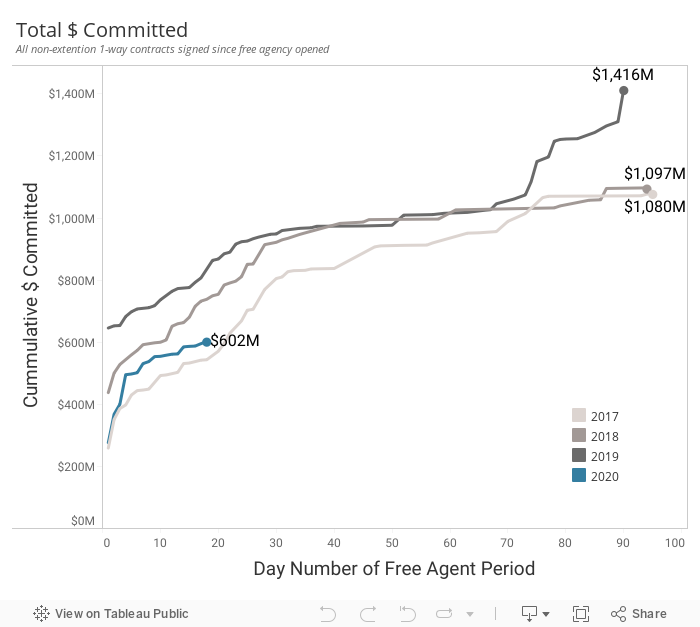
We’ve already talked about the impending cap crunch that most of the teams in the league will be facing. The impact has been very evident during the first 18 days of NHL Free Agency where the teams aren’t spending as much as they have in the past couple of years.
Here is the breakdown of the current dollars committed through day #18 of the free agent period and how it stacks up to the prior 3 years.
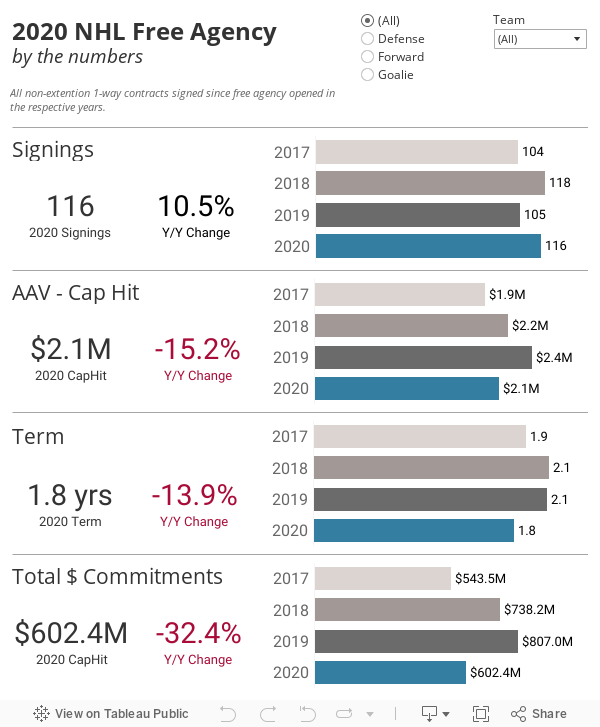
Of course, the total committed dollars is not the whole story. It’s also important to view the average annual value (Cap Hit) and average term of the contracts. Both are down double digits from last year at this point in time. Here is an interactive dashboard to let you explore the numbers by team.
So teams are signing roughly the same amount of players in the same timeframe, but signing them for less money and for shorter term deals.
And for the heck of it, here is a comparable to how each team is spending and the number of players they have signed this free agent period.
The shorter deals and cap crunch are all good news for the Kraken as they get ready for the Expansion Draft next summer. This won’t be a one-year trend as the cap is projected to stay flat next year as well due to lost revenue of partial season with optimistically, limited fans in the buildings.
Big-time guests on Sound of Hockey this week, as not one but two brilliant minds from the Seattle Kraken’s analytics department join the show for a fun and informative chat. Namita Nandakumar and Dani Chu bring tons of deep data-driven knowledge to the team and to the episode. You won’t want to miss this!
Also in this episode, the guys share some thoughts on the retirement of Doc Emrick, and John shares his story of meeting the broadcasting legend. Plus, some discussion of the latest free agent signings and trades in the NHL, and updates on various leagues returning to play.
Big-time guests on Sound of Hockey this week, as not one but two brilliant minds from the Seattle Kraken’s analytics department join the show for a fun and informative chat. Namita Nandakumar and Dani Chu bring tons of deep data-driven knowledge to the team and to the episode. You won’t want to miss this!
Also in this episode, the guys share some thoughts on the retirement of Doc Emrick, and John shares his story of meeting the broadcasting legend. Plus, some discussion of the latest free agent signings and trades in the NHL, and updates on various leagues returning to play.