The Seattle Kraken news machine is starting to slow down, but there were plenty of odds and ends to tie up on the Sound Of Hockey Podcast this week.
To start the show, John gives Darren a very thoughtful gift.
Then, the guys drift to Kraken news for quite a while, before hitting their interview with forward prospect Oscar Fisker Mølgaard. The promising and affable Dane returns for his second appearance on the show, and he does not disappoint.
The Coachella Valley Firebirds have made it to the Calder Cup finals in each of their first two seasons. Despite the success, there has since been a lot of movement within the Firebirds roster this offseason, with several stalwarts moving on to new organizations and several new players being added to the fold.
There is nuance to American Hockey League roster-building rules that we suspect many fans may not know about, so we thought we should dig in to explain how that works and how it has influenced the Firebirds roster.
American Hockey League and the “veteran rule”
The primary purpose for the AHL is to be a developmental league for potential NHL players. To ensure the league remains focused on helping players progress through its ranks, it has rules on roster construction. The “veteran rule” requires the gameday roster to include the following:
A minimum of 12 skaters that have played fewer than 260 professional games – development players
A maximum of one skater that has played fewer than 320 professional games – veteran exempt player
A maximum of five skaters that have played over 320 professional games – veteran players
The roster breakdown applies to players that dress for each game, so it is possible to have more than five veterans on the roster, but only five can play on any given night. The veteran and veteran exempt classification only applies to players 25 years of age or older or as of July 1.
The calculation for determining the number of professional games played happens prior to the start of the season and is not adjusted during the season. For example, Cale Fleury was considered a development player during the 2023-24 season, since he started with 217 games played and was 24 years old. He had a birthday in November and finished the season with 282 professional games, which means he will be a veteran exempt player for the entire 2024-25 season, having passed the 260-game threshold.
Professional games are defined as games played in the NHL, AHL, and elite European leagues. Recognized elite European leagues include Svenska Hockeyligan (SHL, Sweden), Liiga (Finland), Kontinental Hockey League (KHL, Russia), Extraliga (ELH, Czech Republic), Deutsche Eishockey Liga (DEL, Germany) and National League (NL, Switzerland). Additionally only games played in European leagues after a player’s junior years count towards the veteran rule.
The veteran rule does not apply to goaltenders.
Coachella Valley Firebirds roster
Now, with the knowledge of the veteran rule, let’s take a closer look at how last season’s roster breaks down between development and veteran players. For the 2023-24 season, here are the player classifications (minimum 25 games played).
Unchanged 2024-25 roster
Hypothetically, if the roster remained unchanged going into the 2024-25 season, the breakdown would have been the following.
This is where we start to see the problem that has arisen for the Firebirds. To be in compliance with the veteran rule, the Firebirds would only be able to dress five of the nine veterans and one of the three veteran exempt players. To complicate matters, the Kraken need to ensure they have space for Jagger Firkus, David Goyette, Jani Nyman, and Ty Nelson, who are ready to join Seattle’s AHL affiliate.
Players that moved on
There are 10 Firebird players that have signed with another team or are currently free agents.
These players were without a contract heading into free agency. With eight of these players being veteran or veteran exempt, it was unrealistic for the Kraken to retain them all.
Of the 10 players, six signed with new teams in the first couple days of free agency, signaling they got a better offer or see a clearer path to the NHL with their new team. Of the four remaining free agents, Marian Studenic is the only stand-out with 44 points last season.
Peetro Seppälä who was a restricted free agent (RFA) was given a qualifying offer, so the Kraken retain his rights. He has signed with Örebro in Sweden.
Re-signed and added
The Kraken did re-sign veterans Max McCormick, John Hayden, and Gustav Olofsson. With Fleury moving to veteran exempt, the Kraken had one veteran exempt player and three veteran players going into free agency. This gives the Firebirds room to sign two veterans, and that is exactly what they did.
Mitchell Stephens (C) – Two years, $775K AAV, two-way contract – veteran
Maxime Lajoie (LD) – One year, $775K AAV, two-way contract – veteran
This gives the Firebirds a total of five veterans and one veteran exempt player. At this point, the Firebird roster is full in terms of veteran and veteran exempt players.
In addition to signing AHL veterans, the following players were signed:
Brandon Biro (LW) – One year, $775K AAV, two-way contract – development
Nikolas Brouillard (D) – One year, $775K AAV, two-way contract – development
Brandon Biro and Nikolas Brouillard are still classified as development players. They have 171 and 238 professional games respectively. This brings some experience to the roster but provides flexibility with the veteran rule.
Ben Meyers (LW, C) – One year, $775K AAV, one-way contract – development
Josh Mahura and Ben Meyers are listed here because although they will compete for depth roles with the Kraken in training camp, we don’t believe they are guaranteed spots on the NHL roster.
Prospects typically do not fill the role of the healthy scratch, since it is usually better to get them playing time in the AHL. With this and their one-way deals in mind, Mahura and Meyers have inside tracks to making the big club.
2024-25 roster breakdown
Nothing is guaranteed until Training Camp, but Ryker Evans and Shane Wright appear poised to make the Kraken full-time in 2024-25. Assuming Mahura, Wright, and Evans are on the Kraken roster, here is how the Firebirds’ roster would look.
With this roster, the Firebirds are in compliance with the veteran rule, and they will maintain flexibility. There will also be options for filling out the Kraken roster if no additional offseason moves are made.
While it is a bummer to see players move on to other teams, it is part of the business side of hockey. Since the Expansion Draft, I have been hoping to see Kole Lind blossom into a full-time NHL player, but that just did not pan out for him in Coachella Valley or Seattle.
With the additions of the new prospects coming into Coachella, it will be exciting to see how these players perform at the next level.
Please comment below of you have any questions or thoughts on this veteran rule. You can also follow @blaizg on x.com
The Seattle Kraken drafted Alexis Bernier, a right-shot defenseman out of the QMJHL’s Baie-Comeau Drakkar with the No. 73 pick in the NHL Draft. Despite speculation the Seattle Kraken would invest on the blue line in this draft, the team came away from the first two rounds with three forwards: Berkly Catton, Julius Miettenen, and Nathan Villeneuve. Bernier, who played top-pair minutes for a Baie-Comeau club that made it to the QMJHL finals in 2023-24, was the first defenseman selected by Seattle.
This pick was a bit surprising based on the public rankings. Bernier’s highest ranking we tracked came from Elite Prospects, which had him at No. 100 overall. NHL Central Scouting ranked him the No. 62 North American skater.
Alexis Bernier defends Lleyton Roed at 2024 Kraken Development Camp
Evaluating Bernier, the prospect
Bernier played in all situations for Baie-Comeau, taking difficult matchups at 5-on-5 and logging minutes on both the power play and penalty kill. He’s a fluid mover and adept puck handler, and he was one of his junior team’s best players at breaking out of the defensive zone.
Perhaps his strongest trait, according to scouts, is his hockey sense, which allows him to diagnose and shut down opposing offensive chances before they materialize. Among defensemen, he was second on his team and seventh in the QMJHL with an on-ice plus-minus of +38 during the 2023-24 regular season.
He has adequate size and bulk at 6-foot-1, 197 pounds, and demonstrated the ability to box out opponents at the net front at Kraken Development Camp. I saw a very smooth and polished skater. On the other hand, I saw a shot and offensive skill level that were a notch or two below other offensive-minded blue liners in attendance. In addition to adding strength, the in-zone offensive aspects of the game will be a key area of development for Bernier.
While it is very early, Bernier looked like a third-pair or depth projection at camp.
The Sound Of Hockey Big Board had Bernier at No. 122 overall. On most public analyst boards, he was a mid- to late-round consideration. Bob McKenzie’s scout-informed list had Bernier listed among 10 honorable mentions after a ranked list of the top 90 players. So, the 73rd overall pick was either the early edge of his range or a few rounds early. My data-only ranking had Bernier at No. 341 overall, though that ranking favors scorers.
Video scouting Bernier
Scouting breakdown
Strengths:
“His head swivels in the defensive zone. He locates attackers all around him and adopts the right positioning and stick angle to nullify as many of their plays as possible on them. And then, with the calm of a veteran, he picks up the puck, turns toward the play, and launches the perfect pass to a teammate inside space.
“Bernier’s breakout abilities help him cut down his defensive zone time. They contribute to his shutdown abilities. As much as possible, he keeps the puck in control of his team with his poise and clever, simple passes. If a teammate gets open in the offensive zone, he spots him. And if another frees himself for a breakaway, he lands the stretch pass.” – Elite Prospects
“He’s a fast, agile defenseman who really knows how to utilize his skating ability. He loves using it to keep the tempo high, whether that’s with his gap control, man-to-man defending, breaking pucks out, or activating from the offensive blueline. Despite not being overly big he really plays hard and with an edge. He might never be a true specialist on either side of special teams, but he’ll be someone who can comfortably handle the responsibilities of both.
“The Drakkar are going to be top contenders in the QMJHL for the next two seasons, and Bernier seems like the type of player who elevates his game to new heights during a deep playoff run and then never looks back.” – McKeen’s
Weaknesses:
“He makes the occasional poor read under pressure but also shows the skills to manipulate pressure. The skill levels and skating are both questions. Fluid, but a bit upright and unable to really correct mistakes or separate from opponents with speed… He could be a mid-to-late-rounder. Not sure that any of his dimensions rank highly enough to project him confidently to the NHL, but his foundation of skills grades highly.” – Elite Prospects
Final thoughts
As mentioned above, based on scoring data only, I had Bernier as a borderline 2024 NHL Draft prospect. Players of his profile rarely develop scoring touch later in their careers, so Bernier likely needs to be a defensive standout to progress beyond the AHL. And, while I saw some building blocks at camp, he looks like he needs to take developmental leaps on that side of his game too.
During the draft I admit that I was disappointed that the Kraken targeted a defensive defenseman at No. 73, given the team’s desperate need for skill and offense from the back end and the availability of a few other gambles, such as Henry Mews (74 overall pick to Calgary) and Luca Marrelli (86 overall to Columbus).
Only time will tell if Bernier hits. But, even if he does hit, he’s highly unlikely to be the kind of top-of-the-lineup defender many were anticipating the Kraken would land in this draft. Bernier’s skill level simply didn’t compare to some of the team’s better blue line prospects at Development Camp, much less surpass it.
None of this is Bernier’s fault, of course. But Seattle’s blue line depth chart–both from a quality and quantity perspective–remains a question.
Curtis Isacke
Curtis is a Sound Of Hockey contributor and member of the Kraken press corps. Curtis is an attorney by day, and he has read the NHL collective bargaining agreement and bylaws so you don’t have to. He can be found analyzing the Kraken, NHL Draft, and other hockey topics on Twitter and Bluesky @deepseahockey.
It’s no secret that the Seattle Kraken, since the announcement of the 32nd NHL franchise in 2018, have worked hard at establishing their roots in any way possible in the Pacific Northwest.
From doing pop-up community events throughout the PNW to inking a new TV deal aimed at reaching a wider swath of fans across the region, it’s clear they’re trying to create and sustain lasting bonds within the local community.
Much of the most die-hard fan engagement in the early days came from the WHL fanbases in the U.S. Division, where the Kraken’s roots are grounded with the core group of people that drove the interest of attaining a franchise in the first place.
In their inaugural season, as a means of thanking those loyal fans from the markets that pushed for the franchise, the Kraken chose to hold their home preseason games in Spokane, Everett, and Kent while Climate Pledge Arena was in the final stages of construction. When they could have chosen one venue and stuck with it for that preseason, the team decided it was better for engagement purposes to do the games at those three separate junior hockey venues across Washington State.
We have since seen on several occasions that the organization has a penchant for bringing players into the fold with local ties. This is likely just by happenstance, but it does create some nice benefits for both the team and its fans, with whom the Kraken continue to foster relationships.
They’ve continued to nurture partnerships with the local WHL clubs and cities ever since the “Three-Rink Rush” days, but three years later, keeping a local flair in the players they employ is helping to strengthen those bonds in a more organic way.
WHL-heavy NHL Draft
The Kraken started off on Night 1 of this summer’s NHL Draft with the selection of Berkly Catton at No. 8 overall from the Spokane Chiefs. One of the most skillful and intelligent forwards in the class, he led all WHL draft-eligible players in goals (54) and points (116) in 2023-24.
On Day 2, Seattle stuck with the theme by taking three more WHL forwards, selecting power forward Julius Miettinen from the Everett Silvertips, then striking in the later rounds with two solid two-way forwards in Swift Current’s Clarke Caswell and Red Deer’s Ollie Josephson.
When the draft concluded on Saturday, a total of 34 WHL players were selected throughout both Days 1 and 2, which was the most of any eligible developmental league in the world. The Kraken’s four picks were the most of any NHL team.
Add in last season’s selections of Everett’s Kaden Hammell and Tri-City’s Lukas Dragicevic, as well as Tyson Jugnauth joining Portland midseason, and the Kraken now have at least one player representing almost every team in the division. Beyond the U.S. division, Seattle also selected Caden Price from Kelowna in 2023 and Jagger Firkus from Moose Jaw in 2022.
Ron Francis in his media availability after the draft detailed why his staff leaned towards the WHL.
“Our player development staff, as it plays out, doesn’t have to travel very far to see some of our players now,” Francis said. “The WHL has always been a good league, and the cities around Seattle have always had good teams and good players.”
While all those players in their own rights were worthy of being selected, the Kraken notably avoided drafting a defenseman until Round 3, which was shocking considering many pegged them to lean heavily on the blue line this draft given their shallow defense pool. Touted defensive prospects Zeev Buium or Zayne Parekh were a couple of the names that were available at No. 8.
Of course, Seattle scouts players across the globe, so it’s impossible to claim that the team is specifically looking locally, but having youngsters develop in the team’s backyard definitely makes for easier logistics.
“Our budget just went down for travel,” Kraken director of player development Jeff Tambellini joked last week about selecting Catton and Miettinen in the first two rounds. “But to have Berkly Catton so close, to have Miettinen so close, it’s fantastic. Any chance they get to see our team play and be around our group, the better, so we’re really exeited in the development staff that we’re going to see those guys a lot.”
Is staying local a good strategy?
Staying local is certainly enticing. Why not just go with what you’re most familiar and comfortable with instead of taking a shot in the dark? If you rank two players similarly but have seen one 10 times and the other once or twice, it becomes very easy to lean toward that player you’ve seen 10 times.
But the benefits of having the player close don’t really kick in until after the player is selected, when the Kraken can take a hands-on approach to development.
Kraken prospect and Everett Silvertips defenseman Kaden Hammell emphasized having that familiarity with Seattle has been helpful for his progression as a player.
“Not many players get to play as close [to their NHL team] as I do here,” Hammell said. “With Seattle being right down the road from Everett, anything that I have needed, they’ve been amazing with.”
Portland’s Jugnauth shared a similar sentiment on the latest episode of theSound Of Hockey Podcast.
“Seattle would be great [at making] an effort to see me when I was in Wisconsin, but obviously when they’re coming out there, it’s just to see me,” Jugnauth said. “But now with [Hammell and Miettinen] in Everett, and [Catton] in Spokane, all of a sudden they’re around all the time.”
While the development angle is great, there are always pros and cons when it comes to staying nearby for scouting. While both players and management can make it easier on themselves to access one another whenever they need, a drawback to this approach is it could be limiting the Kraken’s talent pool slightly.
Of course, the Kraken do not limit themselves to drafting locally, and there’s no doubt they do their due diligence when it comes to deciding on the players that enter the organization.
Fans like local talent
We do believe it will be a long-term challenge to retain season ticket holders and keep the casual game-attending audience engaged in Seattle. Having players that were either born in Washington or developed their game in Washington seems to help create connections between fans and players, as the fan relates to the player more.
There’s no better example of this than with the home-state signing of Kailer Yamamoto last summer. While it was a low-risk deal for the Kraken to make at just one year, $1.5 million, Yamamoto was never a great fit for Seattle. We have to think that he was more interested in playing for the Kraken, and the Kraken may have become interested in him at least in small part because of him being born and raised in Spokane and previously playing for the Chiefs.
Sure, there was some upside he could have tapped into, having that first-round pedigree from 2017, but Francis even alluded to Yamamoto’s local ties in the initial press release following the acquisition.
“He played junior hockey in his hometown of Spokane, Washington, and we’re happy to welcome him to the Kraken,” Francis said on July 1, 2023.
Yamamoto wound up appearing in 59 games as a Kraken, scoring only eight goals in his tenure and averaging five fewer minutes than he previously grew accustomed to in Edmonton. Still, there was a fervent group of fans that was not shy in telling us how much they loved Yamamoto and how furious they were any time he was left out of the lineup.
On the other side of the local coin, Oliver Bjorkstrand doesn’t necessarily belong in the same category as Yamamoto given how much more productive he has been as a member of the Kraken. But it’s important to note that him being a former Portland Winterhawk allowed the large and rabid audience down in the ‘Rose City’ to have an in when it came to keeping a rooting interest in the team.
The Kraken aren’t unique in selecting players from their own implicit biases, as many teams boast either hometown or local products of their own. Correlation isn’t always causation in this case.
But with the talent pool being less concentrated in the Pacific Northwest compared to the combined other regions on the continent, and for them to acquire the talent from around here as often as they do, whether it be via the draft or acquisition, it’s easier to see the patterns start to emerge and wonder if there’s reason for their choices beyond impact on the ice.
We just had a verybusy week covering the Seattle Kraken, and something that might have been overlooked was the official release of the NHL schedule for the 2024-25 season. As I do every year, I enjoy looking at a few key data points across the league to see how the Kraken schedule stacks up against that of other teams.
Travel distance by NHL team
Based on the location of some NHL franchises, it is expected that certain teams will log more miles in a season compared to the rest of the league. Seattle is one of those teams that needs to travel more than most.
The Kraken have consistently fallen in the top 10 for travel miles, and coming in at third place for most miles traveled in 2024-25 will be the highest Seattle has been on this list. The Kraken will travel 3,000 more miles this coming season compared to last season.
Here is a look at all the teams by division.
The Pacific Division teams, as a whole, end up traveling more than the three other divisions.
Number of road trips
A side benefit of being based outside the northeastern corner of North America is that you tend to have fewer road trips.
As you can see, Seattle has the second-fewest number of road trips across the league. Of course, that means the actual road trips themselves will be longer.
Note that because of the league-wide break for the 4 Nations Face-Off, Seattle will have no home stands that start in February this coming season.
Back-to-back games
Another element of the NHL schedule I like to review is the number of back-to-back games for each team. The Kraken come in close to the league average on this.
Other odds and ends of the Kraken schedule
As many people have noticed already, the home opener is at 1:30 p.m. on a Tuesday as the NHL hopes to recreate an MLB Opening Day-type vibe with a triple-header on ESPN.
The Kraken have 11 Saturday home games this coming season, up from nine during the 2023-24 season. I’ve joked that this is bad news, considering they did not win any of those Saturday games last season.
Alex Wennberg’s first game as a visitor to Climate Pledge Arena will be on Nov. 30 when the Sharks visit Seattle.
The Stanley Cup champion Florida Panthers visit Seattle on Dec. 10.
The Utah Hockey Club makes its first appearance at Climate Pledge Arena on Dec. 30, and the Kraken’s first game in Utah is not until April 8.
We discussed it on the Sound Of HockeyPodcast, but if you are looking for a fun road trip, the Kraken play three games in four days when they visit the New York area for an extended weekend in early December.
There are three days when the Kraken, Seattle Thunderbirds, and Everett Silvertips all have home games this coming season: Nov. 27, Jan. 18, and March 14.
What did I miss? Are there any home games you are particularly excited about? What about a possible road trip you’re considering? Let me know your thoughts in the comments.
Phew! Those last couple of weeks in the hockey world were nutso, and now that the Seattle Kraken Development Camp has wrapped up, it feels like we can finally take a big collective breath.
The NHL crammed a lot into a short period, with teams having just a few days between the end of the Stanley Cup Playoffs and the NHL Draft, which happened last weekend in Las Vegas. The draft always segues straight into Dev Camps for many teams, but wedged in-between was the opening of unrestricted free agency, adding its own chaos. Toss in a couple of coaching announcements from the Kraken, and you have a whirlwind of hockey coverage.
This schedule was even more packed than usual due to the extended season, with the Stanley Cup Final featuring extra off days between games. For the Kraken, who missed the playoffs, there was a long period of inactivity (excluding the Coachella Valley Firebirds’ Calder Cup run), followed by a sudden rush of activity. Now, it seems we’re headed back into a quieter news period.
So, we thought this would be a good time to slow down, take stock of everything that happened over the last week, and consider where the organization stands.
Development Camp takeaways
Dev Camp always turns out to be an enjoyable event and somehow manages to exceed expectations every year. It’s exciting to see young players who are just joining the organization hitting the ice in Kraken garb for the first time, and it’s equally intriguing to witness the progress of prospects we’re already familiar with.
We did not get to see prospects like Shane Wright, Ryan Winterton, Logan Morrison, Jani Nyman, and Ville Ottavainen, who all played significant roles for the Firebirds this season. However, those who did not have a prominent AHL role, such as Jagger Firkus, Ty Nelson, Carson Rehkopf, Eduard Sale, Oscar Fisker Mølgaard, and Tucker Robertson, all attended and all showed improvement compared to last summer.
Rehkopf, especially, was outstanding in 3-on-3 scrimmages on Wednesday, when we watched him score three goals and an assist for his team in a 7-3 win. He’s a player with a bright future, and we continue to wonder if the Kraken will give him a nine-game look out of Training Camp.
Remember, Rehkopf is in that same boat as Wright from two seasons ago, when his only options were to play in the NHL or return to the OHL because of his age. There is a loophole where a player can stay with the NHL club for up to nine games before burning a year of his entry-level contract. Will Seattle do this with Rehkopf?
Eyes on Berkly Catton
Perhaps most notably, we got our first look at Berkly Catton, the No. 8 overall pick and Spokane Chiefs superstar, as a member of the Kraken organization. While we were already aware of his dominance in the WHL, it was fascinating to watch him maneuver against his peers, particularly during those 3-on-3 games. He stood out as one of the best players on the ice in that setting, but during Friday’s 5-on-5 Stucky Cup game, Catton was less prominent. He did still display flashes of brilliance and narrowly missed setting up a few sure goals for his teammates.
Other players raved about Catton’s abilities, with Tyson Jugnauth, who we spoke to on the latest Sound Of Hockey Podcast, calling Catton the best player he faced this season while playing with Portland. Jugnauth joked about team meetings focusing almost exclusively on Catton before games against the Chiefs.
Like Wright two summers ago, Catton signed his entry-level contract on the ice alongside general manager Ron Francis on Friday, drawing loud cheers from the hundreds of fans in attendance and setting a positive tone for the Stucky Cup.
Other impressive prospects
Before wrapping up Development Camp and never speaking of it again (just kidding, we will certainly speak of it again), we want to highlight a few more players who caught our attention. Goyette, as mentioned earlier, performed well against his fellow Kraken prospects. We’ve maintained since last year’s Training Camp that he has a future in the NHL, and that was reaffirmed this week.
We were also impressed by Lleyton Roed, signed by the Kraken as an undrafted free agent from Bemidji State University in March. After making appearances in five regular-season games and five playoff games with the Firebirds, Roed stood out this week as one of the fastest skaters on the ice. His scoring touch was also on display Friday when he dangled and scored bar-down off a partial breakaway.
Eeli Tolvanen signs, Matty Beniers still pending
Francis drew an even bigger cheer from the crowd when he announced a two-year extension had been signed by winger Eeli Tolvanen. The deal, averaging a $3.475 million cap hit per year, aligns well with projections and seems fair to both sides.
This leaves Matty Beniers as the remaining major contractual question mark. Before CapFriendly ceased operations (sleep well, sweet prince), we ran one last Armchair GM simulation for Seattle, and this is what we came up with for its roster:
You’ll see we signed Beniers to a hypothetical $6 million cap hit and assumed Ryan Winterton and John Hayden would make the team as the 13th and 14th forwards. We also assumed Josh Mahura would stick with the team as a seventh defenseman. Making these very reasonable decisions left us $456K over the cap.
There are plenty of levers an NHL team can pull to make itself cap compliant, so being slightly over isn’t a big concern. But, it does demonstrate that the Kraken have effectively filled their roster and will need to get Beniers under contract at the right dollar amount.
Are the Kraken done cooking?
Looking at the CapFriendly image above (R.I.P.), it appears the Kraken have answered most of their questions at this point, and they will still have healthy competition in Training Camp. Their cap situation suggests they may be done with major offseason moves, a sentiment echoed by Ron Francis earlier this week after signing Brandon Montour and Chandler Stephenson to significant seven-year deals. 24 hours after Francis said that, though, he then traded Brian Dumoulin to clear dollars off the books.
Could they be done? Possibly, but we still think Francis will be looking for opportunities to add offense and/or improve Seattle’s cap situation.
Coaching updates
Seattle made massive headlines by promoting Jess Campbell to the NHL, making her the league’s first full-time female assistant coach. While this announcement brought significant media attention and even a congratulatory message from the legendary Billie Jean King, the Kraken continued to focus the narrative on Campbell’s abilities as a coach. We’re excited to see what she can do to help the Kraken offense next season.
Congratulations to Jessica Campbell who has made #NHL history as the league's first full-time woman hired as an Assistant Coach for the @SeattleKraken! https://t.co/W11Q41G3kB
Simultaneously, the team hired Bob Woods to backfill for Jay Leach and later announced Derek Laxdal as the new head coach for Coachella Valley.
Laxdal, 58, has decades of experience at all levels of hockey from the WHL, where he won the Memorial Cup with the Edmonton Oil Kings in 2014, to the NHL, where he spent three seasons as an assistant for the Dallas Stars. Laxdal (which comically rhymes with Hakstol, but that’s neither here nor there) most recently served as head coach and assistant general manager of the Oshawa Generals of the OHL.
We wondered what this meant for Firebirds assistant coach Stu Bickel, who we know was being considered for a promotion of his own, and it sounds like he will remain in his same role for next season under Laxdal.
Darren Brown
Darren Brown is the Chief Content Officer at soundofhockey.com and the host of the Sound Of Hockey Podcast. He is a member of the PHWA and is also usually SOH’s Twitter intern (but please pretend you don’t know that). Follow him @DarrenFunBrown and @sound_hockey or email darren@soundofhockey.com.
As the smoke clears from an active opening to free agency, we at Sound Of Hockey, wanted to highlight some of the movements around the NHL. There were 190 signings on the first day of free agency and 252 signings and counting so far with more than $1 billion committed across the league. We will focus on the impacts to the Pacific Division teams, what the new additions to the Seattle Kraken mean for their chances, and touch on a few other teams that made significant moves around the NHL.
Seattle Kraken
General manager Ron Francis was not his usual conservative self and made a big splash, signing two big free-agent targets:
Brandon Montour (RD) – Seven years at $7.14M AAV ($50M total)
Chandler Stephenson (C) – Seven years at $6.25M AAV ($43.75M total)
"#SeaKraken reportedly signing defenseman Brandon Montour to a monster seven-year contract"@DarrenFunBrown gives quick analysis on the surprising seven-year signing and considers how Montour could fit with the Kraken.
"#SeaKraken make another splash, signing Chandler Stephenson for seven years" @DarrenFunBrown gives his reaction to the signing and an update on where Seattle sits after grabbing Stephenson and Brandon Montour.
The initial feedback has not been all positive. Both players are 30 years old and signed seven-year deals. If either player actually plays out the entirety of his contract, he will be in a small minority of players in the league at that point. Only 15 NHL players were 37 at the start of the 2023-24 season. The cost of each contract has been described as an overpay, but that is the cost of doing business in free agency, especially if you want to attract talented players.
There are some positives from these signings. Let’s start with a simple question, are the Seattle Kraken better with Montour and Stephenson? On paper, this is a resounding yes, they have strengthened the defense and improved at the center position. Montour will most likely play on the second defensive pairing, but is capable of a first-pairing role and led all Florida Panthers in ice time last season. Stephenson is an improvement over former Kraken center Alex Wennberg and provides a bit more offensive punch. Stephenson will also be able to fill the second-line center role, hopefully reducing some pressure on Shane Wright, who looks to make the Kraken roster full-time this upcoming season.
Contract length
Seven years is the longest contract the Kraken could award to these players. Offering this term was likely a driving factor in Stephenson and Montour choosing to play for Seattle, which does not have the allure of being a true Stanley Cup contender.
I’m not terribly worried about the contract length, though I know this is a big part of the discourse about these signings. The reason I’m not worried about it is because a lot can happen during seven years. Players can be traded, bought out, get injured, or retire. While I don’t hope for the last two, the reality is injuries happen in hockey, and it is possible these contracts get moved to long-term injured reserve after a number of years.
Average annual value (AAV)
The AAV also seems high, but remember, seven years ago the NHL salary cap was at $75 million. It has increased 17.33 percent to $88 million. If the cap continues to grow at this rate, these deals may not seem as rich in a few years. If they produce, $6 million and $7 million contracts could seem cheap a couple years from now.
Players tend to decline in performance as they age, but these are the only two contracts currently on the books from 2027-28 onward.
Acquired through free agency
There are four ways to acquire a player, drafting, signing as a free agent, trading, or claiming off waivers. It’s generally believed that the best way to build a team is to build from the draft, but that takes time. Trading or signing free agents can speed up the timeline, but both have positives and negatives.
The positive for signing a free agent is the prospect pool remains intact, whereas trading often costs draft picks and/or prospects. The Kraken have a promising prospect pool, so to be able to add two solid players to their current roster without giving up any futures is a positive. To me, keeping that pool intact is worth a few extra million in overpay.
Stanley Cup pedigree
Ron Francis has a penchant for signing players that have won the Stanley Cup. Both Montour and Stephenson have hoisted Lord Stanley’s Cup, and Francis believes that experience is valuable when it comes to the grind of the season and the playoffs. Other Stanley Cup winners that have been signed by Ron Francis include Jaden Schwartz, Andre Burakovsky, Philipp Grubauer, Justin Schultz, and Brian Dumoulin (and, of course, head coach Dan Bylsma).
Signings overall
The Seattle Kraken have improved their roster with these signings, and, at least for the next two-three years, fans will get to enjoy this benefit. Hopefully by the time the contracts start to age, we will see a boost in performance from Seattle’s prospects.
Other Signings
The Kraken also made the following signings, mainly to backfill for departures from the Coachella Valley Firebirds, although Ben Meyers and Josh Mahura will certainly be looking to secure spots on the NHL roster. Their one-way contracts give them each an inside track to these spots, but we will see how training camp shakes out.
Signed Ben Meyers (LW, C) – One year, 775K AAV one-way contract
Signed Mitchell Stephens (C) – Two year, 775K AAV, two-way contract
Signed Brandon Biro (LW) – One year, 775K AAV, two-way contract
Signed Nikolas Brouillard (D) – One year, 775K AAV, two-way contract
Signed Maxime Lajoie (LD) – One year, 775K AAV, two-way contract
Signed Josh Mahura (LD) – One year, 775K AAV, one-way contract
Kraken moves overall
The Kraken have improved on both the offensive and defensive sides of puck. But have they done enough to secure a playoff spot? Time will tell, but it is reasonable to expect growth from Matty Beniers, Eeli Tolvanen, and Ryker Evans, and Andre Burakovsky should have a rebound year as well. With the additions of two legit players, the Kraken have a deeper roster than before, and all four lines should produce offense closer to what they did two seasons ago. Seattle also has a new coach in Bylsma who hopefully can bring an uptick in production.
Pacific Division
Anaheim Ducks
Added
Lost
Same/Better/Worse
Brian Dumoulin
Jakob Silfverberg
Same – Anaheim was bad last year and will continue to build this year.
Calgary Flames
Added
Lost
Same/Better/Worse
Anthony Mantha Ryan Lomberg
Jacob Markstrom Andrew Mangiapane
Worse – They still have some work to do to get a starting goaltender to replace Markstrom.
I would love to see Dustin Wolf get a crack at the starting job, but that seems farfetched. The Flames will need to find a starting goalie. Some Seattle Kraken fans will dream of Grubauer getting traded, but Seattle needs him, especially without Chris Driedger stashed in the AHL. Grubauer also has a 10-team no-trade list and a huge contract, so we don’t see him getting traded.
Edmonton Oilers
Added
Lost
Same/Better/Worse
Viktor Arvidsson Jeff Skinner
Warren Foegele
Better – Resigned many of their current team and added, if you can believe it, more offense.
Jeff Skinner is an excellent signing and should easily replace the offensive output of Warren Foegele. This should be the year Skinner finally gets to play in a playoff game.
Los Angeles Kings
Added
Lost
Same/Better/Worse
Warren Foegele Tanner Jeannot Joel Edmundson Darcy Kuemper
Pierre-Luc Dubois Cam Talbot Matt Roy Viktor Arvidsson Blake Lizotte
Worse – Dubois never panned out in LA, but Warren Foegele’s offensive ceiling is close to Dubois’ floor. Both had about 40 points this last season. It was Foegele’s best season and Dubois’ worst season.
San Jose Sharks
Added
Lost
Same/Better/Worse
Tyler Toffoli Alex Wennberg Macklin Celebrini (Draft) Barclay Goodrow (waivers)
Devin Cooley
Better – They definitely have an improved forward group, but their defense and goaltenders still need some help. They probably are not the favorite to land another first overall draft pick, but making the playoffs would still be a huge stretch.
Back in January, we at Sound Of Hockey predicted it would take between $4.5-$5.5M to re-sign Wennberg, and that is exactly what San Jose paid, coming in at $5M AAV for two seasons.
Alex Wennberg
Vancouver Canucks
Added
Lost
Same/Better/Worse
Jake DeBrusk
Ian Cole Elias Lindholm Nikita Zadorov Casey DeSmith
Same – Lindholm did not work out, but prior to him coming, Vancouver was good. DeBrusk brings some more offense, and Arturs Silovs proved he is worthy of a backup role in the NHL.
Jake DeBrusk has averaged a 24-goal pace for his NHL career.
Jake DeBrusk, signed 7x$5.5M by VAN, is a top six scoring winger with a well-rounded offensive game and good defensive metrics who plays in all situations. Lots of goal-scoring upside even if it's not the most consistent. #Canuckspic.twitter.com/ZAyIBKjxVe
Chandler Stephenson Jonathan Marchessault Anthony Mantha Logan Thompson
Slightly Worse – The Golden Knights lost a lot of offense, but they did add Hertl last year at the trade deadline. The goalie and defense situation should be similar to what it was before, even after trading Thompson.
Hertl can replace Stephenson’s offensive production. Olofsson is a proven 20-goal scorer and did it on only 14 minutes of ice time with the Sabres. However, he will not match Marchessault’s production, which has now moved on to Nashville. Samsonov might thrive in a 1B role after shedding the pressure of playing in Toronto.
Overall Pacific Division
After a few days of free agency, it is way too early to predict standings for next season, but I’ll give it a try…
The Edmonton Oilers and the Vancouver Canucks look poised to hold onto the top two spots in the Pacific Division. The Los Angeles Kings, Vegas Golden Knights, and Calgary Flames appear ready to slide in the standings and open the door for the Kraken to slip into a playoff spot. The Anaheim Ducks and San Jose Sharks are content in the cellar for another year.
There is a lot of offseason left, and these teams will continue to make moves. But if the season started today, here is my (way too early) prediction for the Pacific Division standings:
Edmonton Oilers
Vancouver Canucks
Seattle Kraken
Vegas Golden Knights
Los Angeles Kings
Calgary Flames
San Jose Sharks
Anaheim Ducks
Around the NHL
A handful of teams set off some fireworks in the early goings of free agency. We will not review every free agency move, but we will highlight some teams that made a big boom or lit a dud. Moves include trades and draft picks that happened around free agency as well. With it being a long 4th of July weekend, we will provide ratings using fireworks.
Boston Bruins
Players added: Elias Lindholm, Nikita Zadorov, and Joonas Korpisalo (trade)
Players that left: Jake DeBrusk and Linus Ullmark (trade)
Firework rating: Firecracker thrown from your hand. Definitely made a bang with their signings, but there is risk in signing Lindholm at $7.75M AAV after his struggles in Vancouver. I like the Kraken’s signing of Stephenson better.
Carolina Hurricanes
Player added: Shayne Gostisbehere
Players that left: Jake Guenztel (traded rights away), Brady Skjei, Teuvo Teravainen
Firework rating: Bottle rocket dud. Carolina was not able to capitalize on Guenztel, who seemed to fit into their system, scoring 34 points in his 28 games after being acquired at the deadline.
Nashville Predators
Players added: Steven Stamkos, Jonathan Marchessault, and Brady Skjei
Players that left: Anthony Beauvillier and Jason Zucker
Firework rating: Mortars with report. Nashville was not happy with its first-round exit and brought in some big names on offense and defense. This improved team might be able to exceed its 18-game point streak from last season.
Breaking: The Predators are adding star forward Steven Stamkos, former Conn Smythe winner Jonathan Marchessault and Carolina Hurricanes defenseman Brady Skjei. pic.twitter.com/a7CRkcLkcJ
Firework rating: Ground Snake. Lou Lamoriello was able to keep this signing quiet, but Duclair is a solid pick-up.
Tampa Bay Lightning
Player added: Jake Guentzel
Players that left: Steven Stamkos, Tanner Jeannot (trade), and Matt Dumba
Firework rating: Ground Fountain. Tampa is out with the old and in with the new. It will be a new era in Tampa Bay with long-time captain Stamkos moving to Nashville. Guentzel was a nice piece of work, though.
Toronto Maple Leafs
Players added: Chris Tanev and Oliver Ekman-Larsson
Players that left: Tyler Bertuzzi, T.J. Brodie, and Ilya Samsonov
Firework rating: Saturn missile. You never know which way the missiles are going to fire. This year, Toronto is adding veteran defense and a new coach in Craig Berube. The team should be playoff bound again, but it will be interesting to see how this roster responds to the offseason changes.
Washington Capitals
Players added: Jakob Chychrun, Logan Thompson, Andrew Mangiapane, Pierre-Luc Dubois, and Matt Roy
Players that left: Nick Jenson and Darcy Kuemper
Firework rating: 500-gram firework cake. The Capitals did most of their moves through trades, but they have brought in a good group of players. These players should be able to improve Washington’s record, but the Caps are currently projected to be ~$13M over the cap. So, some work still needs to be done.
Wrapping up
It has been a busy start to the summer with all the free-agent signings, the trades, the NHL Draft, and Kraken Development Camp all hitting at about the same time. We are only a couple weeks into the official offseason, and I am already looking forward to the start of next season.
Please let me know your thoughts on the players acquired or traded and how you think this impacts the Kraken and/or league. You can follow @blaizg on x.com
It’s been a HUGE week for the Seattle Kraken, with many MANY headline-making moves, plus Development Camp. The Sound Of Hockey Podcast is here to bring you up to speed on everything you need to know. Plus, the guys are revisiting their feelings on the recent Kraken free-agent signings.
They also interview Kraken prospect Tyson Jugnauth and hustle through all the big UFA signings from across the NHL.
Segments include Weekly One-Timers, Interesting or Carry On, and Tweets of the Week.
On Tuesday, the Seattle Kraken announced the trade of defenseman Brian Dumoulin to the Anaheim Ducks in exchange for Anaheim’s 2026 fourth-round draft pick. Dumoulin, who signed a two-year contract with the Kraken on July 1, 2023, with an annual cap hit of $3.15 million, played 80 games during the 2023-24 season, scoring six goals and adding 10 assists.
Why did Seattle trade Dumoulin? How do we evaluate the move, and what does it mean for Seattle’s offseason plans? Let’s dive in.
Dumoulin played a valuable role for the Kraken
Before discussing team dynamics, it’s important to note Dumoulin’s solid performance for a Kraken team that fell short of expectations last season. Although he faced initial challenges upon joining the Kraken, Dumoulin quickly established himself as a valuable asset.
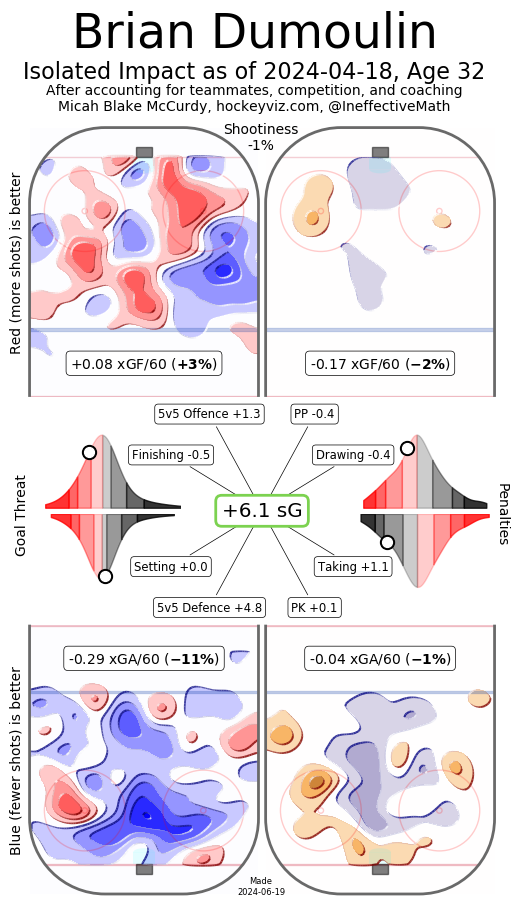
Just how valuable was he? While Dumoulin achieved a career high in goals (six), his true impact lies beyond the score sheet. As a defensive defenseman, his effectiveness is measured by how well he suppresses opponent opportunities and shifts momentum in Seattle’s favor.
He excelled in this role last year. According to HockeyViz, with Dumoulin on the ice, the Kraken suppressed opponent shot quality by 11 percent above average. Additionally, the team generated 54.5 percent of the overall shot quality during 5-on-5 play with Dumoulin on the ice, per Natural Stat Trick. Among regular lineup players, none achieved a higher expected goals-for percentage. These on-ice results translated into success; Dumoulin ranked third on the team in on-ice plus-minus at +3, while the team as a whole was at -19.
Although primarily deployed as a third-pair defenseman, Dumoulin earned trust from the coaching staff and often stepped up when injuries required it.
Kraken free agent additions dictate a roster move
Why, then, did Seattle trade Dumoulin if he played such a crucial defensive role? The team’s recent signings in free agency necessitated a move to manage its salary cap.
Shortly after free agency opened on July 1, 2024, the Kraken announced a seven-year contract with defenseman Brandon Montour, averaging $7.14 million annually. This brought the number of established NHL defensemen on the roster to seven: Montour, Dumoulin, Vince Dunn, Adam Larsson, Jamie Oleksiak, Will Borgen, and Ryker Evans.
Within hours, center Chandler Stephenson was also signed to a seven-year deal with an average annual value of $6.25 million. These contracts marked the largest total-value signings in Seattle’s or any Ron Francis-managed team’s history.
Assuming Shane Wright and Evans make the team, these signings left the Kraken with approximately $8.25 million in cap space, with 10 forwards and seven defensemen already signed. Qualified restricted free agents Eeli Tolvanen and Matty Beniers, who are yet to sign, will bring the total number of forwards to 12 once their contracts are finalized.
Here are some possible contracts for Tolvanen and Beniers from two prominent contract projections:
Considering Beniers’ decreased point production in the 2023-24 season, most analysts predict a shorter, so-called “bridge” deal. Using the data points above, a reasonable estimate for a bridge deal might be a three-year, $4.6 million AAV contract.
As for Tolvanen, the prevailing wisdom favors a multi-year deal with an expected cap hit in the $3 million to $4 million range. Let’s use a three-year, $4 million AAV contract as a placeholder for Tolvanen.
If Beniers and Tolvanen were added to Seattle’s salary cap table after their spending spree in free agency, the team would already exceed the cap, even without a 13th (or 14th) forward on the roster.
Even a shorter-term deal for Tolvanen, such as a one-year contract at $3.2 million, would leave insufficient room to add a full-time 13th forward. Something had to give.
The team’s decision to trade Dumoulin
Kraken general manager Ron Francis met with the media after the Montour and Stephenson signings on Monday, July 1. When he was asked if the signings would necessitate further moves, Francis said: “[N]ot at this point,” before noting that “[i]t will depend on… talks … with Matty [Beniers] and [Eeli] Tolvanen.” Any subsequent moves will “depend on where those [contracts] come in… But we have looked at a lot of different scenarios and we feel comfortable we will be under the cap and ready to go when the season starts.”
When Sound Of Hockey’s Darren Brown asked Francis what he thought of a crowded seven-player blue line, Francis answered “that’s what training camp is for.” Francis continued: “We carry seven normally all season long. So, we felt comfortable with our six before today, and now we feel really good about our seven.”
We were cautious taking these comments at face value, suspecting that disclosing a tight financial position during negotiations could weaken the team’s bargaining stance.
Lo and behold, less than 24 hours later, Seattle announced Dumoulin’s trade to Anaheim, effectively clearing their defensive logjam and fixing their cap situation. With Dumoulin’s $3.15 million cap hit off the books, the team now had $11.4 million in cap space to accommodate Beniers, Tolvanen, and potentially add a 13th forward and seventh defenseman.
Other potential trade candidates, such as Will Borgen ($2.7 million AAV) or Adam Larsson ($4 million AAV), were less straightforward solutions for Seattle’s roster needs. The team likely values them higher and prefers to either retain or trade them under more favorable circumstances. Alternatively, trading a forward like Brandon Tanev ($3.5 million AAV) without a ready replacement could have simply traded one problem for another by creating a new roster vacancy.
Completing the Kraken roster
The cap picture is much clearer following the Dumoulin trade. Allocating $8.6 million total to Beniers and Tolvanen based on our calculations above, the team could then easily add one depth forward and one depth defenseman on minimum contracts and remain under the cap. Consider the following scenario where John Hayden and Cale Fleury assume those roles:
Alternatively, on July 1, the Kraken signed 25-year-old forward Ben Meyers to a one-year contract at a $775,000 cap hit. Bringing six goals in 67 games of NHL experience, Meyers should compete with Hayden to stick with the team as a 13th forward.
On the blue line, the Kraken signed 26-year-old, left-shot defenseman Josh Mahura to an identical one-year, $775,000 minimum contract on July 3. Mahura has 191 games of NHL experience. He was a full-time, third-pair defender for the Florida Panthers in 2022-23, and continued in that role to begin 2023-24 before a lower-body injury knocked him out of the lineup, and he shifted down the depth chart in favor of other options. Mahura should compete with Fleury for the depth defenseman role.
Evaluating the Dumoulin trade
Given Dumoulin’s strong performance in Seattle and reasonable contract term, some might question why the Kraken didn’t secure a better return in the trade. Recent trade trends indicate that deals around this time of year often prioritize cap management over maximizing player value. The Kraken took advantage of that dynamic when it came to acquiring Oliver Brjorkstrand, but were on the other side of it this time.
Here are the completed player-for-pick trades just before or during the first 10 days of free agency over the last three years:
July 2, 2024: Seattle trades LD Brian Dumoulin to Anaheim for a 2026 fourth-round pick.
July 1, 2024: Pittsburgh trades F Reilly Smith (plus salary retention) to New York Rangers for 2025 fifth-round pick and 2027 second-round pick.
June 30, 2024: Montreal trades RD Johnathan Kovacevic to New Jersey for a 2026 fourth-round pick.
July 2, 2023: Tampa Bay trades F Patrick Maroon (plus 20 percent salary retention) to Minnesota for a 2026 seventh-round pick.
July 1, 2023: Dallas trades LD Colin Miller to New Jersey for a 2025 fifth-round pick.
July 1, 2023: Montreal trades Joel Edmundson (plus 50 percent salary retention) to Washington for 2024 third- and seventh-round picks.
July 22, 2022: Columbus trades F Oliver Bjorkstrand to Seattle for 2023 third- and fourth-round picks.
July 13, 2022: Ottawa trades F Connor Brown to Washington for a 2024 second-round pick.
Kovacevic is the most recent comparable for the Dumoulin deal. Kovacevic is a 26-year-old, 6-foot-5, right-shot defenseman who played 62 NHL games in 2022-23 in a third-pair role, tallying 13 points. He is also cheaper than Dumoulin, with just a $766,667 cap hit for one year. Dumoulin is a better player, no doubt, but it is easy to see how the other factors could even out the value based on the acquiring team’s need. Add in that San Jose’s 2026 fourth-round pick is likely to be a better pick than the one secured for Kovacevic return, and the deals look roughly similar.
The 2023 Joel Edmunson trade may be the closest fit in terms of player profile traded in our sample. The return was slightly better in that case, but I attribute that to Montreal’s $1,750,000 salary retention. Edmunson cost Washington approximately half what Dumoulin will cost against the cap.
The 2023 Colin Miller trade is another comparable deal. Again, Dumoulin is the better player, but Miller was cheaper ($1.85 million AAV for one-year), and he brought a lesser return.
All told, it appears Seattle took a trade in line with what might be expected on the market.
Importantly, Seattle avoided a scenario where they would need to sweeten the deal with prospects or draft picks to move Dumoulin’s contract, similar to Detroit’s experience with Jake Walman, who had two years at $3.4 million average annual value remaining on his deal. Detroit sent a second-round pick to San Jose to facilitate Walman’s trade due to cap constraints.
Revisiting Soucy vs. Dumoulin a year later
All of this made me recall the decision faced by Seattle last offseason whether to re-sign Carson Soucy or sign Brian Dumoulin. Opting for the latter, the team underscored that the shorter term accepted by Dumoulin was important to avoid blocking Ryker Evans. Leap to today, and Evans is ready for the NHL, has a clear path to a role, and the Kraken have a minor draft asset for their troubles.
If the team had instead signed Soucy to the same contract he took in Vancouver, the Kraken would have a player with two years remaining at a $3.25 million annual cap hit. If Soucy had experienced a similarly injury-plagued season in Seattle as he did in Vancouver, moving him may have incurred costs akin to Detroit’s situation with Walman.
Final takeaways
The Dumoulin trade was a necessary step to navigate Seattle’s cap situation while finalizing contracts with restricted free agents Beniers and Tolvanen. Given their current cap space, the deal does not portend additional acquisitions, beyond depth signings, unless the Kraken move out additional existing player contracts in the interim.
Could Seattle have secured a better return for Dumoulin if it had more cap flexibility to hold onto him? Perhaps, but the team prioritized securing targeted players in free agency, placing them in a weaker bargaining position during trade negotiations amidst a depressed summer trade market. In this context, the trade appears fair and aligned with market norms.
* * *
What do you think about the Dumoulin trade and the rest of Seattle’s offseason moves? Do you think the Kraken are done? Do you have anything else you’d like to see the team do? Are the Kraken a better team heading into the 2024-25 season? Let us know in the comments below or X, formerly known as Twitter, @sound_hockey and @deepseahockey.
Curtis Isacke
Curtis is a Sound Of Hockey contributor and member of the Kraken press corps. Curtis is an attorney by day, and he has read the NHL collective bargaining agreement and bylaws so you don’t have to. He can be found analyzing the Kraken, NHL Draft, and other hockey topics on Twitter and Bluesky @deepseahockey.
Jessica Campbell and Bob Woods have been hired as assistant coaches for the Seattle Kraken, the team announced on Wednesday.
Campbell, 32, becomes the first female to be hired full-time as an assistant coach in the NHL, while Woods, 56, joins the organization after spending parts of the last seven seasons with the Minnesota Wild.
Campbell broke ground two seasons ago as the first woman in AHL history to hold a full-time assistant coach position. She made headlines once more on Sept. 25, 2023, when she coached a Kraken preseason game against the Calgary Flames at Climate Pledge Arena in Seattle, joining a select group of women who have coached behind an NHL bench.
Now, she takes perhaps her biggest step yet by ascending to the NHL.
“This is an important day for our organization,” general manager Ron Francis said. “We’re bringing in valuable coaching experience to our staff and are confident that both Bob and Jessica will make an immediate impact for our team.”
A native of Rocanville, Saskatchewan, Campbell helped lead the Coachella Valley Firebirds of the AHL to two consecutive Calder Cup Finals in 2022-23 and 2023-24, where they lost to the Hershey Bears both times. With Coachella Valley, she managed the forward corps and power play and is well-regarded in the Seattle organization for her ability to develop prospects.
“During our tenure in Coachella Valley, I saw firsthand Jessica’s commitment to player development,” Bylsma said. “Her ability to establish relationships with her players, specifically Tye Kartye, Shane Wright and Ryker Evans, was an important factor in this hire. I’m looking forward to continuing to work with her at the NHL level.”
Campbell’s name began circulating in rumors that she could join the NHL staff after Bylsma, who initially hired Campbell for her AHL role on July 4, 2022, was promoted to head coach of the Kraken in May.
During Bylsma’s introductory press conference on May 28, Kraken general manager Ron Francis suggested that Campbell would be considered for a promotion. “We didn’t hire her [for Coachella Valley] because she’s a woman; we hired her because she’s a good coach,” Francis said. “She has an impressive background in skating and skill development, which has been integral to Coachella Valley’s success. She oversees the power play, works with our forwards, and helps everyone improve their skating and skills.”
Bylsma took over from Dave Hakstol, who was relieved of his duties as Kraken head coach on April 29 after three seasons. Assistant coach Paul McFarland also departed at that time, and Jay Leach later departed to join the Boston Bruins, creating openings for Campbell and Woods.
Campbell has long said that her childhood dream was to become the first woman to reach the NHL as a player. When she realized that dream wouldn’t come to fruition, she shifted her focus to coaching after attending Cornell University and playing professionally for the Calgary Inferno of the Canadian Women’s Hockey League and the Malmo Redhawks of the Swedish Women’s Hockey League.
Throughout her coaching career, she has helped players at all levels from juniors to the NHL improve their individual skills, proving to be a valuable asset to the Kraken organization.
Woods’ coaching career spans nearly three decades, including NHL assistant coaching roles in Washington, Anaheim, and Buffalo, where he previously worked with Bylsma. He has also served as a GM, head coach, and assistant coach in the AHL, ECHL, and WHL.
“After spending a season together in Buffalo, I’m excited to be reunited with Bob here in Seattle,” Bylsma said. “Bob’s resume speaks for itself – he has worked with some of the NHL’s top defensemen in Washington, Minnesota and Anaheim, and I know he will bring valuable experience to our locker room.”
Woods will be responsible for the defense and the power play, with input from Campbell. It is expected that Campbell’s focus will be primarily on Seattle’s offense.
Darren Brown
Darren Brown is the Chief Content Officer at soundofhockey.com and the host of the Sound Of Hockey Podcast. He is a member of the PHWA and is also usually SOH’s Twitter intern (but please pretend you don’t know that). Follow him @DarrenFunBrown and @sound_hockey or email darren@soundofhockey.com.