With that in mind, let’s veer off the ice and into the minutiae of game presentation for some of the most important decisions the club will make before its first game: selecting the correct arena music.
After going without fans – or few fans in some cases – in NHL arenas for more than a year, generating maximum energy in home rinks will be vital components to team success next season. We know Seattle fans can be loud, but a good soundtrack will help produce a top-notch sports atmosphere when the Kraken hit the ice.
Certain songs are inextricably associated with sports teams, producing a signature sound that defines a club and becomes a part of their identities. “Gloria” became the St. Louis Blues’ victory song after it represented a key moment in their turnaround from last place team to Stanley Cup champions in 2019. Every visiting team loathes to hear “Chelsea Dagger” play in Chicago because it means the Blackhawks scored again. Manchester City fans sing “Hey Jude” before games and after victories at Etihad Stadium. “Sweet Caroline” gets Boston Red Sox fans singing along in the eighth inning at Fenway Park. West Ham has “I’m Forever Blowing Bubbles.”
While we trust the folks at KEXP to be up to the task, Sound of Hockey’s writers have some sound opinions about what the Kraken should play for their pregame introductions, goal celebrations, victory revelry and more.
Everyone appreciates good music curation. Consider this to be a carefully crafted mixtape we’re sharing with you. So let us know what you think of our playlists in the comments area at the bottom of this page, and tell us what songs you believe the Kraken should use to get Climate Pledge Arena rocking.
Introduction song: “Can’t Hold Us” by Macklemore and Ryan Lewis
I know it’s been struck down by some on the Sound Of Hockey Podcast, but this one’s a no-brainer to me. “Can’t Hold Us” will get the audience fired up like no other song and blow the old roof off The Pledge. The music video even has a winter motif and ends up atop the Space Needle. The punchy “nah, nah, nah, nah, nah-na-na-na” parts just invite fans to sing along with all the gusto of European football fans. Macklemore is a part owner of Seattle Sounders FC and a loyal fan of all Seattle sports teams, although he might have some explaining to do about the jersey he wore at a 2017 concert up in Vancouver.
Goal song: “Everlong” by Foo Fighters
A goal song will, hopefully, be played a lot. It needs to be an appealing earworm that people won’t get sick of. If I was sentimental for a hockey-themed song, I might lean toward something from the Tragically Hip or Warren Zevon’s “Hit Somebody.” Despite the nostalgia of Seattle Thunderbirds fans, going the Gary Glitter “Rock ‘n’ Roll Part 2” route won’t fly even with a chorus that has some na-nas or yeah-yeahs to sing or chant with.
I considered Jimi Hendrix, Heart, Nirvana, Pearl Jam and other Seattle music greats but kept coming back to “Everlong.” You get about 35-40 seconds to use after the red light flashes, which is perfect for the guitar and drums build-up near the end and through the last chorus:
“And I wonder “If everything could ever feel this real forever “If anything could ever be this good again “The only thing I’ll ever ask of you “You’ve got to promise not to stop when I say when”
Victory song: “We Win” by Duff McKagan’s Loaded
This one is a little obscure, but it’s a catchy sports anthem that is Seattle in its heart. McKagan is a class act and a hardcore sports fan (full disclosure: I was his editor when he wrote a column for ESPN.com) who bursts with civic pride for his hometown. I admire and respect McKagan immensely for surviving his own incredible personal comeback and for being a man of character. And this song kicks ass. Forgive me for going a little Ron MacLean on you again:
“Some day “We might find “The victory “Is well worth the bitter fight”
Just imagine fans filing out of The Pledge into the streets of Lower Queen Anne after another Kraken victory singing together, “We win, we win, we win, we win, yeah we win.”
I hate clichés and always look for a different approach. My choices are not going to be popular, but that is precisely the point. I want Seattle to have a truly unique experience. My desire is that these songs are distinctively Seattle across all of hockey. I do not hate Macklemore’s music, but the fact I hear him in literally every hockey arena I visit including Angel of the Winds Arena for Silvertips games and accesso ShoWare Center for Thunderbirds games disqualifies him from my list, regardless of his Seattle roots.
Introduction song: “You On The Run” by The Black Angels
For the intro song, I want something dark and ominous as the legend of the Kraken. It will be loud, and I want it to strike fear in the opposing team’s hearts and minds. I want the visiting team to be defeated before the puck is even dropped.
Honorable mention: “Wolf Totem” by The HU, “Angel” by Massive Attack
Goal song: “Turnaround” by Nirvana
The goal song needs to hit you right away with no build up. It also needs to be fun and might unknowingly get people moving when they hear it.
The victory song gets people moving and shaking. The right song could get some fan participation. Imagine a fan chant of “Oh yeah, all right, hell yeah, that’s right” after the Kraken seal the victory.
I hate most popular music so I’m going to go off the board but still try not to venture too far out into left field for Kraken songs. Hate is probably too strong of an emotion, but I find most pop music boring and its use at hockey arenas is overdone and obvious. We have a chance to tap into some great bands that don’t get regular airplay. So, let’s do that.
Introduction song: “The Nights of Wine and Roses” by Japandroids
This could be the ultimate get hyped song by a pair of Canadian maniacs. Yes, just two guys make all this beautiful noise. But what else to get the crowd going than a line like “We yell like hell to heavens.” Japandroids are from Vancouver, B.C., which could be problematic because the Canucks have used some of their music in the past. But Seattle is obviously better.
Goal song: “Uncontrollable Urge” by Devo
Most people know Devo from “Whip it” and nothing more. That was probably their least interesting song. “Uncontrollable Urge” is one of their better tunes. It’s fast, upbeat and imagine the Climate Pledge crowd all yelling “yeah, yeah, yeah, yeah” along with this classic track. It has goal song written all over it.
Victory song: “Everyday Sunshine” by Fishbone
We all like sunshine. We’d all love it every day. What a happy, uplifting song to celebrate winning. It’s got horns, bass, funk, ska, and most importantly, it’s fun. This tune starts strong and builds up to pure joy by the end.
A Seattle band with a fun little song that would be the perfect soundtrack to a tilt on the ice. It’s fast paced, and when they chant “one hit” it will perfectly frame any scrap on the ice that usually ends with one hit.
Unlike some of my fellow Sound Of Hockeyers, I’m not too concerned with picking “popular songs” as long as they fit the situation. Several of these songs feature ties back to the Seattle music scene and they all, in my humble opinion, kick ass.
Introduction song: “Cochise” by Audioslave
Tipping a cap to Seattle’s music history with legendary frontman Chris Cornell of Soundgarden and Temple of the Dog fame, this song from Audioslave features a perfect build-up, is extremely upbeat and would set the tone in the arena before Kraken home games. Ignore that the song is about an Apache chief, I think it’s a good fit for a team introduction that isn’t very cookie cutter.
What it probably will be: Some intense mashup from “Pirates of the Caribbean.”
Goal song: “Bulls on Parade” by Rage Against the Machine
In this scenario, Tom Morello – who is also the lead guitarist of Audioslave – will be prominently featured at Seattle home games. In this instance, this iconic guitar riff from Morello would be a treat to hear after the Kraken’s goal horn.
What it will probably be: Something by Nirvana, Soundgarden or Pearl Jam.
Victory song: “Purple Haze” by Jimi Hendrix
This groovy guitar riff from Seattle icon Jimi Hendrix would be a perfect fit at Climate Pledge Arena. The song is catchy, upbeat and popular enough to hold the distinction of the Kraken’s victory song, but the lyrics may be a dealbreaker (not sure what Purple Haze has to do with a sea creature – or hockey for that matter).
Introduction song: “Guerrilla Radio” by Rage Against the Machine
Picture this: The lights go down in Climate Pledge Arena. A hype video plays on the state-of-the-art triangular scoreboards, with “Guerrilla Radio” blasting. Then, in sync with the 2:58 mark of the below video, the screens go black. The arena is filled with complete darkness.
Zack de la Rocha whispers into the tension of the crowd, “It has to start somewhere. It has to start sometime. What better place than here? What better time than now?” Then, BANG! Explosions! Fireworks! Goal horn!
“AW! HELL! CAN’T STOP US NOW!” de la Rocha screams, with Rage blasting away in the background.
“Please welcome to the ice, YOUR SEATTLLLLLLLLLLLE KRAAAAAAAAAAAKEN!!”
Goosebump City, population 17,000.
Goal Song: “Can’t Hold Us” by Macklemore and Ryan Lewis
Screw it, I’m doubling down.
I’ve taken a lot of heat on the “Sound Of Hockey” podcast for my opinion that this should be the goal song, with John and Andy claiming that it’s far too common in sports arenas. Fine. But you know what? It gets the people going! And other arenas don’t have the local ties to Macklemore that Seattle does. Yes, it’s a bit cliche. But also, yes, it would work great as a goal song. There’s literally a clap-and-sing-along portion built in.
I was running the Disney World Marathon at the beginning of 2019, struggling mightily around mile 18. I heard “Can’t Hold Us” playing as I shuffled through a miserably long stretch between Disney’s Wide World of Sports and Disney’s Hollywood Studios. Suddenly, my feet were hitting the ground to the beat of the music, and I was back in the game in every way. If that’s not proof that it gets the people going, then I don’t know what is.
And if you’re among the poo-pooers of this fine ditty, then go listen to John’s selections in this post and good luck cleaning up the blood that will surely come out of your ears.
Victory song: “Octopus’s Garden” by The Beatles
Why not? A victory song should just be fun. Ringo’s songs are generally the less-beloved of Beatles songs, but this one is a banger. And how many songs are out there about cephalopods?
Finally, some hockey weather in Seattle! Man, imagine if it got cold enough here to freeze the ponds and lakes and create outdoor rinks in parks with just a simple flooding of an open field. Some of us would never come inside during the winter. Then again, even more of us would likely flee the Emerald City because of a general disdain for such atmospheric conditions.
Regardless, I—a good Minnesota boy—welcome with open arms the falling of fresh snow, something we rarely see in Seattle proper.
You might be wondering how I got here, and how I created such a long skidmark on the ice.
Well, I was racing my sister around a pond—as two well-adjusted adult siblings would do—in northern Minnesota about a month ago, going just as fast as my goalie skates would carry me. If you’re unfamiliar, goalie skates come to a toepick-like point at the front. At full tilt, I inadvertently kicked the point of my right skate into the ice and flew like an ungainly Superman, slamming down HARD on the ice. The Carmex in my pocket did not survive.
It wasn’t my proudest moment, and I certainly felt the impact for days to come.
Nonetheless, in these Covid times, being outside on an ODR truly is like a brief trip to a very chilly heaven. On days like these in Seattle, it’s easy to daydream of a place to lace up the skates in nature.
Seattle Kraken news
Training Center partners named
It may not be in nature, but there will at least be a new place to lace up the skates within the next six months, and it will be used to expand Seattle’s budding hockey community. The Seattle Kraken’s three-sheet Northgate practice facility is coming along nicely, and the team announced some interesting community-centric partners this week.
You may recall press conferences from way back in 2018 when the team now known as the Kraken was simply called “NHL Seattle.” At several of those events, Jaina Goscinski, a young player from the Washington Wild Female Hockey Association (WWFHA), stood alongside Kraken CEO Tod Leiweke. She helped Leiweke evangelize the Pacific Northwest as a marvelous hockey market yearning for the league’s 32nd franchise.
Fast forward by two full years and one pandemic, and the Kraken didn’t forget about the WWFHA. On Tuesday, the team announced that it is partnering with the WWFHA as well as the Greater Seattle Hockey League (GSHL) to provide a home base for both organizations within the friendly new confines of the Kraken Training Center.
The WWFHA teaches the game to girls and young women from age four up to 19. The GSHL is the area’s largest adult hockey league with more than 3,000 participants. As a proud member of the GSHL’s Fighting Narwhals, I was pleased with this announcement.
The Kraken also teamed with the Black Girl Hockey Club (BGHC) to sell beanies through their team store this week, with all proceeds going to the organization. The BGHC helps fund the costs of playing the sport for young Black women and girls and works to disrupt racism on and off the ice.
The first shipment of beanies sold out almost immediately.
On and off the ice, twin sisters Jocelyne Lamoureux-Davidson and Monique Lamoureux-Morando are hockey legends. Both 31 years old, they have decided to call it quits on a pair of illustrious careers with the US national team.
The sisters experienced their greatest on-ice triumph at the 2018 Winter Olympics in PyeongChang, where they played a huge role in defeating Canada to help the Americans win their first gold medal since 1998.
Watch this whole video:
A golden career 🥇
Monique & Jocelyne Lamoureux announce their retirement from professional hockey today and all we can say is: thank you ❤️
It’s been no secret—and we’ve actually talked about it in the last two Weekly One-Timers posts—that the Pittsburgh Penguins have been looking to quickly fill their vacant general manager role after Jim Rutherford abruptly announced his resignation on Jan. 27. Lots of retreads were reportedly being considered, along with a few would-be newcomers to the GM circle.
In the end, Mario Lemieux and company opted for not just one retread but two. They hired Ron Hextall, the former feisty netminder and GM of the cross-state rival Flyers, to lead the team with Brian Burke, the ornery former GM turned TV personality, serving as President of Hockey Operations.
Pittsburgh is at an interesting juncture in its life cycle of winning. The team’s two veteran superstars are aging and are no longer considered the best players in the world. The Penguins have also been exiting the postseason in progressively earlier rounds each of the past three seasons since winning two consecutive Stanley Cups. Can Hextall and Burke get the team back into true contender mode, or is it time to start thinking about the next life cycle?
The Dallas Stars have issued a statement for some reason
This week, eccentric billionaire and Dallas Mavericks owner Mark Cuban made waves by asking his team to stop playing the national anthem before games. The NBA quickly reversed Cuban’s course for him, requiring teams to play the anthem.
The Dallas Stars offered an unsolicited statement on the matter.
Not agreeing with Cuban is one thing, and it’s totally fine to do so. But from the Stars’ standpoint, this is one of those situations where it would have also been fine to just say nothing and keep going about your business and nobody would have batted an eye.
What a recovery after missing with the pokecheck. A save like that is a sign that a netminder is feeling it.
Tuukka Rask gave his entry for save of the year as well this week, committing highway robbery on Mika Zibanejad.
As long as we’re talking about “of the year” candidates, we might as well throw in a couple of nice tallies from former Seattle Thunderbird Mat Barzal and his teammate Casey Cizikas.
Yes, those goals were both scored in the same game, and yes, the Islanders lost that game in a shootout.
You don’t see that every day
The Red Deer Rebels, who are preparing to start their 24-game WHL season on Feb. 26, will spend the duration of the shortened campaign living in suites at their home arena.
The Red Deer Rebels will be living at the rink this year for the 24-game WHL season….. pic.twitter.com/ZUiPSzHvpV
Darren Brown is the Chief Content Officer at Sound Of Hockey and the host, producer, and editor of the Sound Of Hockey Podcast. He is an inconsistent beer league goalie who believes that five players have to make a mistake before the puck gets to him. Follow him on Twitter @DarrenFunBrown or email darren@soundofhockey.com.
It seems like every season we hear the narrative that goal scoring in the NHL is up year over year. Instead of taking someone’s word for it, I like to dig into it to A) see if it is true and B) identify changes at the individual team level.
As you can see above, scoring is up but only slightly from 6.07 goals per game last year to 6.12 this year. Heading into this season, there were a lot of questions around the long downtime for the seven teams that did not qualify for the NHL Playoff bubble last summer, shorter training camp, and the lack of pre-season games possibly impacting the scoring in the league this year. Those factors might have an effect on the games in some manner but at this time it seems to be immaterial to draw any conclusions based on scoring.
Scoring by NHL Team
There might not be a material change for the league at large, but there certainly are changes in scoring by individual teams. Here is a rundown of the scoring change year over year by team through Friday’s games.
Margin of victory
Another broad metric I like to look at is the ‘average margin of victory’ in games. The general consensus is that the smaller the margin of victory, the better the game, and I tend to agree. Let us take a look.
As you can see, the games are closer this year compared to last year and a heck of a lot closer compared to the 2018-19 season. It will be interesting to see if this trend continues through the rest of this campaign or if it is just an early season blip.
Goals for and goals against
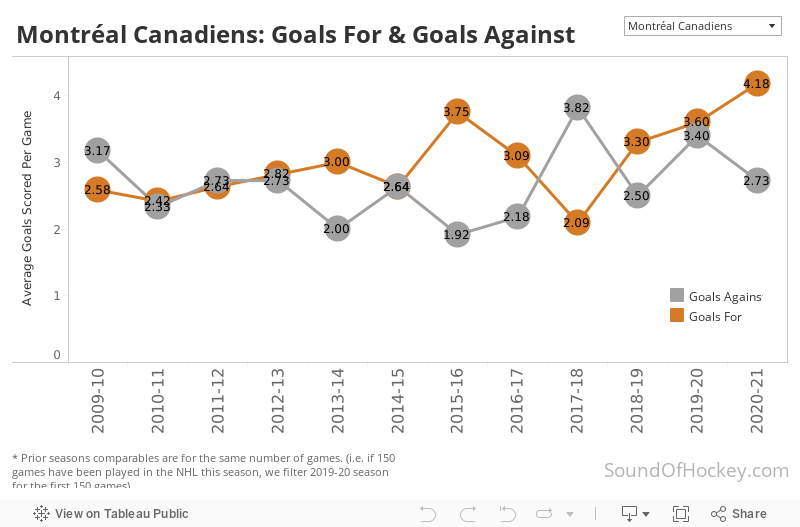
Of course goal scoring is one thing, but goals against is another important factor in how teams are performing (just ask the Vancouver Canucks). If you want to look at individual teams’ performances over time in the ‘goals for’ and ‘goals against’ categories, I’ve created an interactive visual below.
It is too early in the season to draw any hard and fast conclusions, but it will be something we keep an eye on as this shortened season progresses. If you have any questions or data requests, message us at the @Sound_Hockey twitter account.
Ever since Seattle Kraken assistant general manager Jason Botterill appeared on the Sound Of Hockey Podcast, his stock has skyrocketed faster than GameStop during a short squeeze. Very topical, I know.
As we mentioned in last week’s Weekly One-Timers post, Jim Rutherford abruptly retired as general manager of the Pittsburgh Penguins, and Botterill’s name was being considered as a replacement for the long-time executive. It made sense, since Botterill was part of that franchise’s front office when it won its three Sidney Crosby-era Stanley Cups.
But Botterill is under contract with Seattle, and when a contract is in place, permission is required to speak to a candidate.
Bobby Margarita updated us via Twitter on Thursday that Pittsburgh did not receive permission from Seattle to talk to him, at least not quickly enough from the Penguins’ point of view.
Quick follow up/clarification on what I reported last night regarding PIT GM search: PIT did ask for permission from SEA to talk to Jason Botterill but did NOT receive permission to do so, at least not in a timeframe that worked for PIT. So Botterill is not a candidate in PIT.
So, although this story has flip-flopped a couple times now, the latest seems to be that Botterill is staying with the Kraken.
Botterill was hired as Seattle’s AGM just one month ago. Here’s hoping he stays at least through the inaugural season.
Other Kraken-related stuff
As you likely heard, Andy Jassy is set to take over as CEO of Amazon in Q3 of this year. We have no idea if this has any impact on the Kraken, but Jassy—currently the CEO of Amazon Web Services—is a minority owner of the team and had a big role in the branding of the franchise. There’s also speculation that Jeff Bezos moving out of the CEO role could somehow lead to the Sonics coming back to Seattle, but it remains unclear who is spreading these rumors.
Jassy is one of the minority owners of the Kraken and will probably be the majority owner someday. I imagine a lot of Sonics fans are assuming Bezos stepping down is related to him making a push for buying an NBA team. a little premature but not totally unwarranted.
Ok, but seriously it has no real evidence behind it at this time, other than Bezos is really rich, is based in Seattle, and Seattleites want the Sonics back.
Climate Pledge Arena also announced its first concert this week.
After the NHL successfully closed out its 2019-2020 postseason bubble with zero positive tests throughout, we at Sound Of Hockey were optimistic about 2020-2021. We thought it could be more successful than other leagues like the NFL and Major League Baseball at safely carrying out a season outside of a central bubble, because clearly the NHL just gets it and wouldn’t allow COVID to be an issue. Right?
Our optimism was perhaps a bit misguided.
As of Friday, 26 NHL games have been postponed this season.
Of course, there was always flexibility built into the schedule to allow for such postponements, but it does beg the question of what else can be done to make it more safe. And if this trend continues, does the league carry on, just accepting that more players and staff will get COVID?
There are currently four teams trying to contain outbreaks in Buffalo, Minnesota, Colorado, and New Jersey—the Devils have had as many as 17 players on the COVID protocol list. This does not include teams like Vegas, Dallas, and Carolina, who have already had their seasons shut down due to positive tests but have since returned to play.
Buffalo head coach Ralph Krueger also tested positive this week. He’s 61 years old, so that’s a bit scary.
With Colorado the latest team to shut down—the Avs just played three games against Minnesota, making us wonder if there may have been some cross-mojonation between the clubs—the league did get creative with its scheduling. It replaced a Blues/Avalanche series with a previously postponed Blues/Coyotes series on Saturday and Monday. It’s a quick pivot in plans for those teams but a clever decision by the NHL to try to keep things somewhat on track.
New protocols
The NHL released a statement on Thursday with new steps that must be taken immediately to hopefully curtail the spread of the virus. The most notable new protocols are removal of partitions behind benches to improve airflow and limiting arrival at the arena to no more than one hour and 45 minutes before game time.
The NHL isn’t the only league that has had its plans altered after COVID infiltrated its ranks. The same is certainly true for the NWHL, which very sadly was forced to suspend its previously exhilarating tournament in Lake Placid.
The NWHL and the Olympic Regional Development Authority (ORDA) have agreed, due to new positive COVID-19 tests and the resulting safety concerns for the players, their respective staff & the community that the remainder of the 2021 NWHL Season in Lake Placid have been suspended.
The Metropolitan Riveters and Connecticut Whale had both exited the so-called Whubble after receiving positive tests, and the rest of the six-team league followed suit on Wednesday.
The timing was especially painful, as the NWHL was preparing for its first-ever nationally televised games. The semi-finals and final were set to be played on NBCSN with the Seattle Kraken’s new play-by-play man, John Forslund, on the call along with AJ Mleczko.
It’s a devastating blow for a league that seemed to finally be finding some traction and national attention with this very protracted season.
WHL update from our WHL correspondent
On the other side of the coin, Sound Of Hockey’s own Andy Eide broke the news this week that Washington Governor Jay Inslee has given the green light to the WHL teams within the state to return to play.
I have learned that Gov. Inslee has approved the WHL’s request to play hockey for its Washington based teams. No word from the league or teams about the next steps as of yet but one major hurdle has been overcome.
We don’t have a start date yet, and we also don’t know if the Portland Winterhawks will be given the same go-ahead by the state of Oregon.
The WHL teams located in Alberta did have a start date set last week and are expected to begin play on Feb. 26.
Victor Hedman is cooler than ever
Victor Hedman has done a lot in his NHL career, including winning a Stanley Cup, a Norris Trophy, and a Conn Smythe Trophy and being named to four All-Star Games. Plus, he just comes across as a cool dude. But we don’t think he’s ever looked cooler than he does now that he has this Swedish banger as his goal song.
Victor Hedman har – utan någon som helst konkurrens – NHL:s bästa mållåt 2020/21. pic.twitter.com/4uZOVM76KH
The Lightning do have a standard song they play for most players, but a few get special treatment with personalized tunes after they tickle the twine.
Here is the full song with lyrics for your enjoyment.
Tony DeAngelo is gone, Rangers rejoice
The Rangers—who waived Tony DeAngelo after he got in a reported scuffle with goaltender Alexandar Georgiev on Saturday—came away with a 4-2 victory on Thursday over the Capitals.
As the Rangers were leaving the ice, they celebrated with what appeared to be a feigned altercation between other goaltender Igor Shesterkin and star forward Artemi Panarin.
Darren Brown is the Chief Content Officer at Sound Of Hockey and the host, producer, and editor of the Sound Of Hockey Podcast. He is an inconsistent beer league goalie who believes that five players have to make a mistake before the puck gets to him. Follow him on Twitter @DarrenFunBrown or email darren@soundofhockey.com.
The Blue Jackets traded wunderkind center Pierre-Luc Dubois and a third-round pick in 2022 for prolific young scorer Patrik Laine and Columbus native Jack Roslovic.
As you can imagine, the Laine-for-Dubois trade will have some implications on the Seattle Kraken Expansion Draft outlook.
Columbus Blue Jackets
As far as the Blue Jackets, it’s less about what becomes available for Seattle than it is what Columbus will be forced to do.
In our initial projection of Columbus’ protected list, we leaned toward the Blue Jackets sticking with the conventional seven-forward structure in order to keep someone like Boone Jenner. But it wasn’t unreasonable to think Columbus would elect to protect eight total skaters in order to retain an extra defenseman such as Gabriel Carlsson or Dean Kukan
If they want to keep Roslovic and Laine, along with Cam Atkinson, Max Domi, Oliver Bjorkstrand, and Jenner, they have to go with seven forwards.
Roslovic’s emergence likely means Eric Robinson, a speedy 25-year-old winger, won’t be protected. But he’s more of a depth piece and wasn’t all that more interesting than Carlsson and Kukan, who we’ve identified as interesting options.
The Blue Jackets now have one more quality player to protect, meaning Seattle’s options get just a little better here.
Updated projected protection list for Columbus Blue Jackets:
But thankfully Winnipeg’s forward pool is robust enough where Seattle should have a decent option, regardless.
We expected Roslovic to be protected in our Winnipeg write-up in December, on the condition he signed a new contract, and it’s likely one of Adam Lowry, Mason Appleton, or Jansen Harkins take his spot.
Lowry, 27, is the most productive player currently and plays up the middle, but the fact he plays a premium position may not matter as much to Winnipeg now that they added even more center depth with Dubois. Harkins, 23, and Appleton, 24, are younger wingers that should be in contention for selection for Seattle.
Or, perhaps, 24-year-old rearguard Sami Niku is the apple of Seattle’s eye. But so far the Finnish defenseman hasn’t posted a point in three games for the Jets thus far this season.
By replacing one elite scorer (Laine) and one quality player (Roslovic) with one elite all-around player (Dubois) and a draft pick, the protection decisions for the Seattle Kraken Expansion Draft now become a little easier for Jets general manager Kevin Cheveldayoff.
Updated projected protection list for Winnipeg Jets:
FORWARDS
DEFENSE
GOALIE
Mark Scheifele
Josh Morrissey
Connor Hellebuyck
Blake Wheeler
Dylan DeMelo
Kyle Connor
Neal Pionk
Pierre-Luc Dubois
Nikolaj Ehlers
Adam Lowry**
Andrew Copp*
*Needs to be re-signed **Needs to be re-signed, Lowry replaces Jack Roslovic
The Philadelphia Flyers had a breakout season of sorts last year. They finished one point out of first place in the Metropolitan Division when the league stopped but were top four in the Eastern Conference and earned a bye during the qualifying round.
While it was a breakout, it was one that you could see coming a mile away.
Starting with former general manager Ron Hextall and continuing on to Chuck Fletcher, the Flyers were acquiring talent. It all came together in 2020 and now the Flyers are a contender again, armed with a roster that has a mix of veterans, youth, and an up-and-coming goalie.
That’s the good news for the Flyers. The bad news? All that roster depth means that they’re most likely going to lose a good player to the Seattle Kraken at this summer’s Expansion Draft. Fletcher has some work to do and multiple paths he can choose to walk down when it comes to handling his roster.
Fletcher doesn’t have a lot of cap space – less than a million dollars – and while the Flyers are in a ‘win now’ mode, he will need to find space for the near future. Will he look to unload some cap at the trade deadline? Will he try to hold on to those expensive vets to take advantage of the window he has now?
Those answers are yet to be revealed but a reason to keep an eye on how Philadelphia fares this season. Whatever choice they make, it will impact the Kraken.
Assumptions
Flyers forward Scott Laughton is an unrestricted free agent after this season, and if he’s re-signed prior to the Expansion Draft he may end up protected. Laughton, 26, is a glue type player for the Flyers. He provides solid minutes and works hard despite not lighting up the stat pages.
His salary is palpable at $2.3 million per year and while he would most likely get a raise, he would still be affordable to Fletcher. If Laughton is not re-signed by the Expansion Draft then Seattle general manager Ron Francis could negotiate with him during the Kraken’s 48-hour free agency window prior to the draft.
We are going to assume that Francis won’t do that, considering the other players that should be available from Philadephia. While Laughton has some value, he would most likely be a guy for the bottom of the lineup. Therefore, for this exercise, we will assume that Laughton is not an option for Seattle.
Philadelphia Flyers protected list
Forwards
Claude Giroux (NMC)
Kevin Hayes (NMC)
Travis Konecny
Sean Couturier
Oskar Lindblom
Nolan Patrick
Nicolas Aube-Kubel
There is a ton of depth with the Flyers forwards. Among those guys, Jakub Voracek will be a lynchpin in how Fletcher proceeds with his protected list.
Voracek, 31, has four years left on an $8.25 million-per-year contract and the Flyers could use some relief. He’s only a couple of seasons removed from 2017-2018 when he scored 20 goals along with a career-best 85 points in 82 games. His cap hit puts him a tier under the highest paid players in the league and an argument could be made its too much for a player of his caliber.
Fletcher has a major choice to make here.
He could try to move Voracek this year, but that cap hit could be tough with a flat salary cap, and the additional complexities of trading during Covid would limit suitors. Fletcher could also protect Voracek and look for cap space elsewhere – like not signing UFA’s Laughton and/or Eric Gustafsson.
The Flyers may also leave Voracek unprotected and hope that his salary would be too rich for Francis. While Seattle will need to hit the required cap minimum, the term on Voracek may not be something the Kraken want to entertain.
Further motivation to do something with Voracek is that Philadelphia will have Claude Giroux and Sean Couturier become UFA’s after the 2022-2023 and if they want to re-sign both, will have to clear room.
For this exercise we will go with the theory that Fletcher is willing to leave Voracek unprotected in the hopes that Seattle doesn’t take him. If the Kraken pass, it allows Fletcher to protect a younger player, like 24-year-old Nicolas Aube-Kubel who was a standout for Philadelphia in the playoffs after a couple of solid AHL seasons.
Fletcher will most likely leave veteran James van Riemsdyk unprotected. Van Riemsdyk, 31, has three years left on a contract that pays $7 million per year and is coming off one of his least productive full seasons in the NHL.
Defense
Ivan Provorov
Travis Sanheim
Philippe Myers
Fletcher has an easier decision when it comes to his defense. Both Ivan Provorov and Travis Sanheim are former first-round draft picks who are talented and young. They’re not going anywhere.
Veteran Shayne Gostisbehere may end up on the outside looking in. The 27-year-old has been a productive, puck-moving defenseman but was limited last season with injuries and started this year on the injured list, although appears close to returning. His $4.5 million yearly cap hit makes the younger and cheaper Philippe Myers a better long-term option for Philadelphia.
Goalie
Carter Hart
Carter Hart is one of the best, and youngest, up-and-coming goaltenders, and despite the best wishes of some Northwesterners hoping for a return to the area for the former Everett Silvertip, Hart will be protected. Veteran Brian Elliot is Hart’s backup this year but is a free agent to be so there will be no need to protect him. Philadelphia has to expose an eligible goalie, and that honor will fall to 24-year-old Felix Sandstrom who has yet to play a game in the NHL.
Philadelphia Flyers Expansion Draft targets
Forwards
Jakub Voracek
Scott Laughton
Nicolas Aube-Kubel
James van Riemsdyk
Defensemen
Shayne Gostisbehere
Justin Braun
Robert Hagg
Goalie
Felix Sandstrom
Thoughts
Francis has good choices with the Flyers roster. If Voracek is exposed the Kraken will have to consider adding a guy who has been productive, is a leader on and off the ice and would add instant credibility to the top-six. His salary is high, and Seattle would have him on the books for three seasons.
If the Kraken want to go with a defenseman, Gostisbehere would be an interesting selection. He’ll by 28 when the Expansion Draft happens and just three seasons ago turned in a 13-goal and 65-point season. Injuries have surfaced lately so his progress this season will need to be monitored closely.
Seattle would also have solid options in veterans like van Riemsdyk and Justin Braun.
Philadelphia Flyers side deal scenarios
Any team with the combination of limited cap space and high salaries brings side deals into the picture. The Philadelphia Flyers fit that description. Would Seattle be able to pull draft picks or prospects in exchange for taking high salaries like Voracek, van Riemsdyk, or Gostibehere off the Flyers hands? They might be interested in those players without a side deal but if Francis can get a player he wants plus say, a draft pick, it could end up being a great haul for the Kraken.